The story deals with the complex of idea of the benefits derived from the re-release of near extinct predator animals back into the wild.
What I found somewhat refreshing in the article was one, its use of language and word along with the near blasphemous concept that science might be and maybe should be questioned.
Question the science?
Gosh!
This haiku is one of a couple or more in a series based on this same article.
There were so many good word combinations that I couldn’t pass them up.
And readers of this blog will know that from time to time I struggle with the weight of effort of producing a daily Haiku and any thoughts I may have about the words and time that went in the Haiku that day.
This daily schedule of missing a day can bring on a personal mental paralysis wherein writing these entries becomes impossible.
I learned to deal with this by not dealing with it and let it go.
Then when I look at my register of entries and see blank days with no post, I will grab a topic or book or poem for a source and produce a series of Haiku to fill in those blank dates.
This is one of the great benefits of this effort being my blog and my blog, my rules.
It IS cricket because I say it is.
It is ‘according to Hoyle’ because I say it is.
Thus I have this series of haiku based on this article and the Ms. Weston’s word choices.
I should also mention that this ‘lack of output’ coincided with a trip up to see our son and being away from a computer keyboard for a long weekend and I am playing catch-up.
yesterday, I saw man who wasn’t me – there I was again today
Inspired by the poem, Antigonish”.
Which is, according to wikipedia, an 1899 poem by the American educator and poet, William Hughes Mearns. It is also known as “The Little Man Who Wasn’t There” and was adapted as a hit song under the latter title.
Yesterday, upon the stair, I met a man who wasn’t there! He wasn’t there again today, Oh how I wish he’d go away!
When I came home last night at three The man was waiting there for me But when I looked around the hall, I couldn’t see him there at all! Go away, go away, don’t you come back any more! Go away, go away, and please don’t slam the door…
Last night I saw upon the stair, A little man who wasn’t there, He wasn’t there again today Oh, how I wish he’d go away…
I was flipping through facebook today, checking on the posts that the folks at work have made to the company facebook page where I work and I saw a photo of two co workers who had taken part in last weeks dolphin count.
I looked at the photo and thought it was interesting as the young lady looked familiar but not the guy in the photo.
I looked again and thought that the hat the guy was wearing looked real familiar.
I looked again and thought that the binoculars the guy was holding looked real familiar.
Then I realized.
I was the guy!
When I was in third grade, as readers of this blog will know, I had an ‘interesting’ relationship with my third grade teacher.
Suffice it to say I don’t know that if an angel were sitting on my shoulder, she would have believed anything I told her.
When I started complaining I couldn’t see the chalkboard in front of my face she felt I was being me and fought back.
First she moved my desk up to a row in front of the first row so I sat by myself about 5 feet from the chalkboard.
That worked for a bit but I soon started telling I couldn’t see that ol’ chalkboard anymore.
She countered by handing me the lessons for the day from her notebook where she had her sentences and spelling words and such written out long hand.
She literally tore the pages out and slammed them on my desk in front of me.
I looked at the pages for a second then said, “I can’t read cursive.”
And it was off to the office and my reserved chair.
She also called my Mom to say I was at it again.
By again, she meant, for example, I had watched the Davy Crockett series on the Walt Disney show.
And Davy, well, he said he never was in a problem that he couldn’t grin his way out of it.
The show opened when Davy was off in the brush trying to ‘grin’ a ‘baaaare’ down a tree.
Taking the words of this great American hero to heart, I tried to grin at my teacher when I got in trouble.
She called my Mom and told her whenever I got a talking too, I just made faces at her.
I also once asked to have my desk moved so I could sit with my back to the wall.
When she asked why, I said so no one could shoot me in the back.
When she asked where in the world did I come up with that idea, I said from the “Life of Wild Bill Hickok” in the school library.
When we talked, she often just sat at her desk staring down for some reason.
So she calls my Mom and says my latest thing was to claim I couldn’t see the chalkboard.
That BIG GREEN BOARD that ran the length of the room.
I don’t know what my Mom said to her but she made an appointment of her own and two weeks later, I walked into class wearing my first pair of glasses.
Hey, I said, I can see the the chalkboard!
My teacher looked and me and burst into tears.
Since that time I don’t know that I have seen more than a hand full of photos of myself without my glasses.
Since the only time I do see myself is in the mirror, that feller who is a mirror reverse of that image of what I look like in my mind is not someone I recognize.
When I came home last night at three The man was waiting there for me But when I looked around the hall, I couldn’t see him there at all! Go away, go away, don’t you come back any more! Go away, go away, and please don’t slam the door…
lines of buried bones unpaid waiting debt – sound of a gentle sobbing
ANZAC Day, 2022.
From the poem, Anzac Cove by Leon Gellert.
He enlisted with the Australian Imperial Forces 10th Battalion within weeks of the outbreak of the Great War and sailed for Cairo on 22 October 1914. He landed at Ari Burnu Beach, Gallipoli on 25 April 1915, was wounded and repatriated as medically unfit in June 1916. He attempted to re-enlist but was soon found out. He returned to teaching at Norwood Public School.
Here is his poem.
There’s a lonely stretch of hillocks: There’s a beach asleep and drear: There’s a battered broken fort beside the sea. There are sunken trampled graves: And a little rotting pier: And winding paths that wind unceasingly. There’s a torn and silent valley; There’s a tiny rivulet With some blood upon the stones beside its mouth. There are lines of buried bones: There’s an unpaid waiting debt: There’s a sound of gentle sobbing in the south.
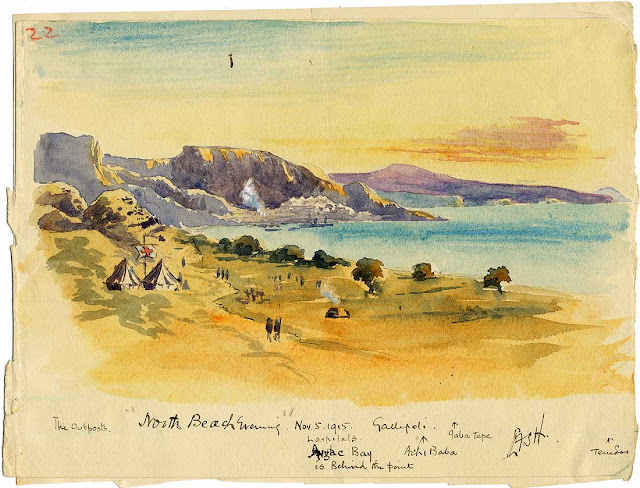
North Beach – Evening Nov 5. 1915 by Leslie Hore
Anzac Day is a national day of remembrance in Australia and New Zealand that broadly commemorates all Australians and New Zealanders “who served and died in all wars, conflicts, and peacekeeping operations” and “the contribution and suffering of all those who have served”. Observed on 25 April each year, Anzac Day was originally devised to honour the members of the Australian and New Zealand Army Corps (ANZAC) who served in the Gallipoli Campaign, their first engagement in the First World War (1914–1918). (from Wikipedia)
Mr. Helmore is reporting on the impression given at CNN and New York Times to focus their news efforts on news.
Jay Rosen, a journalism professor at New York University is quoted saying that the NYT is “… e saying they’re not going to be intimidated by the right wing or congratulated by the left wing into doing what they want.”
Mr. Helmore reports that “Two weeks ago the paper’s outgoing executive editor, Dean Baquet, issued “a reset” in the paper and reporters’ approach to Twitter, long held up as having undue influence over some aspects of the Times’s editorial approach.”
I can’t see anything wrong in any of these points of view.
Time will tell if the NYT follows through.
This is the newspaper that used to say, “All the News that is Fit to Print.”
The NYTs hasn’t actually made an announcement of this change but Mr. Helmore reports:
In February, the Times launched a new advertising campaign: Independent Journalism for an Independent Life. To Rosen, it was the carefully calibrated articulation of a shift that cannot be fully articulated.
“This whole issue has been wrapped up in a bow of independence,” he said. “It’s the language they’re using to announce a shift without articulating any need for a shift.”
Something along the line of trying to explain something that cannot be explained.
I wish them luck and will hope for the best.
If nothing else, I love the combination of the words.
each generation its past, future determined by its own problems
Based on essay, On the Charms of History and the Future of the Past by Aldous Huxley, published in Music At Night and other essays, including Vulgarity in Literature, by Chatto & Windus, 1931.
Mr. Huxley writes: The past and the future are functions of the present. Each generation has its private history, its own peculiar brand of prophecy.
What it shall think about past and future is determined by its own immediate problems. It will go to the past for instruction, for sympathy, for justification, for flattery.
It will look into the future for compensation for the present – into the past, too.
For even the past can become a compensatory Utopia, indistinguishable from the earthly paradises of the future, except by the fact that the heroes have historical names and flourished between known dates.
From age to age the past is recreated.
It was curious for me to take in this thought and think that past and present can be generational.
It of course makes sense that each generation sees the past and the present by their problems but by presenting the past and the present as something different for each generation, then these pasts and futures exist for the different generations together.
We live in the parallel universes of generational experience all at the same time.
The seems simplistic and oh-of-course on the surface though below the surface there is something here.
Tempora mutantur.
Times change and we change with the times.
But we don’t.
The times may change, but within our generation, we don’t change.
And our times co-exist and interact with the times of the previous and following generations.
And of course plus ça change, plus c’est la même chose.
The more we change the more we stay the same.
Everyone searching for that compensatory Utopia.
There is more here to be sure but it is too early in the morning and I have to get to work.
I am reminded of a discussion of weather forecasting that I had with my friends when I worked in the world of online television news.
We had developed the rule that the 7th day of the 7 Day forecast was always warm and sunny.


 No Haiku For You