I ran across confabulate in a wonderful paragraph in my reading the other day.
In the Social Animal, David Brooks writes, “The unconscious mind merely confabulates stories that try to make sense of what the unconscious mind is doing of it own accord.”
I liked the word confabulate.
I was pretty sure I had heard it before.
I was pretty sure I knew what it meant.
I looked it up to make sure.
The first definition, engage in conversation; talk, seemed to apply to Brooks’ use of the word.
There was a 2nd definition listed.
PSYCHIATRY fabricate imaginary experiences as compensation for loss of memory
That definition demanded more investigation.
My question, is the confabulator making things up on purpose?
Telling a lie in other words?
Or are these imaginary memories born out of frustration for lack of real memory?
Or are these imaginary memories there because that is how the confabultor really remembers them?
The online Merriam-Webster dictionary gives this use of the word, ” A major characteristic of brain-damaged patients is the tendency to confabulate—to hide and dissemble about their damage.”
To me that sounds like its all made up except that it refers to brain damaged people?
Merriam-Webster also states, ” Confabulate is a fabulous word for making fantastic fabrications. Given the similarities in spelling and sound, you might guess that “confabulate” and “fabulous” come from the same root, and they do – the Latin fabula, which means “conversation, story.” Another “fabula” descendant that continues to tell tales in English is “fable.” All three words have long histories in English: “fable” first appeared in writing in the 14th century, and “fabulous” followed in the 15th. “Confabulate” is a relative newcomer, appearing at the beginning of the 1600s. “
testing the Nation so conceived, dedicated how long can endure?
These United States of America, as a county founded on the principle that we are all created equal has been a work in progress since July 4, 1776.
Tests come both from within and without.
Somehow this Country survives it all and moves on.
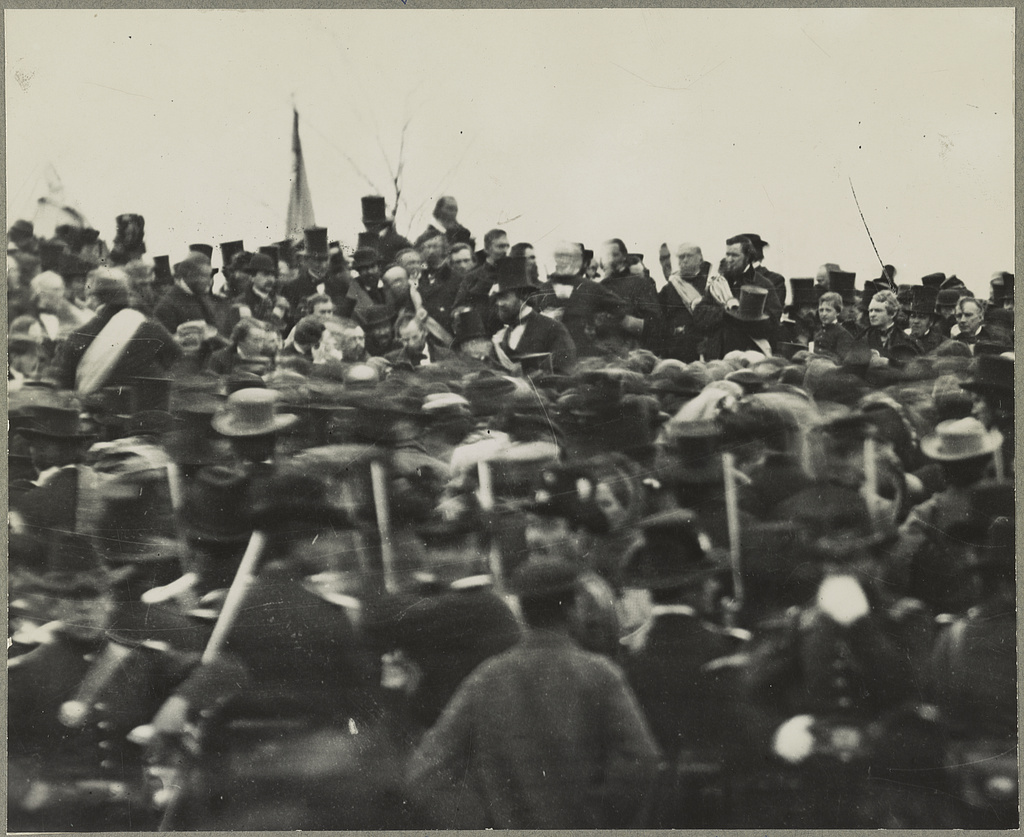
Mr. Lincoln called out the country 166 years today at Gettysburg when he said, “It is for us the living, rather, to be dedicated here to the unfinished work which they who fought here have thus far so nobly advanced.“
The closing words have been repeated so often and parodied so much that they have lost their simple meaning.
Government of the people, by the people, for the people.
Mr. Lincoln’s remarks were to commemorate the dedication of cemetery.
The text itself is a warning more than anything else.
To quote another passage from Mr. Lincoln, “We — even we here — hold the power, and bear the responsibility” (Annual Message to Congress — December 1, 1862)
Monument to the 16th Michigan – My Great Great Grand Father’s unit – though he had been out of the army for almost a year by the time of GettysburgLincoln at Gettysburg – (hatless) just to the left of the guy who looks like Lincoln but has a mustache
Gettysburg Address – November 19, 1863, Gettysburg, PA
Four score and seven years ago our fathers brought forth on this continent, a new nation, conceived in Liberty, and dedicated to the proposition that all men are created equal. Now we are engaged in a great civil war, testing whether that nation, or any nation so conceived and so dedicated, can long endure. We are met on a great battle-field of that war. We have come to dedicate a portion of that field, as a final resting place for those who here gave their lives that that nation might live. It is altogether fitting and proper that we should do this.
But, in a larger sense, we can not dedicate—we can not consecrate—we can not hallow—this ground. The brave men, living and dead, who struggled here, have consecrated it, far above our poor power to add or detract. The world will little note, nor long remember what we say here, but it can never forget what they did here. It is for us the living, rather, to be dedicated here to the unfinished work which they who fought here have thus far so nobly advanced. It is rather for us to be here dedicated to the great task remaining before us—that from these honored dead we take increased devotion to that cause for which they gave the last full measure of devotion—that we here highly resolve that these dead shall not have died in vain—that this nation, under God, shall have a new birth of freedom—and that government of the people, by the people, for the people, shall not perish from the earth.
—Abraham Lincoln
Despite the historical significance of Lincoln’s speech, modern scholars disagree as to its exact wording, and contemporary transcriptions published in newspaper accounts of the event and even handwritten copies by Lincoln himself differ in their wording, punctuation, and structure. Of these versions, the Bliss version, written well after the speech as a favor for a friend, is viewed by many as the standard text. Its text differs, however, from the written versions prepared by Lincoln before and after his speech. It is the only version to which Lincoln affixed his signature, and the last he is known to have written. (Wikipedia)
if I had someplace treehouse away from the world I might just stay there
Where ever I have worked, I always go walk about and explore the building I am working in.
I have found my way onto rooftops, garages, basements and storage areas that had not been visited in years.
The skylight to the building was behind the parapet at the very top of building, about the red tiles
Often I would use these out of the way places to hide during the day.
For those moments when I needed a moment to myself.
At WZZM13 in Grand Rapids, there were restrooms off of what was then the main conference room.
These restrooms had a back door.
If you went through the back door, you were in a small room with a desk and a lit make up mirror.
All it needed was a star nailed on the door and it would have been a museum example of the ‘dressing room’ in every TV sitcom.
Two odd things about these rooms.
There were one floor away from the studio with no real clear path to the get there.
And, they were along the front building so one wall was a glass window looking out over the parking lot.
Not what you would expect in a ‘dressing room’.
As far as I know, at the time I was with WZZM13, they were never used.
I would sit in there and hide often.
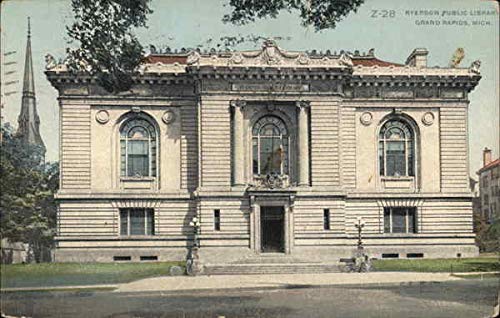
My favorite hidden place though, was the attic of the Grand Rapids Public Library.
I worked at the GRPL before the remodeling that took place at the turn of the century when much of the main or Ryerson building was restored.
At the time, the Ryerson had been ‘modernized’ and there were odd doors, stairs, cupboards and closets everywhere.
One day I took the keys and went through a door and up a stairway to another door that opened to an almost vertical stairway ladder.
Something like you would see in a ship.
I went up the ladder and into a small room, about 12 x 12, that was dark except for the light that poured in from a doorway opposite from where I was standing.
The light was, for lack of a better word, thick.
It poured through this doorway which was a rough opening cut through a brick wall.
The light was almost solid somehow.
I walked across the dark room towards the light and went through the doorway.
I had found Oz.
The Ryerson had been built in 1904 and designed to be used WITHOUT electric light.
The center of the building was a three story open well or atrium beneath a leaded glass skylight.
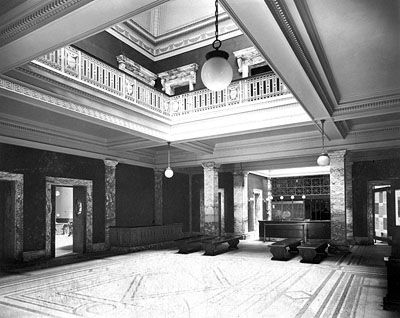
Ryerson Building Atrium
I was in the attic.
When I walked through that doorway I was looking DOWN at the surface of atrium skylight.
This is the one photo I can find of the INTERIOR SKYLIGHT with it’s Beaux Arts tracery – I was on the other side of the skylight in the upper left of this photo
Above me was the roof of the building.
The roof was one massive skylight.
The quality of light in that room stays with me to this day.
It defies description.
You had to be there.
You had to experience it.
Somehow, the light, made you feel better or maybe, out of your skin.
The attic was silent.
The stillness was eerie.
It wasn’t a flat empty room, but a tangle of cables and piper and conduits going this way and that.
There was no ‘floor’ but the surface of the skylight.
The walls rose about 20 feet all around.
From the top of the walls was the peaked roof structure of iron girders that supported the thick glass of the skylight.
A rickety wooden cat walk was built over the skylight to the other side of the attic.
There was a wooden railing that ran along the catwalk and the railing had been covered with names.
Names of other library staff that had found this place away.
Aside from those names, there was no evidence that anyone had been up there for years.
Do you remember when we first met? I sure do
It was some time in early September
Though you were lazy about it, you made me wait around
I was so crazy about you I didn’t mind
So I was late for class, I locked my bike to yours
It wasn’t hard to find, you painted flowers on it
I guess that I was afraid that if you rolled away
You might not roll back my direction real soon
Well I was crazy about you then and now
The craziest thing of all is over ten years have gone by
And you’re still mine, we’re locked in time
Let’s Rewind
Do you remember when we first moved in together?
The piano took up the living room
You played me boogie-woogie I played you love songs
You’d say we’re playing house now you still say we are
We built our getaway up in a tree we found We felt so far away but we were still in town Now I remember watching that old tree burn down I took a picture that I don’t like to look at
Well all these times they come and go
And alone don’t seem so long
Over ten years have gone by
We can’t rewind, we’re locked in time
But you’re still mine
Do you remember?




 No Haiku For You