6.18.2021 – defy ignorance

defy ignorance
of vested prejudices
vested interests

17 syllables, 7 words and more situational application than you can shake a stick at, if that’s your idea of a good time.

If I started listing the different situations in the current news cycle that these 7 words could be applied, the list would soon be hiring than the Empire State Building and its 102 floors.

I adapted today’s haiku from a “Beyond the Hundredth Meridian: John Wesley Powell and the Second Opening of the West” written by Wallace Stegner and published in 1954.

Major John Wesley Powell was the one armed explorer of Wonderful World of Disney fame who rafted down the Colorado River in 1869 and located the Grand Canyon and invented a tourist sport at the same time.

Major Powell also served as the second Director of the United States Geological Survey, a post he held from 1881–1894.

When Mr. Stegner wrote about Major Powell, Stegner was able to comment about the problem of living out west.

Living out in the American West where there was LOTS of SUNSHINE, LOTS of WILD FIRES and VERY LITTLE WATER.

Mr. Stegner was able to comment about as Major Powell noticed that there would be issues.

Major Powell published in 1878 a government paper titled: Report on the Lands of the Arid Regions of the United States.

According to one account, Major Powell, “. . . unflinchingly described the scarcity of water, and summarized that much of the American south-west, if it must be settled, should be settled lightly and modestly. Overpopulate it, and it will be unforgiving.”

According to Mr. Stegner, “As a government scientist, Major Powell was now defying ignorance. He was taking on vested interests and the vested prejudices by which they maintained themselves.”

As one account puts it, Major Powell was a sage.

And what does sage mean?

According to the online Merriam-Webster it means:

Wise through reflection and experience.

Proceeding from or characterized by wisdom, prudence, and good judgment.

One (such as a profound philosopher) distinguished for wisdom.

A mature or venerable person of sound judgment.

So what happened to Major Powell and his report?

No one listened to him.
6.2.2021 – I grew up with life

I grew up with life
But I never outgrew it
too often forget

To steal from Sir Walter Scott:

Breathes there the man, with soul so dead,
Who never to himself hath said

School year is over.
Summer is here.
Let me stay in bed.

(the last three lines are mine)

I am now old enough to be considered old I guess.

If I get hit by a car crossing the street, the headline will start; “elderly pedestrian …”

Well so what?

Can’t stop the clock.

As for getting old with life, there is only one other alternative unless you happen to have a goofy portrait locked up in the attic.

There are some things though that I hope stir your soul no matter the time of your life.

Sunny days.

Sun on the water.

Snow days.

If I happen to hear that schools are cancelled somewhere, anywhere, due to snow, inwardly, I smile and outwardly I laugh.

AND I want to stop working and take a snow day even though I haven’t measured snow on the ground (Devil’s Dandruff) in years.

End of the school year.

I hear talk of year round school and I have heard all the arguments in favor and against and the history of the development of the ‘school year’ around the farm based economic year and now the pressures to find summer day care.

Yes yes and yes.

NEVERTHELESS!

That day.

That morning.

That minute.

When it really sunk in.

To quote Maya Angelou, “singin’ and swingin’ and gettin’ merry like Christmas” deep down in the center of your soul.

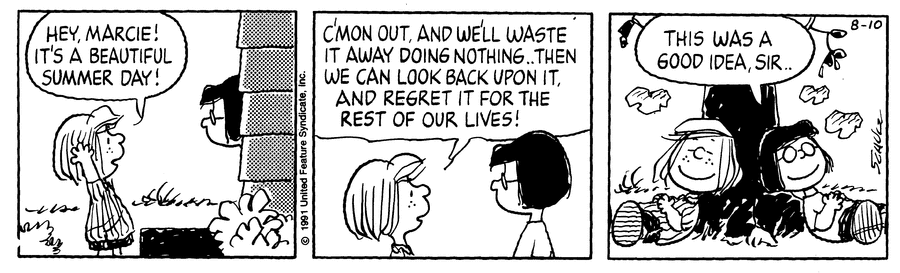
The words for today’s Haiku I adapted from President Barack Obama.

Mr. Obama wrote the forward to the “The Complete Peanuts.”

An anthology published in 2016.

Mr. Obama wrote, “Like millions of Americans, I grew up with Peanuts. But I never outgrew it.

Wherever I lived, wherever I travelled, I could find those three or four panels in the paper each morning. And Charlie, Snoopy, Linus, Lucy, Franklin and the gang brought childhood rushing back.

That’s what made Charles Schulz so brilliant – he treated childhood with all the poignant and tender complexity it deserves. He gave voice to all its joys and anxieties – a spectrum of emotions that run from the start of a new baseball season to the anguished “Augh” that comes with losing the big game. He explored the emotions that we too often forget kids feel until we’re reminded that we once felt them ourselves. Hope. Doubt. The exquisite pain of unrequited love. The self-exploration of what it means to be different. The comfortable knowledge that it’s all going to be OK – even if Lucy’s advice isn’t very good.

For decades, Peanuts was our own daily security blanket. That’s what makes it an American treasure.”

Childhood with all the poignant and tender complexity it deserves.

He gave voice to all its joys and anxieties

Summer time.

You don’t have to sign up.

It’s free.

School is out.

I grew up with life.

I hope I never outgrow it.

I hope I do not too often forget the fun of doing nothing.

5.20.2021 – I saw him and he

I saw him and he
saw me at same time, Second bite,
one that broke the bones

And other reason to stay out of the woods.

Taken from “Second bite is one that broke the bones’: Alaska man describes bear mauling”

“Allen Minish was alone and surveying land for a real estate agent in a wooded, remote part of Alaska, putting some numbers into his GPS unit when he looked up and saw a large brown bear walking about 30ft (10 meters) away.”

This is better (or worse) than the story from down here in the low country and the dog and the alligator.

That headline was, “Didn’t even have time to bark!”

3.5.2021 – often factitious

often factitious
objectivity lends a
cold mendacity

In the Guardian this morning, quoted Joan Didion, writing:

“… Joan Didion makes a case against newspapers. Too often, she argues, their reporting style rests on “a quite factitious ‘ objectivity’”, which “lends the entire venture a mendacity” by failing to make explicit the writer’s own particular set of influences and biases. Didion praises instead magazines that cultivate a personal voice, and which aim to impart character and atmosphere rather than straightforward information: “They assume that the reader is a friend, that he is disturbed about something, and that he will understand if they talk to him straight; this assumption of a shared language and a common ethic lends their reports a considerable cogency of style.” Often, she concludes, the real story is “the story not in the newspaper”.

I like the sentence “a quite factitious ‘ objectivity’”, which “lends the entire venture a mendacity”.

I wasn’t sure what Ms. Didion meant but I was sure it wasn’t a good thing.

Using the online dictionary I came up with, “artificially created equal treatment of all rivals or fairness develops an untruthfulness.”

It was during the FAB FIVE era of Michigan Basketball that Coach Steve Fisher said, “Everyone will be treated fairly but not everyone will be treated the same.”

If I was there I would tell him that a quite factitious objectivity lends the entire venture a mendacity.

Of course I mean that had I read this back then and had I been there back then, I would had said this.

But I wasn’t reading Joan Didion back then.

Nor was I hanging out with the Michigan Basketball team.

On such hinges the fate of history swings back and forth.

I was going to say that had I been there at the Trump White House, I could have said this but then I thought it over and I think I could say this to any White House.

Maybe to paraphrase Mr. Lincoln, be truthful, be fair, whatever differs from this, to the extent of the difference is no longer true and no longer fair.

Reminds of when Jim Harrison wrote that over 10 million laws have been passed trying to enforce the 10 commandments.

Get along?

Why can’t we do the right thing?

Cold mendacity?

Had to make it fit somehow into a haiku.

2.22.21 – slight shades of difference

slight shades of difference
religion, manners, habits
triumphed together

For George Washington’s Birthday, this was taken from General Washington’s 32 page farewell address to the nation written in 1796.

Famous for his warning against Foreign entanglements saying, “Against the insidious wiles of foreign influence (I conjure you to believe me, fellow-citizens) the jealousy of a free people ought to be constantly awake,” the General was also aware of the problems of party and states and government by party and by states.

The General said this:

“Citizens, by birth or choice, of a common country, that country has a right to concentrate your affections. The name of American, which belongs to you in your national capacity, must always exalt the just pride of patriotism more than any appellation derived from local discriminations. With slight shades of difference, you have the same religion, manners, habits, and political principles. You have in a common cause fought and triumphed together; the independence and liberty you possess are the work of joint counsels, and joint efforts of common dangers, sufferings, and successes.”

Citizens, by birth or choice,

of a common country,

that country has a right to concentrate your affections.

The name of American, which belongs to you in your national capacity, must always exalt the just pride of patriotism.

I recently ran across an essay that took the form of an email from a grand father to a grand son trying to explain the what this country was in danger of losing.

Have to point this essay appeared in the New Yorker on April 6, 2020 (Love Letter by George Sanders)

“… disrupt something so noble, so time tested and seemingly strong that had been with us literally everyday of our lives. We had taken a profound gift for granted. We did not know the gift was a fluke, a chimera, a wonderful accident of consensus and mutual understanding.”

The General understood this.

He even warned us saying:

“Interwoven as is the love of liberty with every ligament of your hearts, no recommendation of mine is necessary to fortify or confirm the attachment.

… you should cherish a cordial, habitual, and immovable attachment to it; accustoming yourselves to think and speak of it as of the palladium of your political safety and prosperity;

watching for its preservation with jealous anxiety;

discountenancing whatever may suggest even a suspicion that it can in any event be abandoned;

and indignantly frowning upon the first dawning of every attempt to alienate any portion of our country from the rest, or to enfeeble the sacred ties which now link together the various parts.”

Happy Birthday General.

We miss you very much and wish you all the best.

As a postscript and a new citizen of the State of South Carolina I have to point out this little factoid.

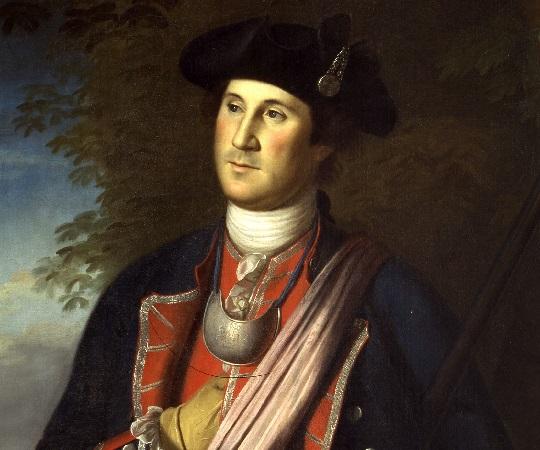
The image I used today is from a portrait of

The image I used today is from a portrait of George Washington as Colonel in the Virginia Regiment, Charles Willson Peale, in 1772.

Notice around his neck is a small metal ‘gorget’ that was worn by officers of the era as a symbol of military rank.

The shape of the gorget was adapted as the insignia or badge of the 1st and 2nd South Carolina Regiments that were formed to protect Charleston from a certain British invasion in 1775.

These two regiments manned Fort Sullivan in Charleston Harbor that held off an attack of Royal Navy, June 28, 1776.

Fort Sullivan was constructed of palmetto trees.

The gorget and the palmetto tree are the symbols on the flag of State of South Carolina.

Sometime after the flag was designed a state functionary changed it a bit by tilting the gorget which makes folks think it is a crescent moon.

It is not the moon but the gorget badge of the 1st and 2nd South Carolina Regiments.

Just thought I would pass that along.