8.30.2022 – habit of weighing

habit of weighing
past against social moral
trends of the present

The End of History was supposed to have happened back in 1989, the year the Berlin Wall fell and Francis Fukuyama announced the conclusive triumph of liberal democracy. We know how that thesis worked out. But what happens when the other kind of History — academic, not Hegelian — starts to collapse?

That’s a question that James H. Sweet, a professor of history at the University of Wisconsin, Madison, and the president of the American Historical Association, tried to raise earlier this month in a column titled “Is History History?” for the organization’s newsmagazine. It didn’t go well.

Sweet’s core concern in the piece, which was subtitled “Identity Politics and Teleologies of the Present,” was about the “trend toward presentism” — the habit of weighing the past against the social concerns and moral categories of the present.

“This new history,” he wrote, “often ignores the values and mores of people in their own times, as well as change over time, neutralizing the expertise that separates historians from those in other disciplines.”

Adapted from This Is the Other Way That History Ends, an opinion piece in the New York Times by BRET STEPHENS.

Way back when I was studying history at the University of Michigan my Professors stressed three things.

  1. YOU ARE THE EXPERT – Take you readers by the hand as they don’t know what you know and they certainly don’t know where you are going.
  2. COMPASSION – Don’t be so quick to judge until you get ALL your facts.
  3. AT ALL COSTS, AVOID PRESENT MINDEDNESS – You cannot make assumptions, conclusions or judgements based on today’s values against yesterday.

Somehow I think I was lucky to have been in school back then and not today.

8.29.2022 – hopelessness is the

hopelessness is the
enemy of justice – is
a constant struggle

I was born on July 17, 1960.

One month later, unknown to me and unrelated to this event, 11 kids went wading in the Atlantic Ocean at the public beach on Tybee Island on the east coast near Savannah, Georgia.

All 11 kids were arrested.

They were officially charged with Public Disrobing.

The real reason is that the public beaches in Georgia in 1960 were segregated.

And these 11 kids were not ‘allowed’ to use the public beach because they were not white.

1960.

Stars of the show, from left, Edna Jackson, Evalena Hoskins, and Mary Gray, who participated as high-school students in the historic 1960’s wade-ins. Ben Goggins / For Savannah Morning News

Three of these students, Edna Jackson, Evalena Hoskins, and Mary Gray, were there that day in 1960 and were back on the same beach, the same beach I have been with my children and grand children.

I now know about that day because the State of Georgia just dedicated a historical marker to remember that day and what those 11 kids did.

At the dedication ceremony, Tybee Island Historical Association Vice-President Allen Lewis said, “These students were ordinary people who did extraordinary things.

These students were ordinary people.

Ordinary people who did extraordinary things.

They went for a swim on an August day at the beach.

Extraordinary things.

Mr. Lewis also said, “They put their beliefs to the test on Savannah Beach. That God has the divine power, and that the U.S. Constitution was on their side as they fought injustice and evil.”

Faced with racial terror, the students responded to hate with love. To violence, with forgiveness. We remember these students for their hope. Hopelessness is the enemy of justice. Their courage. Because peace requires bravery. Their persistence. Because justice is a constant struggle. And their faith.”

They went for a swim on an August day at the beach.

Arlo Guthrie once said something along the lines that in a world where everything is going great, you would have to do an awful lot of good to standout, but in a world that sucks, you don’t have to do much to accomplish something good.

They went for a swim on an August day at the beach.

Ordinary people doing extraordinary things.

Respond to hate with love.

To violence, with forgiveness.

Because peace requires bravery.

Because justice is a constant struggle.

8.16.2022 – life in low country

life in low country
alligator attacks rare
but not surprising

The body of an 88-year-old woman who was killed by an alligator was discovered on Monday in a pond in a gated community near Hilton Head Island, S.C., officials said. It was at least the fourth deadly alligator attack in the United States so far this year.

The Beaufort County Sheriff’s Office responded to a 911 call at 11:15 a.m. on Monday from a Sun City Hilton Head resident who reported that a large alligator was guarding a human body. “When we got there that’s exactly what we found,” said Maj. Angela Viens, a public information officer with the Beaufort County sheriff’s office.

“Alligator attacks are rare but not surprising,” Major Viens said of the area.

Two more alligator deaths have been recorded this year in Florida. One a 47-year old man apparently searching for a frisbee on May 31 and another an elderly woman, 80, who fell into a pond near a golf course on July 15.

47-year-old Sean Thomas McGuinness’ body was found missing three limbs at the lake at the John S Taylor Park in Largo, Florida.

Investigators now believe he had gone into the 53-acre freshwater lake looking for UFOs when he was attacked.

I am not sure if the alligator attack and the search for UFO’s are connected.

Advice for living near alligators is to:

Never swim at night –

Never feed them –

Keep pets and children away from the water’s edge –

Stay alert when you are in territory where they may live –

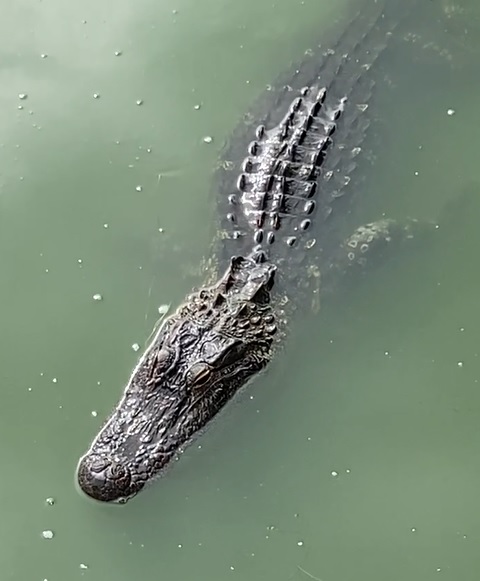
I took this photo in a local park last year.

Like the Great White Shark, all they do is sleep, eat and make little alligators.

You get used to it.

Earlier this summer, my wife was up in Michigan visiting.

Seeing the new home of one her sisters and that the property had a large pond, my wife cautioned, “make sure you watch out for alligators!”

It comes with the territory.

As Mr. Tolkien wrote: ‘It does not do to leave a live dragon out of your calculations, if you live near him.’

7.13.2022 – pick and choose numbers

pick and choose numbers
that tell you what you want and
glue them together

Adapted from the last paragraph of the article, The Humbug Economy, by Paul Krugman in the New York Times.

Writing about the current economic climate, Mr. Krugamn stated:

Overall, the picture appears consistent with a “soft landing” — a slowdown that falls short of a full-on recession, or involves a mild recession at worst, together with stabilizing inflation.

But, of course, we don’t know that. In fact, given the wide discrepancies in economic data, economic pundits (including me) have unusual freedom to believe whatever they want to believe. Just pick and choose the numbers that tell you what you want to hear and glue them together.

He also stated:

Are you confused? You should be. I’ve been in this business a long time, and I can’t remember any period when economic numbers were telling such different stories. On the other hand, we’ve never before faced the kind of shocks we’ve gone through in the past few years: Both the pandemic-induced recession and the recovery from that recession were, to use the technical term, weird, and maybe we shouldn’t be surprised the measures we normally use to track the economy aren’t working too well.

Hmmmmmmmmmmmmmmmm.

Both the pandemic-induced recession and the recovery from that recession were, to use the technical term, weird, and maybe we shouldn’t be surprised the measures we normally use to track the economy aren’t working too well.

Got to love the use of the technical term, weird!

And the warning that we shouldn’t be surprised the measures we normally use to track the economy aren’t working too well?

NO KIDDING!

7.4.2022 – something more abstract

something more abstract
more compelling – America
lost faith in itself

Adapted from the book, Lyndon Johnson and the American Dream (Copyright © 1976, 1991) by Doris Kearns Goodwin and a passage dealing with the USA after the Kennedy assassination.

Ms. Goodwin writes that in November, 1963;

The people of America responded to the news of Kennedy’s assassination and the continuing televised reports of every subsequent happening with a state of shock that went beyond mourning to something approaching melancholia, a serious collapse of self-esteem. With the assassination, something more than a man had been lost, something more abstract and more compelling – a part of America’s faith in itself as a good society.

The line, something more than a man had been lost, something more abstract and more compelling – a part of America’s faith in itself as a good society, hit me.

America’s faith in itself as a good society.

I admit much of that faith was a hypocrisy.

But it was a useful hypocrisy.

Recent political turmoil over, well, politics and Covid and any number of other issues of late have ripped the scab off the hypocrisy and left folks, not wondering if we have lost a part of America’s faith in itself as a good society but now QUESTIONING even if America was, is or can be, a good society.

I like to think that Mr. Lincoln was right when he said the United States was, “… the last best hope of earth.”

Maybe Mr. Lincoln is right, its just that the bar to being recognized as the last best hope of earth was a lot lower than I ever thought.

Again, the passage quoted from Ms. Godwin is about the United States after the assassination of President John F. Kennedy.

Lyndon Johnson took over as President.

5 Days after Kennedy was murdered, LBJ spoke to Congress and the Country.

LBJ said this:

America must move forward.

The time has come for Americans of all races and creeds and political beliefs to understand and to respect one another.

So let us put an end to the teaching and the preaching of hate and evil and violence.

Let us turn away from the fanatics of the far left and the far right, from the apostles of bitterness and bigotry, from those defiant of law, and those who pour venom into our Nation’s bloodstream.

As Mr. Lincoln put it in his December, 1862 Annual Address to Congress, “We must disenthrall ourselves, and then we shall save our country.”

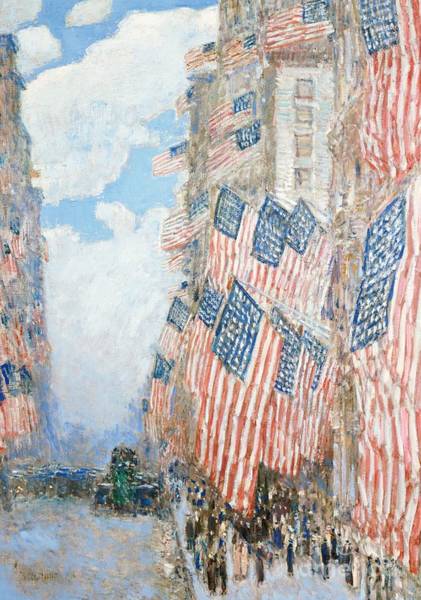
The Fourth of July, 1916 (The Greatest Display of the American Flag Ever Seen in New York, Climax of the Preparedness Parade in May) by Childe Hassam (1859-1935)