10.20.2022 – refused to believe

refused to believe
prejudice trample knowledge
and benevolence

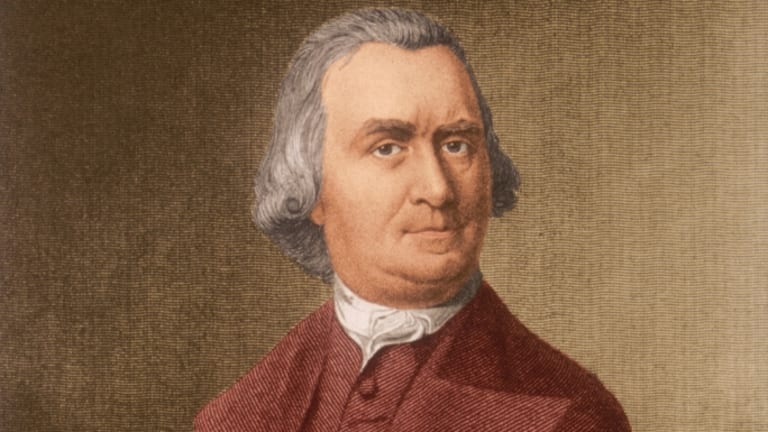
Adapted from the recent article, Samuel Adams in Smithsonian, Oct 1, 2023.

The article states: Adams banked on the sage deliberations of a band of ambitious farmers reasoning their way toward rebellion.

That was how democracy worked.

He dreaded disunity.

“Neither religion nor liberty can long subsist in the tumult of altercation, and amidst the noise and violence of faction,” he warned.

He refused to believe that prejudice and private interest would ultimately trample knowledge and benevolence.

Self-government was in his view inseparable from governing the self; it demanded a certain asceticism.

He wrote anthem after anthem to the qualities he believed essential to a republic — austerity, integrity, selfless public service — qualities that would become more military than civilian.

The contest was never for Adams less than a spiritual struggle.

It is impossible with him to determine where piety ended and politics began; the watermark of Puritanism shines through everything he wrote.

Faith was there from the start, as was the scrappy, iconoclastic spirit, as were the daring, disruptive excursions beyond the law.

10.18.2022 – A 4 year old could

A 4 year old could
understand wonkiness go
find a 4 year old

Adapted from the Marx Brother’s Movie Duck Soup.

In the movie, the Treasury Secretary presents his departmental report saying, “I hope you’ll find it clear.

Grouch, in the role of President of Freedonia, Rufus T. Firefly, accepts the report and responds, “Clear? Why a four year old child could understand this report.”

Groucho hands the report to Zeppo playing the usual role of secretary to Groucho and in a lower voice says, “Find me a four year child. I can’t make head or tail of it.”

I just finished reading the article, NYT/Siena Poll Is Latest to Show Republican Gains.

The article asks, “Is four points the real margin nationally? That’s a good question.”

The writer of the article, Mr. Nate Cohen, then tries to answer the question.

His response seems to focus on the wonderful polling/statistical concept known as WONKINESS.

(I present a representative section of the article with buzzwords in bold for artistic license.)

Mr. Cohen writes:

Is four points the real margin? (Wonkiness 4/10)

Our poll may show Republicans ahead, 49-45, and yet it may not be accurate to say they lead by four points. In fact, they actually lead by three points.

This is a polling custom that has always left me a little cold. The case for rounding is straightforward: Reporting results to the decimal point conveys a false sense of precision. After a decade of high-profile polling misfires, “precision” is most certainly not the sense pollsters want to try to convey right now. And in this case, reporting to the one-thousandth of a point would obviously be ridiculous. We didn’t even contact a thousand people; how could we offer a result to the one-thousandth?

But there’s a trade-off. Characterizing this poll as a four-point Republican lead doesn’t merely offer a false sense of precision — it’s just false. That’s not something I can gloss over.

Sometimes, the difference is enough to affect the way people interpret the poll. We’ve reported one party in the “lead” by one percentage point when, in fact, the figures are essentially even. These differences don’t actually mean much, of course, but no one — not even those of us well versed in statistics and survey methodology — can escape perceiving a difference between R+1 and Even.

I am reminded of the old Saturday Night Live sketch of Chevy Chase playing Gerald R. Ford.

When he gets an question about economic numbers, Chase (as Ford) looks at the screen and says quietly, “I was told there would be no math.”

10.16.2022 – not going to say

not going to say
I will reduce my income
to achieve this goal

Sorry to say it but after 20 some years in the news business I am not used to seeing someone, anyone, be honest in print.

Brutally honest.

In an article that everyone should read but too few people will, the New York Times quotes Eli Ungar, the founder of Mac Properties, which is based in Englewood, N.J., and owns about 9,000 apartments, including 2,000 in Kansas City, who bluntly laid out the economics of rental development.

“The folks who think of themselves as middle class and are feeling increased worry and pressure as rents go up faster than incomes, and the people who are most vulnerable in our society and desperately need housing that no developer can provide without a massive subsidy,” Mr. Ungar said. “As a citizen, I would be entirely comfortable with my taxes being higher to provide well-maintained housing for those who can’t afford it.

The question is how that is achieved, and market-rate developers are not unilaterally going to say, ‘I will reduce my income to achieve this goal.’”

As I do think this article is worth reading and I acknowledge that most folks haven’t figured out the never expiring free three day NYT accounts available at many public libraries, I have created a download version of the article you can access here.

10.8.2022 – wish what I always

wish what I always
wish when I see you – I wish
you would go away

In 1975 there was a made-for-television romantic comedy film named Love Among the Ruins.

For a made-for-television movie it had some heavy weight credentials as it was directed by George Cukor (Gone With the Wind, My Fair Lady) and starred Katharine Hepburn and Laurence Olivier and the script has some truly sparkling dialogue.

You can watch the movie here on YouTube and its worth the 90 minutes.

For my purposes today I focus on one short scene where Olivier is preparing to go into court and bumps into the opposing counsel and says simply.

I wish what I always wish whenever I see you.

And what is that? asks the other lawyer.

I wish that you’d go away.

I am SO TIRED of the current news cycle.

I am SO TIRED of the news that in any way focuses on the former occupant of the White House.

At this point, whenever I see his name in the headline I wish what I always wish whenever I see the name and that is I wish it would go away.

But then that is the game isn’t.

As Big Bill put it:

Tomorrow and tomorrow and tomorrow.

Creeps in this petty pace from day to day,

To the last syllable of recorded time

This never ending story, creeping in this petty pace, from day to day, to the last syllable of recorded time.

The former occupant of the White House might be a poor player, that struts and frets his hour upon the stage … but it has been so much more than just his hour.

How long until he is heard no more?

Make it stop.

Make it go away.

But then that is the game isn’t.

Draw out the agony and then offer a price, offer a settlement, offer something and then he goes away and is heard no more.

That is the game isn’t.

Somewhere in unrecorded time, someone’s pig was eaten by another man’s dog.

The pig man brought the dog man to court.

The dog man’s lawyer said to the pig man’s lawyer, ‘Let us not deal with court but settle this together. Dog man will give 10 pieces of gold for the pig. You take four for your trouble. I’ll take four for my trouble. And pig man gets 2 to buy a new pig and its all settled and we are all happy. Or I can file for a date in court … sometime next year.

And so it happened and settlement through litigation was born and the concept of beating justice by delay became part of human existence.

When Columbus landed in Haiti, he set up a gallows and a Cross and said, take your pick.

When the Colonists landed in North America, they built Churches and Court Houses and said, take your pick.

They started worshipping and suing each other right off.

It became the American Way.

The State of Georgia has 159 counties.

For the most part, all about the same, odd size, geographically.

Why?

When the state was mapped into counties, they were designed so that every county seat, where the courthouse was, was no more than 1 days horseback ride from anywhere in the county so every could get to court and sue someone.

File an action in Court.

Delay, delay, delay.

And Settle.

Truth, Justice and the American Way!

That is the game isn’t.

The art of the deal.

10.6.2022 – no matter how thick

no matter how thick
or how thin you slice it, it
is still baloney

On August 23, 1936, a book review in the New York Times was headlined, “Carl Sandburg Writes in the True Accent of the People; His New Poem Displays and Develops the Popular Sayings That Americans Live By THE PEOPLE, YES.”

According to Wikipedia, The People, Yes is a book-length poem written by Carl Sandburg and published in 1936. The 300 page work is thoroughly interspersed with references to American culture, phrases, and stories (such as the legend of Paul Bunyan). Published at the height of the Great Depression, the work lauds the perseverance of the American people in notably plain-spoken language. It was written over an eight-year period. It is Sandburg’s last major book of poetry.

Written in 1936.

Containing the sayings that Americans live by.

One of those lines is “No matter how thick or how thin you slice it, it’s still baloney.”

Published almost 100 years ago.

In the words of that old Virginia Slims cigarette commercial, “We’ve come a long way, baby!”

I watch the news.

I read the papers.

I look at the magazines.

All I can think is, No matter how thick or how thin you slice it, it’s still baloney.

Who knew you could say such a fine line of words and be quoting Carl Sandburg.

I can go down to the beach and stand with my feet in the Atlantic Ocean waves and face Algeria across the water.

Looking out, the entire country is behind me.

Turning around and I face the entire country all the way to the Pacific Ocean.

I want scream, “WAKE UP CANTCHA!!! GEE WHIZ”

The next line in the poem is, “I would if I could and I could if I would but if I couldn’t how could I, could you?”

I guess I will just turn away and look out.

At least I can see the sun rise.

If I said the poem, The People, Yes, was a bit nonsensical, it would only serve to make it more fit for reading today.