5.7.2026 – an ugly era

an ugly era
of ugly choices that is …
all I am saying

Adapted from the New York Times Joint Opinion piece, Graham Platner Is a Rorschach Test, by Frank Bruni and Bret Stephens where Mr. Bruni writes:

… an election is a binary, and, yes, Bret, I would choose him over Collins, who voted to confirm Robert F. Kennedy Jr., Tulsi Gabbard and Russell Vought and whose vaunted moderation doesn’t match her fear of President Trump’s supporters.

You think that the guardrails are mostly containing Trump, and I think that he’s showing us how fragile they are and what peril we’re in. To believe as I do is to root for the candidate less likely to rubber-stamp his agenda. It’s that simple.

I don’t think we have the luxury of such big-picture, long-term philosophizing. Democratically speaking, it’s do-or-die time, and it’s essential that Trump not have a Congress under Republican control for the final two years of his current term. Sure, Democrats are favored as of now to win the House, but they might not: Look at all the gerrymandering still going on. So they must do everything possible to win the Senate. The Republican Party — to which Collins belongs, no matter her discrete and admirable rebellions — has shown that it cannot be trusted to stand up to Trump. So my relentlessly practical, far-from-jubilant take is that Platner is the better choice.

When I say I’d vote for him, Bret, that’s not “giving him a pass.” That phrase — that concept — doesn’t really apply. This is an ugly era of ugly choices. I’m saying that I’m less scared of Platner than of a Congress under Trump’s thumb. That’s really all I’m saying. But if we’re going to talk passes, it’s Trump I refuse to give one.

The Scotty Who Knew Too Much

Several summers ago there was a Scotty who went to the country for a visit. He decided that all the farm dogs were cowards, because they were afraid of a certain animal that had a white stripe down its back. “You are a pussy-cat and I can lick you,” the Scotty said to the farm dog who lived in the house where the Scotty was visiting. “I can lick the little animal with the white stripe, too. Show him to me.” “Don’t you want to ask any questions about him?” said the farm dog. “Naw,” said the Scotty. “You ask the questions.”

So the farm dog took the Scotty into the woods and showed him the white-striped animal and the Scotty closed in on him, growling and slashing. It was all over in a moment and the Scotty lay on his back. When he came to, the farm dog said, “What happened?” “He threw vitriol,” said the Scotty, “but he never laid a glove on me.”

A few days later the farm dog told the Scotty there was another animal all the farm dogs were afraid of. “Lead me to him,” said the Scotty. “I can lick anything that doesn’t wear horseshoes.” “Don’t you want to ask any questions about him?” said the farm dog. “Naw,” said the Scotty. “Just show me where he hangs out.” So the farm dog led him to a place in the woods and pointed out the little animal when he came along. “A clown,” said the Scotty, “a pushover,” and he closed in, leading with his left and exhibiting some mighty fancy footwork. In less than a second the Scotty was flat on his back, and when he woke up the farm dog was pulling quills out of him. “What happened?” said the farm dog. “He pulled a knife on me,” said the Scotty, “but at least I have learned how you fight out here in the country, and now I am going to beat you up.” So he closed in on the farm dog, holding his nose with one front paw to ward off the vitriol and covering his eyes with the other front paw to keep out the knives. The Scotty couldn’t see his opponent and he couldn’t smell his opponent and he was so badly beaten that he had to be taken back to the city and put in a nursing home.

Moral: It is better to ask some of the questions than to know all the answers.

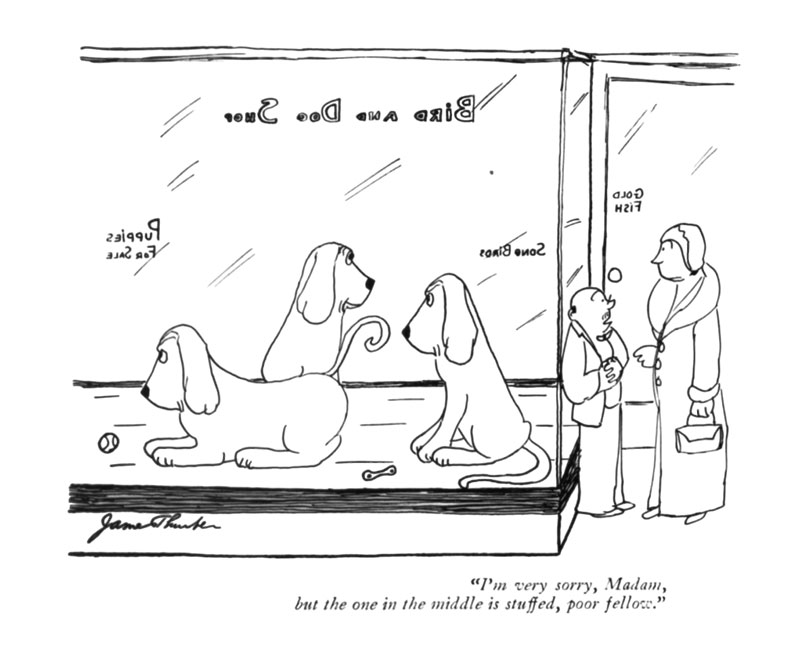
By James Thurber in Fables for For Our Time as published in The Thurber Carnival (Modern Library Edition, 1957).
2.17.2026 – world so full should be

world so full should be
happy as kings, and you know …
how happy kings are

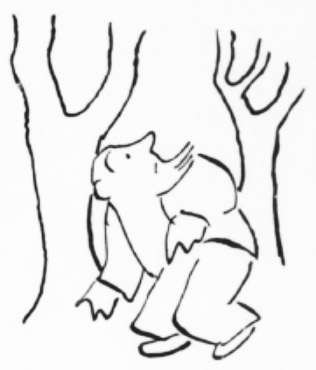
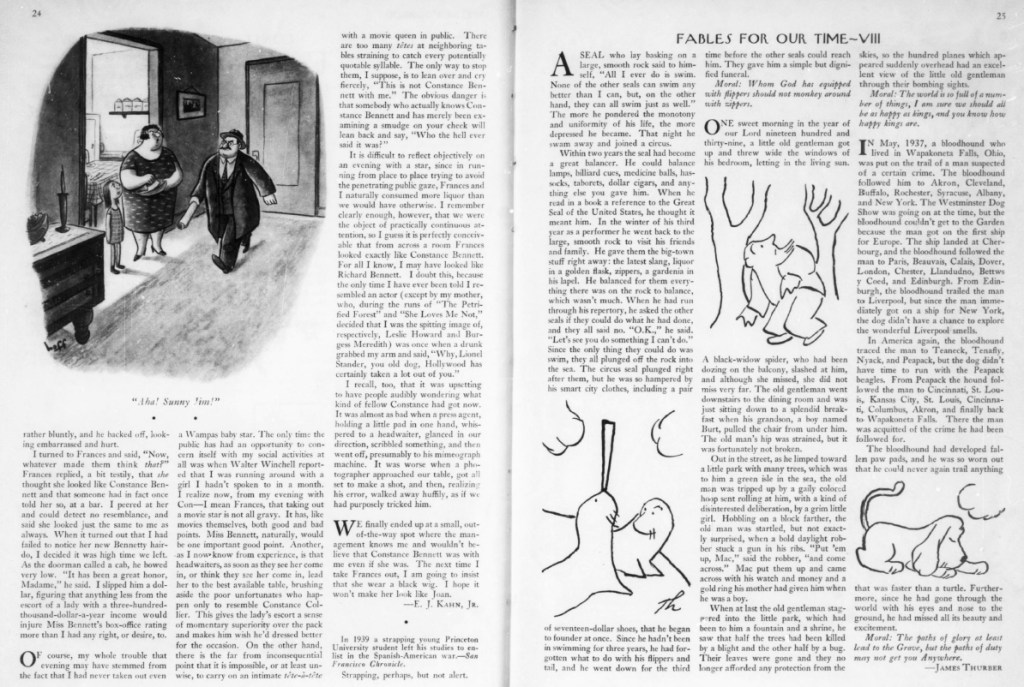
One sweet morning in the year of our Lord nineteen hundred and thirty-nine, a little old gentleman got up and threw wide the windows of his bedroom, letting in the living sun. A black-widow spider, who had been dozing on the balcony, slashed at him, and although she missed, she did not miss very far. The old gentleman went downstairs to the dining room and was just sitting down to a splendid breakfast when his grandson, a boy named Burt, pulled the chair from under him. The old man’s hip was strained, but it was fortunately not broken.

Out in the street, as he limped toward a little park with many trees, which was to him a green isle in the sea, the old man was tripped up by a gaily colored hoop sent rolling at him, with a kind of disinterested deliberation, by a grim little girl. Hobbling on a block farther, the old man was startled, but not exactly surprised, when a bold daylight robber stuck a gun in his ribs. “Put ‘em up, Mac,” said the robber, “and come across.” Mac put them up and came across with his watch and money and a gold ring his mother had given him when he was a boy.

When at last the old gentleman staggered into the little park, which had been to him a fountain and a shrine, he saw that half the trees had been killed by a blight and the other half by a bug. Their leaves were gone and they no longer afforded any protection from the skies, so the hundred planes which appeared suddenly overhead had an excellent view of the little old gentleman through their bombing sights.

Moral: The world is so full of a number of things, I am sure we should all be as happy as kings, and you know how happy kings are.

Further Fables VIII by James Thurber as was printed today, February 17, in the New Yorker Magazine back in 1940.

The first 2 stanzas of the moral are from the Robert Louis Stevenson’s poem Happy Thought (XXIV) from Mr. Stevenson’s Child’s Book of Verse.

The world is so full of a number of things,
I’m sure we should all be as happy as kings.

The final part, and you know how happy kings are, was a favorite Thurber quote.

Oh how I wish for a Thurber or a Mencken to experience this era …

But then, I wouldn’t wish this era on anyone.

As Mr. Thurber said, The world is so full of a number of things, I am sure we should all be as happy as kings, and you know how happy kings are.

The fable must have been too dark as it wasn’t picked to be the either Fables for Our Time, published in 1939 or Further Fables for Our Time published in 1955, but had to wait for the Collected Fables which didn’t come around until 2019.

2.8.2026 – once rhetorical

once rhetorical
exaggerations feeling
less hyperbolic

Adapted from a paragraph in the article in the Guardian, The world heard JD Vance being booed at the Olympics. Except for viewers in the US by Bryan Armen Graham in Milan where Mr. Graham writes with a lot of wonderful words:

But there is a difference between contextual pressure and visible reality distortion.

When global audiences can compare feeds in real time, the latter begins to resemble something else entirely: not editorial judgment, but narrative management.

Which is why comparisons to Soviet-style state-controlled broadcasting models – once breathless rhetorical exaggerations – are starting to feel less hyperbolic.

It’s been a year without joy.

Really/

Think about it.

Bright spots to be sure.

Got two new grand kids for one.

But the bright spots have been few and far between the low spots and the daily drudge is more drudge like every day.

It got me to thinking about history.

Dark periods in history.

World War II

What was it like at home?

I am sure there were birthdays and graduations and new grand kids.

But in the back of your mind, there had to be that nagging feeling that being too happy, feeling too good … just wasn’t right.

There was a shadow over all other experiences.

A shadow that could not be erased.

There were reminders for the people at home.

Gas was rationed.

Not because there wasn’t gas but because one, there wasn’t rubber for tires, and two, it reminded folks there was a war on.

Food was rationed.

And there were those flags with blue and gold stars in windows of homes and businesses.

If your household had someone on active service, you put a flag with a blue star in your window.

If that someone died, you put a flag with a gold star in your window.

This is where those Blue Star Memorial Highway signs and the Association of Gold Star Mothers comes from.

Daily reminders that all was not right with the country and with the world at large.

I am told that the church my family attended had a banner made with 34 blue stars on it.

How would like to be looking at that during your Sunday prayers?

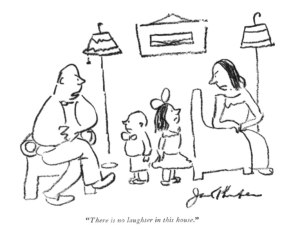
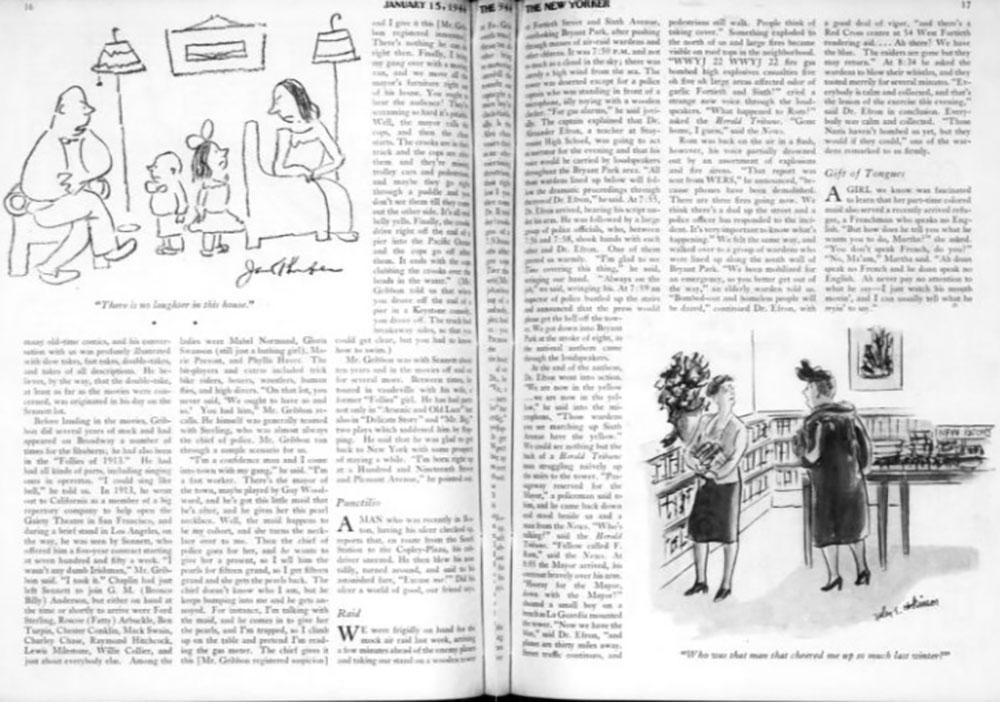
This drawing by James Thurber appeared in the New Yorker Magazine on January 15, 1944 after two years of war.

The caption reads, “There is no laughter in this house.”

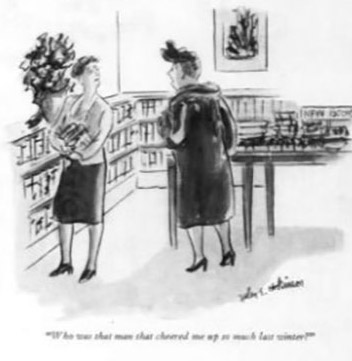
On the opposite page from this drawing was another one.

The caption here is, “Who was that man that cheered me up so much last winter?”

The ladies are in a bookstore, looking for relief.

The New Yorker is a magazine of humor.

But it was a time without joy.

Daily reminders that all was not right with the country and with the world at large.

Today, this past year, everyday it’s something new.

Something new and somehow, something worse than yesterday.

And daily, more and more predictions on how it is going to get worse.

Predictions just a year ago, would have been dismissed out of hand.

Not possible.

Not going to happen.

Not in America.

Which is why comparisons to Soviet-style state-controlled broadcasting models – once breathless rhetorical exaggerations – are starting to feel less hyperbolic.

Breathless rhetorical exaggerations – are starting to feel less hyperbolic.

Daily reminders that all was not right with the country and with the world at large.

I embrace weeping may endure for a night, but joy cometh in the morning (Psalms 30:5) …

Trying to remain hopeful for that dawning.

Not feeling worn down.

Feeling ground down.

Ain’t America great again.

1.1.2026 – Janus, two faces

Janus, two faces
one looking forward, one back
doorway to New Year

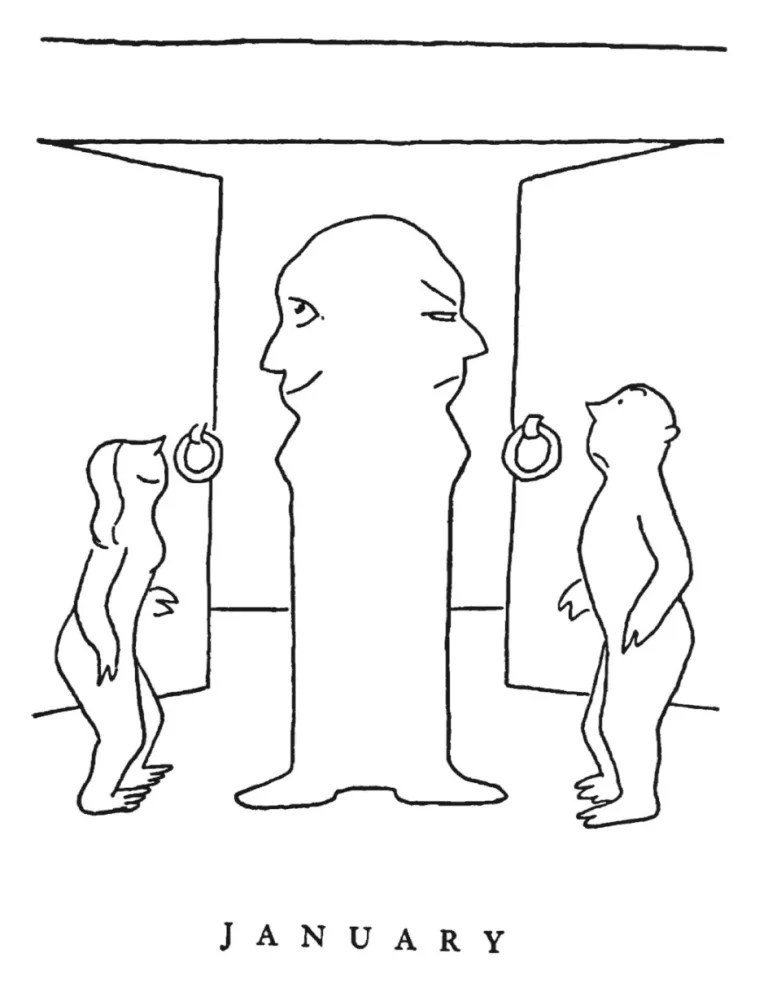
January Latin Janus, the ancient Latin deity who guarded doors and entrances. Naturally he looked after the doorway to the New Year, too. Janus had two faces — one looking forward, one back. That useful but humble man the janitor derives his title from the same root, janua, door. Janus’ temple was closed only in times of peace, which were not frequent.

From In a Word by Margaret Samuels Ernst with illustrations by James Thurber (Great Neck, N.Y. : Channel Press. 1954).

Janus might have had two faces, one looking forward and one looking back but in the words of Willy Wonka, “You can’t get out backwards. You got to go forwards to go back.

Hope for a new years worth of good thoughts.

One question I ponder, do fans of that team in Columbus feel better about this season that ended with a 1 win and then 2 losses then they do about last season that ended with a loss and then three wins and a ‘so called’ National Championship?

Deep in F. Scott Fitzgerald’s world of “a real dark night of the soul it is always three o’clock in the morning,” you bet they do.