7.2.2022 – laughter, singing rang

laughter, singing rang
again, all the sounds of the
earth were like music

Adapted from James Thurber’s Further Fable, “The Bears and the Monkeys.”

I have used this fable of Mr. Thurber’s before.

I will most likely use again and if I don’t use it again, I will read it again and most likely often.

The fable is an analogy on the red scare of the McCarthy era when folks were afraid to think for themselves and wake up to find out they were accused of being a communist.

It was better to let someone else do the thinking for you than risk being labeled being part of the red threat or a pinko commie sympathiser.

So they thinking went according to the monkeys.

When I first read this probably 50 years ago when I was a kid, I think I was able to grasp the meaning that folks do not want anyone telling them what to.

Maybe I was thinking along the lines of Mr. Lincoln’s “as I would not be a slave, so I would not be a master.”

I thought the story noble in its’ irony.

I read it today not in with humor but with horror.

I read it today and feel that the irony now goes over most folks heads.

I read the line, “By sparing you the burden of electing your leaders, we save you from the dangers of choice. No more secret ballots, everything open and aboveboard.” and I hear folks yelling, “YESSIR, THAT’S IT!”.

As Mr. Twain wrote in Huckleberry Finn, “Hain’t we got all the fools in town on our side? And hain’t that a big enough majority in any town?”

BOY Howdy 😦

I still somehow have hope.

Maybe its more I want to refuse to be hope-less.

But I do hope that one day folks will break the chains of their new freedom and found their way back to the deep forest and begin playing leap-bear again and stealing honey and buns from the nearby cottages. And folk’s laughter and gaiety will ring through the forest, and birds that had ceased singing begin singing again, and all the sounds of the earth will be like music.

The Bears and the Monkeys.

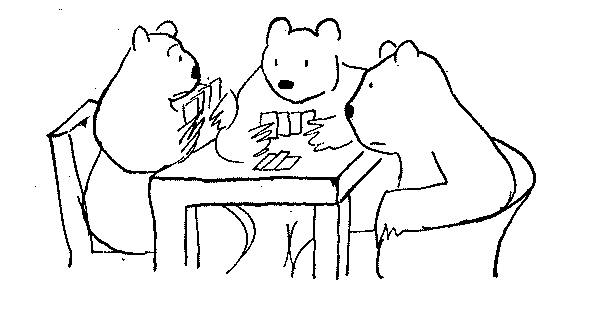
In a deep forest there lived many bears. They spent the winter sleeping, and the summer playing leap-bear and stealing honey and buns from nearby cottages. One day a fast-talking monkey named Glib showed up and told them that their way of life was bad for bears. “You are prisoners of pastime,” he said, “addicted to leap-bear, and slaves of honey and buns.”

The bears were impressed and frightened as Glib went on talking. “Your forebears have done this to you,” he said. Glib was so glib, glibber than the glibbest monkey they had ever seen before, that the bears believed he must know more than they knew, or than anybody else. But when he left, to tell other species what was the matter with them, the bears reverted to their fun and games and their theft of buns and honey.

Their decadence made them bright of eye, light of heart, and quick of paw, and they had a wonderful time, living as bears had always lived, until one day two of Glib’s successors appeared, named Monkey Say and Monkey Do. They were even glibber than Glib, and they brought many presents and smiled all the time. “We have come to liberate you from freedom,” they said. “This is the New Liberation, twice as good as the old, since there are two of us.”

So each bear was made to wear a collar, and the collars were linked together with chains, and Monkey Do put a ring in the lead bear’s nose, and a chain on the lead bear’s ring. “Now you are free to do what I tell you to do,” said Monkey Do.

“Now you are free to say what I want you to say,” said Monkey Say. “By sparing you the burden of electing your leaders, we save you from the dangers of choice. No more secret ballots, everything open and aboveboard.” For a long time the bears submitted to the New Liberation, and chanted the slogan the monkeys had taught them: “Why stand on your own two feet when you can stand on ours?”

Then one day they broke the chains of their new freedom and found their way back to the deep forest and began playing leap-bear again and stealing honey and buns from the nearby cottages. And their laughter and gaiety rang through the forest, and birds that had ceased singing began singing again, and all the sounds of the earth were like music.

MORAL: It is better to have the ring of freedom in your ears than in your nose.

Fables for Our Time and Famous Poems Illustrated by James Thurber, New York, Harpers, 1940.

4.2.2022 – take time, understand

take time, understand
once a week, moment to pause,
reflect, consider

I happened to be reading the papers this morning off of my desktop computer instead of a tablet and came across the links at the bottom of the home page of The Guardian.

Readers of this blog will not be surprised that The Guardian (or Manchester Guardian) is my favorite source for news.

The stories are well written and for the most part adapted for Americans when it comes to spelling colour and theatre and centre.

And the history of the paper, that it was founded and endowed by a family back in 1850 or thereabouts so it would not have to depend on advertisers and could print the truth.

At least the truth as they saw it.

Across the bottom of the home page are links to other Guardian News options and one of the those options is the Guardian Weekly edition.

The blurb with the link states:

Take time to understand the week:
Once a week, take a moment to pause, reflect and consider. In the Guardian Weekly we select the highlights from our newspapers to bring you a deeper, more rounded view of world events.

I thought about that.

And I thought that I should take time to understand my week.

And I thought that once a week, I should take a moment to pause, reflect and consider.

So I tried it.

I tried to understand my week.

I took a moment and paused, reflected and considered my week.

First thing that happened is that I threw up.

Then I got back in bed and pulled the covers up over my head.

I may stay there a while.

I am in zugzwang and I cannot get out.

Zugzwang, you might remember, is a term from chess.

You are in zugzwang when it is your turn and you have to make a move and every move you can make is a bad move.

The online dictionary defines zugzwang as “a situation in Chess in which the obligation to make a move in one’s turn is a serious, often decisive, disadvantage.”

I am reminded of the short story, “A Box to Hide In” by James Thurber.

The story ends with:

But I still have this overpowering urge to hide in a box.

Maybe it will go away.

Maybe I’ll be all right.

Maybe it will get worse.

It ‘s hard to say.

The story 1st appeared in print in The New Yorker in January 24, 1931.

90 years ago, 190 years ago, 1900 years ago.

As Mr. Thoreau said, “The mass of men lead lives of quiet desperation. What is called resignation is confirmed desperation.”

Plus ça change, plus c’est la même chose.

As they say, I shall endeavor to persevere.

Here in a poorly formatted format is the story:

A Box to Hide In - James Thurber 

I waited till the large woman with the awful hat took up her
sack of groceries and went out, peering at the tomatoes and
lettuce on her way. The clerk asked me what mIne was.
"Have you got a box," I asked, "a large box? I want a box to
hide in"

"You want a box?" he asked.

"I want a box to hide in," I said.

"Whatta you mean?" he said. "You mean a big box?"
I said I meant a big box, big enough to hold me. "I haven't
got any boxes," he said. "Only cartons that cans come in." I
tried several other groceries and none of them had a box big
enough for me to hide in. There was nothing for it but to
face life out. I didn't feel strong and I had this overpowering
desire to hide in a box for a long time.

"What do you mean, you want to hide in this box?", one
grocer asked me.

"It's a form of escape", I told him. "Hiding in a box, it
circumscribes your worries and the range of your anguish.
You don't see people, either".

"How in the hell do you eat when you're in this box?" ,
asked the grocer. "How in the hell do you get anything to
eat?".

I said I'd never been in a box and didn't know, but that
would take care of itself. "Well", he said finally, "I haven't
got any boxes, only some pasteboard cartons that cans come
in." It was the same every place. I gave up when it got dark
and the groceries closed, and hid in my room again. I turned
out the light and lay on the bed. You feel better when it gets
dark.

I could have hid in a closet, I suppose, but people are always
opening doors. Somebody would find you in a closet. They
would be startled and you'd have to tell them why you were
in the closet. Nobody pays any attention to a big box lying
on the floor. You could stay in it for days and nobody'd
think to look at it, not even the cleaning woman."

My cleaning woman came the next morning and woke me
up. I was still feeling bad. I asked her if she knew where I
could get a large box.

"How big a box you want?", she asked. "I want a box big
enough for me to get inside of", I said. She looked at me
with big, dim eyes. There's something wrong with her
glands. She's awful. But she has a big heart, which makes it
worse. She's unbearable, her husband is sick and her children
are sick and she is sick too. I got to thinking how pleasant it
would be if I were in a box now, and didn't have to see her
I'd be in a box right there in the room, and she wouldn't
know.

I wondered if you have a desire to bark or laugh when
someone who doesn't know walks by the box you're in.
Maybe she would have a spell with her heart if I did that and
would die right there. The officers and the elevator man and
Mr Grammage would find us.

"Funny, dog gone thing happened at the building last
night", the doorman would say to his wife. "I let in this
woman to clean up 10-F and she never came out, see? She
never there more than an hour. But she never came out,
see?" So when it get time for me to get off duty, I says to
Crimmack in the elevator, "I says what the hell you suppose
happened to the woman that cleans 10-F?" He says he didn't
know. He says he never seen her after he took her up. So I
spoke to Mr Grammage about it. "Sorry to bother you, Mr.
Grammage", I says, "but there's something funny about that
woman that cleans 10-F". So I told him - he said we better
have a look. And we all three goes up, knocks on the door,
rings the bell, see, and nobody answers

So he said we'd have to walk in. So Crimmack opened the
door and we walked in. And there was this woman, cleans
the apartment, dead as a herring on the floor, and the
gentleman that lives there was in a box.

The cleaning woman kept looking at me. It was hard for me
to realize she wasn't dead. "It's a form of escape", I
murmured. "What say?", she asked dully? "You don't know
of any large packing boxes, do you?", I asked. "No, I don't,
she said."

I haven't found one yet. But I still have this overpowering
urge to hide in a box. Maybe it will go away. Maybe I'll be
all right. Maybe it will get worse. It 's hard to say.

You can read the short story here.


3.31.2022 – much lucubration

much lucubration,
confused line of thought – this way
of course, lies madness

Yes, I had to look it up.

Lucubration means study or mediation or a piece of writing, typically a pedantic or overelaborate one.

Like some blogs I know.

I seem to be stuck in rut quoting James Thurber lately.

His book on the founder of the New Yorker Magazine, The Years with Ross, is a trip to the dictionary waiting to happen.

I cannot vouch for its content or the stories told in the book except to mention that the White’s. EB and Katherine Angell, did not care for the book and thought the portrayal of Ross by Thurber was unnecessarily unkind.

The writing.

The contruction.

The play of words against each other.

It is fun to read for the writing.

Then with the discussion of how Harold Ross edited short stories.

Well, like I said, I have been dipping in and out of it over and again since I was able to get a copy in ebook form.

The passage in particular dealt with how long a certain story took to write.

Thurber is quoting another managing editor, Stanley Walker, who said about Harold Ross (Thurber wrote):

“He thought such a story should have required at least a week’s work and painful lucubration. Then, following this confusing line of thought, he wondered if he were not being cheated by the writers who took too much time. This way, of course, lies madness.”

It must have been crazy wonderful to work in that environment I think.

Most of my working career has been spent working in ‘Creative’ Deaprtments.

I have had great bosses who understood that the last thing you want to do is creative people is force them into a system and take away the thing that makes them creative.

I have had bosses who believed in the system and did not care a fig about the output so long as all the check marks were checked.

This way, of course, lies madness.

Thurber ends these couple of pages with one last quote from Mr. Walker on his time at the New Yorker.

 “. . . it was like fighting a revolving door in a blizzard. You can’t win, but anger doesn’t get you anywhere either. “

I guess.

So long as there is generous time available for much lucubration.

3.26.2022 – here with little on

here with little on
my mind and going nowhere
in particular

Growing up in West Michigan with an eye on reading, I was aware of the writing of Niles, Michigan native, Ring Lardner.

Mr. Lardner was a sportswriter who also wrote short stories, many of which, “Alibi Ike” and “You Know Me, Al” were short stories based on sport.

If you happened to see the 1988 (1988???) movie, “8 Men Out” about the Chicago Black Sox scandal, Ring Lardner is the sportswriter the movie follows to tell the story.

When the movie was made, Lardner’s son, Ring, Jr., was on the set as a consultant and Ring, Jr. said he could not be on the set when the director, John Sayles, who also played the part of Ring, Sr. was in costume as he looked so much like his father.

Like I said, I have always been aware of Mr. Lardner’s writing.

It was said that no one wrote dialogue like Mr. Lardner or as one person put it, his mastery of idiosyncratic vernacular.

If you grew up in West Michigan and you knew of Mr. Lardner and you read anything he wrote that wasn’t about baseball, you most likely read the short story, The Golden Honeymoon, the story that takes place in the 1920’s about a couple from West Michigan that celebrates their 50th wedding anniversary with a month long trip to Florida.

It is written is a way that you can hear the man narrating the trip and telling the entire story – and its quite a story – all in one sitting without taking a breathe.

In a bizarre magical way it starts out rolling and the words don’t stop and all of sudden it is over and you have spent the last 30 minutes of your life in real time on a month long trip to Florida.

Here is a snippet –

I felt sorry for Hartsell one morning. The women folks both had an engagement down to the chiropodist’s and I run across Hartsell in the Park and he foolishly offered to play me checkers.
It was him that suggested it, not me, and I guess he repented himself before we had played one game. But he was too stubborn to give up and set there while I beat him game after game and the worst part of it was that a crowd of folks had got in the habit of watching me play and there they all was, looking on, and finally they seen what a fool Frank was making of himself, and they began to chafe him and pass remarks. Like one of them said:
“Who ever told you you was a checker player!”
And:
“You might maybe be good for tiddle-de-winks, but not checkers!”
I almost felt like letting him beat me a couple games. But the crowd would of knowed it was a put up job.
Well, the women folks joined us in the Park and I wasn’t going to mention our little game, but Hartsell told about it himself and admitted he wasn’t no match for me.
“Well,” said Mrs. Hartsell, “checkers ain’t much of a game anyway, is it?” She said: “It’s more of a children’s game, ain’t it? At least, I know my boy’s children used to play it a good deal.”
“Yes, ma’am,” I said. “It’s a children’s game the way your husband plays it, too.”

You can read the short story here.

It colored my view of making any trip to Florida to this day!

So why was I thinking about Ring Lardner this morning?

I was thumbing through another book by James Thurber titled the Years with Ross, about the operation of the New Yorker Magazine and its founder, Harold Ross.

Ross claimed, so Thurber wrote, that [Ross] “asked Lardner the other day how he writes his short stories, and he said he wrote a few widely separated words or phrases on a piece of paper and then went back and filled in the spaces.

And I came across this passage.

The 1933 scroll was charged with all kinds of things for H. W. Ross. The Depression, which had been aimed directly at him, was still holding on, though getting better (1934 was to be one of the New Yorker’s best financial years). Hitler had risen to power, the banks had closed, Prohibition was soon to become a sorry memory, and the Roosevelt family had come to Washington, thus supplying “Talk of the Town” with dozens of anecdotes and the art department with dozens of idea drawings. In 1933 Ring Lardner died, and the morning World came to an end – major sorrows that saddened Ross and all of us.

It struck me that Thurber, recounting the good and bad that happened in 1933, the fact that Ring Lardner died was enough to make it bad year.

And I thought about that a good long while.

If nothing else it made want to dig out and read Mr. Larder over again.

With little on my mind and going nowhere in particular, its a great day to read.

Doing so I came across the line of words that I assembled into today’s Haiku.

As Frank Lloyd Wright might have said, “there you are.”

3.21.2022 – Are you sitting in

are you sitting in
the catbird seat? explain what
the gibberish mean
s

The one and only reason this haiku got written is because it makes me laugh.

Wellllll, maybe not the haiku itself, but the source.

Hopefully someone recognizes that it comes from a short story, Sitting in the Catbird Seat by James Thurber.

Not place dropping, but I was at Thurber’s house this past summer in Columbus, Ohio.

Due to Covid, the museum wasn’t open but Leslie let me run around the outside of the house taking pictures and two little girls came by selling flowers they had just picked from the next door garden so we sat on the front porch, sitting in the catbird seat, and had a nice little chat.

The phrase, sitting in the Catbird Seat, is a quote from Red Barber, the radio announcer of the Brooklyn Dodgers.

In the short story, Thurber writes:

She was constantly shouting these silly questions at him. “Are you lifting the oxcart out of the ditch? Are you tearing up the pea patch? Are you hollering down the rain barrel? Are you scraping around the bottom of the pickle barrel? Are you sitting in the catbird seat?”

It was Joey Hart, one of Mr. Martin’s two assistants, who had explained what the gibberish meant. “She must be a Dodger fan,” he had said. “Red Barber announces the Dodger games over the radio and he uses those expressions–picked ’em up down South.” Joey had gone on to explain one or two. “Tearing up the pea patch” meant going on a rampage; “sitting in the catbird seat” meant sitting pretty, like a batter with three balls and no strikes on him.

The short story was one my mind, and I know what you are thinking, these stories are always on my mind, but that’s not true.

It’s the short story, “One is a Wanderer” that is always on my mind, but that is for another time or an earlier time as I know I must have commented on it a couple of times in this blog.

But why tonight?

When bored and wanting something to read that won’t land me in a war – as an aside I think the last 10 or so books, fiction and non fiction, that I picked up landed me in a war or a refuge crisis or somehow, I am still not sure, in a morgue – I check out what my Canadian Friends have added to the Faded Page.

You will remember that those wonderful people in Canada are finding older books whose authors or copyright holders have allowed the Canadian Copyright’s to expire which puts these books in the public domain.

They are careful to say that if the copyright is enforce in your country, Do Not Download These Books.

So please be aware of that and please don’t throw me in that briar patch.

When I checked tonight, Faded Page had added a half dozen Thurber Books including Thurber Carnival, My Life and Welcome To It and the far-to-little-read The Years with Ross.

These are all there, ready to download for any device or read online.

You can read Sitting in the Catbird Seat here and I hope you do.

The books are here and you read or down epubs or mobi.

Did I tell you how much I love Canadians?

Like Mr. Martin, I will end with, “He went out and shut the door, and his step was light and quick in the hall. When he entered his department he had slowed down to his customary gait, and he walked quietly across the room to the W20 file, wearing a look of studious concentration.