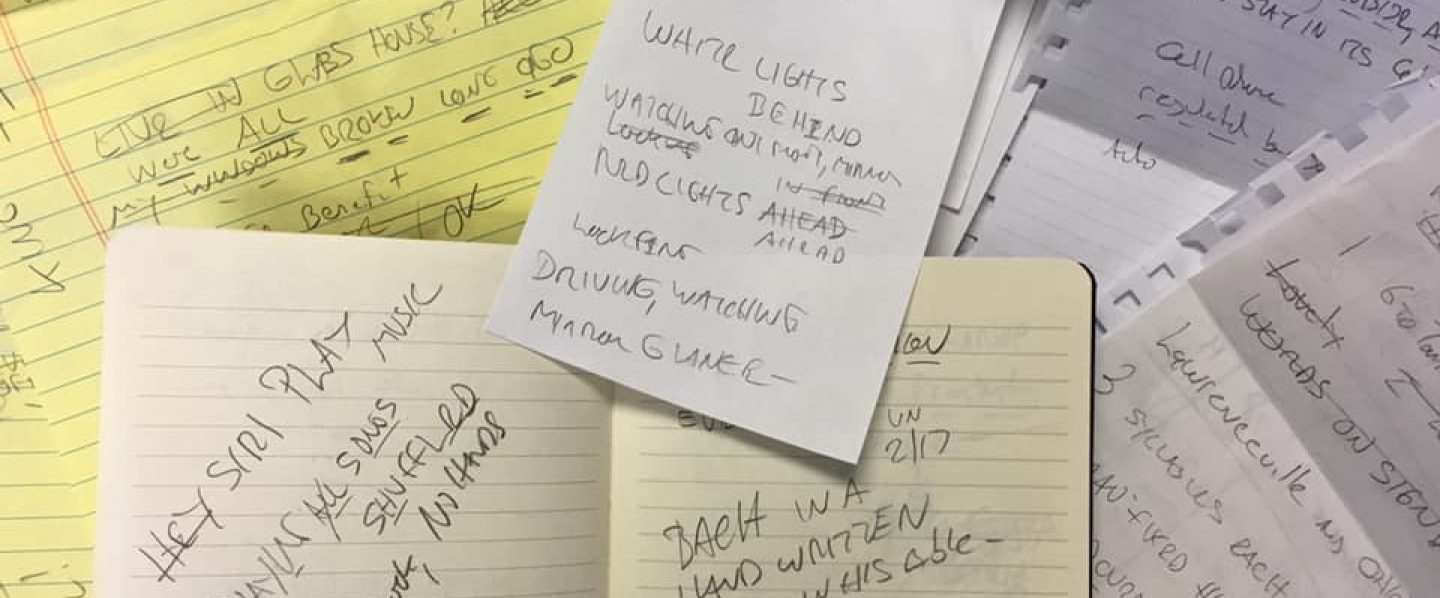
7.29.2020 – night of summer stars

night of summer stars
low, near, lazy in the sky
sky of summer stars

Walking at night in the warm dark of summer in Georgia is something you to cannot explain to people up north.

I remember our first 4th of July fireworks down here and realizing it was near midnight and I was still in a T shirt and shorts.

No sweatshirt.

No hoodie.

No long pants.

Up north in Michigan, I was lucky to go out at night and not end up wanting a coat.

Jim Harrison in the Brown Dog novellas writes about a summer in the Upper Peninsula of Michigan without tourists.

It was so cold that people went to the 4th of July fireworks in snowmobile suits and watched the rockets red glare through snow flurries.

Walking in the warm dark of the Georgia night.

Stars so fat and close.

No big names but the North Star and the Big Dipper, maybe Booters, but so many stars without names.

Warm and lazy stars of summer time.

Maybe global warming will bring this Michigan.

Maybe that might bring me back.

Summer Stars
by
Carl Sandburg in Smoke and Steel (Harcourt, 1920).

Bend low again, night of summer stars.
So near you are, sky of summer stars,
So near, a long arm man can pick off stars,
Pick off what he wants in the sky bowl,
So near you are, summer stars,
So near, strumming, strumming,
So lazy and hum-strumming.

7.21.202 – ten, twelve hours a day

ten, twelve hours a day
8 cents a box, drops to 6
pictures for today

Today’s haiku comes from the poem, Onion Days, by Carl Sandburg, that I recently ran across.

It is a poem about a woman who picks onions 10 to 12 hours a day for 8 cents a box.

The owner of the farm worries about how to make his farm produce more efficiently so he hires more workers so he only has to pay 6 cents a box.

The poem was written in 1916.

I also recently watched the movie ‘The Irishman”.

I wonder if its time for DeNiro and Pesci to close the door on mob movies but I digress.

The movie was about Jimmy Hoffa, a man today more famous for not being here than for what he did when he was here.

And that’s too bad.

Right or wrong in his methods, Hoffa cared about the people who did the working.

Not sure there is anyone in that role today.

His first strike was on the loading dock of a grocery company in 1931.

The crew on the loading dock was expected to work 12 hours shifts.

They were paid 32 cents an hour.

12 cents in cash and 20 cents in credits at the grocery store.

BUT they were only paid for the time they spent actually unloading trucks.

Hoffa organized the crew and on a hot summer day when truckloads of strawberries rolled in, they went on strike.

They demanded a full 32 cents an hour in cash and a minimum of 4 hours pay for a 12 hour day.

The grocery store, a place called KROGER, gave in a signed a one year contract.

Congress will meet this week to ‘discuss’ a further stimulus package.

How many of them are really thinking of the people who work.

Don’t the men and women of Congress enjoy chanting the Nicene creed with their daughters on each side of them joining their voices with theirs?

I am lucky.

I have a well paying job and am allowed to work from home.

No one would ever write a play about me.

But as Mr. Sandburg says in his poem about Mrs. Gabrielle Giovannitti …

or the crew on the loading dock …

or the people who need to work and can’t work because there is not enough work …

or can’t work enough because stores are closing …

because restaurants are closing …

because businesses everywhere are closing …

No dramatist living COULD put them into a play.

No one could capture that.

In 1916, in 1931, or today.

But I hope the men and women in Congress at least think about them this week

– – – – – – – – – – –

Onion Days in Chicago Poems by Carl Sandburg, (1916)

Mrs. Gabrielle Giovannitti comes along Peoria Street every morning at nine o’clock

With kindling wood piled on top of her head, her eyes looking straight ahead to find the way for her old feet.

Her daughter-in-law, Mrs. Pietro Giovannitti, whose husband was killed in a tunnel explosion through the negligence of a fellow-servant,

Works ten hours a day, sometimes twelve, picking onions for Jasper on the Bowmanville road.

She takes a street car at half-past five in the morning, Mrs. Pietro Giovannitti does,

And gets back from Jasper’s with cash for her day’s work, between nine and ten o’clock at night.

Last week she got eight cents a box, Mrs. Pietro Giovannitti, picking onions for Jasper,

But this week Jasper dropped the pay to six cents a box because so many women and girls were answering the ads in the Daily News.

Jasper belongs to an Episcopal church in Ravenswood and on certain Sundays

He enjoys chanting the Nicene creed with his daughters on each side of him joining their voices with his.

If the preacher repeats old sermons of a Sunday, Jasper’s mind wanders to his 700-acre farm and how he can make it produce more efficiently

And sometimes he speculates on whether he could word an ad in the Daily News so it would bring more women and girls out to his farm and reduce operating costs.

Mrs. Pietro Giovannitti is far from desperate about life; her joy is in a child she knows will arrive to her in three months.

And now while these are the pictures for today there are other pictures of the Giovannitti people I could give you for to-morrow,

And how some of them go to the county agent on winter mornings with their baskets for beans and cornmeal and molasses.

I listen to fellows saying here’s good stuff for a novel or it might be worked up into a good play.

I say there’s no dramatist living can put old Mrs. Gabrielle Giovannitti into a play with that kindling wood piled on top of her head coming along Peoria Street nine o’clock in the morning.

7.13.2020 – When I get old, I

When I get old, I
shall read Proust, was the thought – will
I see with new eyes?

I like stories about people and their books.

Maybe because I feel more at home in the world when there other people who regard books as parts of their lives instead of props.

Young Abraham Lincoln reading a borrowed copy of the Life of George Washington at night and placing in between the logs of the cabin for safe keeping.

Then it snows and water seeps in and ruins the book.

Young Abe walks 50 miles and offers to split thousands of fence rails to make up for the loss.

When he finishes the chore and reports to the owner that he is done, the owner presents him with the somewhat waterlogged copy of the book.

Paul the Apostle, writing a reminder in one of his letters to please send his coat AND don’t forget the books!

Thomas Jefferson selling his library to the US Government to establish the Library of Congress and also pay off some personal debts.

As soon as he gets the notified that the money from Congress is in the bank, Mr. Jefferson orders more books.

James Thurber getting his nerve together and going over to an ex-wfe’s house to reclaim his collected works of Henry James.

There is a marvelous video of an interview with historian Shelby Foote on YouTube.

CSpan’s Brian Lamb has Mr. Foote walk the viewer on a tour through his personal library where he did most of his work.

What surprised me is that Mr. Foote stopped at a set of the collected works of Marcel Proust.

It is a set that Mr. Foote says his mother gave him for his 17th birthday.

Mr. Foote said, “Everytime I feel the right to do it, I quit everything and re-read Proust.”

One reason he says if for the pure enjoyment.

And the other is that a writer can always learn from Proust.

I was intrigued to say the least.

Don’t much besides a few quotes from the writings of Marcel Proust.

Like Calculus and Neils Bohr’s heavy water and the Taft family of Ohio, Proust, or at least his name, is floating around in my brain like an ice berg.

Something I was aware of but didn’t know much about.

And aware that a lot more of it was below the water line if I cared to find out.

Cricket was like that and one summer I decided I would learn to understand what cricket was all about.

Now I am hooked on cricket. T20, ODI or TEST?

Mr. Foote, in the sweet Mississippi voice of his, recalls the pleasure of reading the 3000 pages.

When would I have time for Proust?

Every summer I try to read a famous classic that I have never read.

The Way of All Flesh.

Sinister Street.

War and Peace.

Last summer I hit Look Homeward Angel but got lost in the slog.

After hearing Mr. Foote I promised myself that when I got old I would read Proust.

This is the summer I turn 60.

I an thinking I have earned the right.

Stay tuned.

7.7.2020 – indifference in

indifference in
this, our democracy,
is abdication

I was thinking about Harold Ross today.

Mr. Ross was the founder-editor of the New Yorker Magazine.

The magazine gave a home to so many American writers and was the focus of so many American dreams.

Neither here nor there but I remember a conversation with Gerald Elliott, then the retired Editor of the Grand Rapids Press and he told me that he missed the Sunday Magazine, Wonderland.

When I asked why, he replied that it was the one place where local authors had a chance to get published.

I didn’t tell him how many short stories I had submitted to Wonderland but I batted 1,000 on rejections.

Anyway, Mr. Ross started up the New Yorker with the announcement that the magazine would, “Not be edited for the little old lady from Peoria.”

Much much ink has been spilled try to explain just what Mr. Ross meant by that and I will not add to it.

I will mention that one of the funniest comments EVER about the New Yorker was an aside by James Thurber in a vignette about his mother. Mr. Thurber wrote that once his Mother told him that one of her friends in Columbus, OH, “took the New Yorker to help Jamie,” but never read it.

What stuck in my head was the thought, “what are the people in Peoria thinking right now?”

Through the magic of the World Wide Web I was soon reading the Peoria Journal Star.

The headline, “Commentary: Law enforcement: Thoughts of a sanctified believer in America” caught my eye.

I am glad it did.

It is what I would call an OP-ED piece.

It was written for the Peoria Journal Star (fabulous name by the way) by Judge Joe Billy McDade (another fabulous name by the way) a senior U.S. District Judge in the Central District of Illinois for the 4th of July.

Judge Joe Billy McDade at a naturalization ceremony, Nov 15 2019 – JOURNAL STAR

Judge McDade led off with the words, “The promise of America”

And went from there.

The Judge went on, “While the promise of America has flickered and faded in dark times, it has never been extinguished. That promise is the bedrock of American values and it should be the touchstone as we confront the challenges, new and old, that plague us.

He concluded with:

We the People are sovereign;

We the People must safeguard our rights against encroachment.

It is upon all of us to do what we can to make the promise of America a reality. Doing nothing emboldens the wrongdoer, whatever the intent; indifference in a democracy is abdication.

These thoughts are only a starting point — I do not have all the answers.

But in the difficult conversations which are occurring and ought to continue, what I can offer is this: ever in the foreground, always in view, must be the fundamental idea of America, a nation where all and the rights of all are equal under the law.

By chance today I got a point of view from Peoria.

I have been feeling mostly rotten lately about our Country.

Knowing that Judge Joe Billy McDade is out there made me feel better.

One little light.

Maybe there are more.

There must be!

But even if Judge Joe Billy McDade is the ONLY one out there, I will not abdicate from my responsibilities as a citizen of the United States.

I will not walk away.

I will not go quietly into the night.

Indifference be damned.

It’s going to be a pub fight.