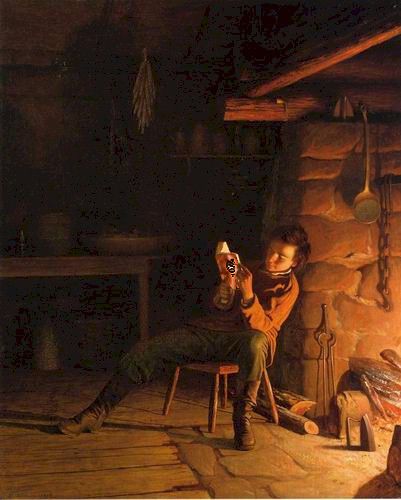
9.3.2020 – things I want to know

things I want to know
are in books – friends will get me
a book I ain’t read

This is attributed to Mr. Abraham Lincoln.

Looking for a citation, the best I that can do is that Carl Sandburg has old Dennis Hanks recalling that his young cousin Abe Lincoln saying, “The things I want to know are in books; my best friend is the man who’ll git me a book I ain’t read.”

Mr Sandburg recorded this in his book, Abraham Lincoln Volume 1 The Prairie Years (Dell, New York, NY – 1927).

So did Mr. Lincoln say it?

Or did Mr. Sandburg imagine that Mr. Lincoln said it?

Would Mr. Lincoln had said it had it thought of it?

Well, maybe and yes and why not all at the same time.

Lincoln or Sandburg or Lincoln and Sandburg.

Someone said it and I like it.

It works for me.

Its good enough for me.

It is late in the day.

I got my new Kindle Fire that my wife got me on my last birthday.

She is my best friend.

I got lots of books on it I ain’t read.

Me for the back porch and the rocker.

Ps – the above painting is owned and displayed by the University of Michigan – I liked to go look at it as student …

8.26.2020 – when coffee not work

when coffee not work
thank goodness for back up plan
those smoothies at dawn

Some mornings I don’t drink coffee so much as I pour into my stomach and wait for the caffine to kick in.

No thought for the taste, aroma or the smooth liquid brown warmth that starts my day.

Its the kick.

The kick in the head.

The kick in the head that starts me up and off past all other complaints and concerns and gets me in a place to start my day.

Some days it isn’t there in the cup.

Then what?

The back up plan.

I get up and go to work on the kitchen counter.

I work there as the coffee usually goes to work.

And on the days that I go to work and the coffee doesn’t?

Well …

On those days,

I have Ellington.

Ellington is my son who is also stuck at home and working his way through his senior year in high school.

He is starting is day.

His day starts with a fruit smoothie.

A concoction that requires about about 10 kinds of fruit, fresh or frozen, that he puts into his smoothie maker.

A smoothie maker might have been called a blender but for one slight diffference.

I am not awake.

Not fully awake anyway.

And the mornings I need a real kick to get going are not my best mornings.

Sickly.

Headachy.

Thick headed.

Slow.

Then Ellington turns on the smoothie maker.

It doesn’t turn on as much as it goes off.

It goes off like a bomb.

Like a bomb three feet from my ears.

Like a shrieking siren.

Like a shrieking siren three feet from my ears.

I have never stood next to an F-16 fighter jet when it takes off.

But I would be surprised if its louder and produces a higher pitched squeal than that smoothie maker,

It wakes me up.

It wakes up the people in the next apartment I am sure.

Maybe the whole building.

It gets me going for a lot of reasons.

In the short story, Something to Say, James Thurber writes of Elliot Vereker, “Vereker always liked to have an electric fan going while he talked and he would stick a folded newspaper into the fan so that the revolving blades scuttered against it, making,a noise like the rattle of machine gun fire. This exhilarated him and exhilarated me, too, but I suppose that it exhilarated him more than it did me.”

I know just the point Thurber was after when Ellington hits the on switch on that smoothie maker.

Except that I am sure if the sound exhilarated Ellington and exhilarated me, too, I suppose that it exhilarated ME more than it did him.

My backup plan.

It’s good to have a plan.

It gets me back up.

7.29.2020 – night of summer stars

night of summer stars
low, near, lazy in the sky
sky of summer stars

Walking at night in the warm dark of summer in Georgia is something you to cannot explain to people up north.

I remember our first 4th of July fireworks down here and realizing it was near midnight and I was still in a T shirt and shorts.

No sweatshirt.

No hoodie.

No long pants.

Up north in Michigan, I was lucky to go out at night and not end up wanting a coat.

Jim Harrison in the Brown Dog novellas writes about a summer in the Upper Peninsula of Michigan without tourists.

It was so cold that people went to the 4th of July fireworks in snowmobile suits and watched the rockets red glare through snow flurries.

Walking in the warm dark of the Georgia night.

Stars so fat and close.

No big names but the North Star and the Big Dipper, maybe Booters, but so many stars without names.

Warm and lazy stars of summer time.

Maybe global warming will bring this Michigan.

Maybe that might bring me back.

Summer Stars
by
Carl Sandburg in Smoke and Steel (Harcourt, 1920).

Bend low again, night of summer stars.
So near you are, sky of summer stars,
So near, a long arm man can pick off stars,
Pick off what he wants in the sky bowl,
So near you are, summer stars,
So near, strumming, strumming,
So lazy and hum-strumming.

7.21.202 – ten, twelve hours a day

ten, twelve hours a day
8 cents a box, drops to 6
pictures for today

Today’s haiku comes from the poem, Onion Days, by Carl Sandburg, that I recently ran across.

It is a poem about a woman who picks onions 10 to 12 hours a day for 8 cents a box.

The owner of the farm worries about how to make his farm produce more efficiently so he hires more workers so he only has to pay 6 cents a box.

The poem was written in 1916.

I also recently watched the movie ‘The Irishman”.

I wonder if its time for DeNiro and Pesci to close the door on mob movies but I digress.

The movie was about Jimmy Hoffa, a man today more famous for not being here than for what he did when he was here.

And that’s too bad.

Right or wrong in his methods, Hoffa cared about the people who did the working.

Not sure there is anyone in that role today.

His first strike was on the loading dock of a grocery company in 1931.

The crew on the loading dock was expected to work 12 hours shifts.

They were paid 32 cents an hour.

12 cents in cash and 20 cents in credits at the grocery store.

BUT they were only paid for the time they spent actually unloading trucks.

Hoffa organized the crew and on a hot summer day when truckloads of strawberries rolled in, they went on strike.

They demanded a full 32 cents an hour in cash and a minimum of 4 hours pay for a 12 hour day.

The grocery store, a place called KROGER, gave in a signed a one year contract.

Congress will meet this week to ‘discuss’ a further stimulus package.

How many of them are really thinking of the people who work.

Don’t the men and women of Congress enjoy chanting the Nicene creed with their daughters on each side of them joining their voices with theirs?

I am lucky.

I have a well paying job and am allowed to work from home.

No one would ever write a play about me.

But as Mr. Sandburg says in his poem about Mrs. Gabrielle Giovannitti …

or the crew on the loading dock …

or the people who need to work and can’t work because there is not enough work …

or can’t work enough because stores are closing …

because restaurants are closing …

because businesses everywhere are closing …

No dramatist living COULD put them into a play.

No one could capture that.

In 1916, in 1931, or today.

But I hope the men and women in Congress at least think about them this week

– – – – – – – – – – –

Onion Days in Chicago Poems by Carl Sandburg, (1916)

Mrs. Gabrielle Giovannitti comes along Peoria Street every morning at nine o’clock

With kindling wood piled on top of her head, her eyes looking straight ahead to find the way for her old feet.

Her daughter-in-law, Mrs. Pietro Giovannitti, whose husband was killed in a tunnel explosion through the negligence of a fellow-servant,

Works ten hours a day, sometimes twelve, picking onions for Jasper on the Bowmanville road.

She takes a street car at half-past five in the morning, Mrs. Pietro Giovannitti does,

And gets back from Jasper’s with cash for her day’s work, between nine and ten o’clock at night.

Last week she got eight cents a box, Mrs. Pietro Giovannitti, picking onions for Jasper,

But this week Jasper dropped the pay to six cents a box because so many women and girls were answering the ads in the Daily News.

Jasper belongs to an Episcopal church in Ravenswood and on certain Sundays

He enjoys chanting the Nicene creed with his daughters on each side of him joining their voices with his.

If the preacher repeats old sermons of a Sunday, Jasper’s mind wanders to his 700-acre farm and how he can make it produce more efficiently

And sometimes he speculates on whether he could word an ad in the Daily News so it would bring more women and girls out to his farm and reduce operating costs.

Mrs. Pietro Giovannitti is far from desperate about life; her joy is in a child she knows will arrive to her in three months.

And now while these are the pictures for today there are other pictures of the Giovannitti people I could give you for to-morrow,

And how some of them go to the county agent on winter mornings with their baskets for beans and cornmeal and molasses.

I listen to fellows saying here’s good stuff for a novel or it might be worked up into a good play.

I say there’s no dramatist living can put old Mrs. Gabrielle Giovannitti into a play with that kindling wood piled on top of her head coming along Peoria Street nine o’clock in the morning.