recover a sense of the malleability behind what is built
Adapted from the book, The Architecture of Happiness (2009, Vintage Books) by Alain de Botton, and the passage:
We should recover a sense of the malleability behind what is built. There is no predetermined script guiding the direction of bulldozers or cranes. While mourning the number of missed opportunities, we have no reason to abandon a belief in the ever-present possibility of moulding circumstances for the better.
According the The New York Review of Books, this is “A perceptive, thoughtful, original, and richly illustrated exercise in the dramatic personification of buildings of all sorts.”
What I find irrestible in reading Mr. de Botton is his use of language.
I get the feeling that if you made a spread sheet of all the words, adverbs and adjectives used by Mr. de Botton, you just might find that he used each word just once.
paradoxically succeeded in curtailing concern for others
Adapted from the book, “The pleasures and sorrows of work” by Alain de Botton, (Random House – 2009) and the passage:
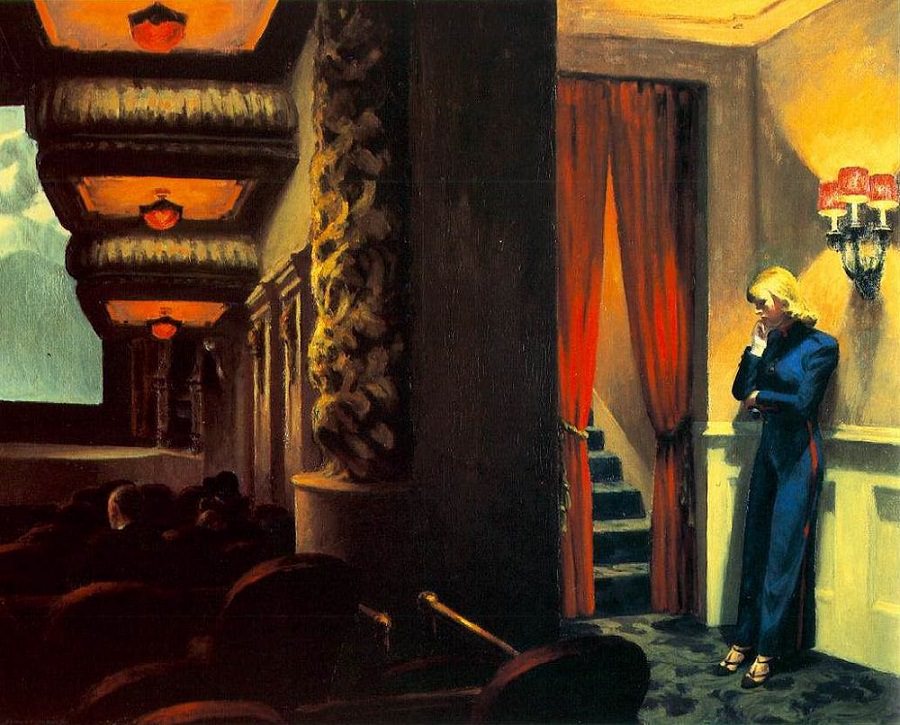
In New York Movie (1939), an usherette stands by the stairwell of an ornate pre-war theatre. Whereas the audience is sunk in semidarkness, she is bathed in a rich pool of yellow light. As often in Hopper’s work, her expression suggests that her thoughts have carried her elsewhere. She is beautiful and young, with carefully curled blond hair, and there are a touching fragility and an anxiety about her which elicit both care and desire. Despite her lowly job, she is the painting’s guardian of integrity and intelligence, the Cinderella of the cinema. Hopper seems to be delivering a subtle commentary on, and indictment of, the medium itself, implying that a technological invention associated with communal excitement has paradoxically succeeded in curtailing our concern for others. The painting’s power hangs on the juxtaposition of two ideas: first, that the woman is more interesting than the film, and second, that she is being ignored because of the film. In their haste to take their seats, the members of the audience have omitted to notice that they have in their midst a heroine more sympathetic and compelling than any character Hollywood could offer up. It is left to the painter, working in a quieter, more observant idiom, to rescue what the film has encouraged its viewers not to see.
And the painting, New York Movie by Ed Hopper.
Reading the history of the painting on Wikipedia I was struck by three things.
One was the note that “Hopper was fascinated by film, and it is said that, when experiencing creative block, he would stay at the theater all day.“
So much community has been lost due to covid and high on that list is the movie theater experience of the big room and the screen, alone in the darkness, surrounded by many.
Though much of this was already lost due to the person next to you or behind you who could not handle the idea that any message they might receive required an immediate response and of course their phone would not be turned off.
Another was the note that fans of the painting and Mr. Hopper have long tried to identify the movie in the painting.
On the one hand easily this is just oh-come-on and just-enjoy-the-painting.
But on the other, for example, when I read an obscure novel and come across an address that lodges in my brain so that years, decades later, reading another novel and this author, for no reason at all that anyone might think, uses that same address and I suspect some form of ‘homage‘ yet one that I may among the few people that get it, I feel I am sitting at a table with both authors.
Picturing yourself at a table with Compton Mackenzie and Jim Harrison is a pleasant picture.
It is a silent picture because if ever I found myself at that table, I am sure that about all the conversation I could come up with would be, “Yes it is warm for this time of year.”
The last thing, I as I read the discussion, was that I noticed that what Mr. de Botton wrote about the painting, that “communal excitement has paradoxically succeeded in curtailing our concern for others” that shows up in the painting, shows up in the discussion as well.
There was one comment though.
Others claim that New York Movie and other paintings of city life are Hopper’s ode to the warmth and endurance of the human spirit in the midst of the dehumanizing existence that is mass living.
Somehow these two statements come can come together as:
While communal excitement has paradoxically succeeded in curtailing our concern for others, the warmth and endurance of the human spirit in the midst of the dehumanizing existence endures.
I like that.
Almost like being at the table with Alain de Botton and Ed Hopper.
And me talking about the cold rain outside my window.
PS – According to Wikipedia, “Josephine Hopper (Mrs. Ed Hopper) wrote in her notes on New York Movie that the image represents fragments of snow-covered mountains.” Which makes me think that the movie must be Lost Horizons which came out in 1937/.
we have no reason to abandon belief in the ever-present better
Adapted from the book, The Architecture of Happiness (2009, Vintage Books) by Alain de Botton, and the passage:
We should recover a sense of the malleability behind what is built. There is no predetermined script guiding the direction of bulldozers or cranes. While mourning the number of missed opportunities, we have no reason to abandon a belief in the ever-present possibility of moulding circumstances for the better.
I felt this was kind of appropriate for the 1st anniversary of the Biden Administration.
Which isn’t so important for the start of the Biden efforts as much as it is important for the end of the previous administration.
According the The New York Review of Books, this is “A perceptive, thoughtful, original, and richly illustrated exercise in the dramatic personification of buildings of all sorts.”
What I find irrestible in reading Mr. de Botton is his use of language.
I get the feeling that if you made a spread sheet of all the words, adverbs and adjectives used by Mr. de Botton, you just might find that he used each word just once.
so you may master the intricacies of the English language
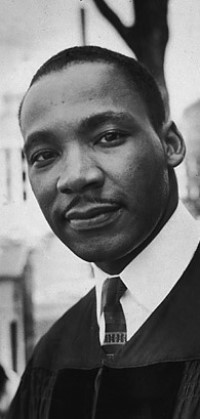
In his famous sermon, Paul’s Letter to American Christians Delivered at Dexter Avenue Baptist Church, Montgomery, Alabama, on 4 November 1956, Dr. Martin Luther King, Jr. said, “So American Christians, you may master the intricacies of the English language. You may possess all of the eloquence of articulate speech. But even if you “speak with the tongues of man and angels, and have not love, you are become as sounding brass, or a tinkling cymbal.”
In a famous documentary of Frank Lloyd Wright, Architect Philip Johnson says that he doesn’t know how Wright designed his buildings.
Mr. Johnson then says, “If I knew how it did it, I would do it.”
Listening and reading the speeches of Dr. Martin Luther King, Jr., I say to myself, how did he do that?
Listening and reading the sermons of Dr. Martin Luther King, Jr., I say to myself, how did he do that?
If I knew, I would do it.
I ask myself, what must it have been like to be a regular at the Ebenezer Baptist Church when Dr. King was in the pulpit.
I grew up Dutch in West Michigan.
I also grew up Baptist.
That meant church twice on Sunday, Wednesday Meeting, Tuesday Bible Club and Monday Awana.
I heard a lot of preaching growing up.
I often felt that Sheriff Andy Taylor’s assessment of the preaching in Mayberry when he says that he, ” … holds with Rev. Tucker. But he can be as dry as dust,” could apply to my years growing up Baptist.
The church I grew was strongly associated with both the Grand Rapids Baptist College and Grand Rapids Baptist Seminary.
Both places still exist but now that the word ‘Baptist’ is a determent to marketing, they are known as Cornerstone University and Grand Rapids Theological Seminary.
My Church did not so much have ‘Preaching’ as it had ‘Teaching’.
If ever in need of what was known as ‘Pulpit Supply’, the Church leaders would turn to the Seminary for someone to preach on Memorial Day Weekend, Labor Day Weekend or in the event that the Church was without a Preacher.
Once when searching for a new Pastor, Dr. Leon Wood of the Seminary spoke for two years using his course and latest book on the Prophet Daniel as the basis for his Sunday sermons.
Dr. Wood’s style was to teach, word by word, through each verse, and explain in detail, the meaning, history and use of the word.
My Dad used to remark on how many verses of the Book of Daniel that Dr. Wood might cover in a Sunday Sermon.
The average was about 2.
I was 10 and when I was told about the upcoming Sunday Sermons, I was excited because the Book of Daniel had those great stories of Daniel in the Lion’s Den and Shadrach, Meshach, and Abednego.
I was so excited, my Mom got me his book for my birthday.
I loved the gift.
I loved that I GOT a gift.
I loved that my Mom remembered.
But what was really cool about that gift was how it came about.
Every summer, my Dad would take a week off and we would take a State of Michigan vacation.
This meant Sleeping Bear Dunes, Mackinaw or Michigan’s Upper Peninsula.
This vacation also usually happened around my Birthday on July 17th.
That meant my birthday was celebrated on the road.
For me, this was (as Jim Harrison writes in his book “The Big Seven”) the kind of injustice that weighs heavily on children who collect injustices for later possible use.
That year we were in Eagle Harbor Michigan up in the Keweenaw Peninsula of Michigan’s Upper peninsula, on my birthday and we trooped into a restaurant for lunch and with about 10 or 12 of us, we took three tables of 4.
Understand that by car, Eagle Harbor Michigan was a far away from Grand Rapids as Washington, DC,
Check a map, it is a LONG way there to get there.
I sat with Mom and Dad and probably little Stevie who would have been about 6.
Not sure why, but it seems like I always got to sit with Mom and Dad.
And most likely I was moping about it being my birthday and no cake or celebration as I was not going to let such an opportunity to whine get by when my Mom reached into her purse and pulled out a wrapped present.
She had packed it away and kept it hidden from me the entire trip.
Few gifts through out my life have been more a surprise.
And it was Dr. Wood’s book on Daniel.
I did read it – or at least tried to read it but I was just 10 years old and I still have it my shelf all these years later.
But I digress.
Dr. Wood, as I remember it, spent three weeks of Sunday Services dissecting the word, word history and meanings of the word ‘pulse’.
(For those who weren’t there, pulse is the veggie diet that Daniel asked for in place of the royal food’s that had been offered up before the Babylonia gods)
Where was the lion’s den?
Where was Shadrach, Meshach, and Abednego?
Daniel’s 70 weeks?
And the missing week?
Minutes seemed like hours.
And hours seemed like days.
Years later, moving to the south, my wife and I (she grew up the same church) decided that anyone who attend our church when we did should be award a M.Div degree from the Seminary AND if anyone, and I mean ANYONE, had tried to preach any of those sermons in the south, biblical stoning would have made come back.
And I have to wonder why.
To be sure, Dr. King had a gift.
But was there anything else?
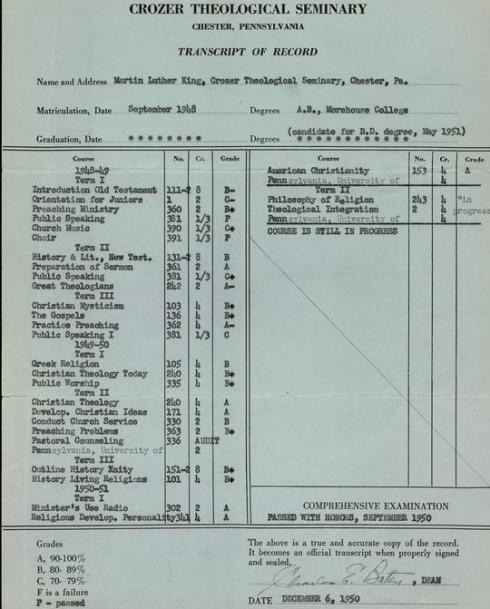
Dr. King after attending Morehouse in Atlanta, went off to post graduate work at Crozer Theological Seminary in Chester, Pennsylvania to work on a Bachelor’s of Divinity degree in 1948.
Dr. King took some 35 courses.
Of those 35 course, 11, almost 1/3 of the course of study, were classes on HOW TO PREACH or other pulpit skills.
Dr. King took the following courses.
Preaching Ministry of the Church Public Speaking (twice) Public Speaking I Preparation of the Sermon Practice Preaching Preaching Problems Conduct of Church Services The Minister’s Use of Radio Church Music Choir
Thinking about my experiences with sermons and preaching, I checked the current catalog list of required courses for a Master of Divinity or M.Div at the Grand Rapids Theological Seminary.
There are 32 required classes.
BBL-501 Biblical Hermeneutics BBL-510 Greek I THE-501 Program Introduction BBL-511 Greek II THE-540 Systematic Theology I MIN-500 Christian Spiritual MIN-543 Christian Formation in the Church MIN-545 Teaching & Learning THE-640 Systematic Theology II MIN-560 Global Impact BBL-516 Hebrew I BBL-672 NT I: Introduction to Exegesis. 3 THE-641 Systematic Theology III BBL-517 Hebrew II BBL-601 Experiencing the Ancient World of the Bible (Israel) BBL-677 NT II: The Gospels MIN-685 Ministry Residency I MIN-510 Organizational Leadership General Elective BBL-640 OT I: Intro to Hebrew Exegesis BBL-678 NT III: Hebrews to Revelation. 3 Ministry Specialization Course MIN-686 Ministry Residency II BBL-641 OT II: Exegesis in the Pentateuch Historical Theology Elective Ministry Specialization Course MIN-781 Ministry Residency III MIN-711 Program Completion MIN-782 Ministry Residency IV BBL-642 OT III: Exegesis in the Prophets and Writings THE-676 Apologetics and Moral Issues in Christian Ministry Historical Theology Elective Ministry Specialization Course
For specialization in Pulpit Ministry, Homelitics (the art of preaching or writing sermons) I & II are recommended Specialization courses.
Otherwise, nothing on how to speak or preach.
Boy Howdy!
That course list reads like a list of sermon titles I have sat through.
I held with the preaching, but it was dry as dust.
Now I am not saying that just the study of preaching and the classes that Dr. King took might have helped but I will say it wouldn’t hurt.
How much did it help Dr. King?
That is hard to say.
According to his transcript, Dr. King got a C’s in public speaking.
ill discoverers that think there is no land, when see nothing but sea
Francis Bacon wrote in his The Advancement of Learning (1605 – bk. 2, ch. 7, sect. 5) that “they are ill discoverers that think there is no land, when they can see nothing but sea.”
The complete line is, “As for the possibility, they are ill discoverers that think there is no land, when they can see nothing but sea.”
As for the possibility …
That they might be giants.
Mr. Bacon warns, “But if any man shall keep a continual watchful and severe eye upon action, operation, and the use of knowledge, he may advise and take notice …”
Take notice of what?
I offer, in answer, the short story, The Glass in the Field, by James Thurber from his Fables for Our Time.
A short time ago some builders, working on a studio in Connecticut, left a huge square of plate glass standing upright in a field one day. A goldfinch flying swiftly across the field struck the glass and was knocked cold. When he came to he hastened to his club, where an attendant bandaged his head and gave him a stiff drink. “What the hell happened?” asked a sea gull. “I was flying across a meadow when all of a sudden the air crystallized on me,” said the goldfinch. The sea gull and a hawk and an eagle all laughed heartily. A swallow listened gravely. “For fifteen years, fledgling and bird, I’ve flown this country,” said the eagle, “and I assure you there is no such thing as air crystallizing. Water, yes; air, no.” “You were probably struck by a hailstone,” the hawk told the goldfinch. “Or he may have had a stroke,” said the sea gull. “What do you think, swallow?” “Why, I–I think maybe the air crystallized on him,” said the swallow. The large birds laughed so loudly that the goldfinch became annoyed and bet them each a dozen worms that they couldn’t follow the course he had flown across the field without encountering the hardened atmosphere. They all took his bet; the swallow went along to watch. The sea gull, the eagle, and the hawk decided to fly together over the route the goldfinch indicated. “You come, too,” they said to the swallow. “I–I–well, no,” said the swallow. “I don’t think I will.” So the three large birds took off together and they hit the glass together and they were all knocked cold.