will you still need me?
feed me? Who could ask for more?
when I’m sixty-four
Not sure how this happened, which seems to be a common feeling, but I start my 64th year today.
Because of family history and often told family stories, I know that was I born around noon so as I write this, I still have 5 hours to go.
I know it was around noon because I was born on a Sunday and my Mom planned a family dinner after church and while I interrupted her day, my Aunt Marion came over and pulled the dinner together so all my brothers and sisters were sitting around the table when my Dad came home from the hospital to announce it was a boy.
All the boys cheered and my sisters all cried as it would have been a tie game had I been a girl.
I was 8th in what would be a family of 11 kids.
When I was 4, my Dad got a place on the shore of Lake Michigan just south of Grand Haven where we spent out summers so my birthday was almost always celebrated out at the lake.
In 1966, my Mom and Dad took me into Grand Haven to WT Grants and said I could pick out anything I wanted for my birthday.
In my mind the toy aisle stretched out sight to the left and right and towered over me.
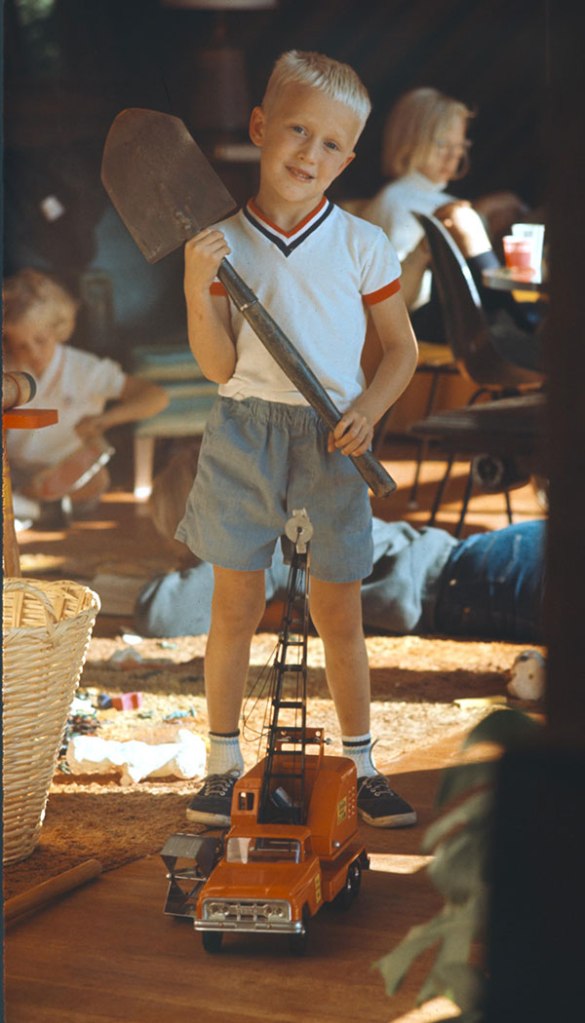
I am not sure how long it took as my Father was generous but not real patient, a buyer not a shopper, and I selected an orange truck with a working steam shovel type crane that I could raise and lower and scoop up sand.
I am sure I had Mike Mulligan and His Steam Shovel in mind when I picked out as I always liked Mike as we shared a first name.
Which, as I am sure I have mentioned before, brings me to the topic of my name.
See, Mike had already been used as a first name in my family.
My brother Tim was born back in 1956 and was named Mike … for about 3 days.
Then my Dad said, ‘Nope, he doesn’t look like a Mike‘ and when the paper work was filled, he became Timothy John.
4 years later when I showed up, my Dad decided I did look like a Mike and Michael James Hoffman was listed on my paperwork.
Not sure what that says or means, but it had to have messed up paperwork in the global accounting of life somewhere.
The moment I got my truck home was captured on film by my Dad with his Nikon camera.
I posed with an army shovel and my new truck, ready to take on the world and all the dirt and sand I could find.
Scrapes and bruises that any 6 year old would have acquired over a summer and one shoe untied, that’s me.
Behind me in the picture are my three sisters, Mary, Lisa and Janet, who are plainly thrilled by my new truck and that it was my birthday.
That was 58 years ago and with the help of the photos, I can feel it, I can smell it.
As Jim Harrison writes in his book, Sundog, “So much of the emotional content of our lives seems to occur before we are nineteen or twenty … “
Now I am 64.
And by chance as I type this out at my desk near the ocean, the 3rd movement of Haydn’s Cello Concerto No. 2 starts playing on the radio and it is one of my favorites.
A piece of music impossible to listen to and not feel light and light hearted.
I will take it as a good omen for things yet to come.
It is my birthday.
What can I do but, and when will I ever get the chance again, to quote Sir Paul?
When I get older losing my hair
Many years from now
Will you still be sending me a Valentine
Birthday greetings bottle of wine
If I’d been out till quarter to three
Would you lock the door
Will you still need me, will you still feed me
When I’m sixty-four
You’ll be older too
And if you say the word
I could stay with you
I could be handy, mending a fuse
When your lights have gone
You can knit a sweater by the fireside
Sunday mornings go for a ride
Doing the garden, digging the weeds
Who could ask for more
Will you still need me, will you still feed me
When I’m sixty-four
Every summer we can rent a cottage
In the Isle of Wight, if it’s not too dear
We shall scrimp and save
Grandchildren on your knee
Vera, Chuck and Dave
Send me a postcard, drop me a line
Stating point of view
Indicate precisely what you mean to say
Yours sincerely, wasting away
Give me your answer, fill in a form
Mine for evermore
Will you still need me, will you still feed me
When I’m sixty-four
will you still need me?
feed me? Who could ask for more?
When I’m sixty-four