people with song mouths connecting song hearts; people who must sing or die
For Labor Day, 2025.
Adapted from Work Gangs by Carl Sandburg as published in The Complete Poems of Carl Sandburg, by Carl Sandburg, Harcourt, Brace, New York, 1950.
Work Gangs
Box cars run by a mile long. And I wonder what they say to each other When they stop a mile long on a sidetrack. Maybe their chatter goes: I came from Fargo with a load of wheat up to the danger line. I came from Omaha with a load of shorthorns and they splintered my boards. I came from Detroit heavy with a load of flivvers. I carried apples from the Hood river last year and this year bunches of bananas from Florida; they look for me with watermelons from Mississippi next year.
Hammers and shovels of work gangs sleep in shop corners when the dark stars come on the sky and the night watchmen walk and look.
Then the hammer heads talk to the handles, then the scoops of the shovels talk, how the day’s work nicked and trimmed them, how they swung and lifted all day, how the hands of the work gangs smelled of hope. In the night of the dark stars when the curve of the sky is a work gang handle, in the night on the mile long sidetracks, in the night where the hammers and shovels sleep in corners, the night watchmen stuff their pipes with dreams— and sometimes they doze and don’t care for nothin’, and sometimes they search their heads for meanings, stories, stars. The stuff of it runs like this: A long way we come; a long way to go; long rests and long deep sniffs for our lungs on the way. Sleep is a belonging of all; even if all songs are old songs and the singing heart is snuffed out like a switchman’s lantern with the oil gone, even if we forget our names and houses in the finish, the secret of sleep is left us, sleep belongs to all, sleep is the first and last and best of all.
People singing; people with song mouths connecting with song hearts; people who must sing or die; people whose song hearts break if there is no song mouth; these are my people.
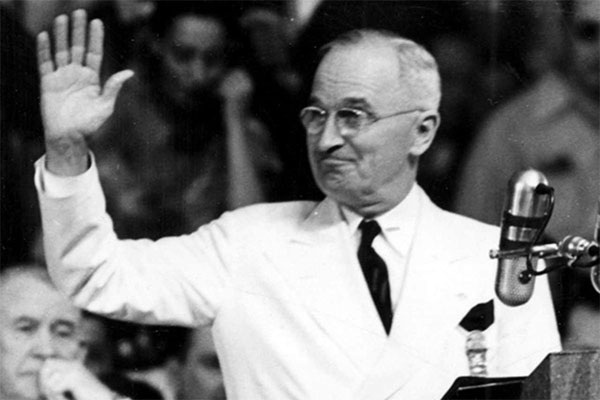
I went looking for a quote about Labor in the back of my mind that memory said was in Harry Truman’s address in Philadelphia accepting the nomination of the Democratic National Convention. I found ” … labor never had but one friend in politics, and that is the Democratic Party and Franklin D. Roosevelt.”
But what I also came across was this:
The United States has to accept its full responsibility for leadership in international affairs.
We have been the backers and the people who organized and started the United Nations, first started under that great Democratic President, Woodrow Wilson, as the League of Nations. The League was sabotaged by the Republicans in 1920.
And we must see that the United Nations continues a strong and growing body, so we can have everlasting peace in the world.
We removed trade barriers in the world, which is the best asset we can have for peace.
Those trade barriers must not be put back into operation again.
Harry had some wild ideas back then.
Raise minimum wage.
Universal Health Care.
This was the famous Give’em Hell Harry speech.
Mr. Truman later said all he did was tell the truth … which made the Republican’s feel like they were in hell.
60 miles of beach no people and no dwellings just beach and water
If you take out your Rand McNally you’ll note that the Upper Peninsula is a long piece of land, over 300 miles, and thickish in places.
It is about 30 percent of Michigan’s land mass but contains only 3 percent of its population.
Growing up in northern Michigan I was early on mystified by the Upper Peninsula even before I traveled there.
In the 1960s I went up a number of times, and it did not cease to mystify me with its wildness.
While camping I would study maps to try to figure out where I was other than within a cloud of mosquitoes and black flies, that irritating species that depends on clean water, of which there is a great deal in the U.P.
There is little or no industry; therefore you could drink the water directly from Lake Superior — at least I always did on my long beach walks.
There was a place near Grand Marais of nearly 60 miles of undisturbed beach, no people, no dwellings, just beach and water.
Climbing on Miner’s Castle near 12 Mile Beach, when climbing was allowed and it had two towers – me in the gold shirt and bell bottom jeans …
If you grew up in the State of Michigan’s lower peninsula or lower half (a designation that led to directions to the town of Gaylord … in upper lower Michigan) at some point your family most likely made a trip to the UP.
My family went often.
Drive across the Mackinac Bridge and up to the Soo and then left over into the wild that was upper Michigan and the Lake Superior shore.
We were all early on mystified by the Upper Peninsula and we weren’t quite sure what the UP was, as what it was, was mostly old or older, as if the 1950’s never stopped.
I could tell lots of stories of the UP with me as a kid or with me as a parent.
I could tell how fun it was to climb all over the Tahquamenon Falls when I was a kid and marvel at the lack of protective railings and at the same time tell you stories about being a parent and being grateful someone finally put some protective railings along the Tahquamenon Falls.
But the story on my mind is of the last trip I took with my parents and little brothers.
As it seems to me that it was me and my brothers Steve and Al, (Pete had a summer job and a girlfriend so he stayed home) and Mom and Dad.
I probably was about 17 and it was the last summer trip I went on with my parents.
It was the usual trip over the Mackinaw Bridge and then Paradise, White Fish Point then on to maybe Newberry and Seney and Grand Marais and Munising.
We got to Grand Marais and had dinner and stayed in a motel there overnight and had breakfast also in Grand Marais which more or less used up the dining options for Grand Marais.
Dad spotted an IGA Grocery store and put forward the idea that he could grab some cold cuts and a loaf of bread and some pop and we could have a picnic lunch at 12 Mile Beach on the shore of Lake Superior.
Mom said okay and we stopped at the IGA and Dad offered to run in and grab the food and Mom was happy to let him go and wait in the car, which she should have known better or maybe did know better but by that time in their relationship, she didn’t care anymore.
I can’t remember if I waited in the car or went in the grocery store to watch but in about 10 minutes Dad came out with two full grocery bags (there were, you recall, 5 people on this trip) which he put in the trunk.
Dad got in and we drove off and Mom asks, “What in the world did you get?”
“Just a little lunch,” was all Dad said.
We found 12 Mile Beach and drove into the park and Dad spotted a picnic table on the sand where it looked like the black flies wouldn’t be too bad and we parked and Dad unpacked his little lunch.
First he had a bought big table covering and plastic plates and silverware and cups.
I mean who wants to eat off a picnic table top.
Then he set out two or three loaves of bread (White, Wheat and Rye).
And a full pound of butter.
And a selection of of least 3 different cheeses (one was an unsliced big block of cheese, so he also bought a carving knife) and lots of different meats – Turkey, Ham, Roast Beef and I think an old fashioned ring baloney.
These were NOT the machine packed cold cuts of today, but sliced to order deli meat wrapped in white paper.
And he got out a jar of mayonnaise and two types of mustard.
I think there were two kinds of chips and there were crackers (for the cheese) and a bag of apples and a bag of oranges.
The store must not have had any watermelons or he would have bought one.
He got a gallon of milk and a case of Coke.
Mom watched and helped spread out this bounty.
Then there were the specials.
Dad was a sucker for small grocery stores and the local goodies they often sold.
Seems like there was small jar of pickled herring and a bag of Trenary Toast and two cold UP pasty’s wrapped up in paper and some fresh potato salad and maybe some cold pickled eggs.
So we sat down to eat.
Mom had us make our own sandwiches and offered up the chips and other sides.
Watching Dad make a sandwich was to watch an artist at work.
He once told me that he learned how to dress a plate by watching Army Cooks get dinner ready for the Generals in his unit during World War 2.
I do know from his letters home that he and the Doctor that made up the Medical Team assigned to the Headquarters Unit of the 12 Corps (Spearhead of Patton’s Third) would often find time to INSPECT the Generals’ mess just before dinner and the Generals’ Cook took good care of them – My Dad famously gained weight in the Army).
When Dad made his sandwich he would select his bread and lay it out just so, then the mayo and the butter and then the layers of meat and cheese and the sandwich would be assembled.
Then, and my brother Bobby said this was the magic part, Dad would take the biggest knife he could find and with the precision and grace of a surgeon, he would cut the sandwich into four triangles.
Bobby said watching Dad make a sandwich with ring baloney and a giant butcher knife was like watching a magician – cut – swoop – spread – cut and POOF – a baloney sandwich in bite sized pieces for little kids.
Using the tip of the knife, he would pick up each triangle of sandwich and move it over to his plate where the triangles would be arranged in an arty pattern.
Then potato salad would be added to the arrangement on the plate and chips and fruit all in the way that somehow made you hungry just to look at it.
Dad took as much satisfaction in the creation of the plate as he did in eating all the food on his plate.
And he enjoyed eating, boy, howdy!
And we ate.
And ate until we were just nibbling on fruit and chips to fill in the edges.
That’s when Mom surveyed the table and pointed out we were on 12 mile beach in the UP, miles from anywhere, with no cooler or anything like that, and asked so what did Dad plan to do with all this food, Mom wanted to know.
It seems like Dad, after thoroughly enjoying the food as well as the success of his picnic idea, just smiled and shrugged as Mom looked him in the eye and shook her head.
So we packed up best we could and Dad loaded the grocery bags back into the trunk and we started off.
We drove about mile through the park, past the park campground and there ahead of was a couple of Park Rangers and a young lady who was visibly distraught.
We slowed to stop as they were standing in the road by the Park Ranger’s jeep.
Dad’s window was open and one of the Park Rangers explained that the young lady had driven to the park and set up her tent and had been met by some friends and as these things will happen, the friends had just driven off with the young lady’s coat in their car.
The problem was the young lady’s car keys were in coat.
At this point, the visibly distraught young lady spotted Mom and saw a sympathetic face so she came over to the other car window to talk to Mom.
Mom had that effect on a lot of people.
The young lady had her tent all set up and was set camp wise but she couldn’t get in her car.
She pointed to her tent over in the campground, next to a picnic table.
She said she and her friends had driven over to the swimming beach and she had left her coat and car keys in their car and now, they had just left.
The young lady said that is wasn’t terrible as they were coming back the next day but she was stuck, couldn’t use her car and had planned to drive into Grand Marais to go the IGA for groceries.
But at that moment, she had no food and they, the Park Rangers, were trying to decide if one of them could drive her to the store.
Ding, Dong, Saved by the bell!
Dad put the car in park and said to everyone, “Nothing to worry about!”
He got out and looked at me and said, “come on” and he opened the trunk and we carried the two bags of food over to the picnic table.
The Park Rangers and the young lady just stared.
Who carries two bags of groceries in their car in the middle of summer?
We got back in and the the Rangers looked at Dad and said “thank you”.
The young lady started crying and Mom reached out the window and gave her as much of hug as she could and off we went.
Did I mention how big a smile Dad had on his face?
Mom too, had to laugh.
Mr. Harrison writes: There is also a tradition in the Upper Peninsula that you never pass by anyone needing help. An Ojibwa Indian once towed me 60 miles after I broke a fan belt on Fourth of July weekend. He seemed startled that I couldn’t install a fan belt. A gas station had a spare, which he installed. He wouldn’t accept money so I stuffed a C note in his wife’s pocket. She smiled, having more sense than he did. Where can you find someone to tow you 60 miles and install your fan belt? Only in the U.P.
I am sure somewhere to this day this is a lady who tells about the miracle of the food on her camping trip.
I still laugh when I try to picture that young lady’s face as she unpacked the bags and looked over that collection of food.
man that is born of a woman is of few days and full of trouble
Man that is born of a woman is of few days and full of trouble. Book of Job, Chapter 14, verse 1.
Thump, thump, thump, went his foot on the floor. He played a few chords then he sang some more— “I got the Weary Blues And I can’t be satisfied. Got the Weary Blues And can’t be satisfied— I ain’t happy no mo’ And I wish that I had died.” And far into the night he crooned that tune. The stars went out and so did the moon. The singer stopped playing and went to bed While the Weary Blues echoed through his head. He slept like a rock or a man that’s dead.
From The Weary Blues by Langston Hughes As printed in The collected poems of Langston Hughes by Langston Hughes (Knopf, New York, 1994).