go to the window watch wait and know the coming of a little love
But leave me a little love.
A voice to speak to me in the day end.
Based on the closing lines of the poem, At the Window, by Carl Sandburg.
Give me hunger, O you gods that sit and give The world its orders. Give me hunger, pain and want, Shut me out with shame and failure From your doors of gold and fame, Give me your shabbiest, weariest hunger!
But leave me a little love, A voice to speak to me in the day end, A hand to touch me in the dark room Breaking the long loneliness. In the dusk of day-shapes Blurring the sunset, One little wandering, western star Thrust out from the changing shores of shadow. Let me go to the window, Watch there the day-shapes of dusk And wait and know the coming Of a little love.
swaddling clothes on hay in a barn why the story never does wear out?
Adapted from the poem, The Silver Star, by Carl Sandburg.
The complete poem reads:
The silver of one star Plays cross-lights against pine green.
And the play of this silver crosswise against the green is an old story….. thousands of years.
And sheep raisers on the hills by night Watching the wooly four-footed ramblers, Watching a single silver star— Why does the story never wear out?
And a baby slung in a feed-box Back in a barn in a Bethlehem slum, A baby’s first cry mixing with the crunch Of a mule’s teeth on Bethlehem Christmas corn, Baby fists softer than snowflakes of Norway,
The vagabond Mother of Christ And the vagabond men of wisdom, All in a barn on a winter night, And a baby there in swaddling clothes on hay— Why does the story never wear out?
The sheen of it all Is a star silver and a pine green For the heart of a child asking a story, The red and hungry, red and hankering heart Calling for cross-lights of silver and green.
tireless pointillist people often say show me picture with the dots
I opened up my computer this morning and my mind went back in time.
This was weird because I went back to a time before everyone had a computer.
I had opened the Google and the google logo was all in dots.
Small points of color.
I knew it had to have something to do with Georges Seurat and when I hovered over the logo the embedded alt information for the graphic displayed the text, “Georges Seurat’s 162nd Birthday.”
If you grew up in the midwest at some time in your life you visited Chicago.
If you visited Chicago at some time in your life you had a good chance of going to the Art Institue.
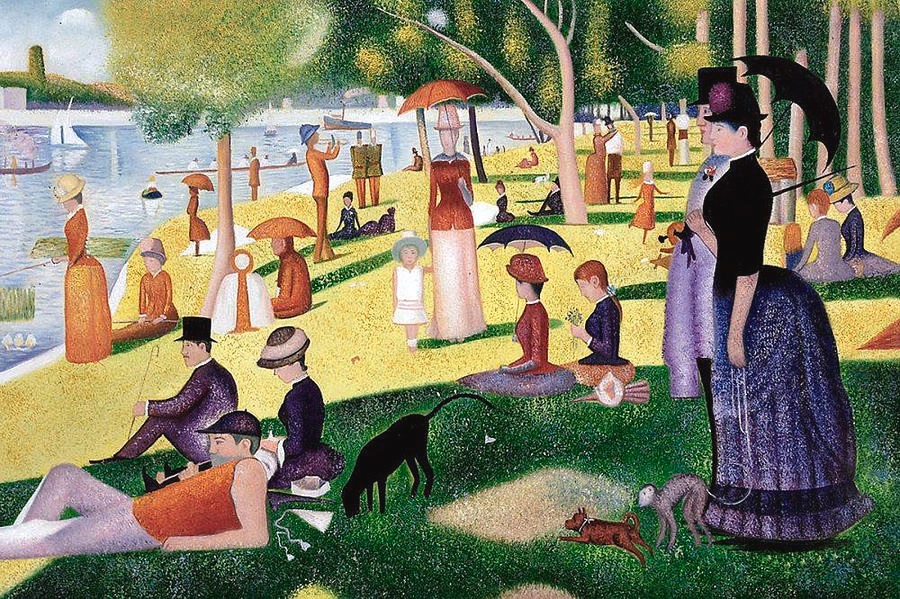
If you went to the Art Institute of Chicago, you most likely saw La Grande Jatte or A Sunday Afternoon on the Island of La Grande Jatte by Georges Seurat.
Sometimes known as Sunday Afternoon in the Park and maybe the inspiration for the song, “Saturday in the Park” by the band, Chicago.
Sometime known as the painting with the dots.
I hear two general reactions from folks who see this painting.
One is HOW BRIGHT IT IS.
Colors just cannot be captured in any form of reproduction.
I remember walking down the main hall of the National Gallery of Art in Washington and through an open entry way, I was faced, unexpectedly, with A Girl with a Watering Can by Renoir.
The color flared out from the painting so bright that I tripped.
No, I am not kidding, fell flat out on the marble floor.
Guard looked at me and shrugged like this happened a lot.
The second thing I hear from folks is HOW BIG IT IS.
Neither, here nor there, but look at this photgraph.
I feel it could have been painted by any one the great impressionists and entitled, ‘A visit to Chicago’.
This is what took me back in time when I thought of Seurat.
For me, I cannot think of this painting without thinking of a documentary on the City of Chicago by Studs Terkel.
Mr. Terkel was the American version of Alistair Cooke.
Where Mr. Cooke wrote and later, read, a weekly column, ‘Letter from America’ for the Manchester Guardian and later the BBC, tried to explain America to Brits, Studs Terkel tried to explain America to Americans.
In my mind was a quote of Mr. Terkel from that documentary on La Grande Jatte and I plugged Studs Terkel Suerat into the Google to try and find it.
It is in this documentary that Mr. Terkel talks about La Grande Jatte and says, “people often say, show me the picture with the dots.“
The bit about La Grande Jatte is at 30:00 into the but go to about 28:00 into the video to catch Mr. Terkel’s comments about Night Hawks as well.
Or, if you have the time, watch the whole show.
Overwhelming in nostalgia for a city and a place that no longer exists.
This is the Chicago I grew up with.
Still a city close to the city of Carl Sandburg.
Still the city of Daley.
You remember the old story.
Richard Daley and two guys are in boat that is sinking and there are only two life jackets.
Daley says they should vote on who got a life jacket and Daley won 9 to 2.
This is the Chicago I loved to visit.
One memorable visit, I had talked my Friend Doug into an overnight trip to the city.
The plan was to drive to Comiskey Park and see the Thursday night baseball game between the Chicago White Sox and the Detroit Tigers.
Then drive to my sister’s apartment on the northside and stay overnight.
Spend the next day in the Chicago museums, back to the ball park for another baseball game and drive home after the game finished out the plan.
I was going through a period of being a Chicago White Sox fan when I was really following their owner, Bill Veeck.
How many people today will say they were fans of an owner?
The deal got a little sweeter when it was announced that the first game was going to be a double header due to an earlier rained out game.
Doug and I knew something was up when we drove up to Comiskey Park on 34th St., and everyone in the crowd seemed to be carrying 45rpm records or singles as they called.
We didn’t know.
Maybe that’s what you did in Chicago.
What it was was a promotion by the White Sox.
You got into the game for 99 cents if you brought a record to the game.
A DISCO record.
All the records where then going to be put into a big box and blown up between games.
This was the famous DISCO DEMOLITON PROMOTION and we had box seats.
The first game was played okay more or less.
Records starting be thrown out of the upper deck late in the game.
Both the left and right fielders were wearing batting helmets IN THE FIELD.
Between games the big box was trucked in and as planned, blown up.
Then, as wasn’t planned, all the fans ran out and took over the field.
In fairness, what else was going to happen when you get 57,000 people in a stadium designed to hold 47,000.
I mean they had to go somewhere.
So Doug and I had box seats for a riot.
In a goofy way, it was kinda cool.
Disco Demolition has gone down in baseball history as the worst thought out promotional stunt in history since the dedication fireworks of the New York City Hall set the new city hall on fire and burned it down back in 1852.
But, as the organizers say, how can it be a promotional failure if we are still talking about it?
But I digress.
In the video, Studs Terkel quotes french filmaker, René Clair as saying, “Everytime I go to America I must stop off at your city to see La Grande Jatte. It refreshes me. I need it.”
Mr. Terkel ends the little bit on with the words, “Hurrah Seurat.”
And, Happy Birthday.
Will you help him change the world? Can you dig it? (Yes, I can) And I’ve been waiting such a long time For today
*The first American Letter was broadcast on 24 March 1946 (Cooke said this was at the request of Lindsey Wellington, the BBC’s New York Controller); the series was initially commissioned for only 13 instalments. The series came to an end 58 years later in March 2004, after 2,869 instalments and less than a month before Cooke’s death. (wikipedia)
**His well-known radio program, titled The Studs Terkel Program, aired on 98.7 WFMT Chicago between 1952 and 1997. The one-hour program was broadcast each weekday during those forty-five years. (wikipedia)
shovel them under let me work, two years, ten years ask where are we now?
Adapted from Carl Sandburg’s poem, Grass.
Pile the bodies high at Austerlitz and Waterloo. Shovel them under and let me work— I am the grass; I cover all.
And pile them high at Gettysburg And pile them high at Ypres and Verdun. Shovel them under and let me work. Two years, ten years, and passengers ask the conductor:
What place is this? Where are we now?
I am the grass. Let me work.
Frustrated at the lack of change when I thought everything had changed.
Then I realize it has only been a couple of weeks.
This is going to take time.
But I do believe that after two years or ten years, passengers ask what place WAS this.
As Mr. Willy Wonka said, “Oh, you can’t get out backwards. You’ve got to go forwards to go back, better press on.”
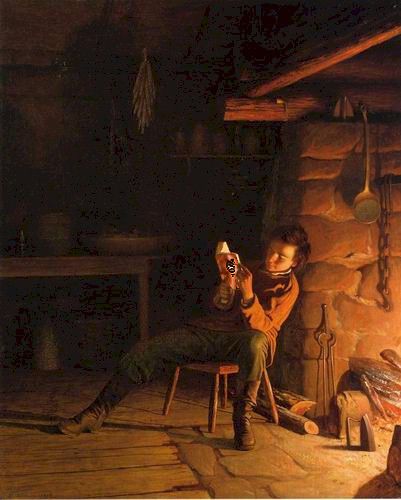
things I want to know are in books – friends will get me a book I ain’t read
This is attributed to Mr. Abraham Lincoln.
Looking for a citation, the best I that can do is that Carl Sandburg has old Dennis Hanks recalling that his young cousin Abe Lincoln saying, “The things I want to know are in books; my best friend is the man who’ll git me a book I ain’t read.”
Mr Sandburg recorded this in his book, Abraham Lincoln Volume 1 The Prairie Years (Dell, New York, NY – 1927).
So did Mr. Lincoln say it?
Or did Mr. Sandburg imagine that Mr. Lincoln said it?
Would Mr. Lincoln had said it had it thought of it?
Well, maybe and yes and why not all at the same time.
Lincoln or Sandburg or Lincoln and Sandburg.
Someone said it and I like it.
It works for me.
Its good enough for me.
It is late in the day.
I got my new Kindle Fire that my wife got me on my last birthday.
She is my best friend.
I got lots of books on it I ain’t read.
Me for the back porch and the rocker.
Ps – the above painting is owned and displayed by the University of Michigan – I liked to go look at it as student …


 No Haiku For You