10.15.2021 – music will wake up

music will wake up
to know something greater
what’s on the surface

I have this quote and I am not sure who said it.

“Music will wake up your mind to know that there is something greater than what we see on the surface.”

The google has been no help tracking this down.

It was Fran Liebowitz, during an on-air discussion with Spike Lee on who was the greater artist, Duke Ellington or Michael Jordan, who said:

I really think that musicians, probably musicians and cooks, are responsible for the most pleasure in human life.

Motown music, which was very popular when I was a teenager — whenever I hear it, I instantly become happier.

This is true of almost nothing!

That’s a very important thing to do for human beings.

Music makes people happier, and it doesn’t harm them.

Most things that make you feel better are harmful.

It’s very unusual.

It’s like a drug, that doesn’t kill you.

One of the few redeeming aspects of the world wide web has to be the access it gives to music.

This is a theme I have pounded out often.

No King, Monarch, Emperor, Despot, Billionaire or otherwise-influencer has had the access to music we have.

Andrew Carnegie owned a castle in Scotland that had a Pipe Organ as big as the one in Carnegie Hall in New York.

Mr. Carnegie also kept an organist on his household staff full time with instructions to start playing at 7:30am as Mr. Carnegie’s own personal alarm clock.

I guess Mr. Carnegie had no problems sleeping despite what was going on during the Homestead Strike back in the US but I digress.

That’s what you needed if you wanted music in your morning back in the day.

With my iPhone, I don’t think there is a piece of recorded music that I cannot access anytime anywhere.

Stop and think about that.

It is beyond belief and the imagination.

No writer of fantasy or sci-fi ever never imagined such a gift to humanity.

And I embrace it.

I love to come across obscure references to music in my reading.

I really love it when I am reading on my iPad over my kindles and phone and older iPad.

I have too many devices with too many books.

Where I used to leave books all over, I now leave my devices all over.

I am getting in the bad habit of wanting to leave a current book open on a device so I grab another one to read other things much like I would leave open books all over the place.

Which calls to mind an old argument.

Aren’t bookmarks really placemarks?

They mark your place in the book.

A big sign that says, YOUR BOOK HERE, would be a bookmark.

Which brings to mind another thought.

Finding things like your book and searching for where you last left it.

Search is nothing new it just seems new due to the inability for anyone to find anything online.

But folks think its new for some reason and even came up with what they think are new ways to help online users find what they are looking for.

SEO or Search Engine Optimization is one of my latest worries.

It purports to be a field of technology that helps web designers design websites that are easier to find.

It is also so much snake oil.

The Google has announced that it pays no attention to SEO.

Sometimes I feel that I may be one of the few people in the world who read announcements made by the Google.

That’s not a problem as the Google is big, its doesn’t read its own annoucements either and the left hand and the right hand of google are never on the same keyboard.

Still most companies make a big deal about their website being up on SEO.

I try to explain to my bosses.

There are two hamburger stands side by side.

One place is on facebook and practices SEO.

The other makes, without argument, the best hamburger in the seven dials.

Then I ask, “Which place is busier?”

Without fail two things are said.

The first is, of course the best hamburgers in the seven dials is the busiest.

Then I am asked, “What are we doing for SEO?”

But there are folks making good money selling SEO so why should I worry.

I just think instead of SEO it should be labeled, Dr. Seachgood’s Patented Tech Tips to Improve Online Life and Feel Better.

Folks have never ever been able to find anything.

Columbus went looking for India and found America in the way.

Back in the day I worked for a couple of years at the Cascade Branch of the Kent District Library.

This was the old library that shared a buidling with the local fire department.

I am not saying it was small but that’s because there are words like tiny …. minute.

Still folks had trouble finding things in the library which is why Librarians were invented.

Simple, right?

That was pretty much the deal with books, libraries and librarians until someone couldn’t stand it anymore and library administration and administrators were invented to muck it all up.

The Cascade Library had a great collection of books on tape.

They were located on the shelves opposite the check out desk.

So close and yet so far, patrons had trouble finding the books on tape.

I decided to optimize the books on tape section for search.

I took one of those giant 4 by 3 foot pieces of red poster board and cut out rectangles on each corner to make a BIG T.

I then cut a point at the bottom of the vertical bar of the T.

I hung the BIG T over the shelves of books on tape and the point pointing right at the section.

The next time a patron asked where the books on tape were, I smiled, pointed over their shoulder and proudly said, “Right there, under the BIG T.”

The patron turned a looked for a moment.

Then looked back at me and said, “Where is this BIG T?”

BUT I DIGRESS.

Music.

Access to music.

Stay on topic can’t you???

Gee whiz.

The other day I was reading happily along.

Got to stop again.

Ain’t that a great phrase?

Reading happily along.

Admit it.

You smiled.

I was reading happily along through a book titled, “The Cure for Anything Is Salt Water: How I Threw My Life Overboard and Found Happiness at Sea” by Mary South.

I admit that such a grandiose title with far reaching claims needs to be taken with a large handful of grains of salt but Ms. South relates her passage of self-discovery in a charming, gee I wish I could this but boy am I glad I not, way that lets you follow her passage without the usual cynicism that I find in myself when reading such books.

Either that or me now living by the sea has made my brain more open to accepting such claims and just enjoying such stories.

Along the way, Ms. Rose relates how at a stop in Point Pleasant, NJ, she found a restaurant about which she wrote:

It was an unpretentious place with a great menu and a homey atmosphere.

Best of all, there was a jazz duet playing-one guy on keyboards and one on guitar.

I asked them if they could play “Wave” and they looked thrilled that someone was actually listening.

She asked them if they could play “Wave.”

Really?

She asked for a song named “Wave?”

Sure, I once asked Nancy Faust, the renowned organist at Old Comiskey Park if she could play the Michigan Fight Sound.

Ms. Faust lit up with a smile and said, ‘The Victors? SURE!’

And she did.

Then she ruined the moment when she segued into that notre dame song.

But everyone knows the Victors.

Wave?

Really?

Ms. South writes, “I got “Wave” and then I got two or three other Brazilian classics without asking. Point Pleasant beach was saved. I’d even go back in a car, if I had to.”

I had to find out.

I clicked over to YouTube and entered Wave into the search bar.

I thought about it a bit and added, jazz classic.

And I got Antonio Carlos Jobim – Wave 1967 – YouTube.

And I clicked and I got:

I got instantly happy.

It was very unusal.

It was like a drug, that doesn’t kill you.

Turns out Wave us a bossanova classic

Besides the music, just saying, let alone typing, bossa nova, makes you laugh out loud.

According to wikipedia, Antonio Carlos Jobim “was a Brazilian composer, pianist, songwriter, arranger and singer. Considered one of the great exponents of Brazilian music, Jobim internationalized bossa nova and, with the help of important American artists, merged it with jazz in the 1960s to create a new sound with popular success. As such he is sometimes known as the “father of bossa nova

I have admit I am not up on bossa nova.

But its playing now as I type.

What a way to start my Friday.

Take that Mr. Carnegie

Antonio Carlos Jobim, thank you.

Mary South, thank you.

Whoever invented YouTube, thank you.

Music.

music will wake up

to know something greater

what’s on the surface
9.24.2021- so quiet and dark

so quiet and dark
star has flickered into dust
song has faded away

Down the rabbit hole again.

Listening to my favorite online radio station, a piece of music caught my ear and I was in time to access the play list.

I discovered I was listening to Schwanenlied or swan song written by Fanny Mendelssohn.

You read that right.

Fanny not Felix Mendelssohn.

Fanny is Felix’s little sister.

Into the google goes Fanny Mendelssohn.

The piece I had heard was a flute and harp version of a piece of music or lieder or simple song that according to wikipedia, Ms. Mendelssohn felt, as she wrote to her brother, “lieder suit me best.”

This version is hauntingly (love to use that word) arresting and somehow familiar.

Yet I never heard it before that I remember so how could it be familiar?

It also has words, sung in German of course but I have never had much luck listening to German lieder.

Silly but it may have to do with an episode of Cheers where Woody’s rich in-laws have a party where the entertainment is to be Kindertotenlieder … or Songs on the death of Children.

Just the look on Sam Malone’s face when the word Kindertotenlieder it is explained to him is worth the price of admission.

Anyway the words for Ms. Mendelsshon’s song were written by the German poet, Heinrich Heine.

I am not up on my German poetry but I defend myself saying, who is.

According to one critic, the text and music “resembles a lullaby. In its clear separation of melody and accompaniment it is akin to the style of many Songs Without Words, for piano solo, some composed by Hensel and some by Mendelssohn. Formally it is simple, like most Hensel settings, consisting of two strophes with the second slightly modified. That slight modification proves significant, however, for it fashions the climax of the song. (Historical Anthology of Music by Women, Fanny Mendelssohn Hensel (1805-1847) by MARCIA J. CITRON – 1987 by Indiana University Press)

I am not sure what to say about using the poetical words of Heinrich Heine for a song without words but I am uneducated in these matters.

The words are simple:

A star falls down
From its twinkling height,
It is the star of love
That I see falling there.
So much falls from the apple tree,
From the white leaves;
The teasing breezes come
And urge on their game.

The swan sings in the pond,
And paddles up and down,
And singing more and more gently,
He disappears into the depths of the river.
It is so quiet and dark,
Scattered is leaf and blossom,
The star has flickered into dust,
The swan song has faded away.

Now the odd part of todays trip.

I was curious as to chicken-egg time of the term Swan Song.

Was it possible that this simple piece by Fanny Mendelssohn was the source of the term swan song as the swan of song of someone’s career?

The Google will tell you that Swan Song has become a euphuism for the final act of someone’s career but it is vague as when this started being used.

I continued down the rabbit hole to read this.

Swan Song as described by the online Merriam-Webster says that: Swans don’t sing. They whistle or trumpet, or in the case of the swan most common in ponds, the mute swan, they only hiss and snort. But according to ancient legend, the swan does sing one beautiful song in its life – just before it dies.

The swan sings one beautiful song in its life – just before it dies.

The swan song.

I wanted to know the name of a piece of music.

Sometimes the world wide web can be a beautiful thing.

so quiet and dark
star has flickered into dust
song has faded away

5.28.2021 – With a graceful lilt

With a graceful lilt
Autochthonous, Number 4
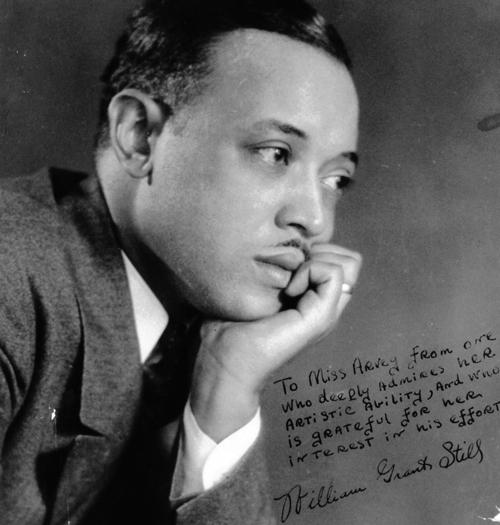
by William Grant Still

A reoccurring theme in this blog is the access to music that anyone and everyone, has so long as they have access to the world wide web.

I am sure there was NEVER been a time in all of human history that such much music is available to so many people for so little effort.

You can search You Tube (Bach and Emperor) to watch a scene for a movie where Frederick the Great summons Johann Sebastian Bach to the palace to play something.

Well, I can bring up anyone from anywhere for any piece of music with a few taps of my fingers.

Boy howdy!

Almost beyond belief.

As my faithful readers know, I listen to Classic FM when I am working.

It is a Classical Music global radio station from London.

Being from London, it is four or five hours ahead of me so I know that somewhere in the world, someone has already made through the next four or five hours.

It also has the best traffic reports.

When the A1 to Cambridge was backed up all the way to the anti clockwise at Potter’s Bar due to a lorry overturned in the lay by, Atlanta traffic didn’t seem so bad.

It is an interesting radio station in that it uses the same software to determine playlists used by pop radio stations.

This is bad as that you did get to hear a lot of music a lot.

I mean it repeats favorites often.

Maybe I could do with a little less Elgar in my day.

But this is good as you avoid a lot of Mahler.

And it is good because when you hear something unfamiliar there is a chance you will hear it again.

So it happened today.

You see, some time back I caught a piece of music new to me.

While I could browse the online playlists for the stations, I think this was one of those moments when the presenter snuck a piece of music on air to see the reaction.

I could tell from the sound that the piece was American.

And I could tell from the sound that the piece was most like from the Big Band – Jazz era.

It was Aaron Copland-esque without being Aaron Copland.

It was Virgil Thomson-esque without being Virgil Thomson.

But I could not found what it was.

And it was played again today.

This time it WAS listed in the online playlist.

I wasn’t prepared for what I learned.

I had never, NEVER heard of the piece of music or the composer ever.

The piece was the 3rd Movement of the 4th Symphony of one William Grant Still.

The symphony is titled, Autochthonous which is defined as an adjective (of an inhabitant of a place) indigenous rather than descended from migrants or colonists.

The 3rd Movement is titled, ” With a graceful lilt.”

William Grant Still, according to Wikipedia, is known primarily for his first symphony, Afro-American Symphony (1930), which was, until 1950, the most widely performed symphony composed by an American. Also of note, Still was the first African-American to conduct a major American symphony orchestra, the first to have a symphony (which was, in fact, the first one he composed) performed by a leading orchestra, the first to have an opera performed by a major opera company, and the first to have an opera performed on national television.

Wikipedia continues, “Still arranged music for films. These included Pennies from Heaven (the 1936 film starring Bing Crosby and Madge Evans) and Lost Horizon (the 1937 film starring Ronald Colman, Jane Wyatt and Sam Jaffe). For Lost Horizon, he arranged the music of Dimitri Tiomkin. Still was also hired to arrange the music for the 1943 film Stormy Weather, but left the assignment because “Twentieth-Century Fox ‘degraded colored people.’

I typed William Grant Still into the google and am now introducing myself to the wonderful works that Mr. Still created for us.

I didn’t know his name until today.

But I will know his name and his work for the rest of my life.

I have to ask, how many more William Grant Still’s might be out there?

Sometimes the changes brought upon us by the information superhighway are for the better.

I’ll take the access to the music of William Grant Still any day.

That and the search for more like this.

2.14.2021 – came a melody

came a melody
in my heart, the sound of love
charles mingus’ bass

Music.

As one person said (and I wish I could find a citation as that always helps so the sake of this essay lets pretend I said this first) music will wake up your mind to know that there is something greater than what we see on the surface.

Fran Lebowitz, in an interview with Spike Lee on Music (arguing who was the greater artist, Duke Ellington or Michael Jordan) made the point that music makes you feel good – feel better – a drug without the down side – makes you happier and doesn’t harm.

I can’t argue.

For Valentine’s is there anything better to express feelings for someone in a way that there is more than what you see on the surface then through music?

For me it is easy to admit I have little to no musical ability or talent.

I am in awe or maybe just jealous of those with voice or instrumental ability.

BUT I can direct others to You Tube.

If it is music and it has been recorded sometime, somewhere, ever in history, you can listen to it on YouTube.

You can also find YouTube clips of a movie made on the Life of JS Bach.

There is a scene where the Emperor of Prussia Frederick the Great has Mr. Bach in for a grip and grin.

Much like the more famous scene in Amadeus where the Emperor Josef II of Austro-Hungary meeets Mozart and Mozart blows them away with his piano playing, Bach is offered up a short tune (written by Freddie the Great) and asked to improvise on it.

Those two Emperors could call in Bach and Mozart.

Who could do that?

Well.

I can.

I have access to music at my fingertips that any monarch or emperor or anyone in the past could only dream of.

With that in mind I offer up for Valentine’s this clip of Charles Mingus’ Duke Ellington’s Sound of Love” from the live album Sound of Love.

I was young and care free,
Not a song have found my soul,
Lost in blues jazz and rag time,
No sound had got to my muse…

I was searching for my melody,
Love blues that gets me ooh,

All alone, sad clown with a circus closed down,
Lost on my merry go round,

Came a melody in my heart,
So yearning…
Taught me to your music out of love,
From the song, for this life,
We all live infinite,
With our lover and beloved,
As one Ellington sound of love…

12.24.2020 – Ding dong merrily

Ding dong merrily
In heav’n the bells are ringing
Ding dong verily the sky

I discard the haiku I was writing and decided quoting Oscar Wilde on Christmas Eve was just not right.

I will use it next week when thinking retrospectively on the year.

That being said, the Christmas Carol (defined by Wikipedia as “a carol (a song or hymn) on the theme of Christmas, traditionally sung at Christmas itself or during the surrounding Christmas holiday season) Ding Dong! Merrily on high was just playing on the Radio.

Followers of this blog will remember that I listen to Classic FM, an online radio station from London (where its is five hours ahead of local time so I know that somewhere somehow someone has made through the next five hours), and at Christmas time they load up their playlist with Christmas Music.

I enjoy as they do not include the American Music of stars and almost stars singing the classics of Rockin’ Round the Christmas Tree or I’ll have a Blue Christmas.

I mean I gots nothing against these recordings, lest I am taken for a ‘high-brow’ Christmas music snob.

And of course as I start writing, Rudolph the Red Nosed is played on my radio station and it was requested by some 4 year old in Sussex and the presenters spend the next 5 minutes talking about their childhoods and Rudpolph.

Which of course calls to mind Frasier Crane’s outburst on the song in an episode of Cheers, when he says, “the story of “Rudolph the Red-Nosed Reindeer” is one of the most unrealistic and therefore potentially damaging in all of children’s music. It gives them a horribly distorted view of reality. First the other reindeer tease and then ostracize him. And then when his abnormality proves of service, they use him. In fact, not only do Donner, Blitzen, et al, not love him and laugh out loud with glee, but they doubly despise the bulbous-nosed little wimp.”

Which is odd because I also cannot but remember Martin Crane’s efforts to sing “Oh Holy Night” whenever I hear that carol.

But what is really odd is that the carol in question, Ding dong merrily …, sticks in my brain because one night long ago I was flipping the channels on TV at Christmas time and landed NBC’s Holiday Special featuring the CAST OF FRASIER and then out came, Frasier and Niles and Martin and Roz and Daphne (though truth be told I wasn’t watching the show back then and didn’t know who these folks were) and they troop down this extravagant holiday stage and line up and raise their mics and break out in, Ding dong merrily

I thought how in the world did their agents talk them into this one?

I read somewhere that you can tell when a star needs money or is truly desperate or some marketer is striking while the iron is hot and a holiday album is produced.

Not only is their money to made but 95% of the songs are no longer under copywrite.

Even the Brady Bunch cut a Christmas album.

BUT I DIGRESS.

As I said, Ding Dong! Merrily on high was playing and I thought I would write a stinging post about such goofiness and DING DONG the Witch is Dead Merrily on High.

Once again down the rabbit hole that is the World Wide Web.

I put Ding Dong! Merrily on high into the google and found out, to my suprise, that it is based on a French tune from the 1500’s.

The lyrics came along in 1924 by an English composer George Ratcliffe Woodward (1848–1934), and the carol was first published in 1924 in his The Cambridge Carol-Book.

This is all from Wikipedia which also notes:

The song is particularly noted for the Latin refrain:

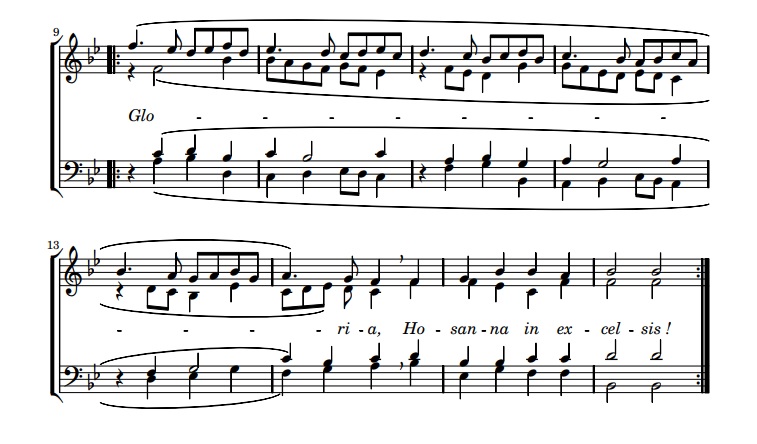
Gloria, Hosanna in excelsis!
[Glory! Hosanna in the highest!]

where the sung vowel sound “o” of “Gloria” is fluidly sustained through a lengthy rising and falling melismatic melodic sequence, extending the word to a 33 syllable long lyric.

I have to repeat that last line again.

The sung vowel sound “o” of “Gloria” is fluidly sustained through a lengthy rising and falling melismatic melodic sequence, extending the word to a 33 syllable long lyric.

Who knew?

Fluidly sustained through a lengthy rising and falling melismatic melodic sequence is quite a trick.

Extending the vowel sound “o” to a 33 syllable long lyric even more so.

It looks like this.

Christmas Carols are often like Christmas Packages.

Lots of surprises inside.