12.24.2021 – sweet rolls, potatoes

sweet rolls, potatoes
stuffing, pumpkin, pecan pie
Christmas Eve cooking

I was making my list and checking it twice of the cooking I need to do today in preparation of the Christmas Day feast tomorrow and the words lined up nicely for a holiday haiku.

I enjoy cooking.

Maybe because I never HAD to do it much but was allowed to dabble in the kitchen from time to time.

Most holiday dinners being part of that time.

Back back years ago, I boarded at a frat house for a term when I started college.

To help with the board bill I took on a kitchen job.

Being last in line to choose kitchen jobs, it fell to me to be Sunday Dinner Cook.

This meant I had to prepare the Sunday After Church Noon Dinner for around 50 college age men.

I didn’t have to know much about cooking or recipes for this job.

And I didn’t learn much about cooking or recipes while on the job.

But I did learn something very important about cooking for a large group.

I learned timing.

The frat had a real weekday cook and she would get the Sunday roast out of the freezer and start it thawing before she left on Friday.

I had to make sure the roast was in the oven by 6AM.

The rest of the meal was opening giant cans of applesauce and vegetables and making a couple gallons of powdered mashed potatoes and remembering to get the rolls out of the freezer.

Pretty much everything was just warmed up on the stove or in the oven.

I had a vintage 1920’s era basement kitchen to work in.

It had a gas range with 8 burners, a 6 foot long flat frying surface, warming table, prep table all made out of cast iron and industrial freezers and fridges.

There was a butcher block stand in the center of the kitchen that, to this day, makes me look at any other butcher block stand in any store or catalog and say, “welllllllllll … not what I am used to.”

It was equipped with all the latest and greatest in kitchen gadgets and tools that were then available in 1920.

The can opener was lethal.

It was like operating a drop forge with razor sharp edges.

Another kitchen tool was a meat cleaver the size of a tennis racket that weighed about 30 lbs.

After I discovered this cleaver hanging on the wall in a back room, and after I learned how to use it, I would ask anyone in the kitchen if they might want an apple.

If they said ‘yes, sure’, I would get an apple (we had a huge bin of apples down there, too) polish it up for a second and place it on that butcher block.

Then I would pick up that cleaver with both hands and get the heft of it going in my shoulders and lift it up and in a flash, chop that apple in half.

Usually the guy would scream, and jump back, then laugh and then run up into the house to find someone and say, “Hey! Go ask Mike to get you an apple!”

We all agreed that apples prepared this way tasted better than any other apples.

The Sunday Dinner crew would show up around noon and set the tables and get pitchers of powdered milk and water ready.

Then my show started.

As I remember there were 4 long tables in the dining room that would seat about 12 guys a table.

The meals were served family style so I needed two big serving bowls of whatever per table.

Whatever dish I was warming up, I need to have enough to fill 8 big serving bowls.

Dinner was served promptly at 12:30pm so that it could be eaten and everyone back upstairs in the TV room for Sunday football by 1:00pm.

(TV Room … GOSH … How old am I?)

When the kitchen crew started setting the tables, I set out all of my serving bowls and made sure I had a pile of serving spoons.

I got the roast out of the oven.

This piece of meat was huge and early on I learned to cut the thing into quarters before trying to slice it.

The roasting pan was filled with marvelous grease and I had enough training from my Mom to know how to make real gravy.

About 12:15pm the kitchen crew would troop in and ask for directions and I had them spoon out the veggie of the day, applesauce and potatoes into the serving bowls.

Baskets of rolls went out.

I started slicing the beef.

By the time the time the other food had been set out, the platters of meat were ready and set and I would yell, ‘Go get Em!’

Someone on the crew would run upstairs to the common room and press the house buzzer for three long buzzes.

This was the call to dinner.

It was a three story house with a wooden stair case.

Those guys didn’t so much walk down stairs as much as the tumbled down in one loud cloud of noise.

As the roar of their stair stomping and loud conversation increased, I filled gravy boats (that I had dug out of the back of kitchen cupboards) and had them placed on the tables.

As the guys came in, the comments started.

“It’s ALL READY AT THE SAME TIME”, they would say.

“It’s ALL HOT”, they would say.

“GRAVY!!!!!”, someone would shout.

Like I said, if I had to do it everyday.

If I just plain HAD to do it, I am sure I would have different thoughts but looking back I have an almost absurd feeling of satisfaction.

And I know how to get a meal of many dishes off the stove, out of the oven and on the table at the same time.

We spent last weekend in Atlanta with the kids and grands.

It is just me and my wife and one son for Christmas Dinner this year.

Still, it is Christmas.

The cooking will start tonight.

I will get the morning sweet rolls all set and in the fridge ready for the oven tomorrow morning.

I’ll get the sweet potatoes peeled, boiled and mashed ready for a casserole of sweet potatoes, two eggs and 1/2 cup of brown sugar – sprinkle with brown sugar and a touch of cinnamon after it comes out of the oven.

I’ll reduce a loaf of bread to cubes and set out to get nice and stale for stuffing even though I am just roasting a turkey breast tomorrow.

Then the pies.

Pumpkin for my son.

He will manage to consume at least the essence of pumpkin pie under a thick coating of whipped cream.

Then the pecan pie.

My Dad loved pecan pie.

I thought it was a bit too sweet.

A bit too sweet until my Grandma Hendrickson would show up with her famous butterscotch pie.

As a kid, I honestly thought my Grandma melted butterscotch candies and poured the bright yellow glop into a pie shell.

To this day I am not sure that isn’t the recipe.

Family history has the story about one of my Mom’s brothers asking if, on his birthday, he could have an entire butterscotch pie to himself.

The story went he never ate butterscotch pie again.

But pecan pie.

As I said, I always thought it a bit too sweet.

Then I moved to the south.

People I met down here introduced me to real pecan pie.

People I met introduced me to a pecan pie that was gooey and thick and crunchy and somehow light and not so sweet that it made your teeth hurt.

There was a secret ingredient.
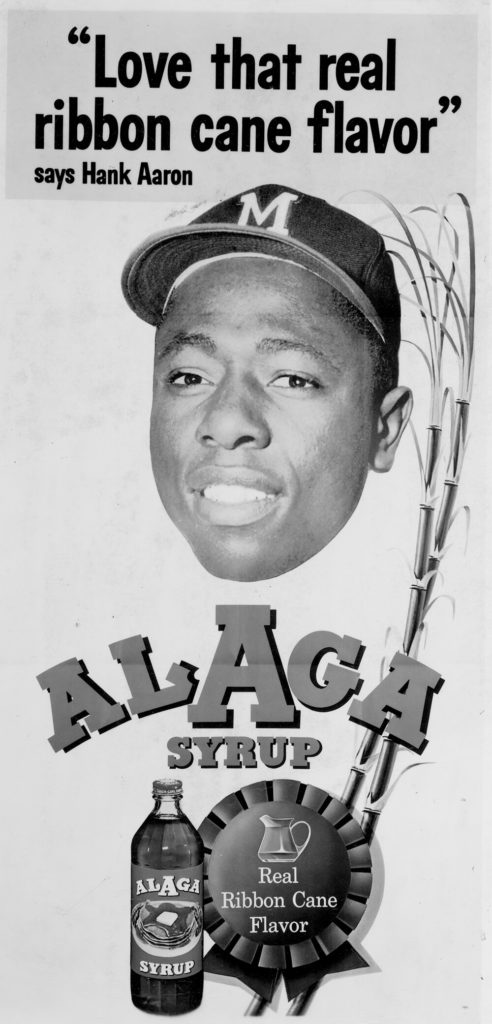
Instead of corn syrup, you know, the stuff they put in soda pop, the secret ingredient is Alaga syrup.

According to the website, “In 1906, the Alabama-Georgia (ALAGA) Syrup Company was established by Louis Broughton Whitfield, Sr. along with his wife, Willie Vandiver Whitfield. Mrs. Whitfield, a native of Montgomery, Alabama, named the company to represent both her home state and that of her husband who was from LaGrange, Georgia.”

The slogan for ALAGA syrup was, “ALAGA – Good Every Drop.

Alaga Syrup is ribbon cane syrup with a little corn syrup added.

Because ribbon cane is grown by small farmers and refined on site, it is less pure than common sugar cane syrup.

The process leaves ribbon cane syrup a brown color.

Ribbon cane is also very sweet to the taste.

Being less refined, it also has a richer, almost full flavor, while sugar cane syrup is just very sweet.

It is easy to find on the shelves at your local Winn-Dixie, Publix, or Piggly Wiggly.

I feel bad for you all up north as you cannot get Alaga Syrup up there.

I feel bad for me as I can’t even get this in South Carolina.

But I got a bottle from my daughter in Atlanta for Christmas.

For the pie, the recipe I always use is on the Alaga website.

The recipe used to be listed as the ALABAMA STATE FAIR GOLD MEDAL PIE of 1923 Recipe but now shows up under the link, Southern Pecan Pie.

It is a simple recipe … really, it is.

Original Alaga Syrup Pecan Pie Recipe

Preheat oven to 350
1-9″ pie plate lined with pie crust
Put Pecans into pie plate lined with pie crust.
1 cup Alaga cane syrup
3/4 cup white sugar
3 eggs, lightly beaten
1/2 stick butter
1 Tbl vanilla extract
1 cup whole pecans

Bring syrup and sugar to a boil and boil for 3 minutes.
Add hot syrup to beaten eggs, beating constantly.
Add butter, let melt.
Add vanilla.
Pour over pecans.
Bake at 350 for 35-40 minutes.

The trick is getting that roiling boil of sugar and syrup and then stirring in the eggs without the eggs separating.

I’ll be making this tonight.

I’ll be eating this tomorrow.

After dinner and pie I will say, “why did I eat all that?

At some point tomorrow night I’ll look at my wife and say, “Want a piece of pie?

12.23.2021 – want only to see

want only to see
my father back in time where
no one made mistakes

Adapted from the line:

She wanted now only to see her father, to go back to that country in time where no one made mistakes.

For a thousand years in thy sight are but as yesterday when it is past, and as a watch in the night.

She had memorized those words at the time of her father’s death, had repeated them as she walked down streets and brushed her hair, as she lay in bed and as she drove the river road, and she repeated them now . . .

From the book, Run River by Joan Didion.

The above line is preceded by the line, “She was not sure that it would be all right even if they could go back to that morning on the river and start over again; because she could not put her finger on what was wrong it would only go wrong a second time.”

Knowing that in your past is a crossroads.

Knowing that in your past your took one of the roads.

Was it the right road?

If you could back, would you take the other road?

Or would you hope for that country were there no mistakes.

Maybe to back to be with your father.

A lot of thoughts in not too many words.

That was the style of Joan Didion.

Joan Didion, the eminent journalist, author and anthropologist of contemporary American politics and culture – a singularly clear, precise voice across a multitude of subjects for more than 60 years – has died at her home in Manhattan, New York. She was 87 years old.

(Taken from the obit in the Guardian).

Ms. Didion wrote, “A place,” she once wrote, “belongs forever to whoever claims it hardest, remembers it most obsessively, wrenches it from itself, shapes it, renders it, loves it so radically that he remakes it in his own image.

I like that a lot.

12.22.2021 – it meant daring to

it meant daring to
disagree it meant to just
have an opinion

Trailblazing cultural theorist and activist, public intellectual, teacher and writer, bell hooks, has died of kidney failure aged 69.

She authored around 40 books in a career spanning more than four decades.

The function of art is to do more than tell it like it is – it’s to imagine what is possible.

“In the world of the southern black community I grew up in, ‘back talk’ and ‘talking back’ meant speaking as an equal to an authority figure. It meant daring to disagree and sometimes it meant just having an opinion,” she explained.

For a child, to speak when not spoken to was to invite punishment, so was a courageous act, an act of risk and daring.

It was in that world that the craving was born in her “to have a voice, and not just any voice, but one that could be identified as belonging to me … Certainly for black women, our struggle has not been to emerge from silence into speech but to change the nature and direction of our speech, to make a speech that compels listeners, one that is heard.”

bell hooks once wrote, “Now when I ponder the silences, the voices that are not heard, the voices of those wounded and/or oppressed individuals who do not speak or write, I contemplate the acts of persecution, torture – the terrorism that breaks spirits, that makes creativity impossible. “

The terrorism that breaks spirits.

That makes creativity impossible. 

bell hooks continued, “I write these words to bear witness to the primacy of resistance struggle in any situation of domination (even within family life); to the strength and power that emerges from sustained resistance and the profound conviction that these forces can be healing, can protect us from dehumanisation and despair

The strength and power that emerges from sustained resistance.

The profound conviction that these forces can be healing.

I did not know her writing as a Kid but I tried to live it.

Hard to believe she was just 8 years older than I am.

If I have a grave stone, please carve on it that, “fought against the terrorism that breaks spirits, that makes creativity impossible.

Yeahhhhhhhhhhhhhhhhhhhhh, well.

bell hooks was born under the name, Gloria Jean Watkin, but wrote under the pseudonym bell hooks – a name she adopted in tribute to her maternal great-grandmother, styling it in lowercase so as to keep the focus on her work rather than on her own persona.

Ms. hooks roamed around the academic world and landed of all places in Berea College in Berea, Kentucky, a school that has a long history in our family.

Berea College has it roots back in 1855 when a one room school dedicated to anti-slavery and to advocate of equality and excellence in education for men and women of all races.

1855?

1855!

This school grew into a private liberal arts work college in Berea, Kentucky.

Berea College charges no tuition; every admitted student is provided the equivalent of a four-year scholarship.

It has a full-participation work-study program in which students are required to work at least 10 hours per week in campus and service jobs in any of over 130 departments.

About 75% of the college’s incoming class is drawn from the Appalachian region of the South and some adjoining areas

Some of the work study programs are in crafts, woodworking and weaving.

Items that they make are for sale in the College store and now, online.

Somewhere along the line my family picked up a skittles games – kind of a 18th century pin ball machine that was the size of a cedar chest, that was made at Berea.

My Dad always talked about it but how he knew about it I do not know.

I know we stopped there at least once or twice

And I have ordered items from their catalog for my kids.

I carry a walking stick those students made.

I use a cherry-wood rolling pin those students made.

If you go, you can tour the work shops and watch the wood workers and weavers.

It seems to me that once my Dad watched a weaver for a bit and noticed something.

He leaned over and whispered in the ear of the young lady who was working the loom.

She stopped.

Looked.

Got up and ran off to get help.

I looked a question at my Dad.

“She wove her cloth measuring tape into the rug”, my Dad said.

From the beginning Berea was different.

Berea College was the first college in the Southern United States to be coeducational.

Berea College was the first college in the Southern United States to be racially integrated.

With a Curriculum Vitae that includes Stanford, Wisconsin and USC, I guess it makes sense that bell hooks, the person who said, “The function of art is to do more than tell it like it is – it’s to imagine what is possible” would end up here.


12.22.2021 – everywhere they are

everywhere wise ones
such as they are the most wise.
they are the magi

Adapted from the closing lines of the short story, The Gift of the Magi by O. Henry.

I have told you the story of two children who were not wise.

Each sold the most valuable thing he owned in order to buy a gift for the other. But let me speak a last word to the wise of these days: Of all who give gifts, these two were the most wise. Of all who give and receive gifts, such as they are the most wise. Everywhere they are the wise ones.

They are the magi.

It occurs to me that maybe you haven’t read it so here is the complete story:

The Gift of the Magi by O. Henry

ONE DOLLAR AND EIGHTY-SEVEN CENTS.
That was all. She had put it aside, one cent and then another and then
another, in her careful buying of meat and other food. Della counted
it three times. One dollar and eighty-seven cents. And the next day
would be Christmas.
There was nothing to do but fall on the bed and cry. So Della did it.
While the lady of the home is slowly growing quieter, we can
look at the home. Furnished rooms at a cost of $8 a week. There is little more to say about it.
In the hall below was a letter-box too small to hold a letter. There
was an electric bell, but it could not make a sound. Also there was a
name beside the door: “Mr. James Dillingham Young.”

When the name was placed there, Mr. James Dillingham Young
was being paid $30 a week. Now, when he was being paid only $20 a
week, the name seemed too long and important. It should perhaps have
been “Mr. James D. Young.” But when Mr. James Dillingham Young
entered the furnished rooms, his name became very short indeed. Mrs.
James Dillingham Young put her arms warmly about him and called
him “Jim.” You have already met her. She is Della.
Della finished her crying and cleaned the marks of it from her face.
She stood by the window and looked out with no interest. Tomorrow
would be Christmas Day, and she had only $1.87 with which to buy
Jim a gift. She had put aside as much as she could for months, with this
result. Twenty dollars a week is not much. Everything had cost more
than she had expected. It always happened like that.
Only $ 1.87 to buy a gift for Jim. Her Jim. She had had many happy
hours planning something nice for him. Something nearly good enough.
Something almost worth the honor of belonging to Jim.
There was a looking-glass between the windows of the room. Perhaps you have seen the kind of looking-glass that is placed in $8 furnished rooms. It was very narrow. A person could see only a little of
himself at a time. However, if he was very thin and moved very quickly,
he might be able to get a good view of himself. Della, being quite thin,
had mastered this art.
Suddenly she turned from the window and stood before the glass.
Her eyes were shining brightly, but her face had lost its color. Quickly
she pulled down her hair and let it fall to its complete length.
The James Dillingham Youngs were very proud of two things which
they owned. One thing was Jim’s gold watch. It had once belonged to
his father. And, long ago, it had belonged to his father’s father. The
other thing was Della’s hair.
If a queen had lived in the rooms near theirs, Della would have
washed and dried her hair where the queen could see it. Della knew
her hair was more beautiful than any queen’s jewels and gifts.
If a king had lived in the same house, with all his riches, Jim would
have looked at his watch every time they met. Jim knew that no king had anything so valuable.
So now Della’s beautiful hair fell about her, shining like a falling
stream of brown water. It reached below her knee. It almost made itself
into a dress for her.
And then she put it up on her head again, nervously and quickly.
Once she stopped for a moment and stood still while a tear or two ran
down her face.
She put on her old brown coat. She put on her old brown hat.
With the bright light still in her eyes, she moved quickly out the door
and down to the street.
Where she stopped, the sign said: “Mrs. Sofronie. Hair Articles
of all Kinds.”
Up to the second floor Della ran, and stopped to get her breath.
Mrs. Sofronie, large, too white, cold-eyed, looked at her.
“Will you buy my hair?” asked Della.
“I buy hair,” said Mrs. Sofronie. “Take your hat off and let me look
at it.”
Down fell the brown waterfall.
“Twenty dollars,” said Mrs. Sofronie, lifting the hair to feel its
weight.
“Give it to me quick,” said Della.
Oh, and the next two hours seemed to fly. She was going from
one shop to another, to find a gift for Jim.
She found it at last. It surely had been made for Jim and no one
else. There was no other like it in any of the shops, and she had looked
in every shop in the city.
It was a gold watch chain, very simply made. Its value was in its
rich and pure material. Because it was so plain and simple, you knew
that it was very valuable. All good things are like this.
It was good enough for The Watch.
As soon as she saw it, she knew that Jim must have it. It was like
him. Quietness and value—Jim and the chain both had quietness and
value. She paid twenty-one dollars for it. And she hurried home with
the chain and eighty-seven cents.
With that chain on his watch, Jim could look at his watch and
learn the time anywhere he might be. Though the watch was so fine,
it had never had a fine chain. He sometimes took it out and looked at
it only when no one could see him do it.
When Della arrived home, her mind quieted a little. She began to
think more reasonably. She started to try to cover the sad marks of what
she had done. Love and large-hearted giving, when added together, can
leave deep marks. It is never easy to cover these marks, dear friends—
never easy.
Within forty minutes her head looked a little better. With her
short hair, she looked wonderfully like a schoolboy. She stood at the
looking-glass for a long time.
“If Jim doesn’t kill me,” she said to herself, “before he looks at me
a second time, he’ll say I look like a girl who sings and dances for money.
But what could I do—oh! What could I do with a dollar and eightyseven cents?”
At seven, Jim’s dinner was ready for him.
Jim was never late. Della held the watch chain in her hand and
sat near the door where he always entered. Then she heard his step in
the hall and her face lost color for a moment. She often said little prayers
quietly, about simple everyday things. And now she said: “Please God,
make him think I’m still pretty.”
The door opened and Jim stepped in. He looked very thin and he
was not smiling. Poor fellow, he was only twenty-two—and with a family to take care of! He needed a new coat and he had nothing to cover
his cold hands.
Jim stopped inside the door. He was as quiet as a hunting dog when
it is near a bird. His eyes looked strangely at Della, and there was an
expression in them that she could not understand. It filled her with fear.
It was not anger, nor surprise, nor anything she had been ready for. He
simply looked at her with that strange expression on his face.
Della went to him.
“Jim, dear,” she cried, “don’t look at me like that. I had my hair cut
off and sold it. I couldn’t live through Christmas without giving you a
gift. My hair will grow again. You won’t care, will you? My hair grows
very fast. It’s Christmas, Jim. Let’s be happy. You don’t know what a
nice—what a beautiful nice gift I got for you.”
“You’ve cut off your hair?” asked Jim slowly. He seemed to labor
to understand what had happened. He seemed not to feel sure he
knew.
“Cut it off and sold it,” said Della. “Don’t you like me now? I’m
me, Jim. I’m the same without my hair.”
Jim looked around the room.
“You say your hair is gone?” he said.
“You don’t have to look for it,” said Della. “It’s sold, I tell you—
sold and gone, too. It’s the night before Christmas, boy. Be good to me,
because I sold it for you. Maybe the hairs of my head could be counted,”
she said, “but no one could ever count my love for you. Shall we eat
dinner, Jim?”
Jim put his arms around his Della. For ten seconds let us look in
another direction. Eight dollars a week or a million dollars a year—
how different are they? Someone may give you an answer, but it will
be wrong. The magi brought valuable gifts, but that was not among
them. My meaning will be explained soon.
From inside the coat, Jim took something tied in paper. He threw
it upon the table.
“I want you to understand me, Dell,” he said. “Nothing like a
haircut could make me love you any less. But if you’ll open that, you
may know what I felt when I came in.”
White fingers pulled off the paper. And then a cry of joy; and
then a change to tears.
For there lay The Combs—the combs that Della had seen in a
shop window and loved for a long time. Beautiful combs, with jewels,
perfect for her beautiful hair. She had known they cost too much for
her to buy them. She had looked at them without the least hope of
owning them. And now they were hers, but her hair was gone.
But she held them to her heart, and at last was able to look up
and say: “My hair grows so fast, Jim!”
And then she jumped up and cried, “Oh, oh!”
Jim had not yet seen his beautiful gift. She held it out to him in
her open hand. The gold seemed to shine softly as if with her own warm
and loving spirit.
“Isn’t it perfect, Jim? I hunted all over town to find it. You’ll have
to look at your watch a hundred times a day now. Give me your watch.
I want to see how they look together.”
Jim sat down and smiled.
“Della,” said he, “let’s put our Christmas gifts away and keep them
a while. They’re too nice to use now. I sold the watch to get the money
to buy the combs. And now I think we should have our dinner.”
The magi, as you know, were wise men—wonderfully wise men—
who brought gifts to the newborn Christ-child. They were the first to
give Christmas gifts. Being wise, their gifts were doubtless wise ones.
And here I have told you the story of two children who were not wise.
Each sold the most valuable thing he owned in order to buy a gift for
the other. But let me speak a last word to the wise of these days: Of all
who give gifts, these two were the most wise. Of all who give and receive
gifts, such as they are the most wise. Everywhere they are the wise ones.
They are the magi.

12.20.2021 – memories so thick

memories so thick
like presents to be unwrapped
what gets remembered
?

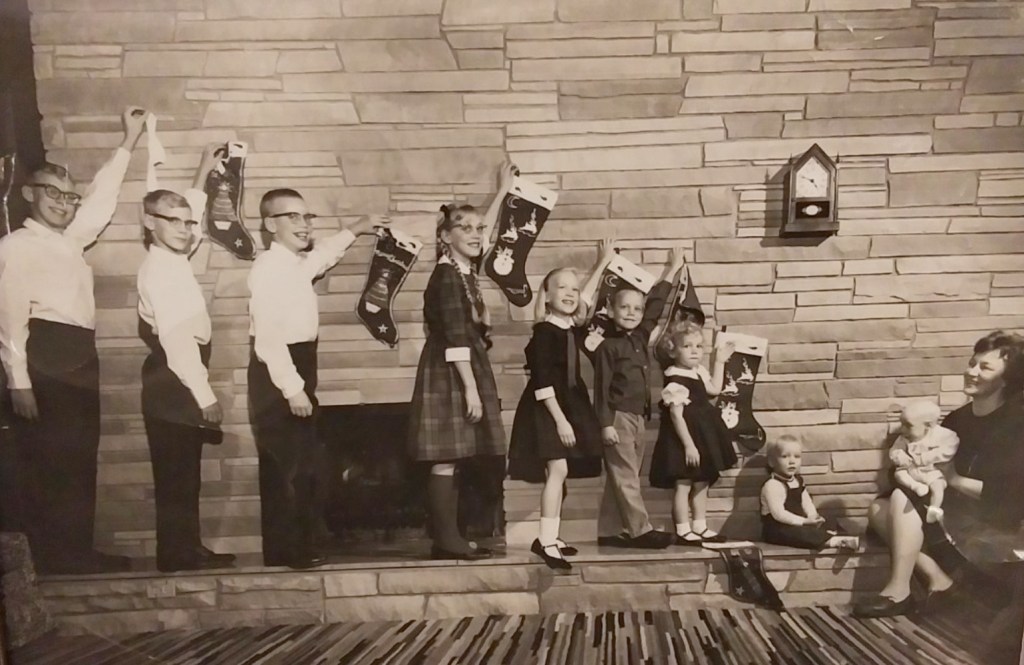
One of my brothers sent out this old photograph the other day.

The photograph had been around our house when I was a kid growing up in Grand Rapids, Michigan as long as I can remember.

And since I am about 1 and a half years old in this photograph, that was longer ago than I can remember.

The story was that some neighbor lady worked for the Grand Rapids Press and thought that a family picture would be a nice addition to the paper at Christmas time.

The caption in the paper read, “GLAD TIDINGS – The nine children of Dr. and Mrs. Robert Hoffman, Sligh Blvd. gather round …”

One of the oddities of this photo is that there were two more kids yet to come.

My Mom always said she thought 8 was a good number.

Being 8th, I really appreciated that.

I am sitting next to my Mom and how they kept me from sticking out my tongue I don’t know.

My sister Janet remembered that my Mom had to go out and buy Christmas Stockings for the photo shoot and didn’t get enough so my brother Paul had to use a gym sock.

But my sister Lisa responded, “Does anyone actually remember this? I must have been three years old at the time and have no memory of it.”

Of course you have to be old enough to have memories.

And Christmas memories are so thick that they have to be brushed away leaves in a fall windstorm.

But what makes a memory?

Here is a photograph from this Christmas.

Me and my grand daughters, Azaria, Ella and Lenox.

Lenox is a little older than I was in that black and white photograph.

I don’t remember that day.

Bothers me a little that Lenox might not remember this day though I understand.

Guess we keep the pictures around as clues or keys to the boxes where the memories are stored.