12.30.2021 – nearly ashamed lest

nearly ashamed lest
it detain our attention
or attract gratitude

I asked my wife to go watch the sunset over the May River on Christmas Eve.

I had a lot of reasons.

I wanted to go was the main reason.

I often find that working from home, I can get to Friday and never been further from home than our daily walks.

And, We were alone with no kids at home and could go without worrying what might happen at home.

It was a warm night for us anyway in December.

It was a few days after the Winter Solstice so the sun would be setting at its most southern point in the sky over the river.

And also because of the solstice, it was conveniently timed at around 5:30 PM.

We got to the park on the bluff overlooking the river just as the sun disappeared.

I wanted to run from the car to get to the dock to catch a photograph of the scene.
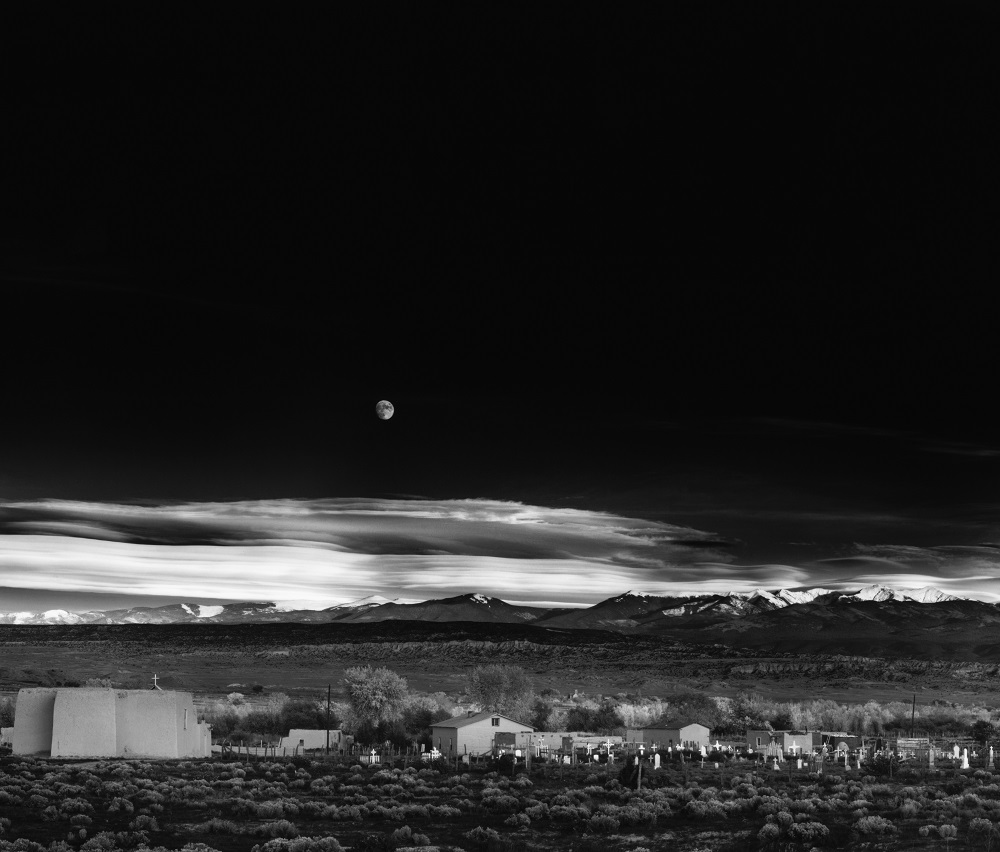
I thought of the photographer Ansel Adams, and his often repeated story of how he was driving with friends in Arizona and spotted the sunset scene of a small church at dusk with the moon rising over the horizon.

He pulls the car over and in a frenzy calls on his friends to help with the camera, tripod and other equipment.

The high point of the story for most photographers is when Mr. Adams admits he couldn’t find his light meter but he did know the amount of light the Moon gave off and was able to mentally calculate the exposure setting for his camera.

Thinking of this I hurried to the river front with my iPhone out.

The scene itself of the sun setting on Christmas Eve over the May River, as I took it in, took away my urgency.

I have used the quote, “A dominant impulse on encountering beauty is to wish to hold on to it, to possess it and give it weight in one’s life. There is an urge to say, ‘I was here, I saw this and it mattered to me,” before.

I wanted to the take a picture to show I was here and that the scene mattered to me.

But when I got there, all I wanted to do was look.

Look and listen.

You could hear the birds and you could here the sound of the passage of water as the tide came in.

And somehow, you could hear the silence.

A few other people were there but for the most part, it was a private viewing for my wife and I.

I thought of this quote about a scene as described by the same author of the prior quote, “like an impartial judge, modest and willingly literal-minded about its own achievements, ashamed lest it detain our attention or attract our gratitude.”

It is odd, but I thought that about the scene I was seeing.

The river, the water, the clouds, the sun setting and the sounds.

I felt it was a scene, that with all its elements, was modest and willingly literal-minded about its own achievements, ashamed lest it detain our attention or attract our gratitude.

It was a fleeting moment to be sure.

One of a kind and special.

A moment to be remembered.

But at the same time …

Of all things, a passage in the book, “How Life Imitates the World Series” by Thomas Boswell came to mind.

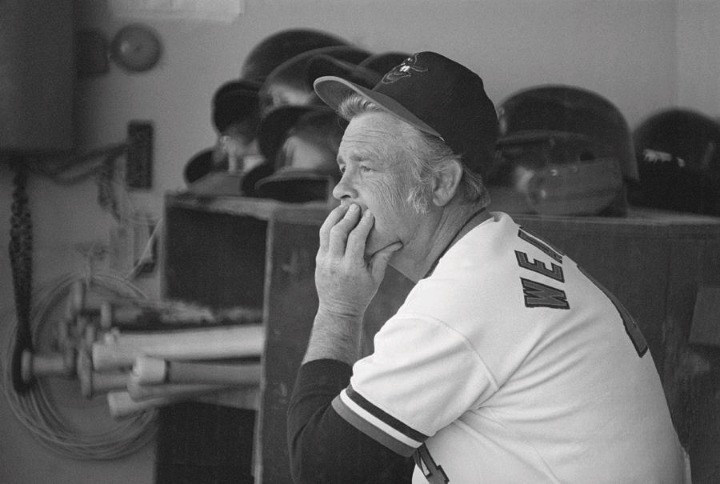
Mr. Boswell tells the story of how an interview in the dugout of Memorial Stadium in Baltimore with then Orioles Manager, Earl Weaver, went over long.

All of sudden, Mr. Boswell, writes, he became aware that the National Anthem was playing and the game was about the start.

The two stood up for the anthem and Mr. Weaver stopped telling the story he had been in the middle of.

The anthem came to end and and Mr. Weaver went to run out to home plate to give the lineup card to the umpires.

Mr. Weaver said to Mr. Boswell, “I’ll be right back and finish that story.”

Mr. Boswell writes that he thought this was crazy and that he was way over staying his time and apologized to Mr. Weaver and said he would get out the dugout as the game was about the start.

“Oh don’t worry about that”, said Mr. Weaver, “We do this every day.”
*Words in the Haiku were adapted from the book, The Architecture of Happiness (2009, Vintage Books) by Alain de Botton, and the passage:

In a valley so steep that its gelatinous walls seem never to have been warmed by the sun, a drop of hundreds of feet ends in a furious brown river clotted with stones and brambles. As the train curves around the mountainside, a view opens up along its length, revealing that, several carriages ahead, the burgundy-red locomotive has taken the unexpected decision to cross from one side of the valley to the other, a manoeuvre it proceeds to execute without so much as pausing to confer with higher authorities. It makes its way over the gap, and through a small cloud, with the brisk formality one might associate with the most routine of activities, to which prayer and worship would be at once unnecessary and theatrical supplements. What has rendered this supernatural feat possible is a bridge for which nothing in this setting has prepared us – a perfectly massive yet perfectly delicate concrete bridge, marred by not the slightest stain or impurity, which can only have been dropped from the air by the gods, for we cannot imagine that there would be anywhere in this forsaken spot for humans to rest their tools. The bridge seems unimpressed by the razor-sharp stones around it, by the childish moods of the river and the contorted, ugly grimaces of the rock-face. It stands content to reconcile the two sides of the ravine like an impartial judge, modest and willingly literal-minded about its own achievements, ashamed lest it detain our attention or attract our gratitude.

According the The New York Review of Books, this is “A perceptive, thoughtful, original, and richly illustrated exercise in the dramatic personification of buildings of all sorts.”

What I find irrestible in reading Mr. de Botton is his use of language.

I get the feeling that if you made a spread sheet of all the words, adverbs and adjectives used by Mr. de Botton, you just might find that he used each word just once.

Neat trick in writing a book.

If I knew how to do that, I would.

12.28.2021 – right now a moment

right now a moment
of time is passing us by
capture that moment

This quote:

Right now a moment of time is fleeting by! Capture its reality in paint! To do that we must put all else out of our minds. We must become that moment, make ourselves a sensitive recording plate … Give the image of what we actually see, forgetting everything that has been seen before our time.

is attributed to the painter, Paul Cezanne by the Cezanne’s biographer and business partner, Joachim Gasquet.

I went searching for a quote on time and a moment of time and this one seemed to work.

I went searching old school.

I got out my hard cover, printed copy of Bartlett’s Familiar Quotations (17th Edition).

Cheating in a way to look for quotes to turn into Haiku but then I think of what Winston Churchill said (and he said a lot).

Specifically, I mean, what Mr. Churchill said about Bartlett’s Familiar Quotations.

Writing in an early autobiography effort, Roving Commission: My Early Life, published in 1930, Mr. Churchill wrote, “It is a good thing for an uneducated man to read books of quotations.

Bartlett’s Familiar Quotations is an admirable work, and I studied it intently.

The quotations when engraved upon the memory give you good thoughts.

They also make you anxious to read the authors and look for more.”

When I started writing this blog to myself, I wrote, “With my haiku’s, I feel if I can pull an obscure bit of text from a forgotten book or poem, I can help reset the clock on that book or poem in the worlds collective consciousness.”

I think this lines up nicely with Mr. Churchill’s, “They also make you anxious to read the authors and look for more.”

ANYWAY, I needed a quote on time and the moment in time.

I needed this because of two photographs that were taken over the holiday weekend.

My wife and I were at my daughters’ home in Atlanta.

We had traveled to Atlanta to be with our kids and grand kidz to celebrate Christmas.

During the gift giving / unwrapping stage, my wife and I, on opposite sides of the room, had our phones out and took a pictures at about the same moment in time.

We appear in each others photograph.

A moment in time.

Passing us by.

Captured from both sides.

We are that moment.

right now a moment
of time is passing us by
capture that moment

12.27.2021 – sighed and looked

sighed and looked
sighed and looked, looked
and sighed again

Adapted from the poem, Alexander’s Feast by John Dryden (1697) and the lines that read:

The prince, unable to conceal his pain,
Gazed on the fair,
Who caused his care,
And sighed and looked, sighed and looked,
Sighed and looked, and sighed again;
At length, with love and wine at once oppressed,
The vanquished victor sunk upon her breast.

It was written, according to Wikipedida, to celebrate Saint Cecilia’s Day.

Jeremiah Clarke of Trumpet Volunteer fame, set the original ode to music, but the score is now lost.

The main body of the poem describes the feast given by Alexander the Great at the Persian capital Persepolis, after his defeat of Darius.

There is much here but my daily struggle embraces:

And sighed and looked, sighed and looked,
Sighed and looked, and sighed again

Sigh.

12.26.2021 – sensing the darkness

sensing the darkness
cold of night through the window
when we were children

Adapted from the book, The Architecture of Happiness (2009, Vintage Books) by Alain de Botton, and the passage:

We feel as safe as we did when we were children being driven home in the early hours by our parents, lying curled up on the backseat under a blanket in our pyjamas, sensing the darkness and cold of the night through the window against which we rested our cheek. There is beauty in that which is stronger than we are.

According the The New York Review of Books, this is “A perceptive, thoughtful, original, and richly illustrated exercise in the dramatic personification of buildings of all sorts.”

What I find irrestible in reading Mr. de Botton is his use of language.

I get the feeling that if you made a spread sheet of all the words, adverbs and adjectives used by Mr. de Botton, you just might find that he used each word just once.

Neat trick in writing a book.

If I knew how to do that, I would.

12.25.2021 – custard-cup without

custard-cup without
a handle holds punch as well
as golden goblets

Valerius Maximus was a 1st-century Latin writer and author of a collection of historical anecdotes titled the Factorum ac dictorum memorabilium libri IX or Nine books of memorable deeds and sayings.

Almost 2000 years ago, Valerius asked the question:

” . . . to what purpose is it to place wealth in the first part of happiness, or poverty in the lowest state of misery, since both the cheerful brow of them is inwardly filled with many bitternesses, and the more rough appearance of the latter abounds in solid and reliable goods?”

The rich must be happy or at least, happier than the poor, right?

For one thing, they are rich.

And the poor, well, they aren’t rich.

Yet, as good ‘ol Valerius says, “both the cheerful brow of them is inwardly filled with many bitternesses.”

And “the more rough appearance of the latter abounds in solid and reliable goods.

Way back in that 1st century.

As an illustration of the point, may I offer a visit to the home of one Robert Cratchit, Esquire in Camden Town, London, about 1860.

“Mrs. Cratchit made the gravy (ready beforehand in a little saucepan) hissing hot; Master Peter mashed the potatoes with incredible vigor; Miss Belinda sweetened up the apple-sauce; Martha dusted the hot plates; Bob took Tiny Tim beside him in a tiny corner at the table; the two young Cratchits set chairs for everybody, not forgetting themselves, and mounting guard upon their posts, crammed spoons into their mouths, lest they should shriek for goose before their turn came to be helped. At last the dishes were set on, and grace was said. It was succeeded by a breathless pause, as Mrs. Cratchit, looking slowly all along the carving-knife, prepared to plunge it in the breast; but when she did, and when the long-expected gush of stuffing issued forth, one murmur of delight arose all round the board, and even Tiny Tim, excited by the two young Cratchits, beat on the table with the handle of his knife, and feebly cried, Hurrah!

There never was such a goose. Bob said he didn’t believe there ever was such a goose cooked. Its tenderness and flavor, size and cheapness, were the themes of universal admiration. Eked out by apple-sauce and mashed potatoes, it was a sufficient dinner for the whole family; indeed, as Mrs. Cratchit said with great delight (surveying one small atom of a bone upon the dish), they hadn’t ate it all at last! Yet every one had had enough, and the youngest Cratchits in particular were steeped in sage and onion to the eyebrows! But now, the plates being changed by Miss Belinda, Mrs. Cratchit left the room alone, — too nervous to bear witnesses, — to take the pudding up, and bring it in.

Suppose it should not be done enough! Suppose it should break in turning out! Suppose somebody should have got over the wall of the back yard, and stolen it, while they were merry with the goose, — a supposition at which the two young Cratchits became livid! All sorts of horrors were supposed.

Hallo! A great deal of steam! The pudding was out of the copper. A smell like a washing-day! That was the cloth. A smell like an eating-house and a pastry-cook’s next door to each other with a laundress’s next door to that! That was the pudding! In half a minute Mrs. Cratchit entered, — flushed but smiling proudly, — with the pudding, like a speckled cannon-ball, so hard and firm, blazing in half of half a quartern of ignited brandy, and bedecked with Christmas holly stuck into the top.

O, a wonderful pudding, Bob Cratchit said, and calmly too, that he regarded it as the greatest success achieved by Mrs. Cratchit since their marriage. Mrs. Cratchit said that now the weight was off her mind, she would confess she had had her doubts about the quantity of flour. Everybody had something to say about it, but nobody said or thought it was at all a small pudding for a large family. Any Cratchit would have blushed to hint at such a thing.

At last the dinner was all done, the cloth was cleared, the hearth swept, and the fire made up. The compound in the jug being tasted, and considered perfect, apples and oranges were put upon the table, and a shovelful of chestnuts on the fire.

Then all the Cratchit family drew round the hearth, in what Bob Cratchit called a circle, and at Bob Cratchit’s elbow stood the family display of glass, — two tumblers, and a custard-cup without a handle.

These held the hot stuff from the jug, however, as well as golden goblets would have done; and Bob served it out with beaming looks, while the chestnuts on the fire sputtered and crackled noisily. Then Bob proposed: —

“A Merry Christmas to us all, my dears. God bless us!”

Which all the family re-echoed.

“God bless us every one!” said Tiny Tim, the last of all.

I can’t say I feel rich.

But I can’t say I feel poor.

I certainly can’t say I lack for anything I need.

I mean even old evil Joseph Stalin, in a discussion over a declaration of the four freedoms, asked FDR if when FDR said “the freedom from want”, did he mean “want” or “desire”.

Can I come up with things I desire.

You bet!

FDR again was once asked if there was one book he could have the world read to understand and appreciate the United States.

“Yes there is”, FDR answered, “The Sears Roebuck Catalog!”

If I want to feel rich all I have to do is go to https://howrichami.givingwhatwecan.org/how-rich-am-i to find out I am richer than 95% of the people in the world.

I don’t feel rich or poor.

What I do feel is lucky.

What I do feel is blessed.

Smart enough to appreciate my good fortune.

Smart enough to recognize that God HAS blessed with this good fortune.

Smart enough to NOT QUESTION my good fortune.

Smart enough to just want to quote Bob Cratchit and say to you all, ““A Merry Christmas to us all, my dears. God bless us!

God bless us everyone.

Haec ornamenta mea

PS: Just before ol’ Valerius Maximus makes his statement about wealth and poverty, he tells the story of Cornelia.

Cornelia is the lady who, according to Cornelia Valerius, “while the matron Campana showed her the most beautiful ornaments of that age, drew her in conversation until the children came back from school and she says, “These are my ornaments.”

This comes down to us as Haec ornamenta mea.

These are my jewels.

Just an old guy with his daughters.

In between the two statement, Valerius also says, “He who covets nothing, indeed possesses all things, so much more surely than he possesses all things, because the dominion of things is wont to slip