4.26.2022 – barnacle scarred

barnacle scarred
nothing at all whole or shut
but tattered split

Based on the poem, Breakage, by Mary Oliver.

Thank you to my sister Lisa, to telling me about Ms. Oliver.

Here is the poem.

Breakage by Mary Oliver.

I go down to the edge of the sea.
How everything shines in the morning light!
The cusp of the whelk,
the broken cupboard of the clam,
the opened, blue mussels,
moon snails, pale pink and barnacle scarred—
and nothing at all whole or shut, but tattered, split,
dropped by the gulls onto the gray rocks and all the moisture gone.
It’s like a schoolhouse
of little words,
thousands of words.
First you figure out what each one means by itself,
the jingle, the periwinkle, the scallop
full of moonlight.

Then you begin, slowly, to read the whole story.

go down to the edge
of the sea – How everything shines
in the morning light

It’s like a schoolhouse
of little words, thousands of words
First you figure out what each one means by itsel

– – – – – – –

Readers of this blog may remember that from time to time I struggle with the weight of effort of producing a daily Haiku and any thoughts I may have about the words and time that went in the Haiku that day.

This daily schedule of missing a day can bring on a personal mental paralysis wherein writing these entries becomes impossible.

I learned to deal with this by not dealing with it and let it go.

Then when I look at my register of entries and see blank days with no post, I will grab a topic or book or poem for a source and produce a series of Haiku to fill in those blank dates.

This is one of the great benefits of this effort being my blog and my blog, my rules.

It IS cricket because I say it is.

It is ‘according to Hoyle’ because I say it is.

Thus I have this series of haiku based on the poem ‘Breakage’ by Mary Oliver.
4.25.2022 – lines of buried bones

lines of buried bones
unpaid waiting debt – sound of
a gentle sobbing

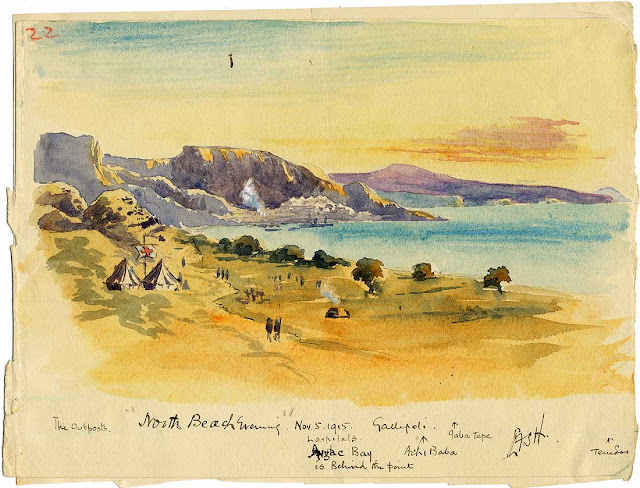
ANZAC Day, 2022.

From the poem, Anzac Cove by Leon Gellert.

He enlisted with the Australian Imperial Forces 10th Battalion within weeks of the outbreak of the Great War and sailed for Cairo on 22 October 1914. He landed at Ari Burnu Beach, Gallipoli on 25 April 1915, was wounded and repatriated as medically unfit in June 1916. He attempted to re-enlist but was soon found out. He returned to teaching at Norwood Public School.

Here is his poem.

There’s a lonely stretch of hillocks:
There’s a beach asleep and drear:
There’s a battered broken fort beside the sea.
There are sunken trampled graves:
And a little rotting pier:
And winding paths that wind unceasingly.
There’s a torn and silent valley;
There’s a tiny rivulet
With some blood upon the stones beside its mouth.
There are lines of buried bones:
There’s an unpaid waiting debt:
There’s a sound of gentle sobbing in the south.

North Beach – Evening Nov 5. 1915 by Leslie Hore

Anzac Day is a national day of remembrance in Australia and New Zealand that broadly commemorates all Australians and New Zealanders “who served and died in all wars, conflicts, and peacekeeping operations” and “the contribution and suffering of all those who have served”. Observed on 25 April each year, Anzac Day was originally devised to honour the members of the Australian and New Zealand Army Corps (ANZAC) who served in the Gallipoli Campaign, their first engagement in the First World War (1914–1918). (from Wikipedia)

4.20.2022 – by means of which sounds

by means of which sounds
represented, language
is made visible

Adapted from the book, Facts for Everybody by Robert Kemp Philp,  1863, T. Nelson and Sons, Paternoster Row, London.

The fact from Facts for Everybody that I am quoting is the listed under ALPAHABET.

Mr. Philp writes thusly:

ALPHABET. The most important invention of man, ascribed to a Phœnician, by means of which sounds are represented, and language made visible to the eye by a few simple characters.

Previous to this invention, pictures, or hieroglyphics, were used to record events; and letters were, probably, a generalization of these.

At this day, the Chinese have no letters, but have 214 keys to classes of words, distinguished by the number of strokes combined in each, The English language has 26 letters; the French 23; Hebrew 22; Greek 24; the Latin 22; the Arabic 28.

The figures used in arithmetic are an universal character, and many attempts have been made by the learned to introduce an universal character into language, but at present (1863 remember) there are 200 or 300 various alphabets.

The most important invention of man?

But what about …

But what …

But …

The most important invention of man!

Language made visible.

I am not sure that anything I have written or quoted (including Mr. Hemingway’s Novel in 6 words) has packed so much into so few words.

Language made visible.

I recall another quote in a post quoting Alain de Botton.

I began word painting because such a factual description seemed of little help to me in pinning down why I found the scene so impressive.

Word painting with language made visible through use of the alphabet.

Word painting in 2022 using a keyboard of letters developed in 1870 and a description describing language made visible written in 1863 about an invention that dates back perhaps to 1000’s of years before the birth of Christ.

The most important invention of man.

I am okay with that.

4.19.2022 – then, even before

then, even before
I was six, books began
to happen to me

Adapted from this passage in the book, The Big Sea, An Autobiography by Langston Hughes.

In Topeka, as a small child, my mother took me with her to the little vine-covered library on the grounds of the Capitol.

There I first fell in love with librarians, and I have been in love with them ever since- those very nice women who help you find wonderful books!

The silence inside the library, the big chairs, and long tables, and the fact that the library was always there and didn’t seem to have a mortgage on it, or any sort of insecurity about it – all of that made me love it.

And right then, even before I was six, books began to happen to me, so that after a while, there came a time when I believed in books more than in people – which, of course, was wrong.

That was why, when I went to Africa, I threw all the books into the sea.

The silence inside the library, the big chairs, and long tables, and the fact that the library was always there and didn’t seem to have a mortgage on it, or any sort of insecurity about it – all of that made me love it.

Not any sort of insecurity about it.

I’ll pass over any discussion about working at a library and being aware of tax-payer funding and other such insecurities to focus on the magic and wonderfulness of that line, ‘[didn’t have] any sort of insecurity about it.’

Mr. Bono sings, “But I still haven’t found what I’m looking for.”

Sometimes what you are looking for is right under your nose.

A place with out any sort of insecurity about it would check a lot of boxes on anyone’s search form.

My motto,
As I live and learn,
is:
Dig And Be Dug
In Return.

  • Langston Hughes