sorry your Highness organised properly for next coronation
So said Thomas Howard, 2nd Earl of Effingham, to His Majesty King George III when the Earl apologized for all the mishaps at the coronation of the King, Tuesday, 22 September 1761.
The coronation was supposed to be managed by the Earl Marshal, Edward Howard, 9th Duke of Norfolk; however, being a Roman Catholic, he had to step back and dropped the planning into his cousin’s lap, Mr. Howard.
According to Wikipedia, When George III complained about the problems to the Earl, Effingham “ … admitted that there had been “some neglect”, but that he would make sure that the next coronation would be organised properly.
Wikipedia also reports that George was highly amused by the answer and made Effingham repeat it several times.”
The first time I heard this anecdote, the quote given was, more along the lines, Sorry Sir, We will get it right next time.
Oddly enough one of the problems was that a jewel fell off the crown which later had some people saying was a bad omen that predicted the American Revolution.
Watching the ceremonies today and I have to ask what aspects of history of kings and queens and family and such might go through your mind if you were in Charles shoes?
I point out that if look at the Crown that Charles wore when he left the Church there are four pearls that dangle down from the top of the crown over the purple cloth.
Those pearls are reported to be earrings that were worn by Elizabeth I.
When Elizbeth I was Queen, it was known that she always wore a ring that was special to her.
When she died, it was found out that the ring was a locket.
a bit of the past suddenly appearing in front of us again
Based on the passage, … it is going to be an incredible thing to see this happen again, just because the sheer antiquity of it is something to marvel at. It is really like a bit of the past suddenly appearing in a time machine in front of us.
So this feller Charles III will be crowned King of England, the Lord’s anointed one to lead the people of Great Britain.
Chosen mostly because of who his ancestors were back when Queen Anne survived all of her 5 children who survived at birth (she had 12 others who did not) so that when Queen Anne died in 1714, the Brits went looking for King and chose the the Queen’s 2nd cousin, the first of the German George’s of Hanover whose family tree led to, eventually to Charles.
And the Brits get a new King but no choice.
While over here, though it is over a year away, America is facing an election that according to most polling, will offer two choices the no one in America wants to chose from.
So there you are.
Not for me at this time to say which way works out better.
I, for myself, am fascinated by the history.
In the article I quoted from there is this great point.
When King Charles enters Westminster Abbey for the coronation ceremony on Saturday, he will be preceded, among many other items of royal bling, by a short gold rod topped with a small cross, known as St Edward’s staff. Unlike the stone of destiny, the sword of mercy or the bracelets of sincerity and wisdom – all real items of regalia that will play symbolic roles in the ceremony – the staff has no role whatsoever. It is carried in at the start of the service, set on the altar, and then carried out again at the end.
In fact, no one has any idea what St Edward’s staff is meant to represent. When Charles II, restored to the throne in 1660 after the English Civil War, ordered his goldsmiths to remake the crown jewels that had been sold or melted down by parliamentarians, the inventory of items that had been lost included a staff of Saint Edward. And so one was made to replace it – an important symbol of something, even if no one could remember what.
I feel the whole spectacle is an important symbol of something, even if no one could remember what.
I feel there used to be a lot of things here in the United States that USED TO BE important symbols.
Right now, I can’t think of one that hasn’t been cheapened, lessened or just make small in recent years.
I can remember what they used to stand for.
And I miss them.
Take something relatively recent like FDR’s four freedoms.
Freedom of speech, freedom of worship, freedom from want, and freedom from fear.
Freedom of speech is under attack and abused at the same time.
Freedom of worship seems to still be around but the religion itself has been defamed and cheapened by those who use it for things other than to further the Gospel and worship God.
Freedom from want is promised yet in the worlds “Greatest” country yet promised at terms that are near draconian and citizens go hungry.
And as freedom from fear, now that everyone has a weapon, I feel less safe than ever. How this works out as the cost of being free has me at a loss.
This weekend I will sit in front of a time machine and watch a little bit history unfold in front me and think of times past.
happy memories to be sitting in the rain making sand castles
Some of the special British details she describes I recognize – afternoon tea, double-decker buses, and so on. Others are more confusing to a colonial. One of the “special British moments” Eggs [Victoria Eggs, a London-based designer] tries to capture is a childhood memory of sitting on the beach in the rain. “We would go on holidays to the seaside, and it would be raining but that didn’t stop us building sand castles and sitting having ice-creams and fish and chips,” she tells me. She remembers “being wrapped in a towel which, if you were in another country, you’d be lying on. We had it wrapped around us in the drizzling rain, eating fish and chips”.
In all honesty, I don’t know what she’s talking about. But it also does sound like the most British thing I ever heard in my life: happy to be sitting in the rain making sand castles. Not only happy. This is one of her happiest memories. Nostalgia compensates for the discomfort, I guess.
From the article, God save us all: Britain is about to get the king it deserves, subtitled, Viewed from Canada, the coronation is especially absurd – and the contradictions of Charles III perfectly suit the moment, by Stephen Marche in The Guardian.
Notice the lower case k in king.
That is all you need to know what this article is about if you don’t want to take the time to read it.
King … with the lower case k.
That and these other sentences.
… it also does sound like the most British thing I ever heard in my life: happy to be sitting in the rain making sand castles.
Not only happy.
This is one of her happiest memories.
Nostalgia compensates for the discomfort, I guess.
I live in a resort town and when I can, I go for a walk on the beach of Atlantic Ocean on my lunch break.
In the early months of the year, even in South Carolina, the beach is the NOT the best place to be even though a bad hour on the beach beats most places.
Still, no matter the weather, the wind, the temperature of the ocean water, there those vacationers are.
They are there.
They are on vacation.
They have paid a lot of money for this.
And they are going to enjoy it, no matter what anyone else says.
As the Activities Director at my Resort once told me, “They are freezing to death, but they will never admit it.”
So there are the Brits.
Stuck with Brexit and no one understands it.
And stuck with Charles.
But, doggone it, they paid for it.
They are going to enjoy it somehow.
I have to love
Just right!
But there was a sadder note in the article when Mr. Marche quoted Jonathan Coe.
For Coe, the lack of enthusiasm for Charles has an obvious source. There is “no enthusiasm for anything”, he says, “The nation is demoralized.”
Boy do I hear that.
Where have you gone, Joe DiMaggio? A nation turns its lonely eyes to you.
Clementine Churchill said of her husband, Winston, that he was the last man to believe in the divine right of Kings or that kings derived their authority from God and could not therefore be held accountable for their actions by any earthly authority such as a parliament.
With that in mind, I do plan to watch the coronation of King Charles III at 5 AM this coming Saturday.
Though an American, I find the history fascinating.
It IS the first British coronation of my lifetime and may be the only one of my lifetime.
So far those once-in-a-lifetime things for me have come up a bit short.
Thinking here of Haley’s Comet.
When I was kid, growing up in Grand Rapids, Michigan, the Public Museum had a display on Haley’s Comet with the text that the comet would return in 1986.
For me, that would be in 20 years and I looked forward to the comet lighting up the skies and freaking out the world.
And when the comet showed up in 1986, I don’t recall that I ever saw it.
So I plan to watch this coronation.
And I wonder what might have happened had we not had the Declaration of Independence or George Washington back in 1776.
You may have caught that the Stone of Scone was moved from Scotland to Westminster Abbey last week.
In Scotland, any future King sat on this same stone block to be crowned.
At least until 1296 when Edward I (AKA Edward Longshanks or Hammer of the Scots) made Scotland part of Great Britain and took the stone back to London where a shelf was added to King Edward’s Coronation Chair (still being used today) and the stone was put on the shelf so that Kings of England were also crowned Kings of Scotland.
Notice there was no voting on this and some Scots have yet to get used to the idea.
In 1950 some goofy college kids broke into the Abbey made off with the Stone and tried to get it back to Scotland.
Then in 1996, the Stone went back to Scotland with the understanding it would be returned when (and if – who knew QEII would be around for almost 30 years) needed to England and now it has been returned.
The Scots got their stone but their are still not independent of Great Britain.
It should be noted that in 1914 when some suffrages tried to blow up the Coronation Chair, the Stone got cracked in half (but no one told the Scots until those college kids grabbed it and it came apart as the pulled it off it’s shelf. Which kind of freaked them out at the time.)
When I was in college in the early 1982, Canada got out of their obligation to the Crown when the Canada Act, also called Constitution Act of 1982, Canada’s constitution approved by the British Parliament on March 25, 1982, and proclaimed by Queen Elizabeth II, making Canada wholly independent.
I was in a class on US History through the Documents of 1776 and the Professor noted that had it not been for these documents, the US might just be getting their Independence as well in 1982.
In 1997, when Great Britain’s 99 year lease on Hong Kong ran out, I happened to be watching the then Prince Charles lower the Union Jack and paddle on out of Hong Kong.
By chance I was watching with someone from Taiwan.
She was with a group of people from a publishing house in Taiwan touring the place where I worked and she stopped to watch.
As the flag came down I asked her how it felt?
How did it feel to see the British finally leave this part of China and give it back to the Chinese.
She looked at the TV and she looked at me and she looked back at the TV and said, “It’s about time!”
We are American Citizen’s, thankfully, not British Subjects.
Still, I plan to watch,
And next weekend I plan to bake a Coronation Quiche.
It seems a simple recipe but it calls for broad beans, otherwise known as fava beans.
Which I have been researching which led to this haiku.
I was the checking the beans for this recipe on the website, https://hodmedods.co.uk/, which seems to a GB version of Whole Foods and the site went into a long discussion of the Coronation Quiche recipe, its ingredients in general and fava beans specifically.
At the very end of the story was this great line.
A good question was asked on Twitter: are fava beans similar to faba beans?
They’re the same thing!
The letter b does a funny thing of turning into a v sometimes.
It’s called betacism apparently.
Betacism?
Really?
Was that even a word?
Betacism!
It is!
It means from (phonology) sound change in which [b] (the voiced bilabial plosive) shifts to [v] (the voiced labiodental fricative). Betacism is a fairly common phenomenon: it has taken place in Greek, Hebrew, Spanish, and some Portuguese dialects, among others.
You know betacism when you hear it.
The voiced bilabial plosive [b] shifts to [v] the voiced labiodental fricative,
And that 2nd line.
Betacism is a fairly common phenomenon: it has taken place in Greek, Hebrew, Spanish, and some Portuguese dialects, among others.
I loved it as it says that Betacism is a fairly common phenomenon but every online entry I have clicked on for betacism, these sites use the same examples from the Latin and Hebrew.
I don’t think it is that common but it has that great name.
Which leads me to think, WHO STUDIES THIS STUFF?
Betacists?
And notice it is the SOUND CHANGE, so I guess this won’t show up in texts but only when the text is read out loud.
Fava?
Faba?
Oh BEANS!
God Save the King!
Here is the recipe for The Coronation Big Lunch right from the Palace. BTW I plan on using my standard pie crust.
Filling
125ml milk
175ml double cream
2 medium eggs
1 tablespoon chopped fresh tarragon,
Salt and pepper
100g grated cheddar cheese,
180g cooked spinach, lightly chopped
60g cooked broad beans or soya beans
Method
To make the pastry…
Sieve the flour and salt into a bowl; add the fats and rub the mixture together using your finger tips until you get a sandy, breadcrumb like texture.
Add the milk a little at a time and bring the ingredients together into a dough.
Cover and allow to rest in the fridge for 30-45 minutes
Lightly flour the work surface and roll out the pastry to a circle a little larger than the top of the tin and approximately 5mm thick.
Line the tin with the pastry, taking care not to have any holes or the mixture could leak. Cover and rest for a further 30 minutes in the fridge.
Preheat the oven to 190°C.
Line the pastry case with greaseproof paper, add baking beans and bake blind for 15 minutes, before removing the greaseproof paper and baking beans.
Reduce the oven temperature to 160°C.
Beat together the milk, cream, eggs, herbs and seasoning.
Scatter 1/2 of the grated cheese in the blind-baked base, top with the chopped spinach and beans and herbs, then pour over the liquid mixture.
If required gently give the mixture a delicate stir to ensure the filling is evenly dispersed but be careful not to damage the pastry case.
Sprinkle over the remaining cheese. Place into the oven and bake for 20-25 minutes until set and lightly golden.
brought the sense of change or irresponsibility reckless as they were
I was going to write that if you read the books and essays of the 100 years ago, your know the phrase, “The Lost Generation” but as so few folks read books and essays of 100 years ago I am going to write that I came across an interesting comment on the people of the lost generation.
I came across a series of books published by George Plimpton’s Paris Review titled, Writers at Work.
There are 9 or 10 books in the series and they are collections of interviews with some of the great, well known and great mostly unknown writers of the 20th Century.
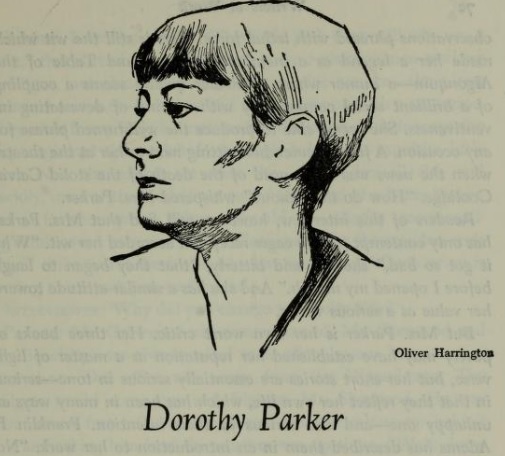
Certainly I have my favorites and I quickly searched out the interview Dorothy Parker.
Hoping against hope for something good (Jim Harrison once wrote that in every interview he ever gave, he would just repeat the question and say, I AGREE, to get the interview over with IE Question: MR. Harrison, would you say that while Hemingway must be counted among the American Greats, today he is little read and has even less impact? – Mr. Harrison : “Yes I would say that while Hemingway must be counted among the American Greats, today he is little read and has even less impact!” Harrison said nothing made interviewers happier than responses like this – but I digress) and I was stunned to read this quote in the Dorothy Parker interview.
Gertrude Stein did us the most harm when she said, “You’re all a lost generation.” That got around to certain people and we all said, “Whee! We re lost.” Perhaps it suddenly brought to us the sense of change. Or irresponsibility. But don’t forget that, though the people in the twenties seemed like flops, they weren’t. Fitzgerald, the rest of them, reckless as they were, drinkers as they were, they worked damn hard and all the time.
Now to wikipedia, The Lost Generation was the social generational cohort in the Western world that was in early adulthood during World War I. The generation is generally defined as people born from 1883 to 1900. The term is also particularly used to refer to a group of American expatriate writers living in Paris during the 1920s. Gertrude Stein is credited with coining the term, and it was subsequently popularised by Ernest Hemingway, who used it in the epigraph for his 1926 novel The Sun Also Rises: “You are all a lost generation. Lost” in this context refers to the “disoriented, wandering, directionless” spirit of many of the war’s survivors in the early postwar period.
And I have ever been taught to regard the original statement by Ms. Stein the term as used by Mr. Hemingway as something sacred in American Literature.
See, these folks were lost.
See, these folks were hardened by their times.
See, though says Ms. Parker, we got a pass. We’re lost!




 No Haiku For You