6.16.2023 – exciting drama

exciting drama
contribution lies in fabling
that it inspired

The significance of the Pony Express is not as apparent as its execution is memorable. The value of what happened during those eighteen months has transgressed the tangible effects carried in the padlocked saddle bags. The Pony Express as a cultural symbol has enjoyed a lot of traction over the years, and among the many artists, authors, journalists, and historians to depict and describe it, few have been able to resist romanticizing it. The apocryphal horseman has galloped off into the sunset so many times that exaggeration has adulterated fact. One exception is the 1930 book Six Horses, written by Captain William Banning and George Hugh Banning. William’s father was a transportation tycoon in California in the late 1800s. The book covers communication, freighting, and passenger conveyance in the West in the nineteenth century. Its title refers to a team of horses drawing a stagecoach. Banning dedicates two chapters to the Pony Express, and his observations are telling:

It did not involve more than 150 round trips. It did not cover a full nineteen months. Like a belated fragment of a storm, it came and was gone. Yet the fact remains: a more glamorous contribution to our historic West than that of this ephemeral Pony would be difficult to name.37

Banning refers to the Pony Express as an “immortal Pegasus” that was “able to identify himself with the new empire as permanently as though he had come racing up from the gold rush to the last spike driven for the Pacific Railroad.” History has lauded the Pony Express as a bold stroke of transcontinental progress, but Banning argues that the Pony Express “neither caused nor hastened the developments that followed his trail” and that “had he never existed, all must have been the same.” It was an exciting drama while it lasted, but it was little more than a drama. Its contribution to our historic West, therefore, lies in the fabling that it inspired:

From The Last Ride of the Pony Express: My 2,000-mile Horseback Journey into the Old West by Will Grant, Little, Brown and Company (June 6, 2023).

Seeming as American as any American enterprise could ever get.

According to legend, the help wanted notice read:

Wanted:

Young, skinny, wiry fellows, not over 18.

Must be expert riders, willing to risk death daily.

Orphans preferred.

It should be pointed out that the Pony Express ran from April 3, 1860, to October 26, 1861.

October 26, 1861 was the day the transcontinental telegraph went into service.

It cost more money than it made.

It didn’t last longer than technology.

But it has a permaemnt place in the history of this country.

A place based on fable than fact.

But who cares.
6.12.2023 – the awe that feels good

the awe that feels good
found in moments of wonder
and humility

Awe, Dr. Keltner explained, is that complex emotion we experience when encountering something so vast that our sense of self recedes.

It can be positive or negative (like the feelings that come from witnessing violence or death), but the awe that feels good is the type found in moments of wonder and humility.

From This Kind of Walk Is Much More Than a Workout by By Jancee Dunn.

Ms. Dunn writes:

This week, we’re exploring “awe walks,” outdoor rambles designed to cultivate a sense of amazement.

Jancee Dunn is the columnist for Well’s subscriber-only newsletter at The New York Times. She writes longer features as well, and spearheads special projects for the desk. Her work has appeared in many sections across The Times.

The idea for a walk with awe or a walk in awe brought to mind a Mary Oliver poem that my sister Lisa sent to me.

Gethsemane by Mary Oliver

The grass never sleeps.
Or the roses.

Nor does the lily have a secret eye that shuts until morning.
Jesus said, wait with me. But the disciples slept.
The cricket has such splendid fringe on its feet,
and it sings, have you noticed, with its whole body,
and heaven knows if it ever sleeps.

Jesus said, wait with me. And maybe the stars did, maybe the wind wound itself
into a silver tree, and didn’t move, maybe
the lake far away, where once he walked as on a
blue pavement,
lay still and waited, wild awake.

Oh the dear bodies, slumped and eye-shut, that could not
keep that vigil, how they must have wept,
so utterly human, knowing this too
must be a part of the story.

I have quoted this line before, but I like it so much.

As Alice Walker writes in her book The Color Purple,

“I think it pisses God off if you walk by the color purple in a field somewhere and don’t notice it. People think pleasing God is all God cares about. But any fool living in the world can see it always trying to please us back.”

5.30.2023 – but they were young yet

but they were young yet
there remained for them many
life’s uncut pages

Adapted from Jack London’s short story, Dutch Courage.

Back in the day, I worked at a publishing house.

They had an entire department devoted to creating the printing pages layout of a the books published by the publishing house.

Then, and maybe still, when a book is printed, the pages are not printed one at a time, like pages out of a copy machine and then bound together.

No Sir!

A book is printed out on sheets of paper, four feet wide and five feet long.

It seems to me that either 32 or 64 pages of a book were printed on one piece of paper.

Pages are printed on BOTH sides of this giant piece of paper.

A machine then folded and folded and folded this sheet of paper, origami style, so that when it was all over, what you had was a block of folded paper, with all the pages lined up in order.

Page 33 might be on the back of page 32, but when it was laid out on the paper, page 33 might be in the center of side 1, so page 32 had to be place in the correct corresponding place on side 2.

Layout was like a giant sudoku game.

A couple of things resulted from this process.

One was that sometimes, the page counted didn’t match up.

Did you ever wonder why you got a book and it had a couple of blank pages before the forward and after the end of the book?

And it is these blocks of 32 or 64 pages that make up the sections of pages that you can see in a book that has bound pages that have uncut edges.

Working in bookstores and libraries, I was taught that having an uncut edge was not a sign of sloppiness but instead the rough edged pages were a sign to those who knew, that the book had a sewn instead of a glued binding

But that was just the outer edge.

Of course, the inner edges of the book had to be cut, if for no other reason to remove the folded edges.

If those weren’t removed, the pages couldn’t be opened and the book couldn’t be read.

And there is the story of life’s uncut pages.

Some book collectors wanting a first edition, who also wanted it kept in mint condition could hardly be expected to want to read any book in question, the true collector just needed the book to complete their collection.

So the true collector bought first editions that were left UNCUT!

Early in their marriage, Young Eleanor perused the books in Franklin Roosevelt’s library and was dismayed to find so many books with uncut pages.

She had to tear open a couple pages just to see what the books were about.

“YOU DID WHAT?” asked Frank at lunch when she reported what she had done.

SO books with uncut pages at not uncommon.

Books with their stories wrapped up inside.

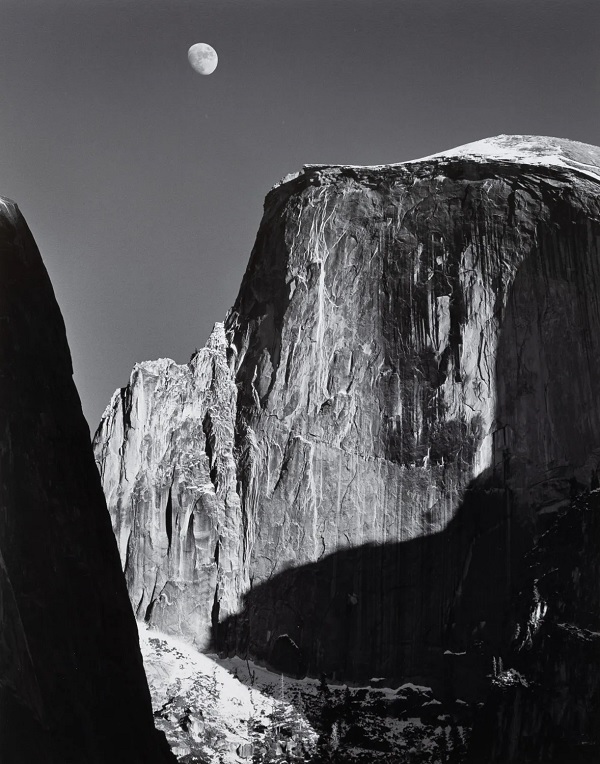
Mr. London, writing about two young men about to try and climb the famous Half Dome in Yosemite wrote this:

“What’s that for?” Gus asked, pointing to a leather-shielded flask which Hazard was securely fastening in his shirt pocket.

“Dutch courage, of course,” was the reply. “We’ll need all our nerve in this undertaking, and a little bit more, and,” he tapped the flask significantly, “here’s the little bit more.”

“Good idea,” Gus commented.

How they had ever come possessed of this erroneous idea, it would be hard to discover; but they were young yet, and there remained for them many uncut pages of life.

So many erroneous ideas.

But they were young yet, and there remained for them many uncut pages of life.

Pages that are waiting to be torn open.

Cut open.

Carefully.

Maybe not so carefully.

Only way to get at the story.

Moon and Half Dome – Ansel Adams – 1960

5.14.2023 – grown up in an age

grown up in an age
permeated by noise of
24-hour news

Adapted from this passage:

You have grown up in an age permeated by the noise of a 24-hour news cycle, by needless political polarization, by devastating gun violence, by the isolating effects of “social” media. You have seen hard-won civil rights rolled back. You have come of age at a time of existential threat — to the planet, to democracy, to the arc of the moral universe itself — and none of it is your fault.

In the Guest Opinion Piece, Against Despair: An Open Letter to Graduates on May 15, 2023 written by Margaret Renkl.

Ms. Renkl is a contributing Opinion writer who covers flora, fauna, politics and culture in the American South.

She, as is evident in the headline, writing to High School and College Graduates in the Spring of the year 2023.

All she says is true.

These graduates have … grown up in an age permeated …

by the noise of a 24-hour news cycle,

by needless political polarization,

by devastating gun violence,

by the isolating effects of “social” media.

You have seen hard-won civil rights rolled back.

You have come of age at a time of existential threat — to the planet, to democracy, to the arc of the moral universe itself …

and none of it is their fault.

But, I have to ask, it is within their ability to realize … there was a time, there was a place when life WAS NOT permeated

by the noise of a 24-hour news cycle,

by needless political polarization,

by devastating gun violence,

by the isolating effects of “social” media.

My children never spend a minute imaging a world without a cell phone.

My grand children, digital natives as they are called, grew up in a world that I am fond of pointing out, never existed anywhere.

Never existed not even in the wildest dreams of worlds that Science fiction and non fiction writers ever imagined.

A world where we all carried some of the most power computers ever designed.

Computers that we carry so we can send pictures of ourselves in places that other people aren’t at.

Now they are a part of life.

They replaced what we now call land lines.

Are they missed?

Do these graduates miss these other things.

They are just as gone.

That they are gone is not the graduates fault.

Can it be their fault that they don’t know them well enough to miss them?

5.7.2023 -instagrammable

instagrammable
moments that did not make it
on to instagram

Any one who reads these essays will know that I often rant about the instagrammable moment.

The idea that proof of being somewhere is better than the being there itself.

For example, 80% of the people who visit the Louvre in Paris are there to see only the Mona Lisa and when they get their 60 seconds in front of the painting, they turn their back on Lisa del Giocondo so they can position their iPhone to take a photo that captures their self with the painting in the background.

Viola, the instagrammable moment.

These moments can be based on an event as well.

Their self at Times Square on New Years, at a big league ball game or taking a walk on a beach at lunchtime.

Something to show you are where you are and other people aren’t.

There hasn’t been a British Coronation in 70 plus years.

For many, it could be a once in a life time event.

An event, that if you were present at, would almost demand to memorilized with an instagrammable moment.

Yet …

As I watched the pageantry playout on my TV and men bowed and women curtsied, not once did I see a slender white box of an iPhone.

I did not see the extended arms of the Instagram Salute.

I did not see anyone turn their back, a breach of etiquette all its own, so that someone could capture that instagrammable moment.

I like pageantry and such.

I’ll watch Inaugurations.

I’ll watch the funerals of past Presidents.

On Christmas Eve, it has become a tradition started after setting out all the gifts and candy for Christmas Morning, that the wife and I watch the service from St. Peters.

Of late, all of these events are filled with the image of people making images.

As an aside, how a Secret Service agent makes the split second decision that someone is reaching out with an iPhone and not a weapon is beyond me.

Last Christmas it comes to mind that one person in St. Peters in the background behind the alter was making such a show to capture selfies that a Vatican Official had to tap her on the shoulder to please sit down.

But yesterday in Westminster Abbey, I didn’t see a one.

When I first noticed I was so pleased that the people in the Abbey were there for the sake of being there and not proving they HAD been there.

When I time to think about it, my thought was, HOW did the Brits accomplish this?

Did Charles have a note at the bottom of the invitation saying something like, “Please refrain from taking selfies. In respect to the moment, the use of hand held devices is prohibited.”

If the invitations did have such a line, would the Brits go along with it?

And you know, I think they would.

You can find lots of indications that Brits don’t like they Royalty but I think that while they say it, they don’t mean it.

I remember a clip of an interveiw of one time Prime Minister, Harold Macmillan by Dick Cavett.

Mr. Cavett was asking about the process of Royal Honors and Mr. Macmillan explained that when he was in charge he would contact people and say, “I have in mind to recommend you to the Queen for a Knighthood,”

Mr. Macmillan explained that way, the honor would be turned down before it was ever offered (it ever one was ever turned down – Even John Lennon took an MBE before, years later, he gave it back).

Mr. Cavett grasped the idea and summed it up saying, “So you wouldn’t be saying no to the Queen.”

Mr. Macmillan agreed, “Saying no to the Queen? It just isn’t done.”