death shall all the world subdue, Our love shall live, and later life renew
Adapted from the sonnet, Amoretti LXXV, by Edmund Spenser.
This is one of several haiku I got from this sonnet.
Edmund Spenser (1553-1559), according to wikipedia, was an English poet best known for The Faerie Queene, an epic poem and fantastical allegory celebrating the Tudor dynasty and Elizabeth I. He is recognized as one of the premier craftsmen of nascent Modern English verse and is often considered one of the greatest poets in the English language.
In 1595, Spenser published Amoretti and Epithalamion. This volume contains eighty-eight sonnets commemorating his courtship of Elizabeth Boyle. In Amoretti, Spenser uses subtle humour and parody while praising his beloved, reworking Petrarchism in his treatment of longing for a woman.
Spenser used a distinctive verse form, called the Spenserian stanza. The stanza’s main meter is iambic pentameter with a final line in iambic hexameter (having six feet or stresses, known as an Alexandrine), and the rhyme scheme is ababbcbcc. He also used his own rhyme scheme for the sonnet. In a Spenserian sonnet, the last line of every quatrain is linked with the first line of the next one, yielding the rhyme scheme ababbcbccdcdee.
But you knew that.
Here is the full sonnet.
One day I wrote her name upon the strand, But came the waves and washed it away: Again I wrote it with a second hand, But came the tide, and made my pains his prey. ‘Vain man,’ said she, ‘that dost in vain assay, A mortal thing so to immortalize; For I myself shall like to this decay, And eke my name be wiped out likewise.’ ‘Not so,’ (quod I); ‘let baser things devise To die in dust, but you shall live by fame: My verse your vertues rare shall eternize, And in the heavens write your glorious name: Where whenas death shall all the world subdue, Our love shall live, and later life renew.
From my reading this morning, I came across this bunch of words, “unparalleled opera of oleaginousness.”
Oleaginousness.
Yes I had to look it up.
When I tell you that the word means, “insincerity by virtue of pretending to have qualities or beliefs that you do not really have” I am sure you will have no problem connecting the statement with the previous President.
The phrasing was used in this paragraph.
“The former president’s first full cabinet meeting in June 2017 remains an unparalleled opera of oleaginousness. Secretary after secretary all but flung themselves at his feet, sang songs of praise and paid homage to the divine emperor of the universe.”
The former President and his antics and the antics of his Cabinet are not my focus here.
I just wanted to point out and celebrate the authors use of words.
“Unparalleled opera of oleaginousness .”
Would opera of unparalleled oleaginousness worked better?
Back in the day, I worked for a while in the Local History Collections of the Grand Rapids Public Library.
Part of the Collections was a large archive of Furniture Industry Periodicals.
In one such periodical, I am not sure but it might have been the Michigan Tradesman or maybe the Grand Rapids Furniture Record.
The lead editorial of the Michigan Tradesman was a weekly column titled, “The Realms of Rascality” where the editor castigated the actions of anyone in the furniture industry who happened to upset the editor.
I liked that.
Realms of Rascality.
You could construct a sentence along the lines of “The realms of rascality led to an unparalleled opera of oleaginousness to define the term of office of the Previous President.”
For some reason recently I was thinking about my time at the Library.
Maybe all this talk about voting and technology and verification and such.
Usually there were three, at least two, people around to work with patrons that wondered into the Local History Department.
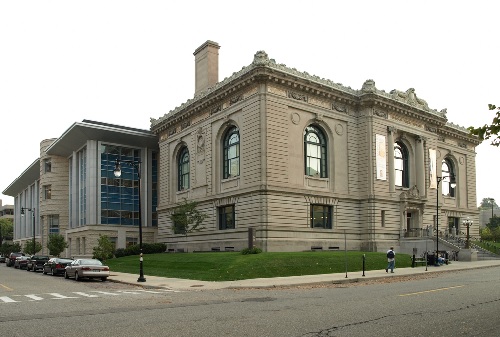
Back then, the LHCs (local History Collections) was located in the OLD GR Public Library that was connected to the new building by a mishmash of elevators and stairways as the floors in the old building did not line up with the floors in the new building.
OLD MAIN with NEW MAIN behind hit
If you weren’t looking for the LHC you weren’t going to find it.
One Saturday was slow and the other people on the staff I was working with asked me if I would mind if they went to lunch at the same time.
I looked around at the empty reading room and microfilm room and such and told them to go ahead.
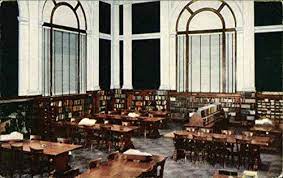
I was alone in what had been the main reading room of the Grand Rapids Public Library Main Building.
A building built in 1904.
A building built in 1904 that required a lot of light for reading.
The room was three stories high on the inside.
Book cases were built into the walls all around the wall to a height of about 10 feet and above the book cases two story windows filled the walls and they filled the room with a wonderful light.
I loved just sitting in there.
I hadn’t been sitting there long when I head the sound of young voices.
A lot of young voices.
A couple of girl scout troops had decided to visit the library and earn a merit badge by looking up a local newspaper for the day they had been born and writing down the major headlines.
This was explained to me by the troop leaders.
As they explained, what seemed like 100 little girls crowded around me at the reference desk.
What I should do was have them all sign in as researchers and then explain how the microfilm library worked (luckily the Grand Rapids Press was self serve and I wasn’t going to have to search for each box of film).
Then show them how to use the microfilm readers and let them take turns finding the information they needed.
They were EARNING a merit badge after all.
With a little luck, I could finish this group up in a couple of hours.
Then the troop leaders told me they hoped this wouldn’t take long as they also wanted to get to the museum.
I stared at them.
I stared and thought.
I stared and thought and made a descision.
The library had many film readers that had been invented maybe by Thomas Edison and they were maybe that old.
The library had one modern reader-printer.
Each print from microfilm cost 25 cents.
For staff use, we had an override key.
I grabbed the key and took the Troop leaders out to the the newspaper microfilm and explained how the rolls were filed by date.
I told them to get a girl scout and find the correct box of film and have the scout bring it to me at the reader printer.
I sat down at the machine and as each scout brought me her roll of microfilm and told me their birthday, I scanned to the date and printed a copy of the front page.
My plan worked for the most part but it was zany.
The microfilm room was in the old lobby of the main building and the walls and floors were marble.
It didn’t take long for the scouts to find out that loud sounds made really funny echos.
It didn’t take long for the scouts to find out that marble floors were great for sliding on in stocking feet.
I ignored it all and soldiered on.
I reached out, took the reel of film, threaded it on the machine and asked, “birthdate?”
I spun the reels and found the date and as the print was being made, I tried to make some comment about that days news.
I took a reel of film and a little voice said, “I’m the last one!”
I looked up to see that the scouts had been herded back into a group and the Scout Leaders were standing next to me.
I printed the last page and a scout leader said, “Can we say thank you to the nice man?”
And a chorus of THANK YOU MISTER NICE MAN rang out.
And just like that they were gone.
I shelved all the boxes and straightened up the room and my coworkers wander back in from lunch.
“Anything happen?” they asked.
ARE YOU KIDDING!
I recounted in my own special way what had happened.
They just looked at me.
They looked around.
They looked for evidence of the mayhem just described.
They looked at the register which of course was blank.
They looked at each other.
“WHAT,” I said.
They looked at each other.
“Go check the counter if you think I made this up.”
The entryway into the LCS had an electric eye that counted patrons when they entered the room.
We all walked over to the counter.
It showed a total of 11 people so far today had crossed the electric eye.
The was counting us coming in to work and leaving for lunch.
They looked at me.
“I GET IT,” I said.”
“See, they came in such a mob, the counter only clicked for one person.”
They looked at me.
“THERE WERE NO BREAKS for the counter to register a click.”
“DON’T YOU GET IT?”
We left it there.
I kept bringing up things like how much printer paper was gone and such like and my coworkers just nodded.
Just nodded and looked at each other.
At least if you can look at someone while rolling your eyes.
We closed at 5PMpm on Saturdays.
Once the doors were locked, the security guards would come through and check each room.
We were standing around the desk chatting when the guard walked in.
“Man those Girl Scouts were Crazy,” she said.
I was thinking about those Girl Scouts.
I was thinking about young Girl Scouts who in 10 or 12 years will have to research what happened on their birthday.
What happened back in 2017.
I thought of this article and I thought of the the realms of rascality that led to an unparalleled opera of oleaginousness.
As the writer wrote in his article, “It was, of course, funny until it wasn’t.”
Just have to wonder how these years will be viewed.
old arguments never die but neither do they just fade away
They tell this story along the lines of one time manager of the Baltimore Orioles, Earl Weaver.
There this one umpire, and it may have been Ron Luciano but it could have been any one of the American League umpires at the time Weaver was a manager.
The story went that both Weaver and the Umpire had been rookies, rookie manager and rookie umpire, years before in the then Eastern Minor League.
Weaver managed the Elmira Pioneers.
Both Weaver and the Umpire went on to the Major Leagues.
From 1968 to 1982, Weaver managed the Orioles.
At some point over that span, Weaver and this Umpire came together again.
This Umpire has a bad day with Weaver and Weaver is tossed from the game.
Weaver is beside himself.
Weaver tosses his hat.
Weaver does his trademark move of kicking dirt on the umpire.
Weaver stalks off the field and into dugout.
When Weaver got to the dugout steps he stops, turns and yells one last thing at the ump.
“AND YOU MISSED THAT CALL BACK IN ELMIRA, TOO!”
In the movie, Citizen Kane, Jedediah Leland, the character played by Joseph Cotton, says to the reporter, “I can remember everything. That’s my curse, young man. It’s the greatest curse that’s ever been inflicted on the human race: memory.“
Adapted from the book, The Art of Travel (2002, Vintage Books) by Alain de Botton, and the passage:
I began word-painting.
Descriptive passages came most readily: the offices were tall; the top of one tower was like a pyramid; it had ruby-red lights on its side; the sky was not black but an orangey-yellow.
But because such a factual description seemed of little help to me in pinning down why I found the scene so impressive, I attempted to analyse its beauty in more psychological terms.
The power of the scene appeared to be located in the effect of the night and of the fog on the towers.
Night drew attention to facets of the offices that were submerged in the day.
Lit by the sun, the offices could seem normal, repelling questions as effectively as their windows repelled glances.
But night upset this claim to normality, it allowed one to see inside and wonder at how strange, frightening and admirable they were.
The offices embodied order and cooperation among thousands, and at the same time regimentation and tedium.
A bureaucratic vision of seriousness was undermined, or at least questioned, by the night.
One wondered in the darkness what the flipcharts and office terminals were for: not that they were redundant, just that they might be stranger and more dubitable than daylight had allowed us to think.
Adapted from the book, The Art of Travel (2002, Vintage Books) by Alain de Botton.
According to the website, GOOD READS, Any Baedeker will tell us where we ought to travel, but only Alain de Botton will tell us how and why.
As I said in the section on Architecture , what I find irresistible in reading Mr. de Botton is his use of language.
I get the feeling that if you made a spread sheet of all the words, adverbs and adjectives used by Mr. de Botton, you just might find that he used each word just once.
at first have viewed aesthetically even mechanically
I based this haiku and several others like it from the writing in the book, The Art of Travel (2002, Vintage Books) by Alain de Botton, and the passage:
On entering a new space, our sensitivity is directed towards a number of elements, which we gradually reduce in line with the function we find for the space. Of the four thousand things there might be to see and reflect on in a street, we end up being actively aware of only a few: the number of humans in our path, perhaps, the amount of traffic and the likelihood of rain. A bus that we might at first have viewed aesthetically or mechanically—or even used as a springboard to thoughts about communities within cities—becomes simply a box to move us as rapidly as possible across an area that might as well not exist, so unconnected is it to our primary goal, outside of which all is darkness, all is invisible.
*Adapted from the book, The Art of Travel (2002, Vintage Books) by Alain de Botton.According to the website, GOOD READS, Any Baedeker will tell us where we ought to travel, but only Alain de Botton will tell us how and why.
As I said in the section on Architecture , what I find irresistible in reading Mr. de Botton is his use of language.
To also quote myself, I get the feeling that if you made a spread sheet of all the words, adverbs and adjectives used by Mr. de Botton, you just might find that he used each word just once.