10.17.2025 – looking where program

looking where program
was, is, where we want to be
was no other course

“Anything this significant just doesn’t come on a whim,” Kraft said. “You have to have scenarios, and we do. How is this going to go? What if this happened? But looking at where the program was and where it is and where we want to be as a program, I just felt there was no other course.”

Penn State athletic director Patrick Kraft on the firing on the Head Football Coach, James Franklin. (Quoted in the article At Penn State, James Franklin was standing on the edge of a cliff for years. Here’s why by Bruce Feldman and Ralph D. Russo, NYT 10/17/2025)

While the statement is about football, I can find application of that last bit in so many areas of todays life in America.

As voters, if we could only say, you have to have scenarios, and we do.

How is this going to go?

What if this happened?

But looking at where the Country was and where it is and where we want to be as a County, We just felt there was no other course.

Hmmmmmmmmmmmmmmmmmmmmmm

HEY WE CAN SAY THAT!

Last time I checked, The Constitution of the United States still starts: WE the PEOPLE.

Admitted I haven’t checked today and you never know what those folks might try.

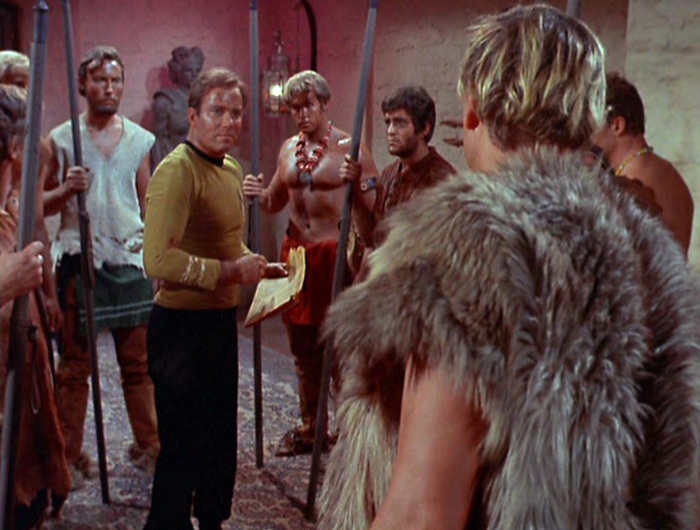
Does anyone else remember the scene from Star Trek, The Omega Glory” (Star Trek: The Original Series, Season 2, Episode 23 – and when I say Star Trek, for myself, I am referring only to the Original Canon of 79 shows, broadcast September 8, 1966 – June 3, 1969) where Kirk explains the Constitution.

The society Kirk and the Crew of the Enterprise come across in outerspace is based on the US Constitution but some how the document was buried in that society’s history and the words were only allowed to be spoken by a very few revered leaders.

In a long speech Kirk grabs their copy of the Constitution and says:

“Hear me! Hear this! Among my people, we carry many such words as this from many lands, many worlds. Many are equally good and are as well respected, but wherever we have gone, no words have said this thing of importance in quite this way.
Look at these three words written larger than the rest, with a special pride never written before or since, tall words proudly saying ‘We the People’.
That which you call Ee’d Plebnista was not written for the chiefs of kings, or the warriors or the rich or the powerful, but for all the people!
Down the centuries, you have slurred the meaning of the words, ‘We the People of the United States, in order to form a more perfect union, establish justice, insure domestic tranquility, provide for the common defence, promote the general welfare, and secure the blessings of liberty to ourselves and our posterity, do ordain and establish this Constitution’.
These words and the words that follow were not written only for the Yangs, but for the Kohms as well!
They must apply to everyone, or they mean nothing! Do you understand?”

But looking at where the Country was and where it is and where we want to be as a County, We just felt there was no other course.

They must apply to everyone, or they mean nothing!

Do you understand?

There is no other course.
10.16.2025 – shrimping boats are late today

shrimping boats are late today
swift mischief or stubborn sea
lost beneath the tide

The shrimping boats are late today;
The dusk has caught them cold.
Swift darkness gathers up the sun,
And all the beckoning gold
That guides them safely into port
Is lost beneath the tide.
Now the lean moon swings overhead,
And Venus, salty-eyed.

They will be late an hour or more,
The fishermen, blaming dark’s
Swift mischief or the stubborn sea,
But as their lanterns’ sparks
Ride shoreward at the foam’s white rim,
Until they reach the pier
I cannot say if their catch is shrimp,
Or fireflies burning clear.

Nocturne: Georgia Coast by Daniel Whitehead Hicky as published in Poems of Daniel Whitehead Hicky by Daniel Whitehead Hicky (Atlanta : Cherokee Pub. Co.: Atlanta, 1975).

10.15.2025 – sea-born Venus, when

sea-born Venus, when
rose from out her cradle shell
wind out-blows, ’tis blue

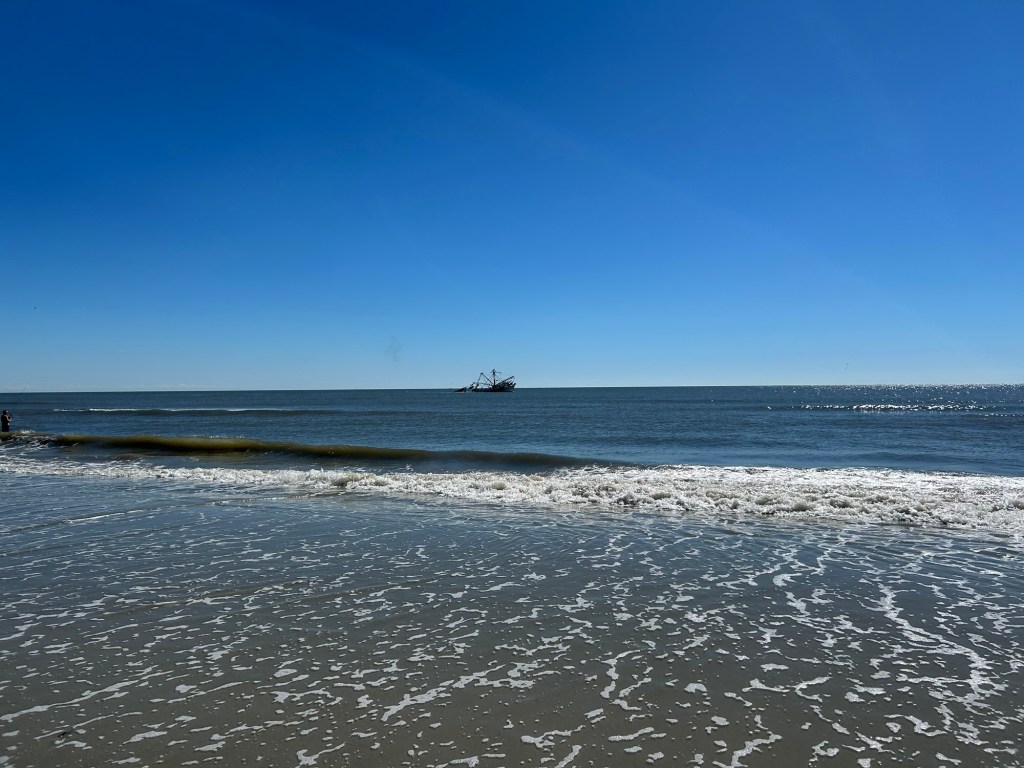
Venus in the Morning Sky over the Atlantic Coast – You will have to take it on faith that its there, but it is

That, when I think thereon, my spirit clings
And plays about its fancy, till the stings
Of human neighbourhood envenom all.
Unto what awful power shall I call?
To what high fane? — Ah! see her hovering feet,
More bluely vein’d, more soft, more whitely sweet
Than those of sea-born Venus, when she rose
From out her cradle shell. The wind out-blows
Her scarf into a fluttering pavilion;
’Tis blue, and over-spangled with a million
Of little eyes, as though thou wert to shed,
Over the darkest, lushest blue-bell bed,

Except from Endymion: a poetic romance by John Keats, John, 1795-1821 (Taylor and Hessey, 93, Fleet Street: London, 1918).

I cannot drive to work without looking to my left and see Venus bright in the pre dawn sky and not relax.

Since the moment of Creation, Venus has been there as the morning or evening Star.

No one in history, whether they made the history books or not, has not, at some point in their lives, seen Venus in the sky.

Maybe they didn’t know it was Venus but there it was.

My Dad had a way of pointing out Venus whenever he saw it.

Or if we pointed out that bright star, he would correct us and say, “That’s Venus … It’s a planet”.

I do the same thing with my kids and now, my many grand kids.

And when I do, I think of my Dad and I think of the how long people Dads and Grandfathers have been doing this.

A quick look at history shows that not only has Venus been around a long time, the name Venus for Venus goes back a ways in recorded history.

The Greeks had two names for Venus:

Phosphoros (Φωσφόρος, “Light-Bringer”) when seen as the Morning Star.

Hesperos (Ἓσπερος, “Evening”) when seen as the Evening Star.

Eventually, Greek astronomers (like Pythagoras) realized they were the same object.

Later Greek writers used the name Aphrodite for the planet in line with mythology.

The Babylonians called Venus Ishtar, their goddess of love and war—very similar to Aphrodite/Venus.

Venus was extremely important in Babylonian astronomy and astrology.

For Egyptians, Venus was associated with goddess Isis and also sometimes Hathor.

Egyptians noted its dual role in the sky and had separate names for its morning/evening appearances.

In Chinese cosmology, Venus is called “Taibai” (太白), meaning the “Great White” star, it is associated with metal in the Five Elements (Wuxing).

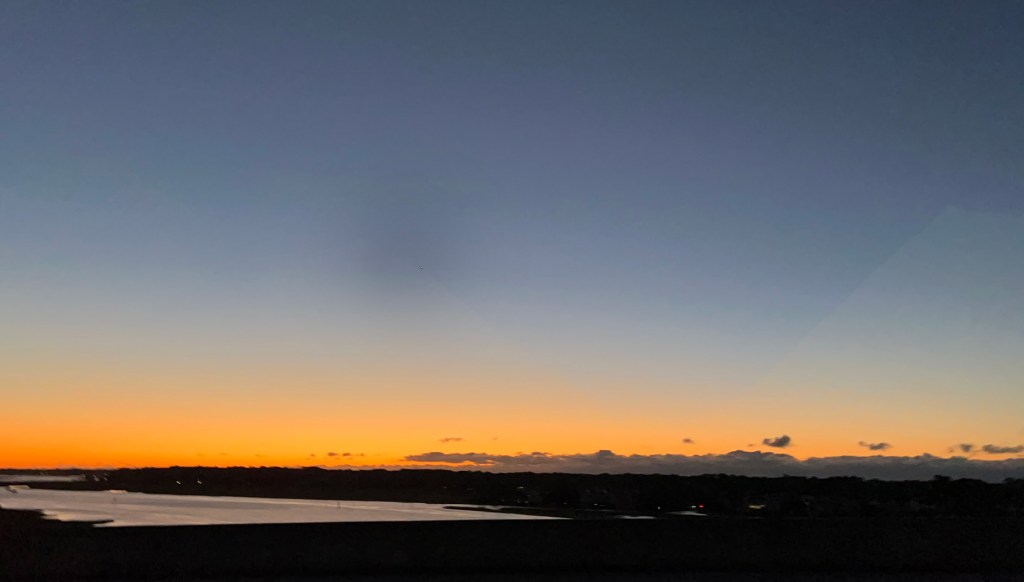
Hard to see in the photo I snapped as I drove over the Cross Island Bridge this morning, but there was Venus.

As C. S. Forester writes in Hornblower and the Hotspur, ” Over there was Venus, shining out in the evening sky. This sea air was stimulating, refreshing, delightful. Surely this was a better world than his drained nervous condition allowed him to believe.”

I see Venus.

I think of my Dad.

I think of my kids and grandkids.

And I think, surely this is a better world than my drained nervous condition allows me to believe.

10.14.2025 – the autumn always

the autumn always
gets me badly – go south where
the cold doesn’t crouch

Beach Colors

To J. M. Murry, from Del Monte Ranch, Questa, 3 October 1924

The country here is very lovely at the moment.

Aspens high on the mountains like a fleece of gold.

Ubi est ille Jason?

The scrub oak is dark red, and the wild birds are coming down to the desert.

It is time to go south, – Did I tell you my father died on Sept. 10th, the day before my birthday? –

The autumn always gets me badly, as it breaks into colours.

I want to go south, where there is no autumn, where the cold doesn’t crouch over one like a snow-leopard waiting to pounce.

The heart of the North is dead, and the fingers of cold are corpse fingers.

There is no more hope northwards, and the salt of its inspiration is the tingling of the viaticum on the tongue.

The Letters of D. H. Lawrence. Vol. 2, Edited by James T. Boulton. )Cambridge: Cambridge University Press, 1962).

10.13.2025 – splish, splash, splosh, slosh, spill

splish, splash, splosh, slosh, spill
end of the morning coffee
last sip on the stairs

I had this four cup drip coffee maker in college.

The way it was built, when the coffee was done, the last bit of water in the maker would be blown in out in one big and loud cloud of steam.

‘Coffee’s Ready!’ my roommates would yell when they heard it even though no one else drank coffee.

My roommates could time there day by the sounds it made as I made a pot when I got up, an afternoon pot around lunch time if I was home or later when I got back from class and a third pot after dinner.

And I drank it all.

And maybe bought coffee when I was on campus.

3 or 4 pots of coffee and I still had that feeling of disappoint as I emptied the pot of its last drops and wondered if I should make another pot.

Coffee had to be at the top of my weekly expenses.

At the same time I remember having no problems napping or sleeping at any time (or conversely, staying up all night if I had too).

Now I am down to a pot of coffee in the morning.

It gurgles and gurgles as the timer starts it up before my alarm clock goes off.

Two cups start my day and I pour a third and sip at through the morning.

When I work from home, I work in the upstairs guest bedroom and I bring my cup along and set in front of me on my desk.

At some point I make the switch to ice water in a travel cup and I grab my half filled coffee cup and head downstairs.

Holding my cup I look fondly at the now cool brown liquid and I think of those days of 12 cups of coffee a day.

And I think one more sip.

I raise the cup to my lips and my head steady/

That I am going downstairs doesn’t enter my mind.

I take a step down, I raise my cup and maybe get a sip before the I sloash and splash coffee all over my face, shirt and the steps.

Here’s the point.

I DO THIS ALMOST EVERYDAY!

Why can’t I learn to stop on my way down?

Why can’t I learn to wait until I reach the kitchen?

Will I ever learn?

If I do, will I forget by tomorrow?

Notice my St Jude medallion – Any web developer worth his download speed keeps something handy in reference to the patron saint of lost causes.