Down and out semi poet who is down and out in the Low Country of South Carolina after living in Atlanta which is not to be confused with the south, the old south or the new south. Atlanta was a global metropolis with all the pluses and minuses that comes with that. The low country, low because it is low, 8 feet above sea level, is not Podunk but once you get to Podunk, turn left. I try to chronicle a small part of all that through my daily haiku for you.
older people know that they are not going to become young again
Adapted from the line, “Young people seem not to know that they are going to get old, but older people know that they are not going to become young again.”
From Off to the side by Jim Harrison (Atlantic Monthly Press: New York,2002).
Then a few lines further down the page, Mr. Harrison warns, “There is a specific melancholy to hardship that accrues later as a collection of gestures, glances, and dire events.”
Holding my grandson, Ian, I was thinking of that bit of writing.
I was thinking that this little guy has no idea he is going to get old.
Using the word “old” as a state of being, as in ‘old people old’.
Ian will get older, we all know that, but Ian being OLD?
Then, there is me in that picture.
Certainly not young.
And very much assured that I am not going to become young again.
But then again, I live in a place where the median age is 64 so I am middle aged and I do see a lot of people who are both old and much older than I am.
So I feel young at least, young enough and as for knowing I am not going to become young again?
I am sure that wouldn’t go through all of that getting old all over again for anything.
who ever saw a dead congressman? yet, he was a man with a sharp tongue
Adapted from the passage in the poem, John Brown’s Body by Stephen Vincent Benét as published in Selected works of Stephen Vincent Benét (New York: Farrar & Rinehart, 1942), where Mr. Benét writes:
Fighting Joe Hooker once Said with that tart, unbridled tongue of his That made so many needless enemies, “Who ever saw a dead cavalryman?” The phrase Stings with a needle sharpness, just or not, But even he was never heard to say, “Who ever saw a dead congressman?” And yet, he was a man with a sharp tongue.
At Mr. Twain wrote in Pudd’nhead Wilson’s New Calendar, “It could probably be shown by facts and figures that there is no distinctly native American criminal class except Congress.”
I feel like we are on the Titanic and the lifeboats are full of members of Congress who wave back at us as the boats row away.
how stands the union? current state of crystal clear blue water is proof
Way back in 1936, Stephen Vincent Benét wrote a short story titled, The Devil and Daniel Webster that was first published in The Saturday Evening Post on October 24th of that year.
The short story opens with:
Yes, Dan’l Webster’s dead — or, at least, they buried him.
But every time there’s a thunder storm around Marshfield, they say you can hear his rolling voice in the hollows of the sky.
And they say that if you go to his grave and speak loud and clear, “Dan’l Webster — Dan’l Webster!” the ground ‘ll begin to shiver and the trees begin to shake.
And after a while you’ll hear a deep voice saying, “Neighbour, how stands the Union?”
Then you better answer the Union stands as she stood, rock-bottomed and copper sheathed, one and indivisible, or he’s liable to rear right out of the ground.
At least, that’s what I was told when I was a youngster.
Today if Dan’l called out, “Neighbour, how stands the Union?” I am afraid that the answer would not be that the Union stands as she stood, rock-bottomed and copper sheathed, one and indivisible.
If you gave the current answer, Old Dan’l would not rear right out of the ground, but dig deeper in the ground and pull his gravestone in right after him.
Dig down deep and weep I would think.
According to the Guardian, the answer to the question, Neighbour, how stands the Union? is:
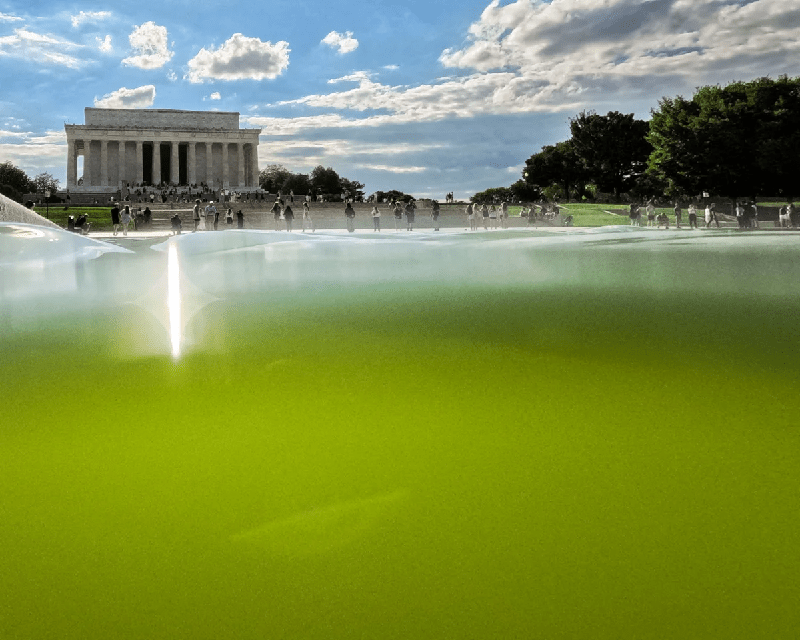
The state of the Lincoln Memorial reflecting pool rehabilitation effort has become the primary crisis affecting the United States. That is, if you ask the current administration. Limiting the right to vote is running a close second in the World Cup of Political Football, but it’s the reflecting pool that is attracting the most fervent attention. As emergencies go, it’s as thrilling as watching a really large body of still water in the middle of a park. The paint is peeling and it’s full of green algae. (Forget crumbling democracy: America’s biggest crisis is a stagnant, murky pool by Dave Schilling.)
I thought can that be true?
I am not so sure that the state of the Lincoln Memorial reflecting pool rehabilitation effort has become the primary crisis affecting the United States.
At least I hope not but I deep down I think its just a case of that current man in office doing his rage-bait shtick while his minions make off with the contents of the US Treasury.
But what if I said this?
The state of the Lincoln Memorial reflecting pool rehabilitation effort has become the perfect metaphor for the political crisis affecting the United States.
The online dictionary defines metaphor as vivid imagery and explains abstract ideas by transferring the qualities of a familiar object to something else, without using comparative words.
And when you read that the New York Times quotes, Katie Martin, a spokeswoman for the Interior Department, as saying about the reflecting pool that, “The current state of the crystal clear blue water is proof.” *
An example of vivid imagery that explains an abstract idea by transferring the qualities of a familiar object to something else, without using comparative words would be that the Lincoln Memorial reflecting pool rehabilitation effort explains the political crisis affecting the United States and you can take the current state of the crystal clear blue water as proof.
I think as my 8th grade Algebra teacher, Mr. Papke would say, Q E D.
all the summer world was bright fresh – brimming with life music at the lips
Saturday morning was come, and all the summer world was bright and fresh, and brimming with life. There was a song in every heart; and if the heart was young the music issued at the lips. There was cheer in every face and a spring in every step. The locust-trees were in bloom and the fragrance of the blossoms filled the air.
From The Adventures of Tom Sawyer by Mark Twain (Hartford, Conn: American Publishing Co., 1884).
I am keeper of the calendar where I work and we keep the next three months of those big desk calendar pages pinned to the wall with significant dates marked up.
I took down June today (as the last week of June is also on the July page) and put up September.
I outlined the important dates of Labor Day, 1st day of NCAA football and 1st day of NFL season and marked the ‘end’ of the summer season here on the Island where I work.
I thought about and thought that something was missing and I noticed I had not included the back to school dates for the area.
This is important for us as it marks the end of the family vacation cycle for the summer.
I looked up the dates for the South Carolina county where we are and the neighboring Georgia County.
Beaufort County, South Carolina starts school … on August 7th.
On a Friday!
Chatham County, Georgia starts school on Monday, August 3rd.
I do not want to get into the school year and extended fall breaks discussion or how if you want to have weeks of High School Football playoffs and still end your football season on Thanksgiving weekend you need to start school earlier and end earlier.
I want to talk about my summer as a kid at Crestview Elementary school in Grand Rapids, Michigan, where I grew up.
We would get out early in June.
Looking at a calendar for June, 1967, when I was in 2nd grade, most likely we got on around June 15th or 16th.
I do remember that Memorial Day was, 1) a day off from school and, 2) a day off anywhere in the week as it was May 30th and if it happened to fall on a Saturday or Sunday, that was too bad.
After Memorial day, there would be another 2 weeks of school in hot rooms with no one able to concentrate on any type of school work.
It was during these two weeks that at some point I would put on my most saddest, mournful face and walk up to the teacher’s desk and ask about final report cards.
I would say, “Guess I’ll be seeing you next year,” and shuffle away.
Somehow I was always passed to the next grade.
The only thing that happened in that last two weeks was field day.
To us kids, field day was the Super Bowl, World Series and Olympics all rolled into one and I thought it was the only one held anywhere in the world.
It wasn’t until years later that I was reading a book about WW2 POW camps in Germany where British soldiers would organize a yearly field day in the spring.
About the same time I also came across lots of references of any number of books and short stories that took place at boarding schools and colleges where field day was a fixture in the schedule.
It had all the great events like standing broad jump, vertical high jump, soft ball throw and running.
And here’s the thing.
Everyone was in it.
No one was left out.
And …
AND … at the end of the day, little medals would be handed out to the winners.
THERE WERE NO PARTICPATION AWARDS!
It was do or die on your own except for the last event which was a relay race between mixed gender teams selected from each grade, 1st thru 6th.
It wasn’t a 100 yard dash or even a 60 yard dash but a dash for as long as lanes could be laid out in the big field behind the school.
As I remember it, someone from the City parks and recs would show up and a race track was laid out with white chalk lines.
The only competition in this relay race was if the 5th grade might pull off the upset and win over the 6th but otherwise those big 6th graders always won.
I always approached field day with enthusiasm and and a level excitement.
I could imagine winning a ribbon or two or, maybe … all of them.
There is an episode of The Andy Griffith Show were little Opie day dreams about winning so many ribbons at field day, they have to turn him around to pin more on his back.
Boy! Howdy! but could I relate to Opie.
Then Field Day would come and it always seemed to be a hot day.
Our playground field was grass but a grass of a kind that didn’t grow anywhere else in my world.
It was sparse and wide blades and prickly and when you ran on it, more dirt and dust came up out of the ground in a way that didn’t happen on any other grass anywhere else that I knew of.
The dirt had a sweet sickly smell to it.
On a hot day with hundreds of kids running around, a cloud of gray hovered about six inches off the ground and your shoes and socks turned an odd dirty gray.
I also remember that in that day and age, no shorts were allowed so we were all wearing long, hot slacks as blue jeans weren’t allowed yet either.
It was hot and stuffy and smelly.
From enthusiastic anticipation I became more and more anxious.
Thinking first what am I doing here to thinking HOW DO I GET OUT OF HERE.
The events would start and I would take my turn and though I might jump kind of high or through my softball kind of far there was always a Don Gagnon or Ross Dornon who jumped higher or throw farther.
It wasn’t humiliation because so many other kids where at my level but every once in a while someone like Donny Gray would go nuts and unleash some super jump or record softball throw and take home a medal.
It didn’t take long for the magic and excitement of field day to wear off and all I wanted was for it to be over.
The relay race would be run and we would all be herded into the gym for the Awards Ceremony but we all had a chance to line up at the drinking fountain from the sink in our classrooms.
The lower EL classrooms also had a small restroom and after looking at the long line at the sink, I went into the restroom and cupped my hands under the sink in there to get a drink.
Which I thought was pretty smart and biblical (thinking of Gideon and his 400 men who drank water from the stream with a cupped hand) and I did this for years until someone caught me and yelled “Mike’s drinking bathroom water!”
Off to the gym to here the names yelled out for kids to come up and get their ribbons.
I could have listed them before we started.
They all would have been those big kids in school.
When you were a little kid, you knew who the big kids were and you knew the law of the jungle.
This was their day.
At least my name wasn’t Opie.
But my day was coming, that last day and when that last day came, it was usually a half day.
Our desks would be empty.
The blackboards were clean.
Because it was spring the windows would be open and the rooms smelled better then they did the rest of the year.
Our gym shoes that hung from our desk seats would have been brought home which also might have contributed to the cleaner smell.
There was nothing we had to do, that final bell would ring and summer would start.
We knew we had the rest of the month of June.
And we had the entire month of July.
And we had the entire month of August.
And somewhere in the far far future, away in September, after some holiday called Labor Day, we would have to be back in school.
But until then, there was NOTHING we had to do.
It was summer break and it seemed like we were off the entire summer and all the summer world was bright and fresh, and brimming with life.
There was a song in every heart; and if the heart was young the music issued at the lips.
There was cheer in every face and a spring in every step.
The locust-trees were in bloom and the fragrance of the blossoms filled the air.
Freedom.
A freedom you don’t get to experience too often.
I looked at those school schedules today and I thought August 3rd? August 7th?
Those poor kids.
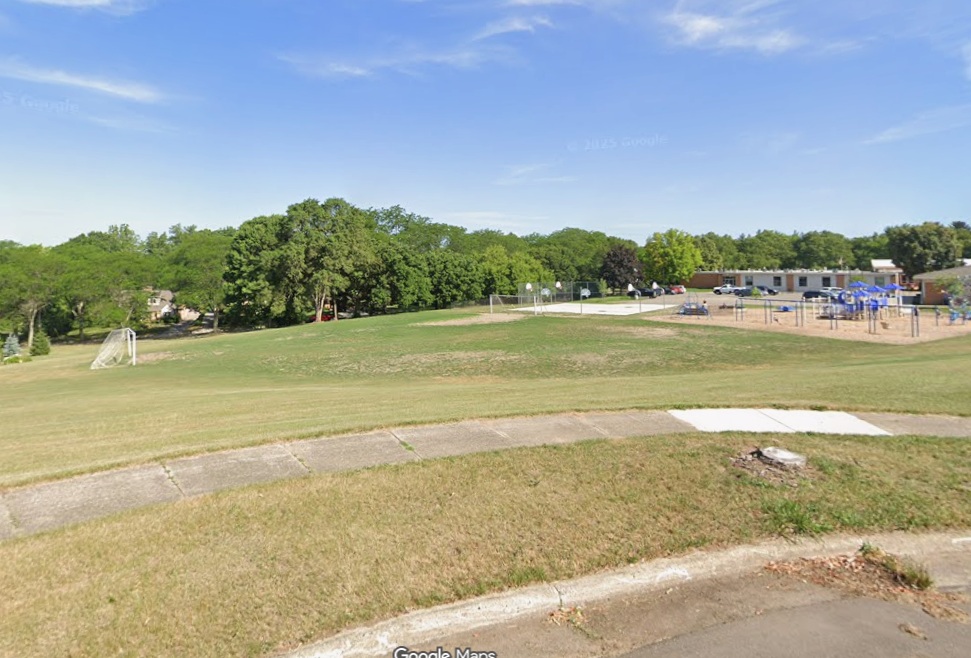
A modern view of our playing field. The playground and basketball courts are new and we didn’t have soccer nets in those days.
The run down ball diamond is gone.
But that grass and the dirt is still there and I can smell and feel the heat and drama of field day.
daily dawns – summer, winter, spring, and fall — I’m a fool to rise at all!
Daily dawns another day; I must up, to make my way. Though I dress and drink and eat, Move my fingers and my feet, Learn a little, here and there, Weep and laugh and sweat and swear, Hear a song, or watch a stage, Leave some words upon a page, Claim a foe, or hail a friend— Bed awaits me at the end.
Though I go in pride and strength, I’ll come back to bed at length. Though I walk in blinded woe, Back to bed I’m bound to go. High my heart, or bowed my head, All my days but lead to bed. Up, and out, and on; and then Ever back to bed again, Summer, Winter, Spring, and Fall— I’m a fool to rise at all!
Inscription for the Ceiling of a Bedroom by Dorothy Parker as published in Enough Rope (New York: Boni & Liveright, 1926).
This from the woman who famously would yell What Fresh Hell is This? anytime the phone rang.
Try that at work some day, I betcha!
High my heart, or bowed my head.
All my days but lead to bed.
I just wish I wouldn’t start thinking about it an hour after I get to work.
I mean, if I went right home and went to bed when I wanted to, I would miss my after dinner nap.
I start looking forward to that as soon as I get up each day.