Some Somewhere where I know I’ll someday go – finally I’ll go Some Somewhere
From this bizarre book I am reading right now titled, The Great Glorious Goddamn of It All, a novel by Josh Ritter.
Hard to even describe the book or what is about but it is … interesting.
It’s basically about lumbering in Idaho at the end of 19th century.
Early in the book, the song Some Somewhere is introduced.
The first line of the song is:
Some Somewhere there are mountains topped with snow, Some Somewhere where the wildflowers grow, Some Somewhere where I know I’ll someday go, When I finally go Some Somewhere.
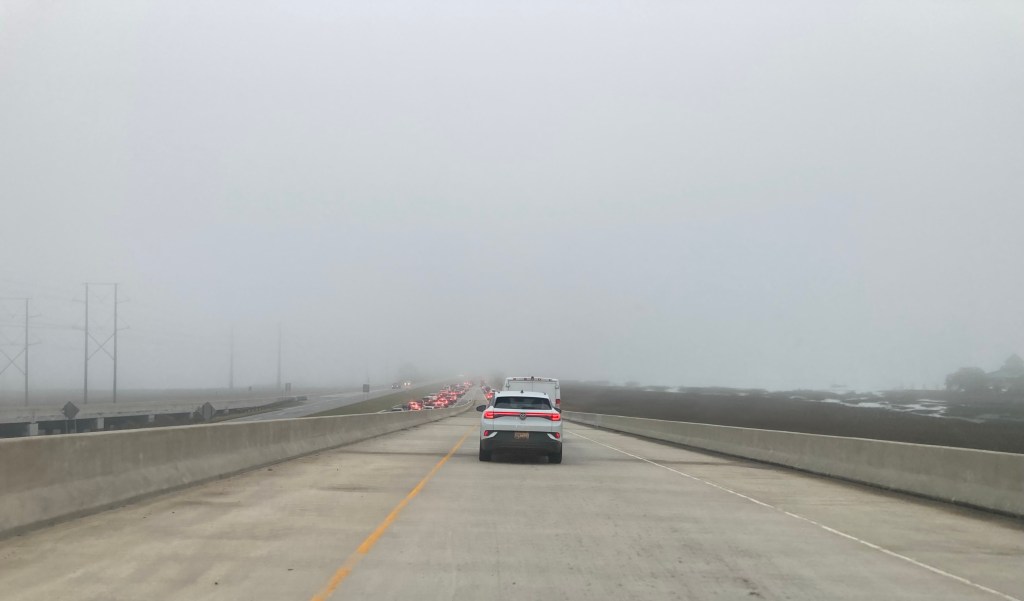
When I drove to the Island this morning, the fog was so thick I felt I was going to some somewhere.
I was going somewhere.
Some Somewhere.
I am not sure where some somewhere is but it isn’t here.
vegetable gardens not big but there’s a science to making gravy
In the book Sundog, Jim Harrison writes of an May Morning in Michigan’s Upper Peninsula;
A cold dawn with the wind shifting to the north in the night.
I tried to scrape frost from my windshield with my fingernails.
No wonder vegetable gardening isn’t a big item up here, while the making of gravy is a science.
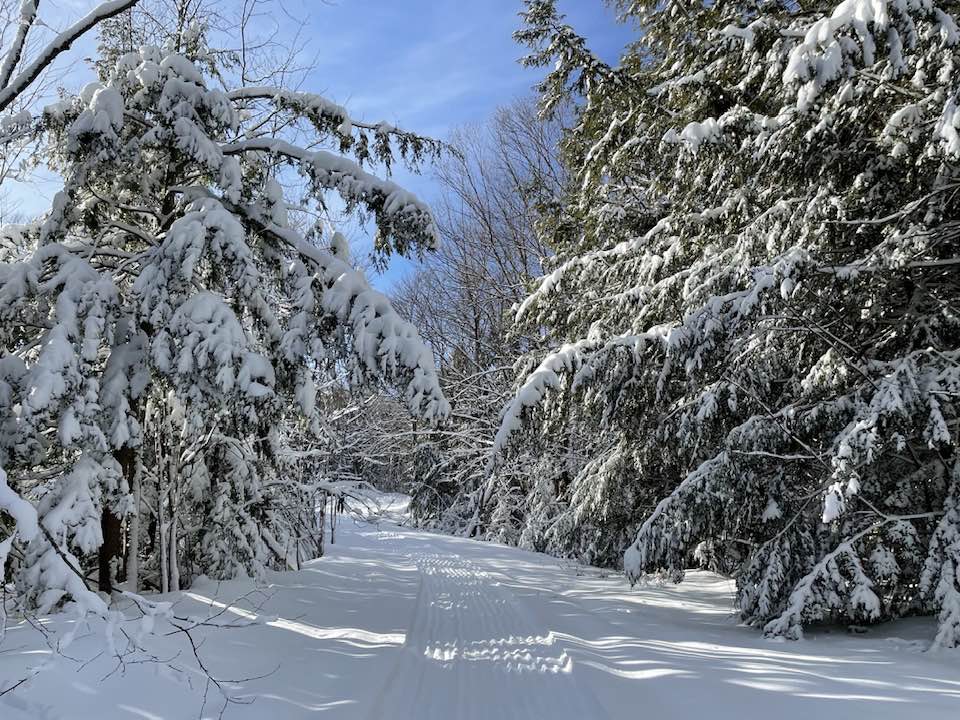
I stole this image of a ski trail up there above the bridge, the Mackinaw Bridge I mean, was taken by my friend Katie who live up there and swears that she loves it.
For myself, I guess, all I need is the picture and that is as close as I want to get.
Mr. Harrison, and he was the UP’s biggest fan, said this:
Above the Straits of Mackinac, the Upper Peninsula sat alone, perhaps the least-known land mass in the United States.
In this age where every niche on earth has been discovered and rediscovered countless times, there is an open secret why the upper Midwest is generally ignored: it is relatively charmless, and it competes with Siberia for the least hospitable climate on earth.
On the other side of the river, the road entered an enormous swamp some thirty miles in width, with very few other cars on the road. For a while the lack of any traffic caused a vertigo as if I had been abandoned.
Apparently on a Thursday night in May in the Upper Peninsula no one goes anywhere, but then where would they go?
[Enter] the UP, as it’s called, [You] enter a timbered-over, rock-strewn waste, a land so dense and desolate it became obvious to me that the most redoubtable survivalist couldn’t survive.
On the other hand I live in resort town and it is the off season.
Apparently on a Monday night in January in the Low Country no one goes anywhere, but then where would they go?
The picture makes a nice contrast to my usual ocean side views.
The Google says where I am and where this this picture was taken are about 1200 miles and about 14 degrees of latitude apart distance wise.
But where it really counts, the google says it is 7 degrees Fahrenheit right now up north while it is 67 degrees down here.
No wonder vegetable gardening isn’t a big item up here, while the making of gravy is a science.
Ms. Stockman writes: Given their résumés, one might think that Tony Perkins, the president of the Family Research Council, and Anurima Bhargava, who worked in President Barack Obama’s Justice Department, would be adversaries — if they ever crossed paths at all. Yet, over the past five years, they have managed to forge a bond that transcends politics and proves that you don’t have to agree on values here at home to promote basic human rights abroad.
But they found common ground.
“Wrong things bother her,” Mr. Perkins told me. “And wrong things bother me.”
Ms. Stocmman quotes Ms. Bhargrava, “He’d treated her with respect from the first moment she met him, Ms. Bhargava told me. He made an effort to learn how to pronounce her name, even as another Republican commissioner refused to do so. They sat next to each other at a dinner retreat in North Carolina and started chatting.“
The friendship made her realize that “respect and trust don’t require agreement,” she [Anurima Bhargava] said.
Friendship.
Respect.
Trust.
Post hoc ergo propter hoc, the Romans liked to say.
In its most common usage the saying is used to disprove an argument.
‘With this, therefore because of this’ is the translation and it usually means event B followed event A so event B MUST HAVE BE CAUSED BY event A.
But in this case.
Friendship.
Trust.
Respect.
Not only can they depend on each other, but the parts in the equation, they might be interchangeable.
Maybe it is better to say of three things, it is hard to have any of one of these three without the other two.
Perhaps the key here is that while all of these there things need the other, none of the three require agreement.
Ms. Stockman closes with the comment:
[Mr. Perkins’] friendship with Ms. Bhargava hasn’t changed his core beliefs, he told me.
He still fights for Bible-believing Christians, whom he views as under attack in the West. But he has changed how he expresses himself.
In an age when others write over-the-top tweets just to outrage their political opponents, he chooses his words more carefully and imagines his good friend is listening.
times when picture worth thousand words – what happened to Great in Great Britain
It was Oscar Fingal O’Flahertie Wills Wilde, the Irish writer, who said, “Life imitates Art far more than Art imitates Life“.
Mr. Wilde felt that the reason life imitated art was the, “… result not merely from Life’s imitative instinct, but from the fact that the self-conscious aim of Life is to find expression, and that Art offers it certain beautiful forms through which it may realize that energy.”
I have no problem with this.
And I suppose there are no rules or guidelines as to which art to imitate.
And it seems that Great Britain has decided to skip ‘The Thick of It’ and ‘Yes Minister’ and go straight to imitate Monty Python.
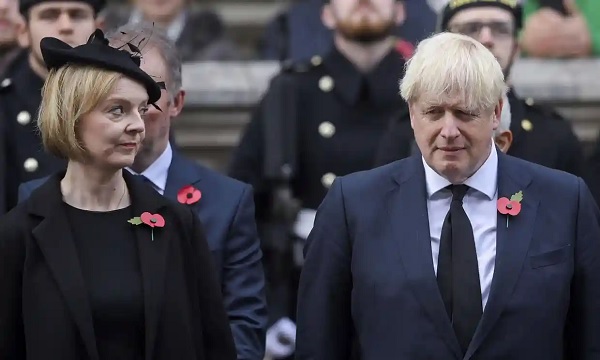
I feel that all I have to say or can say on the subject is illustrated in the above photo.
Who are these people?
From what slime at the bottom of a genetic gene pool were they scrapped up and presented to the world as viable political leaders?
Oh Boy Howdy, but do I love this photograph.
It says it all.
All you need to know about what happened to the Great in Great Britain.
I put it to you that you had been able to take this photograph to Graham Chapman, John Cleese, Terry Gilliam, Eric Idle, Terry Jones, and Michael Palin and asked, can you come up with a sketch that presents these two as the leaders of Great Britain, they might have said it was possible, but even in the World of Monty Python, who would believe it?
According to Wikipedia, “[The British Empire] At its height, was the largest empire in history and, for over a century, was the foremost global power. By 1913, the British Empire held sway over 412 million people, 23 per cent of the world population at the time, and by 1920, it covered 35.5 million km2 (13.7 million sq mi), 24 per cent of the Earth’s total land area.”
Great Britain WAS Great.
There were leaders who put the GREAT in Great Britain and it was felt all around the world.
Not arguing here if that was good or bad but I will say this.
I remember talking with a friend years ago who had just spent time in Canada and Australia and I asked her what she felt those folks thought about the US and the relationship with Britain and those countries.
Her response was that the people she met regarded the US as the country that was able to get out, but I digress.
As I was saying, one time Britain had a hand in the live of a quarter of the worlds peoples and a say over a a quarter of the lands available in the world.
Now they make deals where they don’t even know if they are or aren’t or maybe might be in charge of Northern Ireland.
Ms. Hyde writes that these leaders fell they failed because their, ” … visions have been betrayed by someone or other in one way or another, when the reality is they were undone by such trifles as “the voters”, “reality” and “the consequences of their own actions”.
Ms. Hyde finishes with “it’s possible – just possible – that the real victims of betrayal are not all these politicians, but the public.”
As the Pythons would say, “Now … for something completely different …”
fascinating thing practitioners of these kinds of fabrications
is how easily disprovable their falsehoods turn out to be so
Adapted from:
The fascinating thing about Santos, and other practitioners of these kinds of fabrications, is how easily disprovable their falsehoods turn out to be.
If compulsive lying has its roots in something deeper and more complicated than mere self-advancement, you assume the risk-taking is part of the appeal.
Psychologically, Santos’s claims appear akin in scale, impulse and thrill-seeking to a man running across a football field naked, each more lurid and exposing than the last.
It’s a serious thing to mislead the electorate and lie to members of Congress, with a much more damaging fallout than the lies of a fake heiress trying to score a free holiday.
Still, in both cases, the fascination with the workings of compulsive liars is the same.
Scrutinising photos of Santos’s blank and babyish face triggers the vertiginous possibility inherent in all really big grifts – and one, possibly, deserving of sympathy, although who knows – that he has come to believe all this stuff himself.
There are a lot of $5 dollar words in this article and I have to admire how Ms. Brockes weaves them into the narrative with seemingly so little effort.
As for the subject of the piece, well, with so many liars in America, don’t they deserve someone in Congress too?


 No Haiku For You