5.26.2021 – what is said, not said

what is said, not said
have to listen to not hear
what I did not say

What is a haiku?

Anyone who reads this blog will tell you that I am the last one to answer that question.

I just write them.

I recently wrote a series of haiku that I felt was one haiku with five stanzas.

Was this allowed I wondered.

I knew who to ask.

My brother Pete teaches a class on poetry, through no fault of his own, at Michigan State University [sic].

I asked him if my use of the word stanzas ‘worked’ when constructing haiku.

He responded much to the point and with words much better than I ever could have brought together.

Pete said:

…does this work? Hmmm…

Well, yes, it works if it accomplishes the purpose you intend for it.

But is it a “haiku in five stanzas”?

That is little like saying, “I have a car with wings that flies.” You can call it that if you want to, but if you brought it to 456 Auto Fix, Hendrick would tell you that is not a car – it’s a plane.

Historically, the most popular Japanese poem form was called a Tanka, consisting of 5 lines and 31 syllables. The first three lines were 5-7-5 syllables, and the last two lines were 7-7.

Among the common people, a kind of slam poetry was developed, where two poets would try to outdo each other. The first poet would offer the hokku – the first three lines, and the second poet would complete the final two lines. These tanka composed by two poets were called Renga. These Renga were of two types – serious and comic. The comic forms came to be known as haikai.

In the Imperial Court, these Renga could be extended by five more lines, with the poets reversing roles, but still connecting the themes of the previous stanza. This could go on and on, up to 100 lines or more, with the “competitions” becoming highly structured and rule-governed.

Haiku is Basō’s reaction to these long court poems that tended to drone on and on. Instead, he tried to say as much as possible with just three lines. He took the hai from haikai and the ku from hokku, and made ‘haiku’ – and called it complete; no poetic completion or response or extension was necessary. It depended on the listener to complete the poem – to connect the dots, so to speak – in his head.

So in a good Japanese haiku, what is unsaid is just as significant – and just as clear to the listener! – as what is spoken. This skill – hearing what is not said – is highly valued not only in Japanese poetry, but also in Japanese life. (It also helps a lot in conversation with your wife!!)

It is a bit like Elijah sensing the presence of God – not in the wind, or the fire, or the earthquake, but in the utter silence – something that sounds like sheer nonsense to the modern western scientific mind. But now I am talking about theology, not haiku.

So a “five stanza haiku” is as oxymoronic as a long shortcut or a tall midget.

Too many words…!

And that is pretty much everything I know about Haiku…

Thanks for sharing your words and thoughts, and for all the things you didn’t write…

From what my brother says, it seems that these haiku competitions were the rap battles of 8 Mile fame in Imperial Japan.

It struck me that I often leave a lot unsaid in my ‘haiku’, hoping that the reader will catch what is unsaid.

And it struck me that to hear what is unsaid one has to listen more closely to what is being said to hear what is being unsaid or not being said to avoid the 1984isms of unsay.

As Chief Dan George said in the movie, “Outlaw Josey Wales”, I will endeavor to persevere.

And thank you all for not listening … I think?

I can hear you fine – I am NOT listening – Me circa 1962?? – Not much changed

As I am so fond of quoting, like Frank Lloyd Wright liked to say, “There you are.”

PS: The use of [sic] with Michigan State University implies that the error is in the original or “Michigan State University as it is understood.”
5.25.2021 – there is a corpus,

there is a corpus,
congenital attitudes,
found in everyone

a way of thinking
of ineradicable
doctrines determine

one’s reactions to
persons ideational
lone environment

In fact, primary
attitudes will constitute
essential person

understanding of
place, function as member of
human society

Part of the Mencken Project.

From THE AMERICAN CREDO: A Contribution Toward the Interpretation of the National Mind

By George Jean Nathan and HL Mencken, 1920

From the line: “deep down in every man there is a body of congenital attitudes, a corpus of ineradicable doctrines and ways of thinking, that determines his reactions to his ideational environment as surely as his physical activity is determined by the length of his tibiæ and the capacity of his lungs. These primary attitudes, in fact, constitute the essential man. It is by recognition of them that one arrives at an accurate understanding of his place and function as a member of human society;”

The first multi stanza haiku I ever wrote.

The question then, what are these primary attitudes?

That is what this Mr. Mencken and Mr. Nathan attempted to gather together in this book.

Mencken writes, “Well, here is an attempt to assemble in convenient form, without comment or interpretation, some of the fundamental beliefs of the largest body of human beings now under one flag in Christendom. It is but a beginning. The field is barely platted. It must be explored to the last furlong and all its fantastic and fascinating treasures unearthed and examined before ever there can be any accurate understanding of the mind of the American people.”

Then they two list some 488 odd things that back in 1920 may have been what we call ‘accepted wisdom.’

#411 – That if one’s ear itches it is a sign that some one is talking of one.

Many have not passed the test of time.

#384 – That all Japanese butlers are lieutenants in the Japanese Navy and that they read and copy all letters received by the folks they work for.

Some of these ‘fundamental beliefs’ that are beyond acceptability today I will attribute Mr. Nathan.

Why should I give Mr. Mencken a pass and not Mr. Nathan on some of their comments?

Mr. Nathan seems to be that brilliant man who would have been mad and angry and prejudiced in any era.

Mr. Mencken just disliked everyone.

Maybe we should re-write them for today?

While the list of things needs updating.

I am not sure the opening preface does.

5.24.2021 – much thinking marked

much thinking marked
by blowsy vacuity
disregard of facts

For the Mencken Project

Adapted from the Minority Report by HL Mencken 1956

The line reads, “… and I sometimes suspect that it may be the main cause of the blowsy vacuity which marks so much of the so-called thinking of mankind. What ails that thinking, two times out of three, is simply its disregard of large categories of essential facts …”

Blowsy?

Having a sloppy or unkempt appearance or aspect.

Vacutiy?

Lack of thought or intelligence; empty-headedness.

Put them together?

An unkempt lack of intelligence or a sloppy empty-headedness.

5.23.2021- Best thing about him?

Best thing about him?
Was very equanimous!
About her? Chose word
.

Okak, okay, okay.

I admit it.

I look forward each Saturday to reading the Blind Date feature in the Guardian.

The Guardian Newspaper sets up a blind date at a London area restaurant and then the two participants answer a list of questions about the date.

I like the descriptions of the restaurants and one of the questions is, Table Manners?

Lots of good answers here like “Outstanding. Unlike me, he ate the pizza with a knife and fork, and didn’t spill anything on himself.”

Also they are back in real restaurants now and not ordering ‘take away’ and meeting on Zoom.

The final question is “Would you meet again?

You get really great answers here.

Like, “Maybe if I was biking past him in the park, I would wave of course,” or, “For sure, we’re both in need of some pub exploration.”

I was struck by the column yesterday by the young lady’s response to the question, Best thing about him?

Her response was, “He was very equanimous.”

I have no idea when the questions about the date are asked.

I don’t know if they are talking on the phone with the reporter or if they are filling out an online questionnaire and have access to an online thesaurus.

Equanimous.

Equanimous?

Boy Howdy! How about that!

How would you like to be described by a word that you had to look up?

How would you like to be described by a word that you had to guess at its meaning.

My first guess was that it meant I was like a horse or had horse like qualities, what ever those might be.

Looking it up it means, possessing or displaying equanimity.

Which means possessing or displaying an evenness of mind especially under stress.

A calm dispositon.

I realized why I wasn’t familiar with the word.

No one has ever described me as possessing or displaying an evenness of mind especially under stress.

I had been described once as l lackadaisical.

When I looked a question at my teacher she looked me in the eye and said ‘goofy smart.’

We left it at that.

I remember once in a loud vocal Newsroom argument I made a strong defense of NOT doing something and someone pointed out that what I said could be considered ‘The Voice of Reason.’

To which someone else yelled, ‘When it comes down to Hoffman being the voice of reason, we know we are in trouble.’

But I digress.

Equanimous.

What a great word.

Maybe that was the best thing about him.

The best thing about her, for me, was that she chose the word.

PS for the record, HIS answer to the Best thing about her was, ‘Beautiful eyes and an easy smile’.

Here you can read it for yourself.

5.22.2021 – Ask, what can I do?

Ask, what can I do?
Can you postpone nightfall? That
is when the bombs fall.

Came across this phrase and it hit me hard.

Can you postpone nightfall?

It was in an essay written by a Palestinian now living in Australia.

She was writing about living with the recent turmoil in the Middle East through phone calls home.

When she closed call she asked, “What can I do?”

The response was “Can you postpone nightfall, that is when the bombs fall.”

Not taking sides here.

I have read a lot of history and a lot of history is military.

A lot of history is war.

War is ‘politics by other means’.

But that seems too simple.

In the grand scope of world history, what great invention, what great increase in knowledge and machines did not find an almost instant application in war.

At one time the greatest military weapon that separated the winners from losers was the stirrup.

A Knight with stirrups could keep his balance and use a sword effectively without falling off.

Few inventions have been so simple as the stirrup, but few have had so catalytic an influence on history, so says Wikipedia.

Gunpowder.

Telescopes.

Sailing Ships.

Motors.

The Wright Brothers first flew in 1903.

By World War 1, 1914, planes were part of the battlefield.

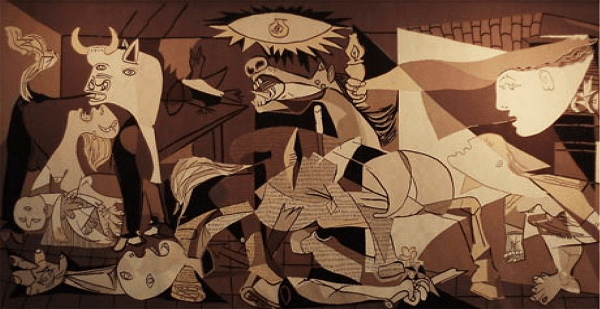
Still when the Hermann Goering’s Nazi Air Force bombed the city of Guernica as part of the Spanish Civil War in 1937 (it’s complicated) the world was shaken, but maybe, not surprised.

Without Picasso’s painting of Guernica, the world would have forgotten about this a long time ago.

A digression but maybe this is what art is all about as it doesn’t let us forget.

I recently finished a good read titled The Last Bookshop in London.

A fictionalized account of life in London during the blitz of World War 2.

What came across for me was the utter randomness with which the bombs fell.

We have been flying around dropping bombs on each other ever since the plane was invented.

Reading the articles about the Middle East again I am struck by the utter randomness of the destruction.

I can think of a lot of words that describe a world where this happens.

Civilized is not one of them.

I think of the saying that the number one proof of intelligent life in the universe is that no one has wanted to contact us.

The frustration builds.

The desire to do something, anything builds.

But what can you do?

Can you postpone nightfall?