I ran across confabulate in a wonderful paragraph in my reading the other day.
In the Social Animal, David Brooks writes, “The unconscious mind merely confabulates stories that try to make sense of what the unconscious mind is doing of it own accord.”
I liked the word confabulate.
I was pretty sure I had heard it before.
I was pretty sure I knew what it meant.
I looked it up to make sure.
The first definition, engage in conversation; talk, seemed to apply to Brooks’ use of the word.
There was a 2nd definition listed.
PSYCHIATRY fabricate imaginary experiences as compensation for loss of memory
That definition demanded more investigation.
My question, is the confabulator making things up on purpose?
Telling a lie in other words?
Or are these imaginary memories born out of frustration for lack of real memory?
Or are these imaginary memories there because that is how the confabultor really remembers them?
The online Merriam-Webster dictionary gives this use of the word, ” A major characteristic of brain-damaged patients is the tendency to confabulate—to hide and dissemble about their damage.”
To me that sounds like its all made up except that it refers to brain damaged people?
Merriam-Webster also states, ” Confabulate is a fabulous word for making fantastic fabrications. Given the similarities in spelling and sound, you might guess that “confabulate” and “fabulous” come from the same root, and they do – the Latin fabula, which means “conversation, story.” Another “fabula” descendant that continues to tell tales in English is “fable.” All three words have long histories in English: “fable” first appeared in writing in the 14th century, and “fabulous” followed in the 15th. “Confabulate” is a relative newcomer, appearing at the beginning of the 1600s. “
take 10 everyone movies, yes, need in real life who is in charge here?
It happens in movies and on TV where a group of people, all engaged in some effort, reach a point of confusion or performance or something and the person in charge yells, “take 10 everyone” and all work stops and everyone can go off to their own little corner and regain focus, think or just do nuthin.
I need that today.
I need someone in charge to yell ‘Take 10 Everyone” and I can go off in my corner and do nuthin.
In that 10 I also want my head to stop hurting.
My brain to stop thinking.
My stomach to stop churning.
My eyes to focus.
My knees stop aching.
My sinuses to clear up.
My sense of smell to come back.
Just for 10.
Just 10 for me myself.
10 what?
10 minutes I guess but I would settle for 10 seconds some days.
10 hours would be really nice but I won’t hold my breathe.
10 days, hmmmmmmm.
10 weeks, oh come on.
Just a short break.
But I want to be conscious of the passage of time.
I don’t want to close my eyes and have it be 10 minutes later.
I think that some people smoke so they can take a break and sit with a burning cigarette just to watch those beautiful trails of smoke go by as time passes.
troubles we suffer memory of pain drips in hearts so we gain wisdom
Wisdom comes through suffering. Trouble, with its memories of pain, Drips in our hearts as we try to sleep, So men against their will Learn to practice moderation. Favours come to us from gods.
― Aeschylus, Agamemnon
Aeschylus (c. 456/455 BC) was an ancient Greek tragedian. He is often described as the father of tragedy. Academics’ knowledge of the genre begins with his work, and understanding of earlier tragedies is largely based on inferences from his surviving plays. According to Aristotle, he expanded the number of characters in the theater and allowed conflict among them; characters previously had interacted only with the chorus. (Wikipedia)
Agamemnon
Aeschylus begins in Greece describing the return of King Agamemnon from his victory in the Trojan War, from the perspective of the towns people (the Chorus) and his wife, Clytemnestra. However, dark foreshadowings build to the death of the king at the hands of his wife, who was angry at his sacrifice of their daughter Iphigenia, who was killed so that the gods would restore the winds and allow the Greek fleet to sail to Troy. She was also unhappy at his keeping of the Trojan prophetess Cassandra as a concubine. Cassandra foretells of the murder of Agamemnon, and of herself, to the assembled townsfolk, who are horrified. She then enters the palace knowing that she cannot avoid her fate. The ending of the play includes a prediction of the return of Orestes, son of Agamemnon, who will seek to avenge his father. (Wikipedia)
that awful question each morning, again at noon what is in my lunch?
Before we begin let me say that I understand that the ‘awful question’ I will be discussing would be a welcome issue in much of the United States and the world for that matter.
That being said, it is an awful question.
I question I face each work day and have faced since about 1972 when I started bringing my lunch with me to Riverside Junior High School.
Not, “What is for lunch?”
But, “What is in my lunch?”
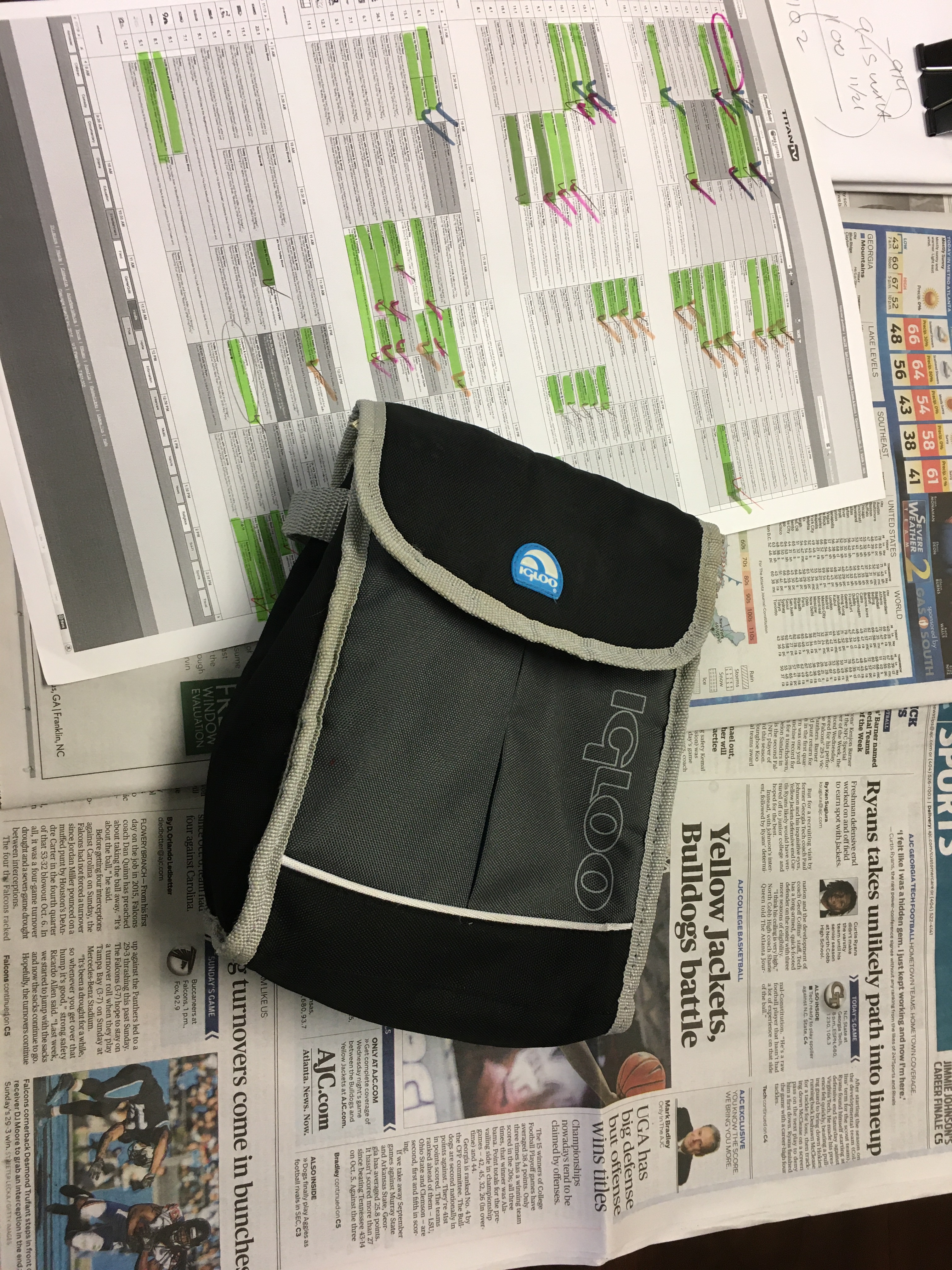
I make and pack my own lunch each morning.
I dread it.
For one thing, coffee is about the only thing I want when I get up.
Coffee is about the only thing that my stomach will stomach.
There was a time when my favorite breakfast was an ice cream sandwich.
There was a glorious period in history when Oreo Ice Cream sandwiches were available.
At my age, that just doesn’t seem appropriate, so coffee it is.
How then, with food not something I want to think about, can I make a lunch?
I watch the clock and as the minutes run out of morning, I say to myself, “Got to do it!”
At this point, all I want is to get this over with.
What is the fastest sandwich I can make?
I check the fridge.
Any cold cuts?
Cheese?
Any packable fruit?
I make an uninspired sandwich as quickly as I can.
I start with and empty cold cut container to hold the sandwich.
We save these containers and their lids for leftovers and such.
I like these better than a baggie as I have eaten too many peanut butter sandwiches that have been squashed flat.
I take the empty container and toss in a piece of bread.
Then I drop a slice of cold cuts or cheese or cold cuts and cheese or maybe spread peanut butter on it.
Then another piece of bread on top and snap on the lid.
The sandwich is done and in the lunch bag.
Now the chips or pretzels or maybe, if I am really lucky, some oreos which I put into another plastic container and into the lunch bag.
Is there any fruit?
An apple, orange or banana?
If the oranges are clementines, I pack 2.
If its a banana, I have to think if its edible.
I have to ask that question because my wife likes bananas to be light green and chewy
How she can eat an unripe banana is beyond me.
There are some days when we have leftovers.
A container of lasagna or chicken alfredo is more than lunch, its a relief that I don’t have to make anything.
Often at dinner the night before, I get excited when I see that there are leftovers for my lunch.
I will be sitting with my coffee and watching the clock move and say to myself, lunch is ready to be packed up, and I sit for one more minute with a smile for my good fortune.
I slide the container in my lunch bag.
Wrap a fork in napkin.
A plastic fork?
Well.
That just isn’t right is it.
I drop the fork into the lunch bag and seal up the Velcro flap.
Lunch is packed in my back pack.
That should clear up any mystery as to what is in my lunch bag each day but, for me, the question still nags at me.
When lunch time rolls around, which is 11AM for me, I still ask myself, “What’s in my lunch?”
I am hungry now and hopeful.
Even though, I know the answer.
I am reminded of the summer when my brother, Tim, worked in construction.
He needed at least three sandwiches a day.
But he couldn’t stand the thought of, one, having to make them, and, two, knowing what was in his lunch.
Not that he was any master of the kitchen.
I have a memory of him standing in the kitchen holding an empty water pitcher and a can of instant powdered lemonade and saying to me, “do you know how to make this?”
Anyway, my brother Tim started paying my brother Pete a dollar a day to make his sandwiches.
That lasted until there was an argument over the selection of sandwiches.
Tim wanted them all different,
Pete felt that a ham sandwich with a slice of cheese WAS different from a cheese sandwich with a slice of ham.

 No Haiku For You