hearing history sounds of summer times long past … was another time
Years and years ago, my Dad took us kids on a spring trip and we traveled south.
When I was 9, my brother Paul got married and moved to the suburbs of Washington DC so our usual spring trip destination was to see Paul and his family and visit Washington.
But one year, my brother took a short-term posting to California and my Dad said we were going south.
This was a small group of just me and my sister Lisa and my little brothers Pete, Steve and Al.
It was a trip marked by breakfasts in the pre-Egg-McMuffin era at little local diners with us kids saying, I am not eating those grits.
We went to Shiloh Battlefield and the Land Between the Lakes in Kentucky and stopped at Mammoth Cave.
It was in an odd little gift shop near Mammoth Cave that my mom found The Gong.
The gong was the ugliest wind chime ever made with two hollow mishappen brass cylinders suspended on either side of a lump of iron the size of a golf ball.
It had an Alexander Calderesque quality to it and it gave off the deepest, loudest … GONG SOUNDS you ever heard.
The chime was hung from the ceiling in the kitchen of the cottage where my family spent our summers.
Lucky for us, it took a near hurricane to get it to move at all so we rarely heard it.
It rang more often when the grand kids would reach out from the stairs and take a swing at it to make it GONG.
But when there were storms, we knew it.
And that is where I am today.
I inherited the chime and it has traveled with my family and hung from porches and balconies all the Atlanta area and now, here in South Carolina.
Last night, the county schools were closed down here due to a forecast of ‘HIGH WINDS’ and storms.
As I sat by the window this morning with my morning coffee, I could hear the wind and, from time to time, a soft gong.
The sound echoed in my head to my heart.
Closing my eyes I was back 40 years ago.
On the shore of Lake Michigan.
I was hearing the sound of my family history.
The sound of summer times long past.
Boy Howdy but it was another time.
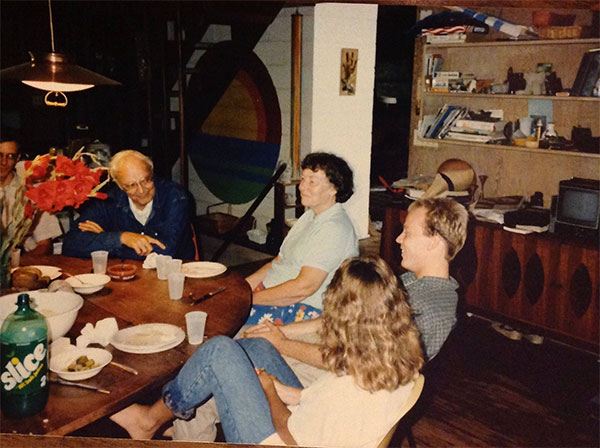
(You cannot see it, but the chime hung back in the upper left corner just in front of the side of the stairs – those stairs, by the way, were completely open on the bottom with a 20 foot drop to the basement, with no rails and open on one side and spaced vertical poles on the other – that you could reach through and push the chime – parents worried for lots of crawling babies but so far as I remember only my little brother Al every fell through)
justice is coming and everybody seems to … to be dreading it
Adapted from the line: Inside the Richard J. Daley Center, they passed through security scanners and took the elevator to the sixteenth floor. The place was bustling with lawyers and litigants, clerks and cops, either hustling about or huddled in little pockets of serious conversations. Justice was looming, and everyone seemed to be dreading it.
In the book, The Litigators by John Grisham.
Really nothing from nowhere about anything in particular but the idea of the folks in this current Executive Branch of the Government are, in the back of their minds, in their hearts, where they are truly honest with themselves at 3 in the morning, there are thinking this.
it is better to have ring of freedom in your ears than in your nose
The Bears and the Monkeys.
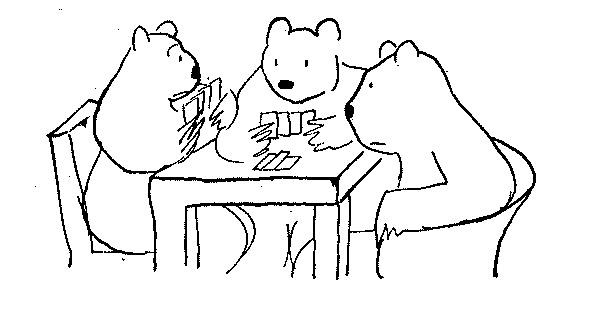
In a deep forest there lived many bears. They spent the winter sleeping, and the summer playing leap-bear and stealing honey and buns from nearby cottages. One day a fast-talking monkey named Glib showed up and told them that their way of life was bad for bears. “You are prisoners of pastime,” he said, “addicted to leap-bear, and slaves of honey and buns.”
The bears were impressed and frightened as Glib went on talking. “Your forebears have done this to you,” he said. Glib was so glib, glibber than the glibbest monkey they had ever seen before, that the bears believed he must know more than they knew, or than anybody else. But when he left, to tell other species what was the matter with them, the bears reverted to their fun and games and their theft of buns and honey.
Their decadence made them bright of eye, light of heart, and quick of paw, and they had a wonderful time, living as bears had always lived, until one day two of Glib’s successors appeared, named Monkey Say and Monkey Do. They were even glibber than Glib, and they brought many presents and smiled all the time. “We have come to liberate you from freedom,” they said. “This is the New Liberation, twice as good as the old, since there are two of us.”
So each bear was made to wear a collar, and the collars were linked together with chains, and Monkey Do put a ring in the lead bear’s nose, and a chain on the lead bear’s ring. “Now you are free to do what I tell you to do,” said Monkey Do.
“Now you are free to say what I want you to say,” said Monkey Say. “By sparing you the burden of electing your leaders, we save you from the dangers of choice. No more secret ballots, everything open and aboveboard.” For a long time the bears submitted to the New Liberation, and chanted the slogan the monkeys had taught them: “Why stand on your own two feet when you can stand on ours?”
Then one day they broke the chains of their new freedom and found their way back to the deep forest and began playing leap-bear again and stealing honey and buns from the nearby cottages. And their laughter and gaiety rang through the forest, and birds that had ceased singing began singing again, and all the sounds of the earth were like music.
MORAL: It is better to have the ring of freedom in your ears than in your nose.
Fables for Our Time and Famous Poems Illustrated by James Thurber, New York, Harpers, 1940.
I would be remiss if I did not mention that the Federal Reserve Bank said today that:
The GDPNow model estimate for real GDP growth (seasonally adjusted annual rate) in the first quarter of 2025 is -2.8 percent on March 3, down from -1.5 percent on February 28. After this morning’s releases from the US Census Bureau and the Institute for Supply Management, the nowcast of first-quarter real personal consumption expenditures growth and real private fixed investment growth fell from 1.3 percent and 3.5 percent, respectively, to 0.0 percent and 0.1 percent.
Bills do come due and a fall of GDP from -1.5 to a -2.8 in five days is rather stunning.
This is the New Liberation, twice as good as the old, since there are two of us.
be dizzy now turn your head upside down see how world looks upside down
Spring is when the grass turns green and glad. Spring is when the new grass comes up and says, “Hey, hey! Hey, hey!” Be dizzy now and turn your head upside down and see how the world looks upside down. Be dizzy now and turn a cartwheel, and see the good earth through a cartwheel.
Tell your feet the alphabet. Tell your feet the multiplication table. Tell your feet where to go, and, and watch ‘em go and come back.
Can you dance a question mark? Can you dance an exclamation point? Can you dance a couple of commas? And bring it to a finish with a period?
Can you dance like the wind is pushing you? Can you dance like you are pushing the wind? Can you dance with slow wooden heels and then change to bright and singing silver heels? Such nice feet, such good feet.
Lines Written for Gene Kelly To Dance To by Carl Sandburg as published in The Complete Poems of Carl Sandburg (revised and updated).
Dancing feet?
Such good feet?
Spring is when the grass turns green and glad.
Spring is when the new grass comes up and says, “Hey, hey! Hey, hey!”
Spring is when the new grass puts so much pollen in the air that I am dizzy now and I turn my head upside down and see how the world looks upside down and can’t breath and think my head is going to explode.
these are simple things dignity, independence, their children, that’s all
The Reuters News Agency compiled a list of social media reactions to a meeting between the President of Ukraine and the current president of the United States.
It is a fairly impressive list.
There are folks who won’t care, who feel this was brought on by an aggressor nation of Ukrainians bent on taking over Russia.
There are folks who will say ATTA BOY DONNY.
As Huck Finn said, “Right is right, and wrong is wrong, and a body ain’t got no business doing wrong when he ain’t ignorant and knows better.”
Here are the Reponses.
ZELENSKIY ON X “Thank you America, thank you for your support, thank you for this visit. Thank you @POTUS, Congress, and the American people. Ukraine needs just and lasting peace, and we are working exactly for that.”
In a social media post on Saturday:
“It is very important for us that Ukraine is heard and that no one forgets about it, neither during the war nor after. It is important for people in Ukraine to know that they are not alone, that their interests are represented in every country, in every corner of the world.”
CANADIAN PRIME MINISTER JUSTIN TRUDEAU ON X “Russia illegally and unjustifiably invaded Ukraine. For three years now, Ukrainians have fought with courage and resilience. Their fight for democracy, freedom, and sovereignty is a fight that matters to us all. Canada will continue to stand with Ukraine and Ukrainians in achieving a just and lasting peace.”
GERMAN CHANCELLOR OLAF SCHOLZ “No one wants peace more than the citizens of Ukraine! That is why we are jointly seeking the path to a lasting and just peace. Ukraine can rely on Germany – and on Europe.”
FRENCH PRESIDENT EMMANUEL MACRON TO REPORTERS IN PORTUGAL: “Russia is the aggressor, and Ukraine is the aggressed people. I think we were all right to help Ukraine and sanction Russia three years ago, and to continue to do so. We, that is the United States of America, the Europeans, the Canadians, the Japanese and many others. And we must thank all those who have helped and respect those who have been fighting since the beginning. Because they are fighting for their dignity, their independence, their children and the security of Europe. These are simple things, but they’re good to remember at times like these, that’s all.
ITALIAN PRIME MINISTER GIORGIA MELONI “Every division of the West makes us all weaker and favours those who would like to see the decline of our civilisation. Not of its power or influence, but of the principles that founded it, first and foremost freedom. A division would not benefit anyone. What is needed is an immediate summit between the United States, European states and allies to talk frankly about how we intend to deal with the great challenges of today, starting with Ukraine, which we have defended together in recent years, and those that we will be called upon to face in the future. This is the proposal that Italy intends to make to its partners in the coming hours.”
SPOKESPERSON FOR BRITISH PRIME MINISTER KEIR STARMER “He retains his unwavering support for Ukraine and is playing his part to find a path forward to a lasting peace, based on sovereignty and security for Ukraine.”
AUSTRALIAN PRIME MINISTER ANTHONY ALBANESE “We will continue to stand with Ukraine for as long as it takes, because this is the struggle of a democratic nation versus an authoritarian regime led by Vladimir Putin, who clearly has imperialistic designs, not just on Ukraine, but throughout that region.”
CANADIAN FOREIGN MINISTER MELANIE JOLY ON X “Canada remains committed to providing the necessary assistance to ensure Ukraine’s security, sovereignty, and resilience.”
DENMARK’S FOREIGN MINISTER LARS LOKKE RASMUSSEN ON FACEBOOK “It’s a punch in the gut for Ukraine. … There must be room for robust conversations – even between friends. But when it happens in front of rolling cameras like that, there is only one winner. And he sits in the Kremlin.”
FORMER RUSSIAN PRESIDENT DMITRY MEDVEDEV, DEPUTY CHAIRMAN OF RUSSIA’S SECURITY COUNCIL, ON TELEGRAM “A brutal dressing down in the Oval Office.”
EUROPEAN COMMISSION PRESIDENT URSULA VON DER LEYEN ON X “Your dignity honors the bravery of the Ukrainian people. Be strong, be brave, be fearless. You are never alone, dear President. “We will continue working with you for a just and lasting peace.”
MOLDOVAN PRESIDENT MAIA SANDU ON X “The truth is simple. Russia invaded Ukraine. Russia is the aggressor. Ukraine defends its freedom – and ours. We stand with Ukraine.”
SPANISH PRIME MINISTER PEDRO SANCHEZ ON X “Ukraine, Spain stands with you.”
HUNGARIAN PRIME MINISTER VIKTOR ORBAN ON X “Strong men make peace, weak men make war. Today President @realDonaldTrump stood bravely for peace. Even if it was difficult for many to digest. Thank you, Mr. President!”
NORWEGIAN PRIME MINISTER JONAS GAHR STOERE IN STATEMENT TO TV2 “What we saw from the White House today is serious and disheartening. Ukraine still needs the US’s support, and Ukraine’s security and future are also important to the US and to Europe. President Volodymyr Zelenskiy has strong support in Ukraine, broad support in Europe, and he has led his people through a very demanding and brutal time, under attack from Russia. That Trump accuses Zelenskiy of gambling with World War III is deeply unreasonable and a statement I distance myself from. Norway stands with Ukraine in their struggle for freedom. We hope that the Trump administration also understands the importance of a just and lasting peace in Ukraine.”
CZECH PRESIDENT PETR PAVEL ON X “We stand with Ukraine more than ever. Time for Europe to step up its efforts.”
DUTCH PRIME MINISTER DICK SCHOOF “The Netherlands continues to support Ukraine. Especially now. We want lasting peace and an end to the war of aggression that Russia has started. For Ukraine, for all its inhabitants and for Europe.”
ESTONIAN FOREIGN MINISTER MARGUS TSAHKNA ON X “The only obstacle to peace is (Russian President Vladimir) Putin’s decision to continue his war of aggression. If Russia stops fighting, there will be no war. If Ukraine stops fighting, there will be no Ukraine. Estonia’s support to Ukraine remains unwavering. Time for Europe to step up.”
POLISH PRIME MINISTER DONALD TUSK ON X “Dear @ZelenskyyUa, dear Ukrainian friends, you are not alone.”
GEORGIAN PRIME MINISTER IRAKLI KOBAKHIDZE “Yesterday, once again, a clear line was drawn between the war party and the peace party. I am referring not so much to the debate between Trump and Zelenskiy, but to the subsequent reactions to this debate. President Trump and his peace efforts were condemned one after another by people responsible for allowing a bloody war and callously sacrificing Ukraine and the lives of thousands of Ukrainians.”
GREEK FOREIGN MINISTER GEORGE GERAPETRITIS U.S. support in the conflict in Ukraine is necessary, although Europe still needs to upgrade its own defence infrastructure, the minister said.
SWISS PRESIDENT KARIN KELLER-SUTTER ON X “Switzerland remains firmly committed to supporting a just and lasting peace, while condemning Russia’s aggression against a sovereign state.”
JOHANN WADEPHUL, DEPUTY OF CONSERVATIVE PARTY-GROUP IN GERMAN PARLIAMENT, THE PARTY OF INCOMING CHANCELLOR FRIEDRICH MERZ, ON X “The scenes from the White House are shocking. How can you stab the president of an invaded country in the back like this? Free Europe will not betray Ukraine!”
ITALIAN DEPUTY PRIME MINISTER MATTEO SALVINI, LEADER OF THE FAR-RIGHT LEAGUE PARTY ON X “Aim for PEACE, stop this war! Come on @realDonaldTrump”.
Reporting by Kate Entringer, Jason Hovet, Andreas Rinke, Anna Wlodarczak-Semczuk, Nerijus Adomaitis, Ron Popeski, Krisztina Than, Ana Cantero Rios; Editing by Howard Goller and Richard Chang.
US Cemetery in Normandy – They died for our freedom today