unmistakable … all in rebuke to rudeness, aggression, greed
Adapted from the article, In Canada, Charles pushed the boundaries of politics as king. So far, he has gotten away with it, by Martin Kettle, where Mr. Kettle writes: No monarch had bothered to make this trip for nearly 50 years. During that time, however, Canada has transformed itself into a major global power and has decisively slipped its old colonial bonds. Yet Trump’s threat to Canada is such that the country’s prime minister, Mark Carney, judged a summons to Buckingham Palace would send a useful newsworthy signal about its national sovereignty that would help bind the nation while sending a shot across the US president’s bows.
At least as significantly, when seen from Britain, King Charles was happy to oblige. Just as with the speech he delivers at Westminster at the start of a parliamentary session, Tuesday’s in Ottawa will have been scripted by the elected government. But the Ottawa speech had a far looser and more personal format than the Westminster version. This allowed the king to speak words that clearly mattered to him, and by which he will be judged.
Trump was not mentioned by name. Even so, he permeated the speech. The king endorsed Canadian national pride and said democracy, law, pluralism and global trade were on the line. He said Canada’s relationships with Europe would be strengthened and, speaking in French, he said Canada faces challenges unprecedented in the postwar era. He was proud that Canada was “an example to the world in her conduct and values, as a force for good”, and he ended, quoting from the Canadian national anthem, by saying “the true north is indeed strong and free”.
All this is an unmistakable rebuke to Trump’s rudeness, aggression and greed. The words are not neutral but committed. Whether the king sought approval from Keir Starmer for his visit and speech is not clear. His main adviser concerning the visit will have been Carney, who may have liaised with Downing Street. Starmer, committed to engaging with Trump, will have been content to keep his distance. The larger point, however, is that this was a willed act by the king. Charles did not have to travel and did not have to make the speech. But he did both, even while continuing to be treated for cancer.
On June 1, 1785, newly appointed ambassador to Great Britain, John Adams told King George III that he wished to restore “the old good nature and the old good humor between people who, though separated by an ocean and under different governments, have the same language, a similar religion, and kindred blood.”
The King seemed equally moved. “I was the last to consent to separation,’ he told his former subject. But, he added, ‘I have always said, as I say now, that I would be the first to meet the friendship of the United States as an independent power.”
That old good nature and that old good humor is in short supply these days on this side.
Instead the current Government offers rudeness, aggression and greed.
Words that clearly matter to some, and by which they will be judged.
Rule: help each other when you can, but never harm — never help the bear
Duff Cooper added: ‘I hope you will forgive me because your friendship, your comradeship and your advice are very, very precious to me.’ Churchill replied on November 22:
Thank you very much for your letter, which I was very glad to get. In the position in which our small band of friends now is, it is a great mistake ever to take points off one another. The only rule is: Help each other when you can, but never harm — Never help the Bear.
Excerpt From: Winston S. Churchill: The Prophet of Truth, 1922–1939 (Volume V) (Churchill Biography Book 5) by Martin Gilbert.
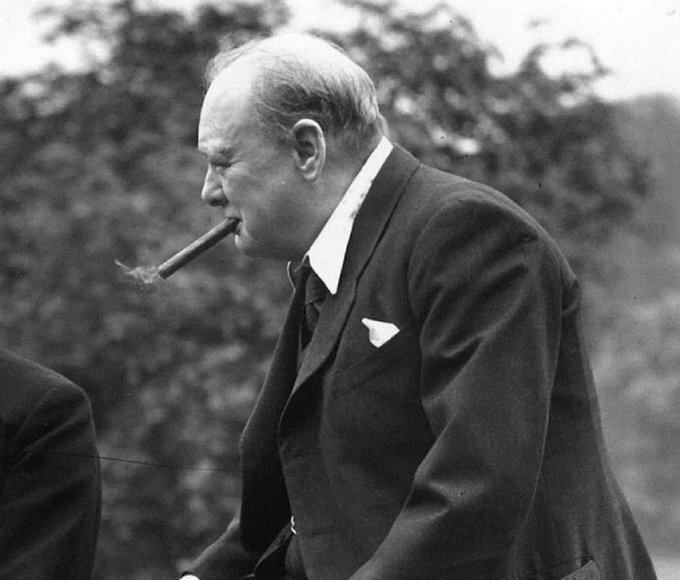
Mr. Churchill had quite the career.
Up – down – up again – down again – up – down.
Biographers like to tell the story how Franklin Roosevelt once said is supposed to have said along the lines that Winston has 100 ideas a day but only one will turn out to be good. Which is okay as he will have another 100 ideas tomorrow.
What is usually included with the quip is that Mr. Churchill heard the story and took umbrage and wanted to know when did he ever have a bad idea.
One idea that took with him was that Hitler was a problem without fixing by anything than removal.
While many sought out accommodation, Mr. Churchill maintained a wall of anti-end-Hitler words.
At one point after the Munich Crisis when the France and Great Britain took Czechoslovakia apart, Mr. Churchill called for a vote question the actions of His Majesties Government and he asked for just 50 members of the House of Commons to vote with him to record the fact that there were some folks who objected to such an action.
Mr. Churchill got 2.
Understand that when the House of Commons votes, the members vote by exiting the House chamber through the yes door or the no door and then the group together in the lobby to discuss the vote.
After this vote, Mr. Churchill stood in the lobby for two other men.
Kind of rubs it in.
Still, he kept at it.
This is the time of Mr. Churchill’s career called The Wilderness Years.
On the outside.
Out of step.
Down.
Has been.
About Mr. Churchill, Herman Wouk wrote:
Winston Churchill, today an idealized hero of history, was in his time variously considered a bombastic blunderer, an unstable politician, an intermittently inspired orator, a reckless self-dramatizer, a voluminous able writer in an old-fashioned vein, and a warmongering drunkard. Through most of his long life he cut an antic, brilliant, occasionally absurd figure in British affairs. He never won the trust of the people until 1940, when he was sixty-six years old, and before the war ended they dismissed him. But in his hour he grasped the nature of Hitler, and sensed the way to beat him: that is, by holding fast and pushing him to the assault of the whole world, the morbid German dream of rule or ruin, of dominion or Götterdämmerung. He read his man and he read the strategic situation, and with the words of his mouth he inspired the British people to share his vision. By keeping back the twenty-five squadrons from the lost Battle of France, he acted toughly, wisely, and ungallantly; and he turned the war to the course that ended five long years later, when Hitler killed himself and Nazi Germany fell apart. This deed put Winston Churchill in the company of the rare saviors of countries, and perhaps of civilizations.
I feel the wilderness is where a lot of Americans are today.
Out of it.
Down.
Take heart.
We need to read the man and the situation.
Anyone of us may be in position to be that rare savior of a country.
In the meantime, help each other when you can, but never harm —
a crime to despair learn to draw from misfortune means of future strength
“It is a crime to despair. We must learn to draw from misfortune the means of future strength. There must not be lacking in our leadership something of the spirit of that Austrian corporal who when all had fallen into ruins about him, and when Germany seemed to have sunk for ever into chaos, did not hesitate to march forth against the vast array of victorious nations, and has already turned the tables so decisively upon them. It is the hour, not for despair, but for courage and re-building; and that is the spirit which should rule us in this hour.”
Excerpt From Winston S. Churchill: The Prophet of Truth, 1922–1939 (Volume V) (Churchill Biography Book 5) Martin Gilbert
to provide for uniform observances public holidays
On June 28, 1968, Congress passed the Uniform Monday Holiday Act, which moved four holidays, including Memorial Day, from their traditional dates to a specified Monday in order to create a three-day weekend. The change moved Memorial Day from its traditional May 30 date to the last Monday in May. The law took effect at the federal level in 1971 all according to Wikipedia.
It is the books as Public Law 90-363 based on House Resolution 15951, “To provide for uniform annual observances of certain legal public holidays on Mondays, and for other purposes.”
The first time this law went into effect would have been Monday, May 31st, 1971.
Had it not been for this law, Memorial Day that year would have been Sunday, May 30th … which means it most likely would have been celebrated on Monday anyway.
I can’t say I remember.
I do remember being bothered that some holidays were being moved just so, as I was told, Government workers could have a three day weekend.
And I think, in my goofy way, I continued to push for celebrating Memorial Day on the 30th and not the last Monday but that was me being me.
My family was big on celebrating Memorial Day or Decoration Day as we called it.
At some point in the week ahead, my Dad would come home with what we called ‘planters’ which were live flowers in a low cardboard box that would fit in the cement funeral urns next to headstones in cemeteries.
The first Memorial Day I remember was the spring of 1965 when I was four as flowers were put on my Grandma Hoffman’s grave for the first time as she had just died on May 18th of the that year.
Grandma Hoffman, for me, was a very special person though I don’t have too many memories of her.
The story that stands out is one told over and over again by many people by the time I was four, is that after I would do something, Grandma would say, “Don’t worry … don’t worry … about Mike … He will turn out okay.”
Not sure what this says, but it says a lot I am sure.
Again … that was being said when I was four.
It was in late May of 1965 that my Dad bought some flowers and took me and my three year old brother Pete and we picked up his sister, my Aunt Marion and we went to Fairplains Cemetery in Grand Rapids where Grandma and Grandpa Hoffman had been buried.
The funeral had been just a few weeks earlier and Aunt Marion pointed with her finger at the grass and said to Pete and I, “See the outline of the grave where the coffin was buried?”
Boy howdy could I see it !
Just after Grandma died, my Dad had brought me and Pete to his office to get us out of the house.
The funeral home, the original Creston Funeral Home, was across Plainfield Avenue from his office and Dad says, “Lets go see Grandma.“
I remember crossing the street in bright sunshine and going through the doors of the funeral home.
One of the undertakers came up and Dad said, “I’d like to see my Mother.”
The undertaker led us down a hall, though a double door into dark room.
The undertaker snapped on some lights, and there, surrounded by flowers was my first coffin.
We walked over and the undertaker fiddled with a latch and opened the lid and there was Grandma.
In my mind, I had stopped breathing when the lights came on and both Pete and I stood stock still.
Dad looked down and told us, “It’s like she is sleeping.”
Oh, okay. Why is she in the box if she is asleep I wanted to ask.
“Do you want a look?” he asked.
No, I am good I said to myself, I am good right here and can see just fine but I guess I nodded yes as Dad picked me with his hands under my arms and leaned me in for a close up.
“You can touch her hand,” he said.
How could I touch her hand when my hands were pulled back into my arms as tight as could be.
No … no … that’s okay, I was thinking but I didn’t want to disappoint Dad so I stuck out a finger for the shortest touch possible.
Then Dad set me down and it was Pete’s turn and while Pete was getting a good look, I started to move slowly for the door.
What I also remember, with absolute clarity, was how bright the world seemed when we got outside and I started breathing again.
Dad may have had second thoughts about taking us as we stopped at the drugstore to get comic books on the way home.
As an aside my brother Bobby had an experience like this as when Dad had to take my Grandpa Hoffman to the hospital for the last time, he brought 10 year old Bobby along and, well, Grandpa didn’t come home. A few years later when Mom had to be taken to the hospital for the next baby, which may have been me, Bobby freaked out. But I digress.
When Aunt Marion asked if I could see the outline of the grave where the coffin was buried I had no trouble seeing the outlines, the grave and the coffin down there under the dirt.
I said I could see, no problem.
No problem at all.
My Dad got out the flowers he had purchased and placed them in the urn.
I doubt my Grandma’s headstone had been prepared yet so that day it would have just been Grandpa Hoffman’s tombstone.
The stones hadn’t been ordered at the same time and the tombstone place couldn’t match the colors and forever after when Grandma’s headstone had been delivered, my Dad would mention the fact that the colors didn’t match.
After Fairplains, we got in the car and drove over to Fulton Street Cemetery where Great Grandma DeYoung and her family was buried.
I remember that there went any planters here so Dad had brought along a flat of petunias and Aunt Marion took a trowel and we helped her plant the flowers around the graves.
Years later, I would bring my kids to the Cemetary.
I don’t have many regrets in life but that my marriage and all our children happened after my Dad died is one of them.
But also I remember that one summer along Lake Michigan, a big black boulder showed up on the beach for awhile.
(That boulders would come and go from the beach was a mystery until one winter I was out on the shore when high winds were crashing waves with huge blocks of ice on the beach and everything and I mean everything got moved around.)
One night sitting out on the deck over looking the beach, Dad pointed and said, “When I die, you can use that boulder for a headstone.”
I said, wellll, okay and we both laughed.
I remembered that and while I couldn’t get that rock, for years on Memorial Day, I would place a bunch of smaller rocks from the lake around his tombstone.
The cemetery groundskeeper couldn’t figure out where those rocks came from but they kept removing them.
But on Memorial Day, I would take our kids, first just the one then two then three then all seven and we would get some cemetery planters at Kingma’s and we get Grandma we would go to Fairplains and decorate the graves.
Dad’s grave was about 50 yards in front of my Grand Parents in Fairplains.
You could watch the cemetery expand as the residents of the North End of Grand Rapids died.
My Dad liked to say that come judgment day, Fairplains Cemetery was going to be like a Sunday School picnic.
It was fascinating to watch the rows expand around my Dad’s grave and how on Memorial Day, there would be solid ranks of American flags that marked the generation that fought in World War 2.
My Mom would get out, I would grab a planter – always red geraniums – and the kids would grab buckets and some stiff brushes and we would clean off the graves and leave the flowers.
First my Dad’s grave and then Grandpa and Grandma Hoffman.
Then my Mom would walk around a little, remarking on folks she had known.
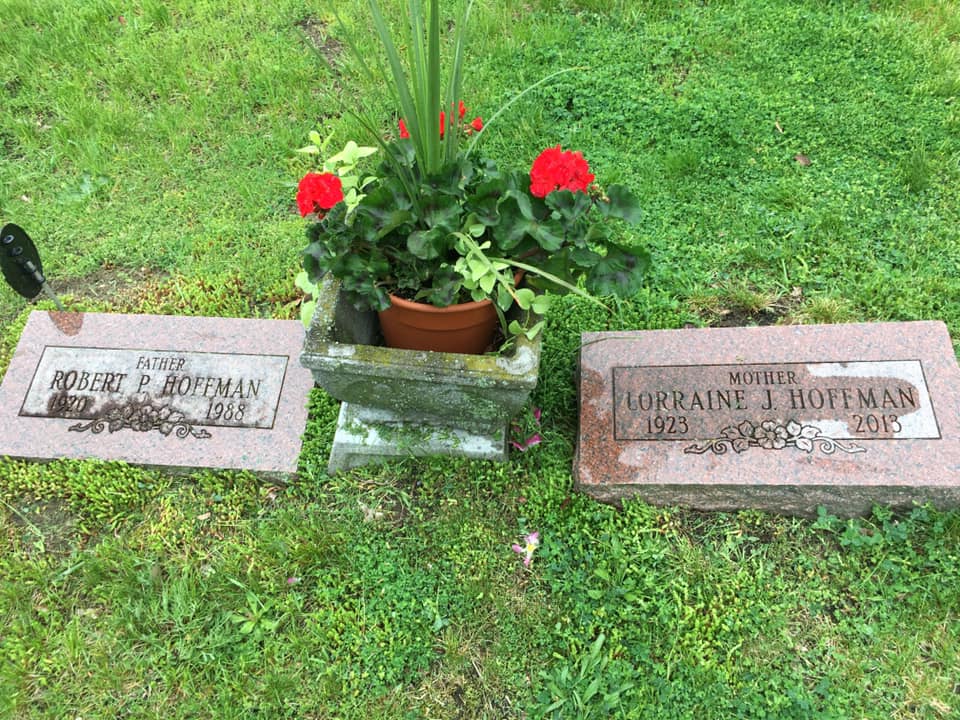
I never asked, but Mom had remember my Dad’s comments on his parents Grave stones so when my Dad died, she ordered a matching stone for herself and for years, saw her stone with a blank space for the final year.
But they match and that’s what Mom wanted.
Lots of good things to remember on remembrance day.