you have to be there … to be there when the bread comes out of the oven
Interesting that the feller who is supposed to have said this, you have to be there when the bread comes out of the oven, film maker Rene Clair, also said, “The film is ready, the shooting is all that remains to be done.“
Maybe you have to be there when the bread comes out of the oven because all that remains to be done is to eat the bread.
Good to keep in mind as well that the bread only comes out of the oven once.
A microwave is quick and cheap but it isn’t fresh baked bread.
Maybe it was the clouds yesterday that put me in mind of bread out of the oven.
And you had to be there on Port Royal sound to see them.
and unwilling to witness permit slow undoing of those human rights
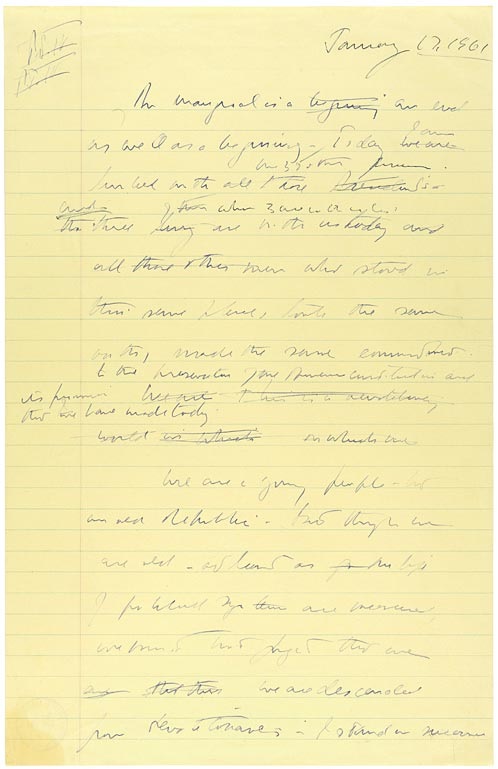
On January 20, 1961, President John F. Kennedy delivered his inaugural address in a message that rings loud and clear for today.
The stunning difference is that President Kenney was speaking to the World at large when today I feel his call for Freedom needs to be heard here in America.
To that end, I am writing a series of Haiku based on that inaugural address.
Also anyone who follows this blog, knows that when I miss a few days, I will create a series of posts based on the same text to catch myself up to date.
This is one of those series.
If you really want to scare yourself or make yourself think in such a way as to scare yourself, read this speech and William Shakespeare’s playJulius Caesar at the same time.
Today’s Haiku is taken from the passage (and yes I used to many words in the third line but my blog, my rules):
We dare not forget today that we are the heirs of that first revolution. Let the word go forth from this time and place, to friend and foe alike, that the torch has been passed to a new generation of Americans–born in this century, tempered by war, disciplined by a hard and bitter peace, proud of our ancient heritage–and unwilling to witness or permit the slow undoing of those human rights to which this nation has always been committed, and to which we are committed today at home and around the world.
Here is the complete text of from that address on January 20, 1961.
Vice President Johnson, Mr. Speaker, Mr. Chief Justice, President Eisenhower, Vice President Nixon, President Truman, Reverend Clergy, fellow citizens:
We observe today not a victory of party but a celebration of freedom–symbolizing an end as well as a beginning–signifying renewal as well as change. For I have sworn before you and Almighty God the same solemn oath our forbears prescribed nearly a century and three-quarters ago.
The world is very different now. For man holds in his mortal hands the power to abolish all forms of human poverty and all forms of human life. And yet the same revolutionary beliefs for which our forebears fought are still at issue around the globe–the belief that the rights of man come not from the generosity of the state but from the hand of God.
We dare not forget today that we are the heirs of that first revolution. Let the word go forth from this time and place, to friend and foe alike, that the torch has been passed to a new generation of Americans–born in this century, tempered by war, disciplined by a hard and bitter peace, proud of our ancient heritage–and unwilling to witness or permit the slow undoing of those human rights to which this nation has always been committed, and to which we are committed today at home and around the world.
Let every nation know, whether it wishes us well or ill, that we shall pay any price, bear any burden, meet any hardship, support any friend, oppose any foe to assure the survival and the success of liberty.
This much we pledge–and more.
To those old allies whose cultural and spiritual origins we share, we pledge the loyalty of faithful friends. United there is little we cannot do in a host of cooperative ventures. Divided there is little we can do–for we dare not meet a powerful challenge at odds and split asunder.
To those new states whom we welcome to the ranks of the free, we pledge our word that one form of colonial control shall not have passed away merely to be replaced by a far more iron tyranny. We shall not always expect to find them supporting our view. But we shall always hope to find them strongly supporting their own freedom–and to remember that, in the past, those who foolishly sought power by riding the back of the tiger ended up inside.
To those people in the huts and villages of half the globe struggling to break the bonds of mass misery, we pledge our best efforts to help them help themselves, for whatever period is required–not because the communists may be doing it, not because we seek their votes, but because it is right. If a free society cannot help the many who are poor, it cannot save the few who are rich.
To our sister republics south of our border, we offer a special pledge–to convert our good words into good deeds–in a new alliance for progress–to assist free men and free governments in casting off the chains of poverty. But this peaceful revolution of hope cannot become the prey of hostile powers. Let all our neighbors know that we shall join with them to oppose aggression or subversion anywhere in the Americas. And let every other power know that this Hemisphere intends to remain the master of its own house.
To that world assembly of sovereign states, the United Nations, our last best hope in an age where the instruments of war have far outpaced the instruments of peace, we renew our pledge of support–to prevent it from becoming merely a forum for invective–to strengthen its shield of the new and the weak–and to enlarge the area in which its writ may run.
Finally, to those nations who would make themselves our adversary, we offer not a pledge but a request: that both sides begin anew the quest for peace, before the dark powers of destruction unleashed by science engulf all humanity in planned or accidental self-destruction.
We dare not tempt them with weakness. For only when our arms are sufficient beyond doubt can we be certain beyond doubt that they will never be employed.
But neither can two great and powerful groups of nations take comfort from our present course–both sides overburdened by the cost of modern weapons, both rightly alarmed by the steady spread of the deadly atom, yet both racing to alter that uncertain balance of terror that stays the hand of mankind’s final war.
So let us begin anew–remembering on both sides that civility is not a sign of weakness, and sincerity is always subject to proof. Let us never negotiate out of fear. But let us never fear to negotiate.
Let both sides explore what problems unite us instead of belaboring those problems which divide us.
Let both sides, for the first time, formulate serious and precise proposals for the inspection and control of arms–and bring the absolute power to destroy other nations under the absolute control of all nations.
Let both sides seek to invoke the wonders of science instead of its terrors. Together let us explore the stars, conquer the deserts, eradicate disease, tap the ocean depths and encourage the arts and commerce.
Let both sides unite to heed in all corners of the earth the command of Isaiah–to “undo the heavy burdens . . . (and) let the oppressed go free.”
And if a beachhead of cooperation may push back the jungle of suspicion, let both sides join in creating a new endeavor, not a new balance of power, but a new world of law, where the strong are just and the weak secure and the peace preserved.
All this will not be finished in the first one hundred days. Nor will it be finished in the first one thousand days, nor in the life of this Administration, nor even perhaps in our lifetime on this planet. But let us begin.
In your hands, my fellow citizens, more than mine, will rest the final success or failure of our course. Since this country was founded, each generation of Americans has been summoned to give testimony to its national loyalty. The graves of young Americans who answered the call to service surround the globe.
Now the trumpet summons us again–not as a call to bear arms, though arms we need–not as a call to battle, though embattled we are– but a call to bear the burden of a long twilight struggle, year in and year out, “rejoicing in hope, patient in tribulation”–a struggle against the common enemies of man: tyranny, poverty, disease and war itself.
Can we forge against these enemies a grand and global alliance, North and South, East and West, that can assure a more fruitful life for all mankind? Will you join in that historic effort?
In the long history of the world, only a few generations have been granted the role of defending freedom in its hour of maximum danger. I do not shrink from this responsibility–I welcome it. I do not believe that any of us would exchange places with any other people or any other generation. The energy, the faith, the devotion which we bring to this endeavor will light our country and all who serve it–and the glow from that fire can truly light the world.
And so, my fellow Americans: ask not what your country can do for you–ask what you can do for your country.
My fellow citizens of the world: ask not what America will do for you, but what together we can do for the freedom of man.
Finally, whether you are citizens of America or citizens of the world, ask of us here the same high standards of strength and sacrifice which we ask of you. With a good conscience our only sure reward, with history the final judge of our deeds, let us go forth to lead the land we love, asking His blessing and His help, but knowing that here on earth God’s work must truly be our own.
not learn anything got verification of what already knew
“I didn’t learn anything,” Lions head coach Dan Campbell said following his team’s 21-20 win over the Kansas City Chiefs. “I got verification of what I already knew.”
I would ask is this the year for the Creston Polar Bears, the Grand Rapids, Michigan, Polar Bears.
But they aren’t around any more.
Once I had to provide my High School Mascot as a security question on an account for something and when I said “Polar Bears” there was this long pause.
“I don’t think I ever heard that one before,” said the person on the phone.
I came later to football and most sports as a fan than most folks.
I really didn’t start to care until I was in High School.
But when I did become a fan, I became a fan!
In football I followed my high school, my favorite college and my favorite pro team.
My high school was the Creston Polar Bears, the team on the NORTH end of Grand Rapids.
It was known as the North End as all the street signs in the neighborhood had NE on them, though some clueless folks thought the NE stood for North East?
We knew those folks weren’t from around here.
For me, there was only one college football team.
Not that I didn’t have a choice, it was just that it was expected I would pick the best school, the one in Ann Arbor, Michigan.
Otherwise, if you grew up in Michigan, you were a Detroit Lions fan.
You hated the Bears.
You hated the Vikings.
You hated Green Bay.
You laughed at Tampa Bay as there were latecomers and mostly a joke.
A joke with really cool Pirates on their helmets.
I would celebrate what I called THREE WIN WEEKENDS.
Any weekend when Creston, Michigan and Detroit all won their games.
It was problematic as Creston only played 9 times.
Then the start of the college and pro football season moved around.
But there were times when the planets aligned and it happened.
I got to thinking about it and I wondered, oh often did this happen.
Creston disappeared in 2012 so it can’t happen any more.
So I focused on the years I was in school.
I started in the fall of 1975 at Creston.
I finished in the Spring of 1984 in Ann Arbor after Grad School.
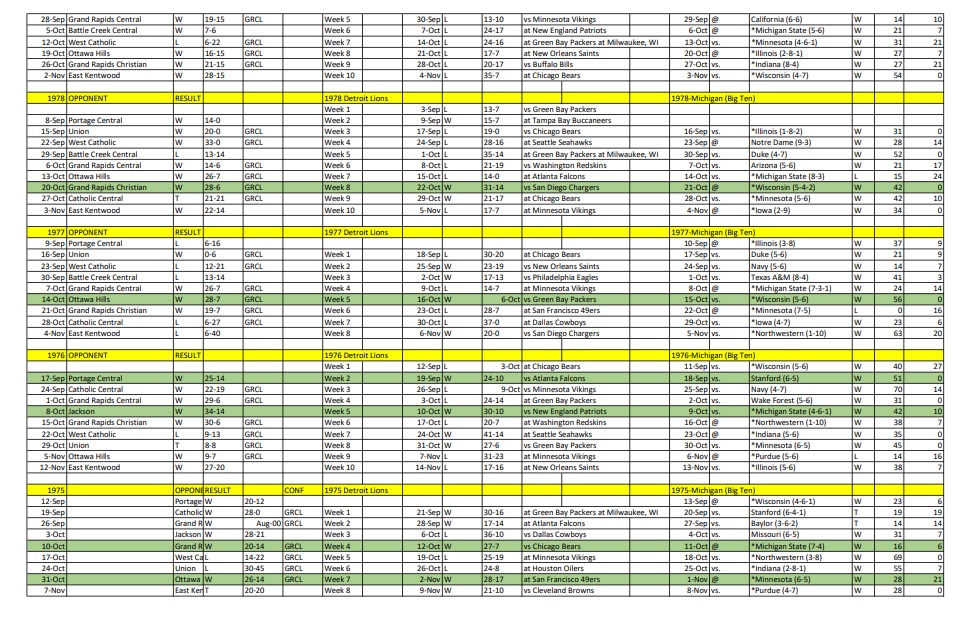
In those 9 fall seasons within that time span, Creston, Michigan and Detroit all played on the same weekend (Friday, Saturday and Sunday), 89 times.
Happy to report there were no three loss weekends.
But there were some awful misses that I remember to this day.
On October 27, 1978, Creston and Catholic Central played to a 21-21 tie and later that weekend, Michigan won the Brown Jug and Detroit beat the Bears.
In 1980 Creston and Detroit had back to back wins and Michigan lost to ND on a 51 yard kick to end the game and then the next week, still in shock, lost to South Carolina.
In 1982, there were a couple other chances, but Detroit and the NFL went on strike.
8 times in 89 games.
I continued to watch for these weekends after college and I remember one of my brothers teased me during the Rich Rod era that Michigan had become the weak link.
Then in 2008-2009, the Lions won just 2 games.
And now my high school is gone.
But the Lions look good.
Michigan looks good.
I think both teams ARE good.
But know what?
It doesn’t matter as they are my teams, win or lose.
Still, it sure does feel good to feel good.
And what have I learned from watching three games so far this season?
crossroad coming up zugswang or zwischenzug and cannot go back
“If these tactics end up working to keep Trump from winning or even running in 2024, it is going to be the last American election that will be decided by ballots rather than bullets.”
So said Former Arkansas Gov. Mike Huckabee on his TV show.
The former Governor has been taken to task for saying such an awful thing though I am not aware of too many folks disagreeing that this is what is coming.
It is kind of like watching this Hurricane Lee out in the Atlantic Ocean and wondering if its coming to where I live, knowing if it does, it won’t be pretty.
What I want to know is was the former Governor quoting Malcolm X on purpose or just cribbing from the a speech on April 12, 1964, at the King Solomon Baptist Church, in Detroit, Michigan where Malcolm X said, “ … if we don’t cast a ballot, it’s going to end up in a situation where we’re going to have to cast a bullet. It’s either a ballot or a bullet.”
What a year.
1964.
And the Republican Candidate for President, Barry Goldwater, would say in his speech accepting the nomination at the Republican Convention on July 16th that, “Extremism in the defense of liberty is no vice. And…moderation in the pursuit of justice is no virtue!”
The last elected President had been gunned down in Dallas.
So when folks talked about guns and bullets and extremism, no one wondered what was being talked about.
I would turn 4 the day after Mr. Goldwater made his speech but I don’t remember that speech or even if there was a party or cake the next day.
With 11 kids it was easy to get over looked and my Dad usually took a week off in July and it happened a few times that I remember my Mom saying, “Is it the 17th? Your Birthday today?”
But I digress.
Things are heating up around here and maybe the Former Governor is just calling it like he sees it.
Not a threat.
Fact.
That crossroad is coming into view.
Zugswang!
One of my favorite words.
It comes from chess.
It means that it is your turn and you have to make a move and any move and every move is A BAD MOVE.
I don’t know about you but all the choices we got coming look like bad choices.
And the choice to go back to where we were, well, that isn’t a choice either.
Zugswang.
Gotta move.
Gotta make a move.
Is there a chance of a zwischenzug?
Zwischenzug (ZWEISS-chen-Zug) is another chess term.
Zwischenzug according to wikipedia is a chess tactic in which a player, instead of playing the expected move, first interposes another move posing an immediate threat that the opponent must answer, and only then plays the expected move. It is a move that has a high degree of “initiative”.
Instead of playing the expected move, first makes another move.
A move that has a high degree of “initiative”!
Maybe it IS up to us.
Maybe it is zugzwang only if we let it be so.
Maybe if we can display a high degree of “initiative” we can pull a zwischenzug out of our hat.
I don’t know if it would take a high degree of “initiative” or a miracle but we better do something.
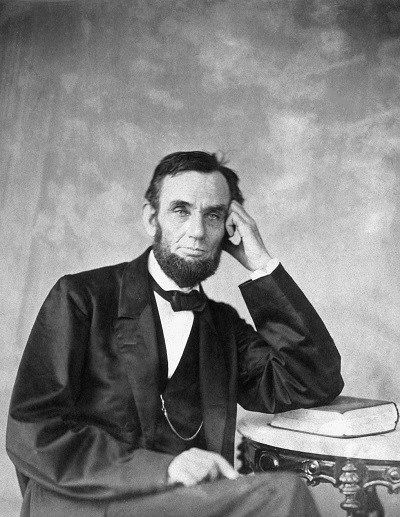
I can here Mr. Lincoln talking to us from Gettysburg, a place to really defined the use of the bullet over the ballot, when he said:
“It is rather for us to be here dedicated to the great task remaining before us —
that from these honored dead we take increased devotion to that cause for which they gave the last full measure of devotion —
that we here highly resolve that these dead shall not have died in vain —
that this nation, under God, shall have a new birth of freedom —
and that government of the people, by the people, for the people, shall not perish from the earth.”
that rare malady cure fully known costs little so hard to achieve
Social isolation is the rare malady whose cure is fully known and costs relatively little, yet is still so difficult to achieve.
In the 21st century, we are a social species living atomized lives; even when living in a high-rise apartment building in a densely inhabited city, surrounded by people in every direction, we can easily feel bereft and melancholy.
Mr. Kristof writes, “As for physical infrastructure to address loneliness, one example is the “chatty bench,” adopted in the United Kingdom, Sweden and Australia. This is a park bench with a sign encouraging strangers sitting there to chat with each other; in a Northern Ireland town, the sign says: “Sit here if you are happy to chat with passers-by.”
There are also “talking cafes,” where people are encouraged to gab with other coffee drinkers. There are “libraries of things,” where you can mingle with neighbors to borrow camping equipment or a carpet cleaner or lend out your own gear.
My wife and I, we talk to people.
Try to catch their eye and say hello.
If we are looking for anyone to talk back, it is usually little kids.
Little kids gravitate to my wife as they have been raised to ‘not to talk to strangers’ and they rarely meet anyone stranger than me.
More times than not, when a little kid gets brave enough to talk to me, they will say, “Do you know you have a gold tooth?“
To which I immediately look over one shoulder and lower my head and confide that, well, see … I’m a pirate.
Which usually delights them and they turn to their Mom and say, “Mom, Mom, this guy’s a PIRATE!!!!!”
Which goes mostly to reinforce Mom’s thoughts to have that ‘no talking to strangers‘ lecture one more time.
But that doesn’t do much for the topic at hand does it.
Social isolation is the rare malady whose cure is fully known and costs relatively little, yet is still so difficult to achieve.
In the 1941 film, Meet John Doe, Gary Cooper as John Doe catches on nationwide with a movement based on the phrase, Be a Better Neighbor.
Be a better neighbor …
Maybe it’s a lost cause.
But in the 1939 film, Mr. Smith Goes to Washington, Jimmy Stewart as Mr. Smith says: I guess this is just another lost cause Mr. Paine.
All you people don’t know about lost causes.
Mr. Paine does.
He said once they were the only causes worth fighting for and he fought for them once. For the only reason any man ever fights for them.
Because of just one plain simple rule.
Love thy neighbor.
(BTW Frank Capra directed both pictures.)
Love thy neighbor.
A lot longer ago than 1939 and before there were films, one of the Pharisees, an expert in the law as it is says, asked Jesus, ‘which is the greatest commandment?’
Jesus replied: ‘Love the Lord your God with all your heart and with all your soul and with all your mind.’ This is the first and greatest commandment … And the second is like it: ‘Love your neighbor as yourself.’
Love your neighbor.
And when Jesus was asked what or who was a neighbor, Jesus told the story of the Good Samaritan.
We are told that the numbers of church goers is dropping at an accelerated rate.
People are moving fast to disassociate themselves from the ‘Chosen Frozen.’
Maybe if we tried to be better neighbors.
Mr. Kristof writes: “Solutions to loneliness are like that — little nudges to encourage us to mingle the way we evolved to. They’re so easy, and loneliness seems so debilitating, that we should be doing more.
We Americans, atomized and polarized, addicted and distressed, are a lonely crowd. Overwhelming evidence suggests that for the sake of our happiness and well-being, we need one another.”