it’s like the dentist unpleasant sometimes, but lots have been there before
Adapted from a passage by Stephen Vincent Benét in the short story Everybody was Very Nice as published in the book Thirteen O’Clock by Farrar & Rinehart in 1937.
That last is the salient note here.
Published back in 1937.
Feeling this way, back in 1937.
“Oh, it was a lot simpler in the old days,” he said. “Everything was for marriage — church, laws, society. And when people got married, they expected to stay that way. And it made a lot of people as unhappy as hell. Now the expectation’s rather the other way, at least in this great and beautiful nation and among people like us. If you get a divorce, it’s rather like going to the dentist — unpleasant sometimes, but lots of people have been there before. Well, that’s a handsome system, too, but it’s got its own casualty list. So there you are. You takes your money and you makes your choice. And some of us like freedom better than the institution and some of us like the institution better, but what most of us would like is to be Don Juan on Thursdays and Benedick, the married man, on Fridays, Saturdays and the rest of the week. ” and he grinned.
For myself in this passage, divorce is incidental.
It’s that cry of Oh, it was a lot simpler in the old days.
Someone once said something along the lines that each generation has to discover the 10 commandments for themselves.
Maybe I always understood this to mean the original 10 commandments.
Maybe instead, it means, each generation has to discover the 10 commandments … for that generation.
Only that’s a bit hard to work out, somehow.
At least in this great and beautiful nation and among people like us.
It’s rather like going to the dentist — unpleasant sometimes, but lots of people have been there before.
am what I have read far more surely than I am what I have eaten
Ms. Margaret Renkl, a contributing Opinion writer for the New York Times who covers flora, fauna, politics and culture in the American South, in a love letter to books titled,My Bookshelf, Myself, writes:
For me, a book made of paper will always be a beautiful object that warms a room even as it expands (or entertains, or challenges, or informs, or comforts) a mind, and a bookcase will always represent time itself. I walk past one of our bookcases, and I can tell you exactly why a particular book is still there, never culled as space grew limited, even if there is no chance I’ll ever read it again.
I could have written this piece.
I know a lot of people who could have written this piece.
I also know a lot of people who won’t understand the line “I walk past one of our bookcases, and I can tell you exactly why a particular book is still there, never culled as space grew limited, even if there is no chance I’ll ever read it again.“
Why would anyone keep a book they’ll never read again?
It is a good a question and I don’t really have a good answer.
At the end of the film, the scene depicts Mr. Adams walking through a flowering field and the narration says, ” … in 1938 Alfred Stieglitz wrote in a letter to Ansel Adams that ‘it is good for me to know there is an Ansel Adams loose somewhere in this world of ours.'”
It is good for some folks to know that certain books are there, still there, close by, even if there is no chance that book will ever be read again.
Ms. Renkl continues, “When I reread a book from my own shelves, I meet my own younger self. Sometimes my younger self underlined a passage that I would have reached for my pencil to underline now. Other times she read right past a line that stuns me with its beauty today. I am what I have read far more surely than I am what I have eaten.“
I love that passage though in some ways its brings to mind the Jim Harrison character in his book, The Road Home, who re-reads his own 50 year old journals and keeps thinking, “What will this fool going to do next?”
Books, books and more books.
As I would say when I worked in a bookstore, books are like jello, always room for more.
I spent my life with them and they are, until you move cross country, a necessity.
When you move, they become a luxury.
To be sure I have two book cases of books I really want, want enough to move with, but I wonder if they will make the next move.
I still look at them and feel good knowing they are there even though I know I most likely won’t read them again.
I have three devices filled with books and I can still get that feeling of pleasure of knowing I have these books on my devices.
And I cannot agree more that I am what I have read far more surely than what I have eaten.
I remember my good friend Gerald Elliot, who over his long life, was an editorial writer for the Grand Rapids Press among many other things.
Late in life he had accomplished two interesting things.
First, about 10 years before he died, he gave his personal library to the Grand Valley State University Library.
Jerry not only wrote editorials but had been the book reviewer for the Grand Rapids Press for decades and was pretty much understood to be the area’s man of letters and his collection was impressive.
He had thought the books would go into the general collection of the library but instead were dumped into the library fundraising book sale which made him so mad that he vowed to me that he would never do that again.
And the second thing was that in the 10 years since giving away his library, he had acquired as many books again as he had given away.
He told me that story at the bookstore where I worked as he picked up the two bags full of new editions he had just purchased.
He looked at me then he looked over at his wife then he looked at the bags of books and back at me.
“Can’t go on forever I guess,” he said.
He looked at his wife and said, “Then it will be her problem of what to do with these damn books.”
believe it or not won’t find it so hot if you ain’t got that do re mi …
Walked in the office the other day singing:
Hilton Head is a garden of Eden, a paradise to live in or see; But believe it or not, you won’t find it so hot If you ain’t got the do re mi.
Everyone once they got past the singing part thought it was pretty good.
A guy can go far today on nothing but Grouch Marx, Mark Twain and Woody Guthrie as most folks have never heard of these guys and think your humor is original.
Here are the real and complete lyrics to Woody Guthrie’s Do Re Mi.
Lots of folks back East, they say, is leavin’ home every day, Beatin’ the hot old dusty way to the California line. ‘Cross the desert sands they roll, gettin’ out of that old dust bowl, They think they’re goin’ to a sugar bowl, but here’s what they find Now, the police at the port of entry say, “You’re number fourteen thousand for today.”
Oh, if you ain’t got the do re mi, folks, you ain’t got the do re mi, Why, you better go back to beautiful Texas, Oklahoma, Kansas, Georgia, Tennessee. California is a garden of Eden, a paradise to live in or see; But believe it or not, you won’t find it so hot If you ain’t got the do re mi.
You want to buy you a home or a farm, that can’t deal nobody harm, Or take your vacation by the mountains or sea. Don’t swap your old cow for a car, you better stay right where you are, Better take this little tip from me. ‘Cause I look through the want ads every day But the headlines on the papers always say:
If you ain’t got the do re mi, boys, you ain’t got the do re mi, Why, you better go back to beautiful Texas, Oklahoma, Kansas, Georgia, Tennessee. California is a garden of Eden, a paradise to live in or see; But believe it or not, you won’t find it so hot If you ain’t got the do re mi.
dark material with a bright impasto of playful irony
Reviewers, whether for food, restaurants, books or movies, seem to get the best words and word play into their writing.
In his review of How Tyrants Fall by Marcel Dirsus, Pratinav Anil writes:
Since the second world war, 23% of the world’s rulers have ended up exiled, imprisoned or killed after leaving office. For dictators, though, the figure rises to 69%.
This was impressed on Robert Mugabe not through statistics but by seeing what happened to his friend Taylor.
Subsequently, he let it be known there was only one way he was going to leave Zimbabwe – “in a coffin”.
How Tyrants Fall arguably belongs to the genre known as “mirrors for princes” – manuals for monarchs – whose exponents include Al-Ghazali and Machiavelli.
Dirsus is a worthy heir to that tradition.
He wears his research lightly and ranges widely, lathering his dark material with a bright impasto of playful irony.
If, back in the day, one Professor had written your wear your research lightly and ranges widely, lathering your dark material with a bright impasto of playful irony on anything I wrote (well, I guess one Professor DID say that but that’s another story and it was another story, a love story I wrote for a creative writing class for my Jimmy Carter era Senior Writing Requirement not a research paper) I would have rolled up and died a happy person.
I recall the story told by Stephen Ambrose (and yes I am aware of the danger of even bringing Mr. Ambrose into a story today) as a student at the Univ of Wisconsin.
Mr. Ambrose tells how he went to see one of his Professors and low and behold, one of Mr. Ambrose’s papers was tacked to the Professors day.
Mr. Ambrose writes that he was about to bust and walked into the Professor’s office all aglow.
Instead of papers, the Professor asked Mr. Ambrose if he knew about rattlesnakes and the western culture.
“Out west,” the Professor said, “Folks will kill a rattlesnake, skin it and nail the skin to door to keep out other snakes.”
Then the Professor stared at Mr. Ambrose for a good long time until Mr. Ambrose pieced it all together and figured out WHY his paper was tacked to the door.
I would say that that Professor wore his messages about research lightly and ranges widely, lathering dark material with a bright impasto of playful irony.
imagination … reconcile raw emotive power of the past
In his book, Walk About (Published in America as Notes from a Sunburned Country), Bill Bryson writes about Australia:
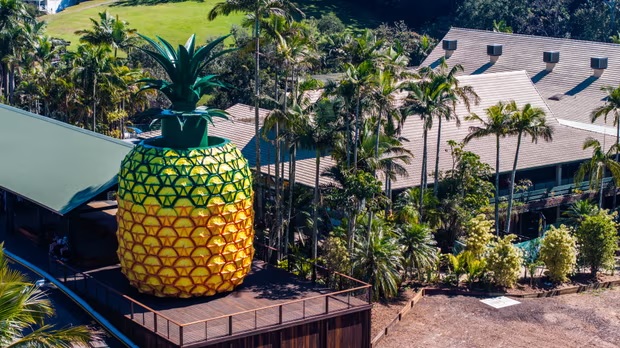
One of the more cherishable peculiarities of Australians is that they like to build big things in the shape of other things. Give them a bale of chicken wire, some fibreglass and a couple of pots of paint and they will make you, say, an enormous pineapple or strawberry or, as here, a lobster. Then they put a café and a gift shop inside, erect a big sign beside the highway (for the benefit of people whose acuity evidently does not extend to spotting a fifty-foot-high piece of fruit standing beside an otherwise empty highway), then sit back and wait for the money to roll in.
Some sixty of these objects are scattered across the Australian landscape, like leftover props from a 1950s horror movie. You can, if you have sufficient petrol] money and nothing approaching a real life, visit a Big Prawn, a Big Koala, a Big Oyster (with searchlights for eyes, apparently), a Big Lawnmower, a Big Marlin, a Big Orange and a Big Merino Ram, among many others. The process, I am patriotically proud to tell you, was started by an American named Landy who built a Big Banana at Coff’s Harbour, on the New South Wales coast, which proved so magically attractive to passing vehicles that it made Mr Landy, as it were, the big banana of the business.
As an aside, I love that word cherishable or having the ability to be cherished and I am working on my own list but I digress.
I am happy to report that according to story in the Guardian, one of these big things in on its way back.
After 14 years of big promises, legal battles and a Game of Thrones’ style ownership jostle, the Big Pineapple finally reopened in June. Patsy, too, has returned, at the age of 93, for another ride around the track.
But it is not just over its former workers that this roadside attraction maintains its peculiar hold. In 2006 the National Trust of Queensland unveiled a list of state icons – alongside the Great Barrier Reef and the Gabba was the Big Pineapple. The year after, it was one of five big things celebrated on Australia Post stamps. In 2009 it was heritage listed. Last year the Royal Australian Mint stamped its likeness on a $1 coin.
For generations of Australians the Big Pineapple conjures up memories of road trips to the sunshine state, of birthday parties and weddings, of train rides and ice-cream.
And it got me thinking about things growing up that I experienced like the Giant Pineapple.
What for me taps into that raw emotive power of the past?
One such place for me and my family was the Dutch Village over in Holland, Michigan.
We would make the short trip when my Dad would take a week off.
My family had a cotttage on Lake Michigan where we would go in the summer and when my Dad took a week off, he would celebrate by not shaving.
But at some point during that week, Dad would shave.
There was a small bathroom off the kitchen.
My Dad would have showered and dressed for the day and would open the bathroom door to let out the shower steam.
In the morning the sun would flood through the back window in the bathroom and my Dad would stand in front of the small sink and look in the mirror and, very deliberately, shave.
Shaving cream spread over his face.
Firm use of the razor.
Down the sides of face.
Then up under has chin.
I can smell the scent of the shaving cream drifting in with the steam and sunshine.
I would be sitting at the kitchen table with my brothers and sisters eating breakfast and we would see Dad shaving and know that we would be going somewhere.
Maybe it would be the Coast Guard festival in Grand Haven.
Maybe it would be a longer day trip up to Sleeping Bear Dunes.
Most likely it was a trip to the Dutch Village.
It wasn’t much.
A glorified tourist trap.
But it was our tourist trap!
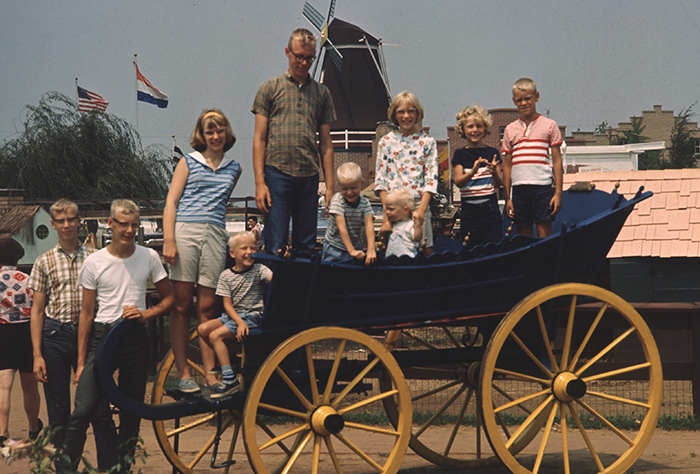
The then 10 Hoffman’s at Dutch Village – maybe 1966.
There were a few shops and some things to play one, a giant wooden shoe and a Dutch barn with barnyard animals to feed.
All operated by a staff in ‘traditional’ Dutch clothes.
We would first run to the candy store.
I remember one time when all of us Dutch blond kids ran in the sales lady said something like ‘you know they’re Dutch when the coming asking for bobbalars and chocolate Droste’s wooden shoes.’
Once when I worked at a local TV station in Grand Rapids, a team was sent out to cover the Holland Tulip Festival and I wrote a tease for one of news broadcasts along the line of … “The bobbalars are just as sweet …” and the anchor came over to ask what that meant. I then had to pronounce the word phonetically bah bah lars .. which she wrote down.
And there was the zweefmolen or swing carousel with swings that spun you high in the air in circle until you were ready to throw up all your chocolate wooden shoes.
This was a condition we called ‘zweefmolen disease’ and we loved to bring friends and new family members who had just married into the family to Dutch Village just to watch them get zweefmolen disease.
Seeing them stagger around was as much fun as just saying zweefmolen.
It was goofy but we loved it.
I loved taking my kids when we got kids to Dutch Village.
I loved watching them get zweefmolen disease.
My kids didn’t look like my brothers and sisters but I told them they were all Dutch anyway.
Nothing gets you odder looks than to live in the south and tell people that you are Dutch and it’s like they can’t imagine anything so exotic.
So for the folks in Australia, the big pineapple is back … ‘but is it a big deal?’, Mr. Hinchliffe asks.
Another case of the ‘You can’t go home again’ syndrome as nothing is like it was but then was anything like it ever was?
When my kids were growing up I watched a lot Nickelodeon and Nick Jr. and I remember that in that cartoon called ‘Rugrats’, the perspective was often drawn from about 1 foot about floor level, the perspective of a toddler.
In the movie Dead Poets Society, Robin Williams dares his students to stand on their desks to gain a new perspective.
I offer that to relive your childhood, sit on the floor, get your head down there and experience life as it used to be.
At the beach, with you head just above the sand, the beach stretches out forever.
At a park, the jungle gym is 5 stories high.
Mr. Hinchliffe closes his article with this:
“Today, the pineapple is a curious site next to a regional road with a serviceable cafe and a train ride. It takes a bit of imagination to reconcile what stands now with the raw emotive power of its past.”
It takes a bit of imagination to reconcile what stands now with the raw emotive power of its past.
I love that.
Embrace your imagination and get as low to the floor as you can go and tap in the raw emotive power of your past.
If nothing else, you will be looking up.
Also, make the trip to West Michigan and visit a little bit of old Holland at the Dutch Village.