“If you read between the lines, you understand what someone really means, or what is really happening in a situation, even though it is not said openly.”
When he says communism, socialism, or Democrat, he means race.
When he says America is declining, he means race.
When he says “American First”, he means race.
When he says blood, he means race.
When he says poison, he means race.
When he says race, he means Black people.
When he says race, he means Hispanics.
When he says race, he means Muslims.
And when he says race, he means other white people, too, some less white, less pure, less clean, less acceptable depending on their ancestral origin, than others.
When he says race, he means the replacement theory.
It seems that half of America would understand and agree with what Mr. Blumenthal is trying to point out.
It seems that half of America would understand what and agree with Mr. Trump is trying to say.
You know what scares me … bothers me the most?
The idea that I am clinging too that this election will settle anything.
I think of Mr. Lincoln and his call to the the better angels of our nature.
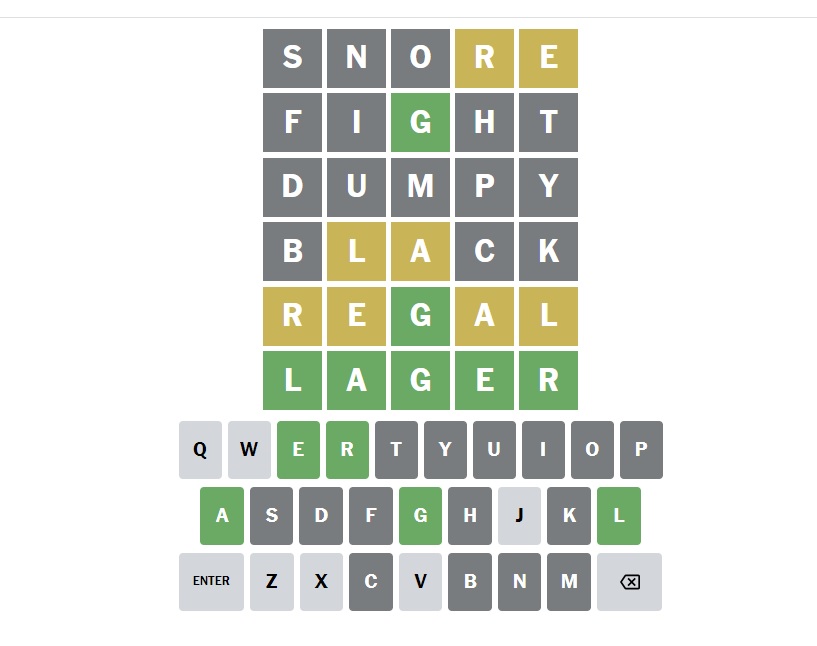
the wordle long game playing to win today or to win everyday
Not much of a surprise I would think to say that I was bit by the wordle bug.
I resisted it at first but then it became part of my morning reading.
Finished with the news while finishing my morning coffee, wordle often add the last little bit of mental stimulation to get me to wake up before starting my day.
I’d enter a some letters and then go through the steps and puzzle out the days word … or not … and go one.
I was asked, “What’s your start word?”
“Audio,” I would respond.
Then something changed.
I had been a casual ‘day’ player and never logged in.
The NYT games managers kept telling me there was so much more available if I would register, so I finally did and a new day dawned.
I now had statistics on my all time wordle performance.
And my game changed.
Instead of playing to win today, I began playing to win everyday.
It wasn’t today’s word that mattered, it was today’s win that I was after, to add my daily string of wordle wins.
I hit 14 days in a row.
Then 21.
The 61.
Then 69 and I was traveling and started a game while in the airport and forgot and never finished and broke that string.
Oh well.
I no longer use my “Start word.”
I use four of them.
I puzzled out one morning in the shower that snore, black, fight and dumpy did not repeat any words and used up 20 of 26 characters.
While I will cycle thru which word I use first, I will enter all 4 four words unless I can make a really good guess.
The result.
112 of my wins are on the fifth choice.
61 are on the 4th choice.
I have never hit the first word while logged in but in my mind I did once.
And 3 times, I made the correct guess on my 2nd choice.
Currently I am on a 21 day win streak with an overall 96% success rate.
Like a dependable quarterback, I see opportunities but I work through my progressions and in the end, win the game.
Sure there are those, like the star quarterback who can hit that long bomb and snatch victory from the jaws of defeat … once in awhile.
Go ahead and play.
Go ahead and enter a word and then make an ‘educated’ guess based on your remaining letters.
You could get it right.
Beware of those double letter words like muddy or a word like refer with double double letters.
I am playing wordle, the wordle long game.
I am going for 99%.
Which with my current number of losses, if I don’t lose again and do the math right, will take another 750 games or just over 2 years.
with holiday pomp autumn Saturdays present a vivid pageant
In the third week in October, the football season opens with the pomp of a major holiday. On these autumn Saturdays the population is sometimes trebled, and the town presents a vivid pageant.”
A description of Ann Arbor from The WPA Guide to Michigan Federal Writers’ Project, 1941.
During the 1930s in the United States, the Works Progress Administration developed the Federal Writers’ Project to support writers and artists while making a national effort to document the country’s shared history and culture. The American Guide series consists of individual guides to each of the states. Little-known authors—many of whom would later become celebrated literary figures—were commissioned to write these important books. John Steinbeck, Saul Bellow, Zora Neale Hurston, and Ralph Ellison are among the more than 6,000 writers, editors, historians, and researchers who documented this celebration of local histories. Photographs, drawings, driving tours, detailed descriptions of towns, and rich cultural details exhibit each state’s unique flavor.
Alistair Cooke would later write in the preface the companion book to his 13 part TV series, America, that:
“On all my trips, from the late 1930s on, I packed in an orange crate in the trunk of my car the federal guides to all the states I was likely to drive through. These had been written by penurious writers and local historians enlisted under the Writers Program of the government’s Works Projects Administration during the Depression. America, which had had no guidebooks worth the name, suddenly had a library of the best; and it was these unsung historians who put me on to hundreds of places along the road that few tourists had ever heard about.”
he wrote we have proved ourselves inept fools on so many mortal fronts
I suspect that it’s inappropriate to strand myself on a high horse when it comes to what people eat. We have proved ourselves inept fools on so many mortal fronts — from our utter disregard of the natural world to our notions of ethnic virtue to the hellish marriage of politics and war — that perhaps we should be allowed to pick at garbage like happy crows. When I was growing up in the Calvinist Midwest, the assumption that we eat to live, not live to eat, was part of the Gospels. (With the exception, of course, of holiday feasts. Certain women were famous for their pie-making abilities, while certain men, like my father, were admired for being able to barbecue two hundred chickens at once for a church picnic.) I recall that working in the fields for ten hours a day required an ample breakfast and three big sandwiches for lunch. At the time, I don’t think I believed I was all that different from the other farm animals.
Jim Harrison in A Really Big Lunch published in the New Yorker, Aug 29, 2004.
Garrison Keillor wrote in his 1991 book, WLT: A Radio Romance, “Don’t concern yourself with things you can’t change, I say. It’s more important to make a very good cup of coffee in the morning and a very good piece of toast than it is to worry about Josef Stalin, because I can do something about breakfast and I can’t do anything about Stalin, and I’m sure he’s having a wonderful breakfast.”
back at it again early to rise drive in dark low country commute
I woke up this morning and looked at the clock about 5 minutes before the alarm went off.
Resigned to what it is, I reached over and clicked off the alarm before it went off, got up, started the coffee, showered, dressed and drove off to work, all in the dark.
Driving in the early dark again to avoid being stuck in my car for too long lengths of time.
For 12 years I commuted into downtown Atlanta.
It was a drive you could make in 30 minutes … if you left early enough and all the 1,000s of drivers cooperated.
If you left later, the time it took to travel grew exponentially.
Now I work for a resort that is on an island on the Atlantic Coast of South Carolina.
The thing is that if you work for a living you most likely cannot afford to live on the island.
So all of us who work on the island have to commute to work from somewhere in the low country so we can provide the amenities of resort island life to those who can afford to be on the island.
I understand this is new, that as recent as 4 years ago, there was affordable housing on the island.
Once equity driven real estate management took over, affordable rental property for housing disappeared as it was purchased and turned into short term vacation rentals.
I also understand this is happening across the country from Long Island to Jackson Hole.
Here in the low country, we all have to be at work between 8 a.m. and 9 a.m. in the morning.
It is called the trade parade.
Toss in the traffic created by getting kids to school and add in that there is only one bridge to get on to the island and you get a commute worthy of Atlanta.
If I leave early enough my drive takes about 20 minutes.
If I leave later, the time it takes to travel grows exponentially.
Like my drive in Atlanta, if I had to choose, I would rather leave early and have some quiet time at my desk rather than leave later and have a lot less quiet but a lot more time in my car.
There are some benefits to where I work.
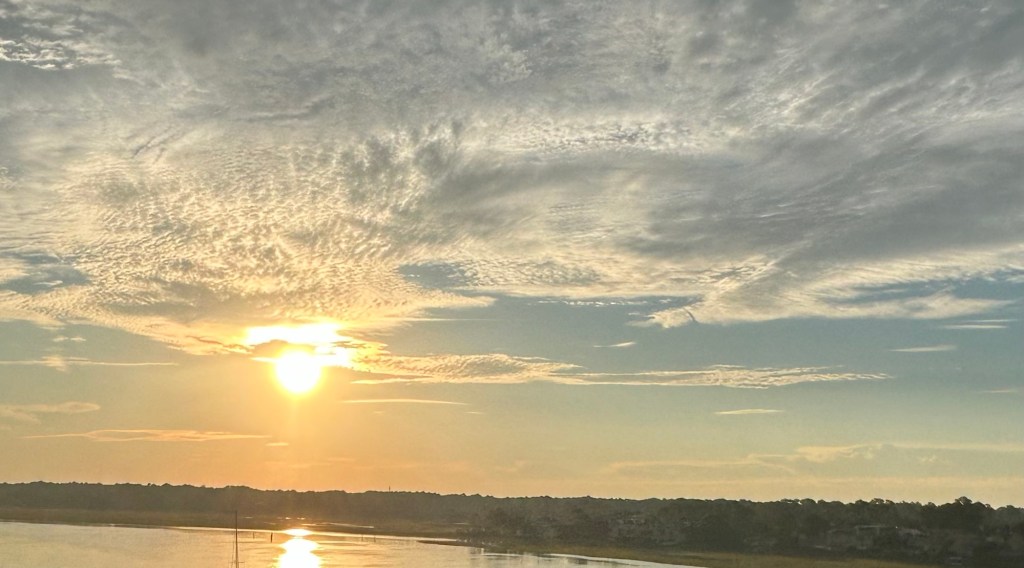
I do get to see the coast for a few seconds and often some wonderful sunrises.
Interesting to note that I hit a sunrise window for about 2 weeks in the spring and fall and then another two weeks with the time change.
I am not commuting in Atlanta where my angst over my drive was compounded by the angst that the nasty people I worked for required me to be in the office while allowing other people who were part of the team I was on, to work remotely. (Looking back, I had a great job in ATL, that was a lot of fun and I worked WITH some great people, but I worked FOR others who made it their business to make my job as awful as possible.)
And I can review my life on my drive to work and wonder what I did to deserve such a life – then I go all over the reasons why I got the life I deserve.
And I can walk the beach on my lunch break if I am a mind too. That alone puts me in a very very select minority of the world’s work force.
Employee Survey: Question #11) Are you able to access the beach on your lunch hour?
I bet that puts me in a the .001% of those who answered yes, of anyone working today.
Happy to say I work a hybrid schedule which means Monday and Friday, I get to work remote.
Which means that tomorrow, at this time, I will still be in bed.