The writer, Morwenna Ferrier, quoted one Anshu Sood, a specialist orthodontist, who said, “The NHS used to tell us that a uniform inspired clinical confidence, particularly given the reputation,” she says, referring to the theory of enclothed cognition, or the use of clothing to affect opinion. “Based on that, we tried to look the part.”
But there was this warning, … main concern is cross-infection so whatever dentists wear to practice, they don’t wear in public. Like most quirky trends, the key is in the styling. Worn head to toe, you risk looking Halloween-adjacent.
See, they are talking about dressing like a Dentist at work.
Smocks, scrubs and such like that.
What came to mind for me was dressing like a Dentist outside of work.
The way my Dad did.
My Dad, my Dentist.
My Dad was one of those guys who felt the most comfortable wearing a tie.
If he had a tie on, he wanted to have at least a sport coat on.
I am pretty sure my Dad never wore what is called a polo or sports shirt.
I know he never appeared anywhere in just a T Shirt.
For him to dress ‘down’ was to wear comfortable clothers.
By that I mean, clothes he was comfortable with.
And in off hours, that was a nice shirt, knitted tie and a corduroy sport coat that got more comfortable as the years went by.
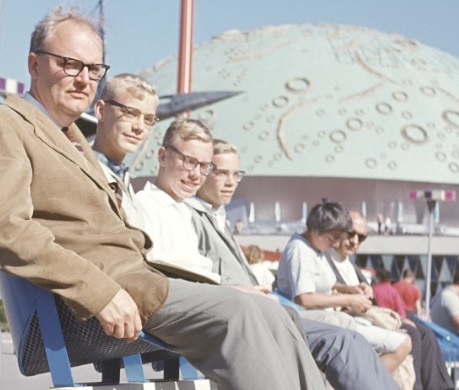
I found a photo of my Dad sitting on a park bench with my three oldest brothers.
My Dad is dressed as I described.
Slacks, shirt, tie and jacket.
The photo was taken at the New York World’s Fair in 1964.
Oh sure, you say, that’s how everyone dressed back then.
Maybe so but then you could jump the calendar ahead to 1984 and that is just how my Dad would have dressed had he gone to something like say, Cedar Point, or a ball game.
I can say that because I went to a ball game with my Dad and that was how he dressed.
It was on a family trip to visit my sister, Mary, in Chicago.
Mary lived in the Greenview area of Chicago about 10 blocks or so from Wrigley Field.
My Dad, a life long Cubs fan, thought it was the best apartment in all of Chicago.
As I remember it, which means this is how it happened, we stopped at my sisters and dropped off everyone and then me and my Dad drove over to the Wrigley Field to get tickets.
We parked close as it was early and walked up to get in line at an open ticket window on West Addison St.
A couple things to keep in mind here.
This was back in the day when ALL the tickets for that day were printed at a print shop.
For any seat any where in the ball park, THERE WAS ONE PRINTED TICKET.
You could not go to the ticket window and decided where to sit and your custom ticket was printed out or sent to your phone.
What that ticket man at the ticket window had in his drawer was what you got.
Traditionally the tickets in any given ticket window matched the location in the ball park where the window was located.
Ticket booths along first base had tickets for the first base side, tickets behind home plate where in the booths behind home plate and bleacher tickets were out behind the bleachers.
But folklore had it that every ticket seller was given a handful of prime seats and for the right ‘code word’ or financial enhancement, these tickets would be available to you.
Bill Veeck writes that when he worked for the Cubs in the 1930’s and the days receipts were totaled up, if he spotted a new $100 bill, he knew Al Capone had been at the game.
As an aside, the great Cub left fielder Hack Wilson was once called to the Commissioner’s Office where Judge Landis told Wilson to stop having his picture taken with Capone when Capone came to Cub games.
“But he shows me such a good time when I’m at his place.” said Wilson.
So we are in line to buy tickets at Wrigley Field.
And my Dad is dressed in his jacket and tie.
And let me say this.
My Dad did not just look the part, he played the part, he embraced the part.
I could not explain it until today but when I read the line about the the theory of enclothed cognition, or the use of clothing to affect opinion, that was my Dad.
He had the air of being in the right place at the right time.
He had the air of being somebody.
There were a bunch of kids ahead of us in line.
They bought their tickets, looked at the ticket location and started complaining.
The guy in the ticket booth was about 102 years old and had most likely been selling tickets from that window since 1916.
With a voice full of gravel, like the old Popeye cartoons, he yelled, “Dose the bestest I got. Now get out of here.”
The kids kept complaining and he kept repeating ‘bestest I got, bestest I got.”
The kids left and went over to the gate.
There was a group of businessmen on a works outing just in front of us.
Four guys in polos and ironed Bermuda shorts and dockers with sunglasses and evident use of after shave just in front us.
One of the bunch walked up and slammed down a $20 and asked for “4 of the best, my good man!”
The guy in the window took $20 and dealt out 4 tickets and asked for $40.
The feller in front paid up and took the tickets with a big smile.
Then he looked at the tickets and showed them to his group of buddies.
And they started complaining.
With a voice full of gravel, like the old Popeye cartoons, the ticket man yelled back, “Dose the bestest I got. Now get out of here.”
They kept complaining and the guy in the window kept repeating ‘bestest I got, bestest I got.”
They left, somehow less preppy then before, and moved over to the gate.
Then my Dad walked up.
My Dad, wearing a jacket and tie.
My Dad, wearing a jacket and tie and with the air of enclothed cognition.
“8 behind first base.” my Dad said.
The guy in the ticket window just stared.
Just stared at this man wearing a coat and tie at a Cubs game.
Had to be a nut.
Had to be a nut or he had to be somebody.
Somebody.
The guy bent down as he reached into another drawer.
I can hear the slap of the tickets as he dealt them out on the counter top.
“One – Two – Tree …” he counted out loud.
“8 … behind first base,” he said as he slid the tickets over to my Dad.
conscience, cowardice one in the same action from not doing nothing
Mr. Oscar Wilde said in his novel, The Picture of Dorian Gray, that “Conscience and cowardice are really the same things.“
In the novel, Basil Hallward is talking with Lord Henry.
Basil says, “…it was not conscience that made me do so: it was a sort of cowardice. I take no credit to myself for trying to escape.”
Lord Henry replies, “Conscience and cowardice are really the same things, Basil. Conscience is the trade-name of the firm. That is all”
Conscience and cowardice are really the same things.
Conscience is the trade-name of the firm.
That is all.
Cannot say why this passage was on my mind of late.
But aren’t they interesting words?
Conscience.
Cowardice.
I looked up the words in the online Webster’s.
The sense or consciousness of the moral goodness or blameworthiness of one’s own conduct, intentions, or character together with a feeling of obligation to do right or be good.
Lack of courage or firmness of purpose.
Really the same things.
That is all.
As Big Bill put it:
Thus conscience does make cowards of us all; And thus the native hue of resolution Is sicklied o’er with the pale cast of thought, And enterprises of great pith and moment With this regard their currents turn awry, And lose the name of action.
(Hamlet, Act III, Scene I)
Very deep stuff for a Saturday.
Thankfully there is always Langston Hughes’ Motto:
I play it cool And dig all jive That’s the reason I stay alive.
My motto, As I live and learn, is: Dig And Be Dug In Return.
Writing about belief polarization, on these opposed certain views, Mr. Edsall wrote: Perhaps the most salient recent illustration of belief polarization is the diametrically opposed views of Trump loyalists and of their Democratic adversaries over the legitimacy of the 2020 election: Trump supporters are convinced it was stolen; Democrats and independents are certain that Joe Biden is the legitimate president.
Mr. Edsall then recounts the trials and travails voting in a democracy and he ends with this warning: These developments — or upheavals — and especially the reaction to them have tested the viability of our democracy and suggest, at the very least, an uphill climb ahead.
don’t cheat yourself out of life be not simply good be good for something
The full quote is: “Do not be too moral. You may cheat yourself out of much life so. Aim above morality. Be not simply good; be good for something.“
And it deserves a better haiku and if time allows, I will work on it.
This appears in a letter written by Henry Thoreau on March 27, 1848, to Mr. Harrison Blake.
The text of the letter appears in the Familiar Letters Of Henry David Thoreau – Part II The Golden Age Of Achievement, Edited, With An Introduction And Notes by F. B. Sanborn, Houghton, Mifflin And Company, 1894.
I was struck by the words, as anyone would be, but me more so on this occasion due to earlier haiku’s I recently posted.


 No Haiku For You