just once in six months or a year, a call serves to keep up acquaintance
From The Home Cook Book, by Ladies of Toronto and Other Cities and Towns, Toronto, Belford Brothers, Publishers, MDCCCLXXVII.
The Title page states:
COMPILED FROM RECIPES CONTRIBUTED BY LADIES OF TORONTO AND
OTHER CITIES AND TOWNS: PUBLISHED FOR THE BENEFIT
OF THE HOSPITAL FOR SICK CHILDREN.
Under SOCIAL OBSERVANCES – Cards and Calling, we read:
The simplest society duty is, that of making calls. A new comer should return each call within two weeks after it is made. After this, a call once in six months, or a year, serves to keep up acquaintance. Calls are due to a hostess two days after a dinner party, and two days after a ball, and a week after a small party, though these are amply fulfilled by leaving one’s card in the case of a gentleman, a personal call being polite from a lady who has more time.
In town, leaving a card with the corner bent signifies that it was left by its owner in person, not sent by a servant. Bending the edges of a card, means that the visit was designed for the young ladies of the house, as well as the mistress of it. If there is a visitor with the family whom you wished to see, a separate card should be left for that person, naming him or her to the servant. A card should also be left for the host, if the call was designed as a family matter, but more than three are not left at one house.
For some reason I must now immediately read each text or message on any electronic device as if it were a message from the Principal of my High School.
And if I don’t respond immediately, somehow, I am RUDE.
I want to pay calls.
Once every six months or a year.
And if you aren’t home, I want to leave my card.
Somehow, afterwards, we are both satisfied that we have done all that is necessary.
All that is required.
The telephone was seen as an intrusion in the home.
Now it sits in my hand constantly … in case someone wants to tell me something that I didn’t need to know in the first place.
the wandering one dreamer of dreams, the eternal asker of answers
The sun goes down in a cold pale flare of light. The trees grow dark: the shadows lean to the east: And lights wink out through the windows, one by one. A clamor of frosty sirens mourns at the night. Pale slate-grey clouds whirl up from the sunken sun.
And the wandering one, the inquisitive dreamer of dreams, The eternal asker of answers, stands in the street, And lifts his palms for the first cold ghost of rain. The purple lights leap down the hill before him. The gorgeous night has begun again.
‘I will ask them all, I will ask them all their dreams, I will hold my light above them and seek their faces. I will hear them whisper, invisible in their veins . . .’ The eternal asker of answers becomes as the darkness, Or as a wind blown over a myriad forest, Or as the numberless voices of long-drawn rains.
From The House of Dust: A Symphony (Part One) by Conrad Aiken, (Boston, The Four Seas Press, 1920).
I was checking some dates on Conrad Aiken and saw that I had missed something on his Wikipedia page.
Mr. Aiken was born and lived in Savannah until he was 11.
Mr. Aiken wrote of his childhood, “Born in that most magical of cities, Savannah, I was allowed to run wild in that earthly paradise until I was nine; ideal for the boy who early decided he wanted to write.“
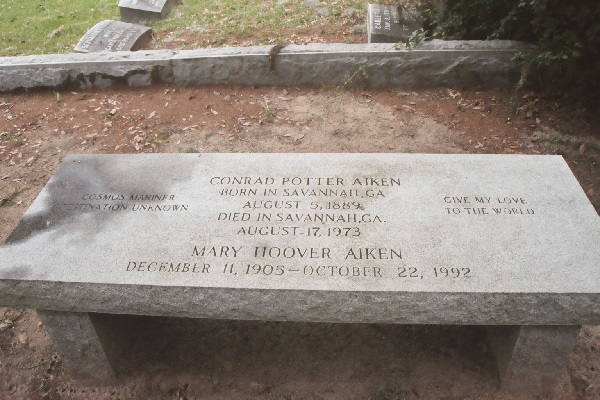
Mr. Aiken is buried in Bonaventure Cemetery in Savannah and there is a bench by his grave with the words, Cosmos Mariner – Destination Unknown carved in it.
Legend has it that Mr. Aiken saw those words while reading a Savannah Newspaper’s daily list of port activity.
Cosmos Mariner – Destination Unknown.
Mr. Aiken left Savannah when he was 11 after a murder suicide took his parents.
I knew all that.
Then I read the line that I had missed.
After their parents’ deaths, the four children were adopted by Frederick Winslow Taylor and his wife Louise, their great-aunt.
Not just any Frederick Winslow Taylor but THE Frederick Winslow Taylor.
The man who invented the D handled 19 1/2 pound shovel.
The man who held a stop watch to workers and told them how hard they had to work.
The man who invented time motion studies.
The man who said, “In the past the man has been first; in the future the system must be first.”
Mr. Aiken went from,” … that most magical of cities, Savannah, I was allowed to run wild in that earthly paradise until I was nine; ideal for the boy who early decided he wanted to write … to It is only through enforced standardization of methods, enforced adoption of the best implements and working conditions, and enforced cooperation that this faster work can be assured. “
And in the end came down to Cosmos Mariner – Destination Unknown.
‘I will ask them all, I will ask them all their dreams, I will hold my light above them and seek their faces. I will hear them whisper, invisible in their veins . . .’
still, how strangely still water is today, not good to be still that way
Adapted from the poem, Sea Calm by Langston Hughes as it appeared in The Weary Blues (Alfred A. Knopf, 1926) .
How still, How strangely still The water is today. It is not good For water To be so still that way
Langston Hughes was just twenty-four years old when his debut poetry collection The Weary Blues was published in 1926.
The first line of the introduction to The Weary Blues reads, “At the moment I cannot recall the name of any other person whatever who, at the age of twenty -three, has enjoyed so picturesque and rambling an existence as Langston Hughes.“
Back in the day when I worked at WZZM13 TV in Grand Rapids, Michigan, I remember a newsroom discussion about travel and places to go and places gone to and plans to go to other places.
I looked up and said in what my wife calls ‘My Hoffman Voice’, you know, the voice you develop in a family of 11 kids if you ever want anyone to hear you – my kids say it cuts through concrete – my Mom said it was just like my brother Bobby’s (who was a baseball coach for 20 years), “I live in house 1 mile from where I grew up, 1 mile from the hospital where I was born and 1 mile from the cemetery where I will be buried.”
Then I said, “Oh am I depressed!”
At the time it was all true.
I lived near Kent Country Club on the North End of Grand Rapids.
It was less than a mile from my childhood home on Sligh Blvd.
It was about a mile to Butterworth Hospital where I was born.
And it was less than a mile from Fairplains Cemetery where my grand parents and parents are buried and where, most likely, I would end up one day.
I was about to turn 50.
Since then, I can say that I have enjoyed a picturesque and rambling existence.
Someone looked at my life and said it was still, too still.
And then that someone decided that it was not good for my life to be still that way.
I am reminded of a silly movie starring Steve Martin named Parenthood.
Mr. Martin watches his life come apart at the seams with the flu, bills, car accidents, kids fighting, job loss and everything else and is ready to lose it.
When his Grandma comes by and kind of in passing says:
You know, when I was 19, Grandpa took me on a roller coaster Up, down, up, down. Oh, what a ride. I always wanted to go again. You know, it was just interesting to me that a ride could make me so frightened, so scared, so sick, so excited and so thrilled, all together. Some didn’t like it. They went on the merry-go-round. That just goes around … Nothing. I like the roller coaster. You get more out of it.
The movie was written by Lowell Ganz and Babaloo Mandel.
These two guys wrote a lot of movies.
One of those was, A League of Their Own where baseball manager Jimmy Dugan, played by Tom Hanks, says:
fundamentally flawed conception of our selves language, knowledge
Adapted from:
Today our supposedly revolutionary advancements in artificial intelligence are indeed cause for both concern and optimism. Optimism because intelligence is the means by which we solve problems. Concern because we fear that the most popular and fashionable strain of A.I. — machine learning — will degrade our science and debase our ethics by incorporating into our technology a fundamentally flawed conception of language and knowledge.
It is at once comic and tragic, that so much money and attention should be concentrated on so little a thing — something so trivial when contrasted with the human mind, which by dint of language, in the words of Wilhelm von Humboldt, can make “infinite use of finite means,” creating ideas and theories with universal reach.
Mr. Chomsky’s global standing as THE expert on language leaves me little room to argue, not that I would, as I was happy to read his opinions on the latest computer generated textual content craze that has a place in the current news cycle.
For me, the concept is as old as the Infinite Monkey Theory which states that if an infinite number of monkeys were left to bang on an infinite number of typewriters, sooner or later they would accidentally reproduce the complete works of William Shakespeare.
It goes back to 1913 and Félix Édouard Justin Émile Borel a French mathematician, who wrote:
.. Concevons qu’on ait dressé un million de singes à frapper au hasard sur les touches d’une machine à écrire et que, sous la surveillance de contremaîtres illettrés, ces singes dactylographes travaillent avec ardeur dix heures par jour avec un million de machines à écrire de types variés. Les contremaîtres illettrés rassembleraient les feuilles noircies et les relieraient en volumes. Et au bout d’un an, ces volumes se trouveraient renfermer la copie exacte des livres de toute nature et de toutes langues conservés dans les plus riches bibliothèques du monde. Telle est la probabilité pour qu’il se produise pendant un instant très court, dans un espace de quelque étendue, un écart notable de ce que la mécanique statistique considère comme la phénomène le plus probable…*
I remembered it more from Bob Newhart who told the joke about the typing monkey’s, “Hey, Harry! This one looks a little famous: ‘To be or not to be – that is the gggzornonplatt.”
To be sure of the date, I did the google and read the article on Wikipedia.
BOY HOWDY!
So much on so little that for some reason caught the attention of so many people including a ‘famous’ study by some fellers named, Hoffmann and Hofmann!
It seems that the image of an infinite number of typing monkeys is just the thing to get stuck in a lot of people’s brain.
And, for the record, my family name is Hofman, but my Grandpa thought it looked unbalanced and changed it to Hoffman.
I think to get four spellings of the same last name into 2 sentences is pretty good for a non monkey!
To return to Mr. Chomsky and his something so trivial when contrasted with the human mind.
I used to try to observe objectively my mind in action as it worked to process all the information coming into my brain as I drove into Atlanta.
I was pretty much left in awe everytime.
In his books, C.S. Forester has several scenes where the hero is in a situation surrounded by activity and is called on to make decision after decision.
In these scenes, one of the sources of activity is either a beeping clock or someone else calling off the time in 5 second intervals or some such thing that marks the time in the background and the hero begins to contemplate how in the world the brain can process all the data let alone arrive at a conclusion, let alone a successful conclusion, in the time allowed for the situation.
Infinite use of finite means, creating ideas and theories with universal reach.
It is, the mind, an incredible thing.
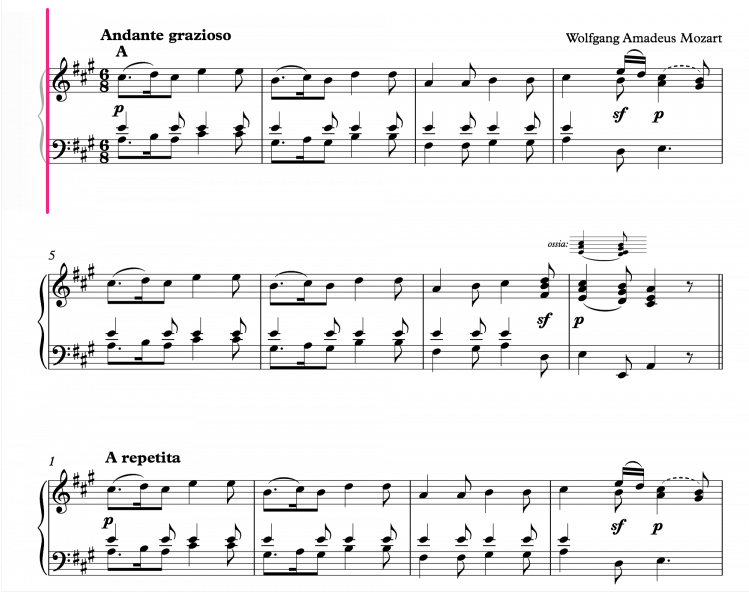
click on image to watch music and listen
To shift from text to music, I have long said that I had been allowed to compose the first 8 bars or so of Mozart’s Piano Concerto #11, I could die a happy person.
When Artificial Intelligence can compose this music, then email me a note.
When Artificial Intelligence can compose this music and KNOW what it did, then text me.
When Artificial Intelligence can LISTEN to this and feel it and know it is special and also know that if the computer was unplugged today, that computer would be happy that it has composed such a piece, then call me.
*.. Let us imagine that a million monkeys have been trained to type at random on the keys of a typewriter and that, under the supervision of illiterate foremen, these typing monkeys work with ardor ten hours a day with a million machines to write of various types. Illiterate foremen would collect the blackened sheets and bind them into volumes. And at the end of a year, these volumes would be found to contain the exact copy of the books of all kinds and all languages preserved in the richest libraries of the world. Such is the probability that there will occur for a very short instant, in a space of some extent, a notable deviation from what statistical mechanics considers to be the most probable phenomenon… (Yes I used a computer generated translation)
Adapted from a scene in the book, Commodore Hornblower, by C.S. Forester who writes that Hornblower:
Recalling himself to reality, he forced himself to remember with what a bubble of excitement he had received his orders back to active service, the light heart with which he had left his child, the feeling of – there was no blinking the matter – emancipation with which he had parted from his wife.
The prospect of once more being entirely his own master, of not having to defer to Barbara’s wishes, of not being discommoded by Richard’s teeth, had seemed most attractive then.
And here he was complaining to himself about the burden of responsibility, when responsibility was the inevitable price one had to pay for independence; irresponsibility was something which, in the very nature of things, could not co-exist with independence.
It is part of the Hornblower lore that when Gene Roddenberry created the Star Trek character of Captain James T. Kirk, he used Hornblower and the Hornblower books as a model.