2.24.2023 – enduring as rock

enduring as rock
charming as waves delicate
as seashore – I wish

“I own a rocky point of land in Carmel, Calif. extending into the Pacific Ocean… I am a woman living alone ‒ I wish protection from the wind and privacy from the road and a house as enduring as the rocks but as transparent and charming as the waves and as delicate as a seashore. You are the only man who can do this – will you help me?”

So wrote Della Brooks Walker to Frank Lloyd Wright.

Mr. Wright took up the challenge and the result is known as the The Walker House, the Mrs. Clinton Walker house and the Cabin on the Rocks.

Mr. Wright took up the challenge in a way consistent with his stated view that: No house should ever be on a hill or on anything. It should be of the hill. Belonging to it. Hill and house should live together each the happier for the other.

How can you not be attracted by that statement?

Easy to understand why Mr. Wright has such a devoted following.

As an aside, one my many nephews (I have over 100 or so counting nephews in law) posted photos recently of a visit to Taliesin West, Wright’s place in Arizona.

I asked this nephew if the folks at Taliesin West told them the story of driving to Taliesin East in the middle of the night to dig up Wright’s body and bring it back to Arizona.

I mentioned that while creepy, it wasn’t as creepy as the Taliesin East butler story.

My Nephew responded that the Taliesin West folks DID not talk about the body snatch and that he had to google the Taliesin East butler story.

And nope, I am not going to relay the stories here as you will enjoy doing the google yourself.

BUT I DIGRESS.

So Mr. Wright designed a house that was part of the beach.

The house, the only Wright house on an ocean, was built in 1952,

The house, located in California’s Carmel-by-the-Sea, is in the news and it is for sale for the low low price of $22 million.

I was intrigued to note that along with all of the Wright intended attributes, as explained by wikipedia, that “The house, an example of Wright’s organic architecture, is built on granite boulders, uses the local Carmel-stone, and has a roof the color of the sea that is shaped to resemble the bow of a ship.” but also it is a house you can hear.

I don’t mean that you can hold the house to your ear and hear the sea as if it was a sea shell.

Nor do I mean that just to look at the house, you can hear the waves.

What I mean is that the house has a sound.

The house has the sound of my childhood.

You see, the house was used in the movie.

A movie maybe more famous for its sound track theme than the movie itself.

That movie was titled, The Summer Place.

For me, and for many folks who grew when I grew up, to hear the song, Theme to a Summer Place, will transport them back to a time where that song was heard everywhere, any where all the time.

Click on the video and listen and I know what you will say.

You will say, OH THAT SONG.

I hear it and I am about 8 years old and I am at home, after school and my Mom is making dinner and the radio in Grand Rapids, Michigan, where I grew up, is tuned to WOOD-AM.

I can hear it and I can see it.

And now I will see this house.

The house that you can hear.

As Mr. Wright would have said, “There you are …”
2.21.2023 – unconquerable

unconquerable
unreposed untired unfaded
unmarred unburlesqued

Based on the poem, The Sea Ocean, by Robert Pollok (c. 1798–1827) From The Course of Time Book I.

Great Ocean! strongest of creation’s sons,
Unconquerable, unreposed, untired,
That rolled the wild, profound, eternal bass
In nature’s anthem, and made music such
As pleased the ear of God! original,
Unmarred, unfaded work of Deity!
And unburlesqued by mortal’s puny skill;
From age to age enduring, and unchanged,
Majestical, inimitable, vast,
Loud uttering satire, day and night, on each
Succeeding race, and little pompous work
Of man; unfallen, religious, holy sea!
Thou bowedest thy glorious head to none, fearedst none,
Heardst none, to none didst honor, but to God
Thy Maker, only worthy to receive
Thy great obeisance.

Untowards utterance unlike usage untofor unknown!

2.14.2023 – while I am I, and

while I am I, and
you are you, so long as the
world contains us both

Escape me?
Never —
Beloved!
While I am I, and you are you,
So long as the world contains us both,
Me the loving and you the loth,
While the one eludes, must the other pursue.
My life is a fault at last, I fear:
It seems too much like a fate, indeed!
Though I do my best I shall scarce succeed.
But what if I fail of my purpose here?
It is but to keep the nerves at strain,
To dry one’s eyes and laugh at a fall,
And, baffled, get up and begin again,
So the chase takes up one’s life, that’s all.
While, look but once from your farthest bound
At me so deep in the dust and dark,
No sooner the old hope goes to ground
Than a new one, straight to the self-same mark,
I shape me—
Ever
Removed!

Life in a Love by Robert Browning

2.13.2023 – neon abstractions

neon abstractions
give the illusion we have
dispelled puzzlement

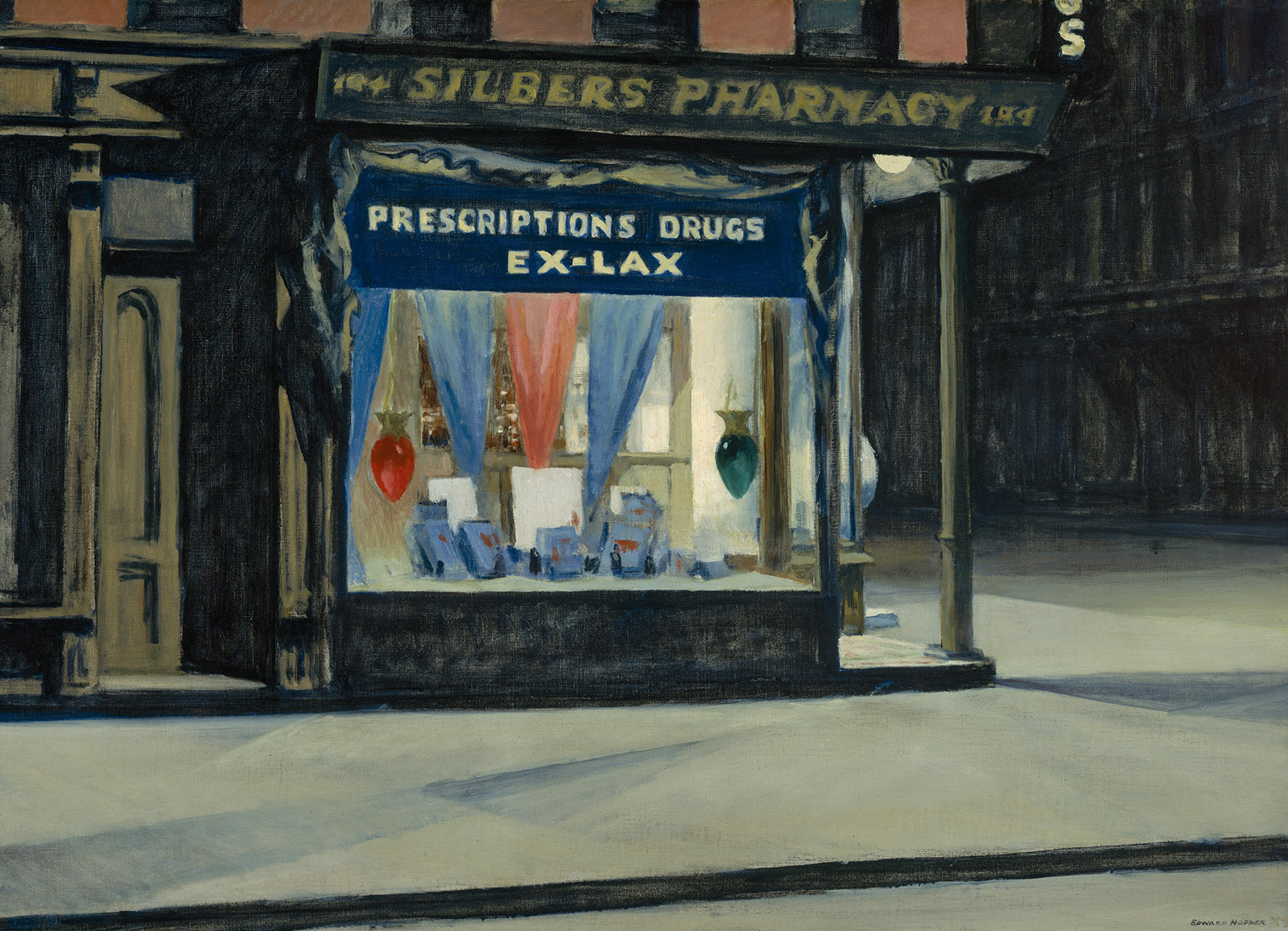
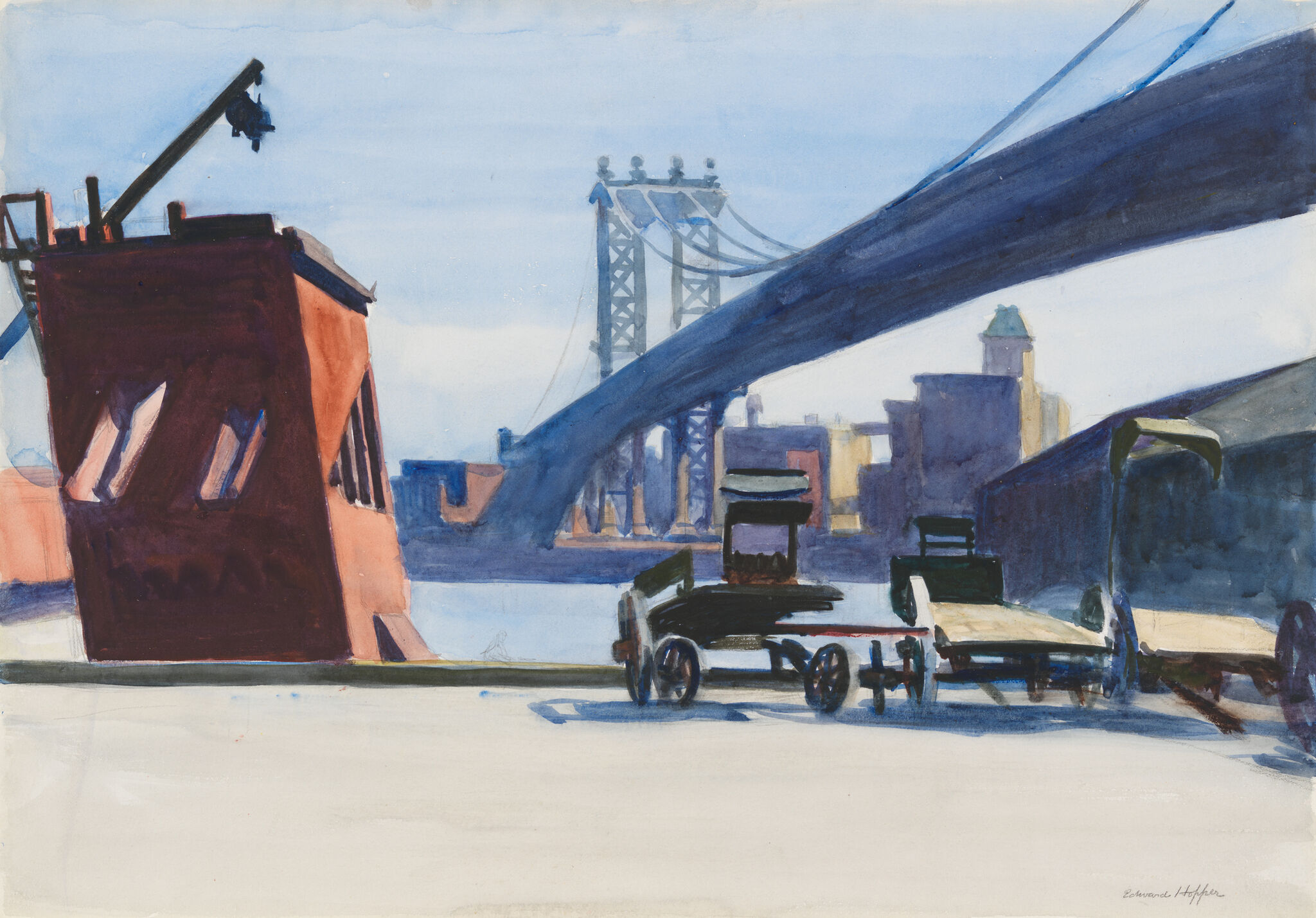
Edward Hopper’s New York, the sumptuous exhibition at the Whitney Museum of American Art, gives us one more chance to retire — at least for a decent interval — those once glamorous words that have come to dominate, and increasingly suffocate, our experience of Hopper’s paintings: alienation, loneliness, voyeurism, the uncanny.

Such neon abstractions give us the illusion that we have dispelled the puzzlement we often feel in front of Hopper’s strange compositions.

What they actually do is give us license to stop looking at the pictures, causing us to miss crucial aspects of his achievement, such as his pervasive and peculiar sense of humor.

A painter who features an ad for Ex-Lax in a moody nocturne of a corner drugstore isn’t just concerned with alienation.

From Buildings Come to Life, by Christopher Benfey in the New York Review of Books.

2.8.2023 – everybody trapped

everybody trapped
was a no-past no-future
state of existence

In a one page reminiscence, Mr. Zach Holland writes in the article, The Lost New Jersey Photographs of Henri Cartier-Bresson, in the New Yorker, (2/13/2023) about photographer, Henri Cartier-Bresson, and the effort made to follow and make documentary of the photographer as he tried to capture the essence of New Jersey with his camera.

This took place in 1975.

Why New Jersey?

“Because people make such a funny face when you mention New Jersey,” said Cartier-Bresson.

A man named Peter Cunningham was assigned to be Cartier-Bresson’s assistant and Mr. Cunningham recalled that New Jersey was “… was a no-past, no-future state of existence.

Mr. Holland writes that, “To Cartier-Bresson, a master of formal composition, the confinement appealed. “Everybody is trapped by something,” he told Evans.

“For me, liberty is a strict frame of reference, and inside that frame of reference all the variations are possible.”

The project fell apart as the documentary was to be on television and the producer said they would have to crop photographs to fit the 4×3 aspect ratio of the TV.

Cartier-Bresson felt that once he snapped the picture, the image was complete and any alteration was a “degeneration.”

The documentary was never made and the photographs have sat on a shelf since 1975 and are just now being released.

It is an odd thing about photographs is that I have long argued that the camera eliminated the need for mastering a craft like sculpture or painting.

The camera, as far as tools went, leveled the playing field between artists and others.

That’s the concept.

Somehow though the artist still makes a difference.

Is it that because the artist has the title, we look at the pictures created by the artist with a different respect?

I don’t know.

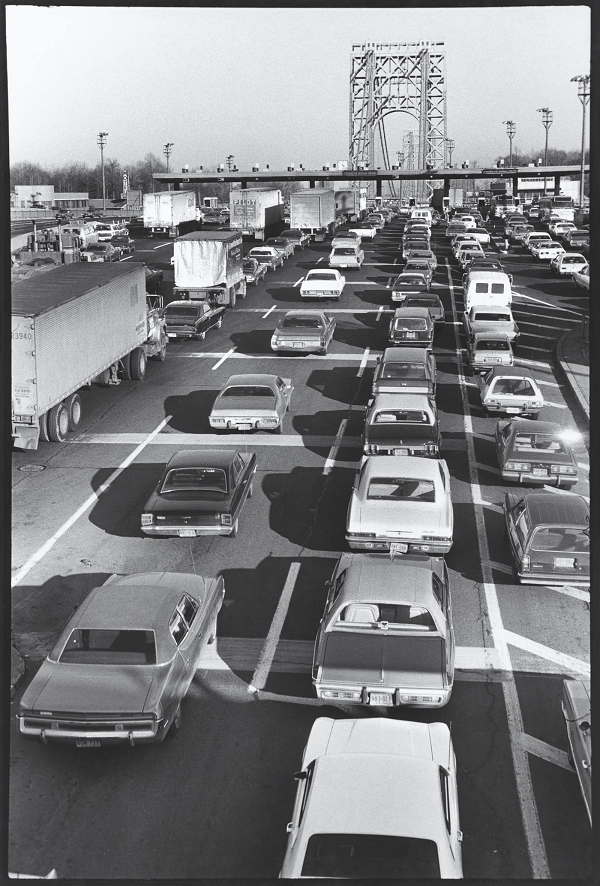
I look at this image of the cars waiting to cross the George Washington Bridge.

At the same time its just a picture of a bunch of cars and it is also a photograph by Henri Cartier-Bresson.

Henri Cartier-Bresson, the champion of the decisive moment.

I know what Henri Cartier-Bresson wanted to capture.

And I look at the photograph of the cars and I ask myself, what did Henri Cartier-Bresson see?

What makes this moment the decisive moment?

Here is expressed that liberty is a strict frame of reference, and inside that frame of reference all the variations are possible.

All these cars.

All these people in the cars.

Everyone trapped.

A no-past, no-future state of existence.

Its also a picture of a bunch of cars.

Maybe this is what is meant when they say and artist just holds up the mirror and you see what you bring in front of the mirror.

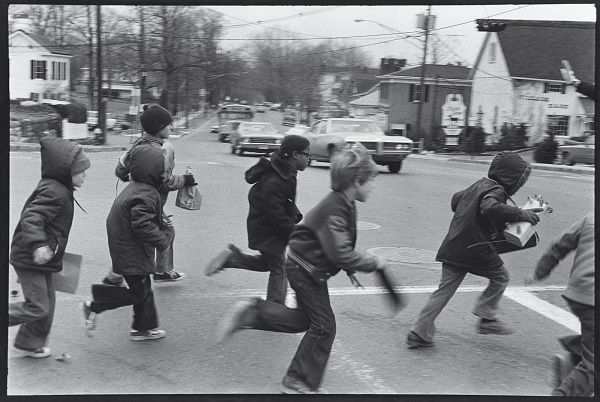
I count seven kids in the photo of the kids running across the street.

Seven kids.

Seven stories.

I want to know … what’s in the bag for lunch?