8.9.2023 – one of the top three

one of the top three
in Baltic mythology
not most important

In the story, Mystery totem pole appears on coastal path in south-east England, by David Batty (Guardian, Aug. 9, 2023), I was intrigued by the lines:

The 8ft (2.4-metre) wooden pole, erected on the clifftops on the North Downs Way in Kent, between Folkestone and Dover, has particularly provoked interest for its inscription with the name Perkūnas, the Baltic god of thunder.

“Perkūnas is perhaps the best known Baltic god,” he said. “That is his Lithuanian name. He’s the same as the Slavic god Perun. He’s one of the top three or four gods in Baltic mythology but not the most important.

I am not sure what to make of the fact that not only was I NOT familiar with Perkūnas, perhaps the best known Baltic god, I wasn’t even aware there were Baltic gods.

I knew my Norse or Viking Mythology but I admit mostly from being aware of the names days of the week.

That is to say, what I thought I knew about the names of the days of week, until for this essay, I opened up Wikipedia.

I have long admired how, with the much better public relations enjoyed by Greek and Roman mythology, that the poor cousins up north were able to grab off several day of the week names and interject their lineage into daily interactions through out the world.

For some reason, I enjoyed the thought the Thursday, with its roots in the Norse (not Marvel Comics) lore in Thor, was adopted globally.

I mean if you fly to Japan or Kenya or Lithuania on Thursday and you want someone to pick you up at the airport, you want everyone to understand what Thursday means.

And in my mind, when everyone in the world used the word Thursday, the meant that day named for Thor.

According to Wikipedia, this may not be totally accurate.

Around the world, if there are 1,000’s of cultures, there are 1,000’s of ways of saying the 5th day of the week.

Why am I so late to this party?

I thought the days of the week were globally universal.

I also thought the Rosenberg’s weren’t guilty but that’s another story.

If I call up a mythical friend in India and make a mythical date for lunch on Thursday, does my friend translate that as being on गुरुवार or Guruvār?

Or, if I understand the article in Wikipedia, there seems to be a trend that cultures recognized that the 5th day of the week would be named after the head deity in the local mythology.

Thursday then can be named for Jupiter, Zeus, Bṛhaspati, Brahaspathinda or Boraspati?

Still, if you go to the airport, what do the arrival and departure screens say?

BUT I DIGRESS.

I do enjoy stories about folks who, for no reason beyond doing something funny, put up totem poles.

Something to ‘raise the dialog.’

Something to make people think.

Something to get folks out of their groove.

I am reminded of an art class I took years ago at what is now Grand Rapids Community College in Grand Rapids, Michigan.

The Professor had a SLIDE SHOW (I’ll explain these magic lantern shows later – but let me say there was a time when COLOR SLIDE SHOW was a point of difference) of the outdoor works of art in Grand Rapids and he put up a picture of the Calder Stabile and asked, ‘What does it mean?’
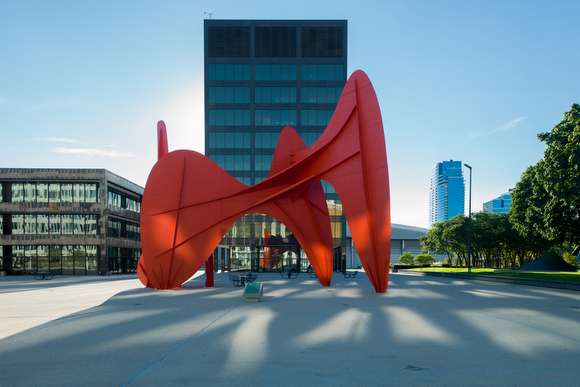
I was thrilled to raise my hand and answer that Calder named his stabile, La Grande Vitesse, or, The Great Swiftness and it was inspired by the once Grand Rapids in the Grand River and the stabile showing water pouring over rocks.

The class fell in line with me and several other students made statements that echoed my answer, agreed with me or even said, OH THAT’S IT.

I felt smug.

Very smug.

The Professor listened, nodding, and waited for the discussion to die down.

Then he looked at the image on the screen and said, “well ….”

And he looked back at the class, smiled and said, “I think it means whatever you want it to mean.”

And he went to the next slide.

One last on the days of the week.

I am reminded of the an old comic bit where two guys are arguing about what day of the week it is.

The first feller says it was WEDNESDAY!!! The DAY NAMED AFTER the NORSE GOD WODEN!

The second feller says, nahhhhhh … they named Wednesday … after they named Tuesday.

8.5.2023 – strikingly glowing

strikingly glowing
marked brilliance of expression
oh incandescence

Rereading Edmund Morris’s book on Thomas Edison at the same time the end of the incandescent lightbulb put in mind to write about two things.

One is the incandescent lightbulb itself.

I am fascinated in this age when old invention exist.

I think of the qwerty keyboard.

Who could guess that such and invention would be driving computers worldwide to this day.

The feller who invented it may not recognize the computer but he would be able to type on the keyboard.

And the electric lightbuld.

The glass bulb and the filament.

The only visual change from that bulb and the one Thomas Edison first showed off in 1879 except that soon after being introduced one of Edison’s engineer came up with the threaded base so it could be screwed into a socket and if held upside down, would not slide out of the socket.

I will miss these light bulbs

Even if I don’t notice when they are being replaced.

The other thing I want to comment on is that most marvelous of words, incandescence.

The word is not onomatopoeic but is it autological or a word that describes itself?

Can it be autological when it has so many meanings?

Incandescence.

Look at the online Merriam-Webster.

incandescent
adjective
in·​can·​des·​cent ˌin-kən-ˈde-sᵊnt
1
a : white, glowing, or luminous with intense heat
b : strikingly bright, radiant, or clear
c: marked by brilliance especially of expression incandescent wit
d: characterized by glowing zeal : ARDENT incandescent affection
2
a: of, relating to, or being light produced by incandescence
b: producing light by incandescence

Then, wikipedia explains Incandescence as the emission of electromagnetic radiation (including visible light) from a hot body as a result of its high temperature. The term derives from the Latin verb incandescere, to glow white.

If you needed a word that described glowing, or luminous with intense heat, strikingly bright, radiant, or clear – marked by brilliance especially of expression – characterized by glowing zeal as well as emission of electromagnetic radiation (including visible light) from a hot body as a result of its high temperature, what word could you come up with other than incandescent.

I am also reminded of a dress was made for Alice Claypoole Vanderbilt. of yellow satin, decorated with glass pearls and beads in a lightning-bolt pattern. A built-in battery lit a light bulb she carried, which she could raise over her head like the Statue of Liberty, made for a masquerade ball that was held in New York City on March 26, 1883. The ball was hosted by Alice Vanderbilt’s sister-in-law, Alva Vanderbilt, as a housewarming party for Alva and William K. Vanderbilt’s new mansion at 660 Fifth Avenue in Manhattan.

The house was one of the first with Mr. Edison’s electric lights.

As Bill Bryson writes in his book, The Home, this was possibly the only occasion in her life in which she could be described as radiant.

7.30.2023 – millionaire is but

millionaire is but
the average dishwasher
dressed in a new suit

Fear of the mob is a superstitious fear.

It is based on the idea that there is some mysterious, fundamental difference between rich and poor, as though they were two different races, like negroes and white men.

But in reality there is no such difference.

The mass of the rich and the poor are differentiated by their incomes and nothing else, and the average millionaire is only the average dishwasher dressed in a new suit.

Change places, and handy dandy, which is the justice, which is the thief?

From Down and Out in Paris and London by George Orwell. (First published by Victor Gollancz 1933.)

Mr. Orwell opens his book with the epigram from Chaucer.

O scathful harm, condicion of poverte!

I am reminded as well as warned, “Listen, my dear brothers and sisters: Has not God chosen those who are poor in the eyes of the world to be rich in faith and to inherit the kingdom he promised those who love him” from the James 2:5 (NIV)

7.27.2023 – think of all the tales

think of all the tales
that have been told, and well told
you will never know

Sunrise over Skull Creek, Hilton Head Island

Everyday the sun rises.

Everyday the sun sets.

(I have to remark on that line by remembering a young waitress at the restaurant at Amicalola Falls State Park & Lodge in Dawsonville, GA, who stopped taking our order to get out her phone and snap a photo of the sunset saying, ‘You don’t see a sunset everyday!’ The moment reinforced what I had read earlier in the day when I checked on the reviews of this restaurant that most mentioned in some way the unique character of the staff. But I digress.)

The tide comes in and washed the beach here twice a day leaving a clean sweep of sand with no footprints or evidence of any body being there before.

But when Winston Churchill wrote, Think of all the wonderful tales that have been told, and well told, which you will never know, he was not referring to the march of time across the span of the days of mankind.

He was thinking only of the efforts of this human race to document the passage of time in books.

In an essay titled Hobbies, which my research seems to show was published originally in the Strand Magazine in either 1921 or 1922 together with his essay Painting as a Pastime and then reprinted in a collection of Churchill’s essay’s titled, Thoughts and Adventures, (Odhams Press, LTD. London, 1932) and now available at Fadepage.com, Mr. Churchill wrote:

But a day in a library, even of modest dimensions, quickly dispels these illusory sensations.

As you browse about, taking down book after book from the shelves and contemplating the vast, infinitely-varied store of knowledge and wisdom which the human race has accumulated and preserved, pride, even in its most innocent forms, is chased from the heart by feelings of awe not untinged with sadness.

As one surveys the mighty array of sages, saints, historians, scientists, poets and philosophers whose treasures one will never be able to admire — still less enjoy — the brief tenure of our existence here dominates mind and spirit.

Think of all the wonderful tales that have been told, and well told, which you will never know.

Think of all the searching inquiries into matters of great consequence which you will never pursue.

Think of all the delighting or disturbing ideas that you will never share.

Think of the mighty labours which have been accomplished for your service, but of which you will never reap the harvest.

But from this melancholy there also comes a calm.

The bitter sweets of a pious despair melt into an agreeable sense of compulsory resignation from which we turn with renewed zest to the lighter vanities of life.

Reading.

To read.

And yet …

I guess when I think about reading under attack, just writing those words is a like a smack in the face, I can’t do much more than to remember the bitter sweets of a pious despair melt into an agreeable sense of compulsory resignation from which we turn with renewed zest to the lighter vanities of life.

In the forward to the book, Mr. Churchill leaves as an epigram:

Le monde est vieux, dit-on: je le crois; cependant

Il le font amuser encor comme un enfant.

I had to look it up but it translates:

The world is old, they say: I believe it; However …

They still make him have fun like a child.

7.26.2023 – remember that wealth

remember that wealth
is not … NOT … directly linked
to intelligence

Taking an easy way out to fill a few of my blog, I am presenting some of Arwa Mahdawi’s five golden rules for spotting an idiot this week.

Building on the theme, If you want to be successful in this world, you have to develop your own idiot detection system,” raised by the governor of Illinois, JB Pritzker, recently in a commencement address to the Northwestern University Class of 2023, Guardian Columnist, Arwa Mahdawi put together her own list of five foolproof red flags to help identify idiots.

Ms. Mahdawi writes: So how do you spot an idiot? Well, says Pritzker, it’s not always easy. “I wish there was a foolproof way to spot idiots, but counterintuitively, some idiots are very smart. They can dazzle you with words and misdirection. They can get promoted above you at work,” Pritzker said. “They can even get elected president.”

“… it’s a shame, I think, that Pritzker didn’t elaborate further. I think we could all do with a bit more of a comprehensive guide, don’t you? So I’ve helpfully put together the beginnings of one.

Behold, five golden rules for spotting an idiot.”

3. Remember that wealth isn’t directly linked to intelligence

I think most folks without money would agree with this.

I think most folks with a lot of money would not agree with this.

And I think we can round and round on this forever.

This rule is good but is much for cautionary that they first two rules of spotting an idiot.

Can we agree that it someone told us to jump off a roof we would say nope!

But if a rich person told us to jump off a roof and you will get $1,000,000 … would we at least consider it?

We don’t like the rich.

We disdain wealth.

But who wants to be poor?

In the end thought, its the rich people that have the money or as Robin Hood said in the movie Time Bandits, “Have you met the poor? Oh you must meet them. I’m sure you’ll like them. Of course they haven’t got two pennies to rub together … but that’s because they’re poor.

Making a lot of money doesn’t mean you are smart.

Having a lot of money doesn’t mean you have smart.

What is does mean is that you will have a lot more confidence.

Condfident that what you say in a meeting won’t be laughed at.

Confident that your clothes won’t be laughed at.

Confident that what shoes you put on in gym class won’t be laughed at.

Confident that what you unpack for your lunch won’t be laughed at.

Confident that what your car or lack of a car won’t be laughed at.

Confident that where you live won’t be laughed at.

Money can’t buy happiness but it can buy confidence.

Ms. Mahdawi writes: A lot of people had a hard time believing that someone so powerful could be so … idiotic. Instead, they convinced themselves he must be some sort of strategic genius. Turns out, no, he wasn’t.

Not saying who she is writing about but as the proof grows that the feller in questions is not so smart, nothing is changing this feller’s confidence that he IS the smartest person in the room.

As Mr. Hemmingway said to Mr. Fitzgerald, “The rich are different from you and me.”

As Mr. Fitzgerald said to Mr. Hemmingway, “Yes, they have more money.”