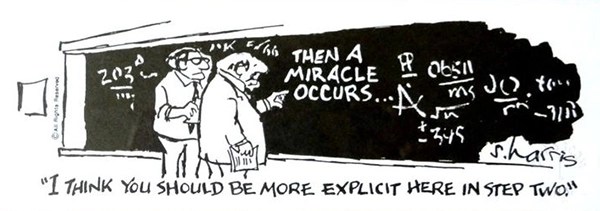
2.10.2024 – incomprehension

incomprehension
should cause suspicion rather
than admiration

I was reading an article titled, Why Bloat Is Still Software’s Biggest Vulnerability A 2024 plea for lean software, by Bert Hubert on the The Institute of Electrical and Electronic Engineers Website (2/8/2024).

Mr. Hubert was commenting how today’s software is so full of ‘bloat’ due to the quick and easy way to make webpages and computer software by focusing on making the software work and not caring how it managed to work, whether it called in software outside your program or not.

Mr. Hubert wrote that this outside software and this desire to make things work and not care how if worked used an unbelievable amount of code as well as created an unbelievable amount of security risks.

Mr. Hubert quoted a paper from 1995 (!) where a Mr. Niklaus Wirth said, “To some, complexity equals power. Increasingly, people seem to misinterpret complexity as sophistication, which is baffling — the incomprehensible should cause suspicion rather than admiration.”

I started making webpages back in 1995.

I can still type out code as fast as I can think it when I have to, but that isn’t so much in demand anymore due to web page building programs and tools that any one can use.

I decided to test the hypothesis that these tools use too much unnecessary code and I made two simple web pages.

Off the top of my head I wrote the code for a page that said, “HELLO WORLD” and uploaded it to a server.

Then, using WordPress, I made a page that said, “HELLO WORLD.”

I used 6 lines of code.

WordPress used 537 lines of code.

OVERBROAD strokes paint this picture I know.

Still …

I read the phrase out load again.

To some, complexity equals power. Increasingly, people seem to misinterpret complexity as sophistication, which is baffling — the incomprehensible should cause suspicion rather than admiration.

Admiring this grand sweep and combination of words, I thought of today’s political news cycle.

Keep that in mind and read this again.

To some, complexity equals power.

Increasingly, people seem to misinterpret complexity as sophistication, which is baffling —

The incomprehensible should cause suspicion rather than admiration.

As Mr. Twain writes in the The Man that Corrupted Hadleyburg .

There is nothing in the world like a persuasive speech to fuddle the mental apparatus and upset the convictions and debauch the emotions of an audience not practised in the tricks and delusions of oratory.

Mr. Twain’s story was published in Harper’s Magazine back in December 1899.

Increasingly, people seem to misinterpret complexity as sophistication, which is baffling —

The incomprehensible should cause suspicion rather than admiration.

Am I missing something from the news cycle today?

I don’t think so.

It is just as Frank Lloyd Wright might have said with a smile and a wave of the backhand.

Well, There you are.

2.9.2024 – where and when to go

where and when to go
destination unknown, I
have already left

You don’t have to live in the Savannah long to learn the story of Poet Conrad Aiken’s grave and the stone bench near the grave.

Carved in the bench are the words, Cosmos Mariner, Destination Unknown.

The story is that Mr. Aiken was reading the ship departures in the daily paper and the combination of the words caught his eye.

It is Friday afternoon.

It is February.

It is a Friday afternoon in February and all I got to do is decide where and when to go.

Though my destination is unknown.

I feel like I have already left.

Maybe warm enough for a book and a cigar in the sunshine tomorrow which will take me farther than I can drive.

But if we drive, well Savannah beckons.

Or the beach.

Though my destination is unknown.

I feel like I have already left.

2.8.2024 – God, it is something

God, it is something
face the sun know you are free
hear the undersong

IT is something to face the sun and know you are free.
To hold your head in the shafts of daylight slanting the earth
And know your heart has kept a promise and the blood runs clean:
It is something.
To go one day of your life among all men with clean hands,
Clean for the day book today and the record of the after days,
Held at your side proud, satisfied to the last, and ready,
So to have clean hands:
God, it is something,
One day of life so
And a memory fastened till the stars sputter out
And a love washed as white linen in the noon drying.
Yes, go find the men of clean hands one day and see the life, the memory, the love they have, to stay longer than the plunging sea wets the shores or the fires heave under the crust of the earth.
O yes, clean hands is the chant and only one man knows its sob and its undersong and he dies clenching the secret more to him than any woman or chum.
And O the great brave men, the silent little brave men, proud of their hands—clutching the knuckles of their fingers into fists ready for death and the dark, ready for life and the fight, the pay and the memories — O the men proud of their hands.

Clean Hands by Carl Sandburg as printed in Smoke and steel, (New York, Harcourt, Brace and Howe, 1920)

Yes, go find the men of clean hands one day and see the life, the memory, the love they have, to stay longer than the plunging sea wets the shores or the fires heave under the crust of the earth

On June 17, 1785, Thomas Jefferson wrote to James Monroe, “I sincerely wish you may find it convenient to come here. The pleasure of the trip will be less than you expect but the utility greater. It will make you adore your own country, it’s soil, it’s climate, it’s equality, liberty, laws, people and manners. My god! How little do my countrymen know what precious blessings they are in possession of, and which no other people on earth enjoy.”

Two years before the Constitution, they were both future Presidents but that was a job that didn’t even exist yet.

As I drive to work and face the sun with clean hands I feel the sun on my face but cannot help but hear the sob and its undersong.

I read the news and I think, My God! How little do my countrymen know what precious blessings they are in possession of.

2.7.204 – do absolutely

do absolutely
nothing be effortlessly
aimless niksening!

I was raised in West Michigan where you often heard the odd phrase, “If you’re not Dutch, You’re not much.”

West Michigan has a history of being Dutch since the first batch of Dutch Protesting Protestants arrived back in the 1850’s.

And what were they protesting back home that they had to leave?

You know …

The use of the modern music in church and I am NOT making this up.

This one group was bound for Iowa when a promoter/developer met them in Buffalo and showed them pictures of the beautiful city on the lake in West Michigan.

The land there that this feller was selling was even cheaper than the land in Iowa, so West Michigan it was, but boy were they surprised when they got there to find all they had was a picture of what the town could be.

But I digress.

As I was saying, the saying was If You’re Not Dutch …

Turns out that has morphed into “If You’re Dutch, Don’t do Much!”

I read with much satisfaction the article The art of doing nothing: have the Dutch found the answer to burnout culture? by Viv Groskop in the Guardian on Feb. 7, 2024.

The Dutch have discovered Niksen!

Niksen?

Niksen means Embracing the Dutch Art of Doing Nothing!

Ms. Groskop writes, “in modern society there are lots of nice things to do. As a result, we do a lot.

The pace of life is higher than in non-western societies and the level of life satisfaction is also high and keeps rising.

And yet … A side-effect is that we get into time pressure.

And we dream of more relaxation.”

Niksen gives us what we crave: an explanation for what’s missing – the presence of nothing in our lives.”

Don’t get too excited as not much is changing about being Dutch.

Ms. Groskop quotes Carolien Hamming, the founder and CEO of CSR Centrum, a centre for research into stress and resilience just south of Utrecht, “It has nothing to do with our culture. On the contrary, we’re Calvinists and tell each other to work harder.”

So what is different?

Olga Mecking, the author of the book, Niksen: Embracing the Dutch Art of Doing Nothing says:

We always have in mind some kind of outcome.

When we prepare meals, we think, ‘This meal will help me lose weight or will make me healthier.’

If we go for a walk, it has to be part of our 10,000 steps.

So we lose that fun of just eating or just walking.

So it’s about letting go of the outcome.”

I like that.

Letting go of the outcome.

I like that a lot.

Doing something just to do something.

Going to the see something WITHOUT needed a selfie to prove you were there.

Just do it as my shoes say.

Letting go of the outcome.

I think I love that.

As Ms. Groskopf writes:

“… you don’t need to be Dutch or know the word niksen to do nothing, you can just … do it.

And there’s no way of doing nothing the wrong way.

I have been practicing niksen most of my life.

2.6.2024 – sometimes, each day is …

sometimes, each day is …
making shoes for dead people
who no longer walk

I had a job I loved but changes and more changes in management made doing the job more and more a frustrating nightmare.

I worked managing local TV news websites.

I had been doing this from day one when this company decided to go online an I was hired to design their first website for TV station in Grand Rapids, Michigan.

Online school closings?

I made up, literally made up, the code.

Online High School Football Scoreboards?

I created the process.

Online election results?

I was part of the team that invented them.

But the job was changing because the managers were changing.

We went from people who did things to people who managed things.

One of the changes that caused so much frustration was the decision to separate the team I was on to be further and further from the news content that we worked to put online everyday.

When I started the job, the people on the web team were part of the creative effort for the content that we put online.

Under new management, we were told we were technicians and that was it.

Not that I added to the news that much but my opinions had been worth something and when I wanted to, I could contribute and write the occasional story.

When President Ford died and his funeral was in Grand Rapids we were ready on air and online.

I worked 24 hour days that entire week it seems like.

And I was able to reserve for myself the privilege of writing the final story that wrapped up the station coverage of the event.

Now I was told no more being a part of the news.

Just get it online.

I needed a creative outlet.

Buy this time I had moved from a local station to a corporate web team working with all the stations owned by this company.

My office was in ATL.

And I needed a creative outlet so I started scribbling down haiku based on words I saw or heard on my daily commute to work in downtown Atlanta.

Instead of saying hello to people at the TV Station where my office was, I would greet them with a haiku.

Sometimes I got a friendly nod.

Most times I got a shaking head.

Then I decided I would take advantage of my background and launch a blog!

A blog were I would publish my haiku on a daily basis.

I started in January of 2019.

On February 6th I wrote this one.

It was, and is, based on a passage in the book, The Short Timers by Gustav Hasford.

Short Timers is the book that Stanley Kubrick turned into the movie, Full Metal Jacket.

In the chapter, Body Count, Mr. Hasford writes:

Rafter Man and I stop by the USO and exchange a few off-color jokes with tie round-eyed Red Cross girls, who give us donuts. We ask the Red Cross girls if they expect us to satisfy our lust with a donut and they explain that a donut hole is all we rate.
In the USO there are barrels and barrels of letters which have been written to us by children back in the World:
Rafter Man reads the letters out loud. He can still be touched by them.
To me, the letters are like shoes for the dead, who do not walk.

That last line, To me, the letters are like shoes for the dead, who do not walk, stuck in my brain and the next morning after reading it, feeling blue about my job I wrote:

Sometimes, this job is …
making shoes for dead people
who no longer walk

I wrote it up and published it on my new blog and posted it on Facebook..

Later that day, Dave, a good friend of mine over in sales who followed my adventures working for a company that wanted to be online without really wanting to be online, stuck his head in my door.

Good one“, was all he said.

And he left.

Better than any A I ever got.

Not that I got that many A’s.

And I thought, let’s see how long I can keep this going.

That was five years ago today.