8.31.2024 – catch a falling star

catch a falling star
hear mermaids singing – tell me …
where all past years are

Adapted from “Song” by John Donne, first published in 1633, as printed in The Oxford book of English verse, 1250-1918, New York, Oxford University Press, 1939.

The first stanza reads:

Go and catch a falling star,
Get with child a mandrake root,
Tell me where all past years are,
Or who cleft the devil’s foot,
Teach me to hear mermaids singing,
Or to keep off envy’s stinging,
And find
What wind
Serves to advance an honest mind.

With seven children in our family, my wife and I watched a lot of Nickelodeon and I thought a lot of those shows had underlying themes that were for those parents who like us, ended up watching those goofy shows.

The cartoon ‘Hey Arnold‘ about a kid with a football shaped head and his adventures growing up comes to mind.

The Grandma in that show would have a line here and there that just stopped you dead.

From “You’d knock down the statue of Liberty if it got a gray hair!” to “Against the law of the king, perhaps. Against the law of common decency? I think not!” you never knew what she would say.

In one episode Arnold was trying to get folks interested in saving an old building or something, I cannot remember what, and in the middle of the night, Grandma wakes him and drags him yelling, “Come on, let’s go grasp some straws!” and they go out to battle for justice and truth.

That is me today.

So so so much.

Michelle Obama’s call to DO … SOMETHING resonated in me to my toes.

… but what?

Mr. Donne writing almost 400 years ago put it this way.

Go and catch a falling star.

Tell me where all past years are.

Teach me to hear mermaids singing.

[Teach me] to keep off envy’s stinging.

Find what wind serves to advance an honest mind.

Come on, let’s go grasp some straws!

8.30.2024 – accidentally

accidentally
damaged and the response will
be accordingly

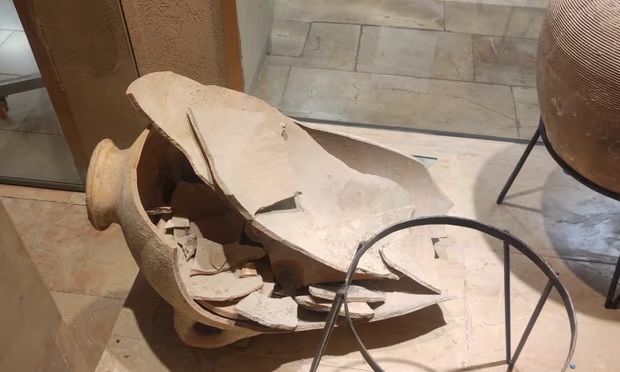
I was refreshingly intrigued to read the story, “‘I couldn’t believe it was my son who did it’: boy, 4, smashes bronze age jar in Israel museum” by Ashifa Kassam in the Guardian.

Ms. Kassam writes of an incident at the Hecht Museum in Israel where a 4 year boy knocked over and smashed a 3,500 year old vase that was ‘Older than King David.’

Ms. Hassem wrote that the parents, “They were not expecting what came next, however. “Instead of imposing fines or punishment, they invited us to visit again,” said Alex [The Dad].

This time the visit would include an organised tour, in an attempt to “sweeten” the family’s previous experience at the museum, the museum’s director, Inbal Rivlin, said in a statement.

Mr. Rivlin is quoted as saying, “There are instances where display items are intentionally damaged, and such cases are treated with great severity, including involving the police. In this case, however, this was not the situation. The jar was accidentally damaged by a young child visiting the museum, and the response will be accordingly.

Someone in 2024, was allowed to have an accident.

No lawyers.

No police.

No courts.

The people who knew the situation said it was an accident and that accidents happen.

How refreshing!

I am happy to know accidents can still happen.

When I was 12, I was the Smithsonian in Washington, DC and in their display on Pirates, there were some gold doubloons mounted on the wall.

I eyeballed them, then I reached out and touched one.

BRAMMMMMMMMMMMMMMMMMMMMM the alarms went off.

A guard slid an accordion style metal grate across the entrance to the display hall.

I suppose I should have been scared, but by age 12 I had mastered the air of concerned innocence in times of stress and when the guard ran over to check the display, he went right past me without a glance.

Once the guard was able to verify nothing was missing the alarm was turned off and the grate was slid back and I started to breath again.

For crying out loud, why did they have them glued to the wall if we weren’t supposed to touch them.

I joined up with my family and we walked on to other rooms, passing by a display of what was identified as Theodore Roosevelt’s desk.

This desk was also known as the Resolute Desk but President Nixon, aware of its history with JFK, chose not to use it in the White House and it was put the Smithsonian.

You cannot image how happy I was to read that a few months later after my Pirate Coin incident, at a Museum Black Tie Gala, the Director of the Smithsonian was showing the Roosevelt desk to some dignitaries when one of them asked if the lid could be raised and the Director said he didn’t know, so he reached over the velvet ropes and grabbed the top of the desk and BRAMMMMMMMMMMMMMMMMMMMMM ….

But I digress.

What happened to accidents?

Don’t accidents happen anymore?

Maybe once in a while and luckily one happened in the Hecht Museum in Israel.

Never heard of it, but I would like to go there.

8.27.2024 – am what I have read

am what I have read
far more surely than I am
what I have eaten

Ms. Margaret Renkl, a contributing Opinion writer for the New York Times who covers flora, fauna, politics and culture in the American South, in a love letter to books titled, My Bookshelf, Myself, writes:

For me, a book made of paper will always be a beautiful object that warms a room even as it expands (or entertains, or challenges, or informs, or comforts) a mind, and a bookcase will always represent time itself. I walk past one of our bookcases, and I can tell you exactly why a particular book is still there, never culled as space grew limited, even if there is no chance I’ll ever read it again.

I could have written this piece.

I know a lot of people who could have written this piece.

I also know a lot of people who won’t understand the line “I walk past one of our bookcases, and I can tell you exactly why a particular book is still there, never culled as space grew limited, even if there is no chance I’ll ever read it again.

Why would anyone keep a book they’ll never read again?

It is a good a question and I don’t really have a good answer.

It is somewhere along the lines of a quote in the 1983 documentary, Ansel Adams: Photographer.

At the end of the film, the scene depicts Mr. Adams walking through a flowering field and the narration says, ” … in 1938 Alfred Stieglitz wrote in a letter to Ansel Adams that ‘it is good for me to know there is an Ansel Adams loose somewhere in this world of ours.'”

It is good for some folks to know that certain books are there, still there, close by, even if there is no chance that book will ever be read again.

Ms. Renkl continues, “When I reread a book from my own shelves, I meet my own younger self. Sometimes my younger self underlined a passage that I would have reached for my pencil to underline now. Other times she read right past a line that stuns me with its beauty today. I am what I have read far more surely than I am what I have eaten.

I love that passage though in some ways its brings to mind the Jim Harrison character in his book, The Road Home, who re-reads his own 50 year old journals and keeps thinking, “What will this fool going to do next?”

Books, books and more books.

As I would say when I worked in a bookstore, books are like jello, always room for more.

I spent my life with them and they are, until you move cross country, a necessity.

When you move, they become a luxury.

To be sure I have two book cases of books I really want, want enough to move with, but I wonder if they will make the next move.

I still look at them and feel good knowing they are there even though I know I most likely won’t read them again.

I have three devices filled with books and I can still get that feeling of pleasure of knowing I have these books on my devices.

And I cannot agree more that I am what I have read far more surely than what I have eaten.

I remember my good friend Gerald Elliot, who over his long life, was an editorial writer for the Grand Rapids Press among many other things.

Late in life he had accomplished two interesting things.

First, about 10 years before he died, he gave his personal library to the Grand Valley State University Library.

Jerry not only wrote editorials but had been the book reviewer for the Grand Rapids Press for decades and was pretty much understood to be the area’s man of letters and his collection was impressive.

He had thought the books would go into the general collection of the library but instead were dumped into the library fundraising book sale which made him so mad that he vowed to me that he would never do that again.

And the second thing was that in the 10 years since giving away his library, he had acquired as many books again as he had given away.

He told me that story at the bookstore where I worked as he picked up the two bags full of new editions he had just purchased.

He looked at me then he looked over at his wife then he looked at the bags of books and back at me.

Can’t go on forever I guess,” he said.

He looked at his wife and said, “Then it will be her problem of what to do with these damn books.”

8.25.2024 – dark material

dark material
with a bright impasto of
playful irony

Reviewers, whether for food, restaurants, books or movies, seem to get the best words and word play into their writing.

In his review of How Tyrants Fall by Marcel Dirsus, Pratinav Anil writes:

Since the second world war, 23% of the world’s rulers have ended up exiled, imprisoned or killed after leaving office. For dictators, though, the figure rises to 69%.

This was impressed on Robert Mugabe not through statistics but by seeing what happened to his friend Taylor.

Subsequently, he let it be known there was only one way he was going to leave Zimbabwe – “in a coffin”.

How Tyrants Fall arguably belongs to the genre known as “mirrors for princes” – manuals for monarchs – whose exponents include Al-Ghazali and Machiavelli.

Dirsus is a worthy heir to that tradition.

He wears his research lightly and ranges widely, lathering his dark material with a bright impasto of playful irony.

If, back in the day, one Professor had written your wear your research lightly and ranges widely, lathering your dark material with a bright impasto of playful irony on anything I wrote (well, I guess one Professor DID say that but that’s another story and it was another story, a love story I wrote for a creative writing class for my Jimmy Carter era Senior Writing Requirement not a research paper) I would have rolled up and died a happy person.

I recall the story told by Stephen Ambrose (and yes I am aware of the danger of even bringing Mr. Ambrose into a story today) as a student at the Univ of Wisconsin.

Mr. Ambrose tells how he went to see one of his Professors and low and behold, one of Mr. Ambrose’s papers was tacked to the Professors day.

Mr. Ambrose writes that he was about to bust and walked into the Professor’s office all aglow.

Instead of papers, the Professor asked Mr. Ambrose if he knew about rattlesnakes and the western culture.

“Out west,” the Professor said, “Folks will kill a rattlesnake, skin it and nail the skin to door to keep out other snakes.”

Then the Professor stared at Mr. Ambrose for a good long time until Mr. Ambrose pieced it all together and figured out WHY his paper was tacked to the door.

I would say that that Professor wore his messages about research lightly and ranges widely, lathering dark material with a bright impasto of playful irony.

8.16.2024 – our diet reflects …

our diet reflects …
food tells us where we came from …
who we have become

The sad theme of loss runs through all of Southern culture from way back. The black spirituals and blues are its musical expression. But its countertheme is endurance. Today, Southerners are more and more aware of their traditional foods as the rest of their culture blends into that of the nation as a whole. Certain dishes give identity to entire communities. Yearly, thousands of people flock to small towns all over the South for festivals in honor of such lowly foodstuffs as chitlins, ramps, and collards. A few years ago, most Southerners wouldn’t admit to still eating these foods. Now we see bumper stickers directing us to “Eat more possum.” It isn’t just a joke. We know we are Southerners because we do eat possum and grits and okra. When we no longer eat these foods, we no longer will be Southerners. Our diet reflects the history of the region and its people: Native Americans, Europeans, and Africans. Our food tells us where we came from and who we have become.

From Biscuits, Spoonbread, and Sweet Potato Pie by Bull Neal, Alfred A. Knopf. Inc., 1990.

I have lived in the south now for 15 years – 11 in Atlanta and 4 in the low country of South Carolina.

Sorry to say that it is easier to read about southern cooking than it is to find places that serve traditional southern food.

I know a place in Gainesville, Georgia where if you order a burger with everything, be prepared to see the burger arrive covered with coleslaw.

We found several places in the ATL area where you had a wide selection of boiled veggies like Okra or squash or black eyed peas along with collards.

Here in the low country the emphasis around here is sea food and what you can do with shrimp.

Happy to say that my wife can now turn out any number of shrimp dishes that will match whatever you can find in a local restaurant.

But the reading, boy howdy, do southerners love to write about the food they used to cook.

This cookbook is worth reading.

It has several recipes that I have used.

One for three layer cake, that has become a staple of the southern branch of the Hoffman family tree.

But I read it, and I read a lot of southern cook books and book about southern cooking.

And much of what is written about is wonderful to read, but hard to find if you want to eat it.

I want to eat it.

I love to read it.

I wish I had time to create it.

I talked with one local chef and told him that when I retire I want man the grill at a waffle house.

He looked at me and offered to let me come work with him and really learn to cook.

But when I said it was the speed of the lunch counter grill I wanted to master, he nodded his head and looked me in the eye and said, ‘Understand that … I understand that.”

Our food tells us where we came from and who we have become.