9.21.2024 – call it Kuwohi

call it Kuwohi
Uluru and Denali …
Mackinaw or nac?

The Hoffman kids skipping stones on the beach at the Straits

The U.S. Board of Geographic Names this week approved a formal request by the Eastern Band of Cherokee Indians. to change the name of the highest peak in the sprawling Great Smoky Mountains National Park from Clingman’s Dome to Kuwohi.

Kuwohi, pronounced “ku-whoa-hee,” is one of the most popular sites in the park, with more than 650,000 visitors per year. It is the tallest point in Tennessee, the third-highest summit east of the Mississippi River.

I do want to point out that Clingman’s Dome was NOT named after a General in the Confederate States Army but it was named after a feller who went on to become a General in the CSA. Not that this makes any difference but I was happy to learn that back in the day geographer Arnold Guyot was not trying to honor anyone connected with the Confederates but a fellow geographer. A small, and now moot, point.

This is not something that has been proposed or something that has been set in motion, this is a done deal starting last Wednesday.

Who knew the U.S. Board of Geographic Names could move so fast?

The highest mountain in the Smokies is now Kuwohi.

And aside for the need for lots of new signs and maps in the National Park, the matter has been settled.

And I think that’s fine.

When the Australians changed the name of Ayers Rock to Uluru, Bill Bryson wrote that Uluru was “its more respectful Aboriginal name.”

When President Obama changed the name of Mount McKinley back to Denali, not much more than some odd Ohioans even seemed to notice.

I have to point out that Denali is a perfectly beautiful name and that opinion has nothing to do with that I have a beautiful Grand daughter by that name.

I grew up in the Great Lakes State of Michigan.

The road map of Michigan is filled with Anishinaabe names that carry over from the days before Europeans got to the place.

Consider the names of Michigan rivers like Potagannissing and Sebewaing.

In his book about traveling around the United States, Blue Highways (Boston, Little, Brown, 1982), William Least Heat Moon writes, “On a map, lower Michigan looks like a mitten with the squatty peninsula between Saginaw Bay and Lake Huron forming the Thumb. A region distinctive enough to have a name was the only lure I needed, but also it didn’t hurt to have towns with fine, unpronounceable names like Quanicassee, Sebewaing, Wahjamega, or other names like Pigeon, Bad Axe, Pinnebog, Rescue, Snover, and—what may be the worst town name in the nation— Freidberger.”

Then there is the Mackinaw region of Michigan that includes upper lower Michigan and lower upper Michigan in an area called ‘The Straits of Machinaw” or is Mackinac or Michilimackinac?

Michigan’s own, Bruce Catton, in his book, Michigan: A Bicentennial History (New York, Norton, 1976) put it this way:

Michilimackinac is a stumbling block for anyone who writes or talks about Michigan. There are innumerable ways to spell it, there is argument over its meaning, and there is no logic whatever to its pronunciation; on top of which, it does not stay put properly as a historic place should. Before Marquette’s time, the name was applied to the entire Straits area, which was the Michilimackinac country. Today, mercifully abbreviated to Mackinac, the name is applied only to the island out in the Straits — a beautiful place, the only spot in the state of Michigan where no automobiles are allowed. South of the island, at the tip of the lower peninsula, there is a village named Mackinaw City; perversely, here the name is spelled the way the name of the island is pronounced. In any case, when Marquette and his charges arrived, the great name was being applied to a more or less intermittent and informal trading center that had come into existence around a little bay on the east side of a point on the north shore of the Straits. Later, it meant the Mackinaw City area, where a notable fort was built, and still later it meant the island, where there was another notable fort. Men said that Michilimackinac meant “great turtle,” in the Ottawas’ language, but an Ottawa chief in the nineteenth century said that this was not so at all; the name came, he insisted, from a small tribe that originally lived on the island, a folk called the Mi-shene-mackinaw-go; and anyone who wants to go into it more deeply is quite free to do so.

Kuwohi.

Uluru.

Denali.

Anyone who wants to go into it more deeply is quite free to do so.

BTW: My sister and brother in law just sent us a care package of Mackinac Island Fudge – I can attest … there is nothing like in the world 🙂
9.20.2024 – fear, uncertainty among

fear, uncertainty among
consumers businesses and
among investors

It was the line after the line that was the source for this haiku that caught me eye and that line being:

Truly the hat-trick.

This is from the article, With the best glasses donor money can buy, surely Starmer can see that this week has been a total disaster by Marina Hyde in the Guardian.

I hate finding facts based on ‘polls’ but when the polls show that the only British Prime Minister to have lower poll popularity numbers that Mr. Keith Starmer (on the job now for about 44 days) was the Prime Minister one before the last one, Liz Truss.

I think Ms. Truss WAS Prime Minister for about 44 days and got to oversee the funeral of Queen Elizabeth which really was a nice bookend.

The funeral of the worlds longest reigning Monarch was during premiership of Britain’s shortest term Prime Minister.

Not sure what the over-under on that bet would have been.

Anyway … Ms. Hyde writes:

Labour took office and immediately declared things to be so dire that they were going to have to do awful and painful things to combat them – but will have left it three months before they finally explain what those awful and painful things are. This, as the former chief economist to the Bank of England Andy Haldane and many others have pointed out, has created a sense of “fear and foreboding and uncertainty among consumers, among businesses, and among investors”.

Truly the hat-trick. The current freebies row taking place during that particular information vacuum consequently feels even worse. It suggests that Starmer is a guy who talks to the public like an undertaker but in private likes the finer things in life. More than that, he feels entitled to them. That is no one’s favourite combination.

The new government in Britain, in 44 days has been able to create a sense of fear and foreboding and uncertainty among consumers.

Among businesses.

And among investors.

Truly the hat-trick.

That is no one’s favourite combination.

I kept the anglicized spelling.

Seems more posh you know that way, and it is almost a comfort that some other country seems to be as messed up as we are.

9.19.2024 – wouldn’t know where to go

wouldn’t know where to go
if didn’t have somebody
that knowed where to go

From the line “I thought I’d go and get something to eat some place, only I wouldn’t know where to go if I didn’t have somebody with me that knowed where to go.” from the play, June Moon, a play by George S. Kaufman and Ring Lardner. Based on the Lardner short story “Some Like Them Cold.”

Back when I was a kid growing up in Grand Rapids, Michigan in a family of 11 kids, it was rare to find myself alone in the family room with the TV.

But that’s where I was one night when I was about 12 years old.

It was bedtime and I should have been in bed but I wanted to stay up, I always wanted to stay up, and watch TV.

My Mom came in and looked at the clock and looked at me and I played my secret card.

Can we just see what is on public television?

Educational or Public TV had just arrived in our area and my Mom would never deny access to something educational.

See I would watch anything if it was on TV and I would even watch educational television if it meant not going to bed.

And you never knew what you might see our the light local PBS station.

She rolled her eyes and said okay, just for a few minutes.

I turned the TV to UHF and then turned the dial the channel 35 and sat on the floor.

What ever was on had already started and we missed the introduction.

It seemed to be a television production of a play but it was just two people, a man and woman who had just met and where on a train and talking.

The dialogue was nothing and everything at the same time and the timing of the two actors was so quick that while nothing was really happening I got drawn into their conversation.

The odd thing was, so was my Mom.

First she turned to watch for a bit.

Then she sat on the edge of chair.

And then she sat back and just took in the play.

There was a quality to the writing, the words and the acting that you could not ignore and we watched the whole play WITHOUT COMMERICIALS.

We watched the entire play together and when it was done, we looked at the clock and it was past 11 p.m.

Get to bed,” Mom said, “that was fun.”

And she gave me hug a off I went.

Years later I can still remember parts of the dialogue and the other day I started to try and search out the play based on what I could remember.

It turns out what we had watched was a special presentation of the play, June Moon, by George S. Kaufman and Ring Lardner and when I learned that so many lights clicked on.

The pacing the timing of Mr. Kaufman famous for his Broadway hits.

The dialogue and words of Mr. Lardner famous for his short stories.

Stories about the new kid from the small town arriving in the big city.

Stories where the kid would say, “I thought I’d go and get something to eat some place, only I wouldn’t know where to go if I didn’t have somebody with me that knowed where to go.”

If you haven’t read Mr. Lardner I encourage you to do so, especially the short story, Golden Honeymoon where Mr. Lardner writes, “After dinner we made them come up to our house and we all set in the parlor, which the young woman had give us the use of to entertain company. We begun talking over old times and Mother said she was a-scared Mrs. Hartsell would find it tiresome listening to we three talk over old times, but as it turned out they wasn’t much chance for nobody else to talk with Mrs. Hartsell in the company. I have heard lots of women that could go it, but Hartsell’s wife takes the cake of all the women I ever seen. She told us the family history of everybody in the State of Michigan and bragged for a half hour about her son, who she said is in the drug business in Grand Rapids, and a Rotarian.”

Its as if you have to read that paragraph in one breath.

Reading Lardner is like getting on a train and you can’t get off until the next station.

I thought I’d go and get something to eat some place, only I wouldn’t know where to go if I didn’t have somebody with me that knowed where to go.

Just something charming about those words as well as the memory of the first time I heard them.

9.16.2024 – cannot read papers

cannot read papers
as they no longer reflect
the world I perceive

Adapted from the passage:

“After twenty years of studying them I am no longer able to read newspapers.

Why?

It’s because they no longer reflect the world I perceive.

I will have to go along with the way I see it even if wrong.

And if they are right, it lacks interest.”

Written by Jim Harrison in the novella, The Man Who Gave Up His Name, published in the collection titled, “Legends of the Fall” by Jim Harrison, New York, Grove Press, 2016.

I still try to read The Guardian and the New York Times every morning with my morning coffee.

I used to try and read USA Today but it’s website defies any real effort to read the stories without a lot of perseverance.

I am speaking of perseverance, of course, from a technical point of view.

Oh to handle all the ads and popups and pop downs and such that make reading online news such a challange.

But of late I am having more and more issues with what I am reading.

I keep asking, what world are these people living in.

The world described more and more in newspapers does not reflect the world I percieve.

One side of the paper can decry the end of the world and those dire portents in the next elections and how if we all could really care about what was happening, we could stop it.

And on the other side of the paper are heart felt discussions of the clothes people wore on the red carpet of the Emmy’s and how the Emmy’s was rigged and whole lot of other stuff that is supposed to be of interest to me.

Maybe it is getting older.

I recently went to a major college football game and while there was much I recognized from when I went to this college as a student, there was much that did not reflect on college football as I perceived it.

I chatted with the lady next to me and she said that they were searching for ways to make if fun for kids.

I guess getting together with your friends along with a keg of beer and going someplace where you could drink in public and yell your head off is no longer fun enough.

Reading this as I type it I decided I better check my drivers license and it says I was born in 1960.

I think I am right on schedule.

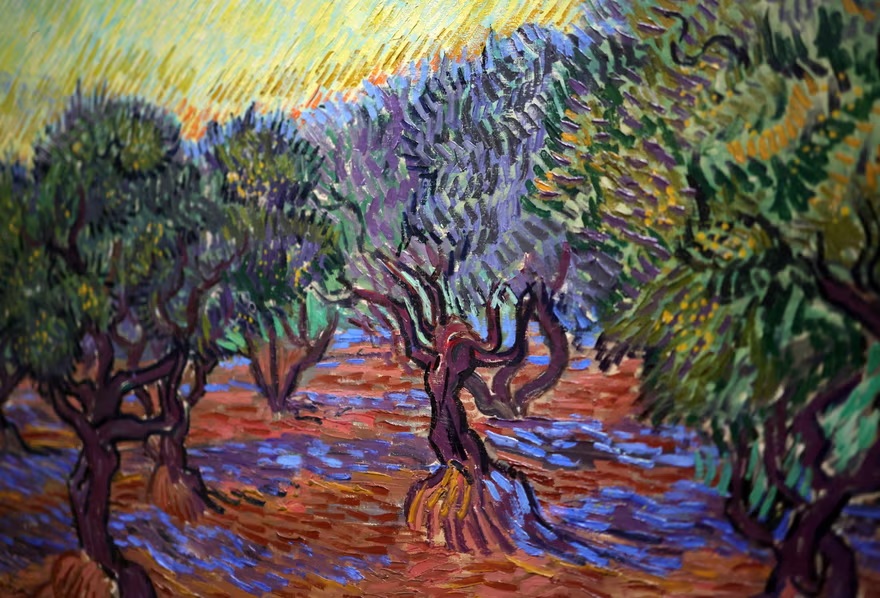
9.13.2024 – many touches but

many touches but
couldn’t care less what the colours
are in reality

From the review, Van Gogh: Poets and Lovers review – a riveting rollercoaster ride from Arles to the stars by Jonathan Jones in the Guardian, September, 10, 2024.

A review of the show, Van Gogh: Poets and Lovers, at the National Gallery, London, that opens September and I will never see.

Mr. Jones writes, “He’d toiled for years doing brown studies of northern life before he met the avant garde in Paris: within weeks of his arrival in Arles, he took the impressionist ideas he’d encountered to the next level. Describing his painting of a man sowing, he wrote in June 1888: “There are many touches of yellow in the soil … but I couldn’t care less what the colours are in reality.”

I have seen so few Van Gogh’s in person but I can testify to the impact of the power of the artist that can be felt standing in front of painting, knowing you have to be in the same space the artist once stood and the world the artist attempted to record on canvas.

As Mr. Jones states: “Reality is not real. The visionary is.”

I like that.

I like that a lot.

Reality is not real.

The visionary is.

When Mr. Jefferson wrote, “We hold these truths to be self-evident, that all men are created equal, that they are endowed by their Creator with certain unalienable Rights, that among these are Life, Liberty and the pursuit of Happiness,” he wasn’t, as we know, describing the world of Colonial America as it then existed.

Not all men, mankind were equal.

It wasn’t the reality.

It was a vision.

A vision we are still too far from after almost 250 years but the vision, for a lot of us, is still there.

Which, I guess, makes us the visionary.

Reality is not real.

The visionary is.

That is the reality of it all.

Mr. Jones closes his review with this.

We all know how badly it ended. The ideals Van Gogh invested in his little home couldn’t withstand the shock of sharing it with Gauguin, and after his ear-cutting and further crises he decided he was better off in an asylum. But here, that never happens. We experience not the sordid facts, but Van Gogh’s dream of The Yellow House. It still exists, always, out there among the painted stars.

It still exists, always, out there among the painted stars.