capacity to love anything attractive however fragile
Adapted from the book, The Architecture of Happiness (2009, Vintage Books) by Alain de Botton, and the passage:
Freud was unsympathetic; for him, the capacity to love anything attractive, however fragile it might be, was a hallmark of psychological health. But Rilke’s stance, though inconvenient, helpfully emphasises how it can be those most in thrall to beauty who will be especially aware of, and saddened by, its ephemeral character. Such melancholic enthusiasts will see the moth hole beneath the curtain swatch and the ruin beneath the plan. They may at the last moment cancel an appointment with an estate agent, having realised that the house under offer, as well as the city and even civilisation itself, will soon enough be reduced to fragments of shattered brick over which cockroaches will triumphantly crawl. They may prefer to rent a room or live in a barrel out of a reluctance to contemplate the slow disintegration of the objects of their love.
According the The New York Review of Books, this is “A perceptive, thoughtful, original, and richly illustrated exercise in the dramatic personification of buildings of all sorts.”
What I find irrestible in reading Mr. de Botton is his use of language.
I get the feeling that if you made a spread sheet of all the words, adverbs and adjectives used by Mr. de Botton, you just might find that he used each word just once.
From the description of Dr George Abbershaw in The Crime atBlack Dudley by Margery Allingham (1904-1966) (published by William Heinemann Ltd, London, 1929).
I have to love the writing of the 1930s.
I think they thought, wrote and inexpressibly expressed themselves like this, leaving me grasping for the now non existent thesaurus.
Ms. Allingham wrote:
He was a smallish man, chubby and solemn, with a choir-boy expression and a head of ridiculous bright-red curls which gave him a somewhat fantastic appearance.
He was fastidiously tidy in his dress and there was an air of precision in everything he did or said which betrayed an amazingly orderly mind.
Apart from this, however, there was nothing about him to suggest that he was particularly distinguished or even mildly interesting, yet in a small and exclusive circle of learned men Dr George Abbershaw was an important person.
never heard the words come from the lips of a soul so vivid with life
Adapted from the book, Searching for Schindler by Thomas Keneally (2007 by The Serpentine Publishing Co., Pty., Ltd.) and the passage:
But I had never heard the words come from the lips of a soul so vivid, so picaresquely Eastern European, so endowed with baritone and basso subtleties of voice and inflection, so engorged with life, as Leopold Page/Pfefferberg.
Searching for Schindler is the book behind the book, Schindler’s List.
Thomas Keneally’s use of language and ‘being from Australia’ in an ‘Oh are from Australia?’ world anecdotes are worth the read.
As an example she uses a clip from the TV Show, Dr. Who, where the Doctor shows “Vincent van Gogh how beloved he would one day be.”
In this scene, the actor Bill Nighy, playing an art museum curator, relates the importance of the Van Gogh to the world in 100 words.
What Mr. Nighy does not know is that is is explaining this to Van Gogh.
I am sorry if you want me to explain how this all works because I can’t.
If this is important to you all I can recommend is that you don’t watch Dr. Who.
Mr. Nighy’s character says, “He [Van Gogh] transformed the pain of his tormented life into ecstatic beauty. Pain is easy to portray, but to use your passion and pain to portray the ecstasy and joy and magnificence of our world, no one had ever done it before. Perhaps no one ever will again.“
From my point of view and history and such, I can’t argue with this statement.
I wouldn’t want to.
But here is the point.
If you could show Van Gogh how much his painting meant to world.
If you could ease his pain. (Wasn’t that also a line from the feller in the corn field in Iowa?)
If you could remove his torment.
Would you do it?
Understanding that it was his passion and pain to portray the ecstasy and joy and magnificence of our world, if you remove the passion and pain, do you remove the motivation for the art?
Do you fix Vincent but destroy his art.
If you destroy his art, do you destroy Vincent?
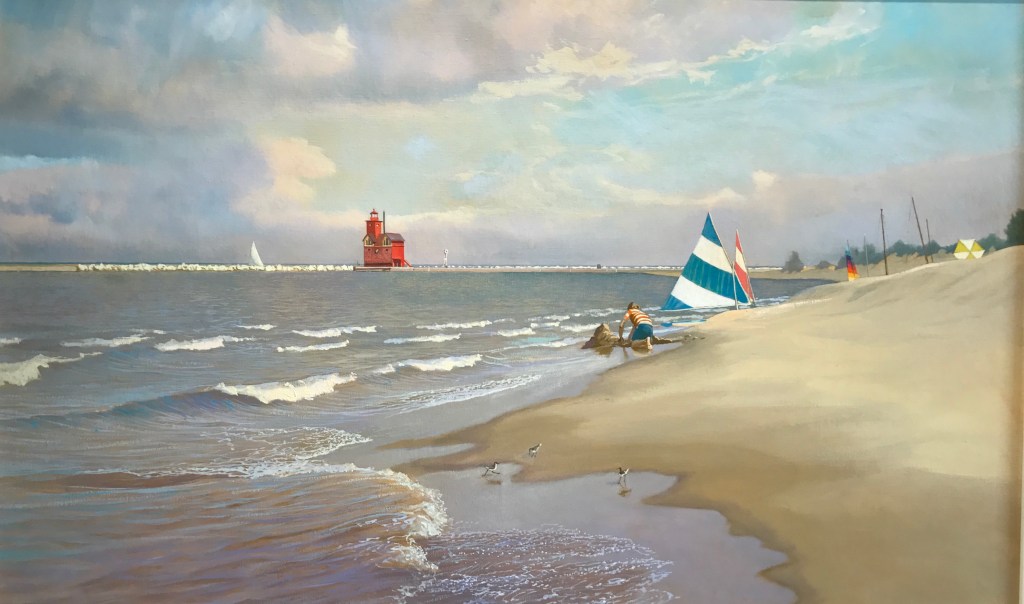
Growing up, I was lucky that my father had a friendship with a painter in the Grand Rapids Michigan area by the name of Armond Merizon.
Most people I know knew his brother who taught for years at Grand Rapids Central High School.
Mr. Merizon would come by our house and bring along a few of his latest works to show my Dad.
I would sit nearby and listen to the conversation.
On one visit, Mr Merizon related a recent trip to Chicago to see a Van Gogh show.
Mr. Merizon told how overcome he was by the passion, the pain and the torment in the paintings.
Mr. Merizon was hit so hard by the pain that he said as he got closer to the end of the show, knowing how the story would end, he could not go on, and he had to leave the museum.
The passion, the pain and the torment was too much.
There are indeed artists who had the passion but not the pain.
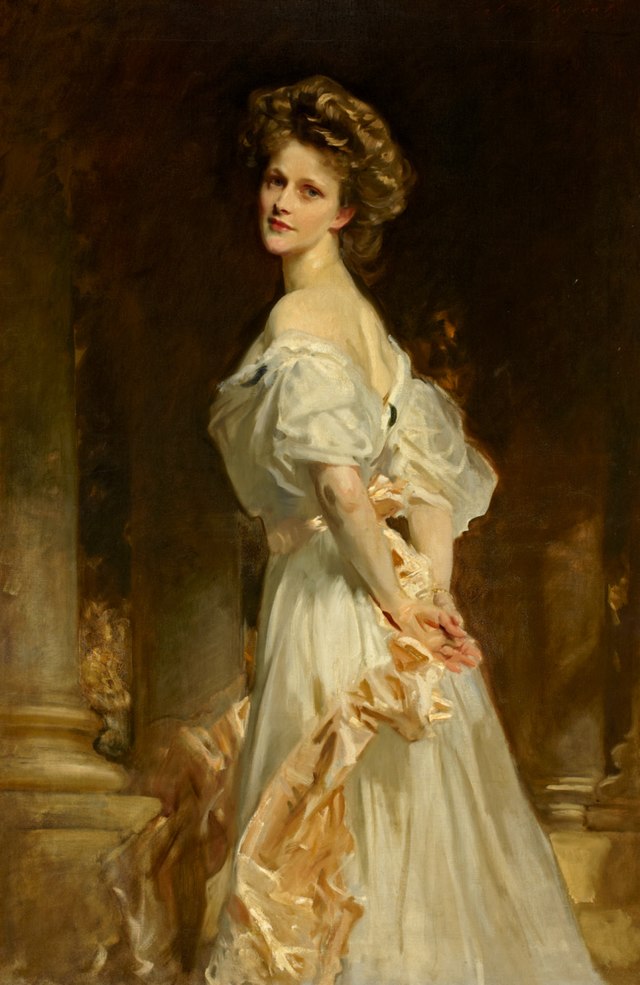
Consider John Singer Sargent.
His life was nothing like Mr. Van Gogh.
According to some accounts, Mr. Sargent averaged a portrait commission a month at a modern day $150,000 per commission.
The pain Mr. Sargent went through as he put it, was having to talk with these people to get them to smile.
Andy Warhol famously commented on John Singer Sargent that, “made everybody look glamorous. Taller. Thinner. But they all have mood, every one of them has a different mood.”
But they all have mood.
Everyone one of them.
Has a different mood.
Like the other architect said about Frank Lloyd Wright, “I don’t know who it does that. If I did, I would do it.”
Nancy Langhorne, Viscountess Astor by John Singer Sargent (1909)
Motivation is the thing.
As Abraham Lincoln put it, that grub that gets to gnaw at you.
I have a weakness for alternative histories that play on the idea of fixing a past wrong.
I am exploring motivation and lost motivation.
So much motivation seems to be grounded in torment, passion and pain.
If I had a choice to be ‘creative’ but the price was pain, what would I choose.
no shortage reasons be suspicious of coyly silent ambition
Adapted from the book, The Architecture of Happiness (2009, Vintage Books) by Alain de Botton, and the passage:
There is no shortage of reasons to be suspicious of the ambition to create great architecture. Buildings rarely make palpable the efforts that their construction demands. They are coyly silent about the bankruptcies, the delays, the fear and the dust that they impose.
According the The New York Review of Books, this is “A perceptive, thoughtful, original, and richly illustrated exercise in the dramatic personification of buildings of all sorts.”
What I find irrestible in reading Mr. de Botton is his use of language.
I get the feeling that if you made a spread sheet of all the words, adverbs and adjectives used by Mr. de Botton, you just might find that he used each word just once.

 No Haiku For You