9.29.2021 – thinking one way to

thinking one way to
spell words obviously lacks
imagination

“Anyone who can only think of one way to spell a word obviously lacks imagination.”

So the WWW says Mark Twain said.

I also love to quote Mr. Twain as saying, “It is a poor sort of person who can only spell a word in one way.”

I dislike to use the WWW as a source if the source is nothing more than page of quotes and I am not alone.

The website, https://quoteinvestigator.com/, is available and these folks work to verify who said what when.

Sadly they cannot attribute either statement to Mr. Twain.

So I have to now say, “… as Mark Twain is reported to have said …”

Spelling has been on my mind of late.

Over the weekend last (Sept 25th) a member of the Ohio State football team quit the team in the middle of the game and took to Twitter to give vent to his feelings.

The story I saw reported that the player, K’Vaughan Pope, “tweeted ‘… Ohio State’ (expletive deleted AND misspelled).” [sic]

I had to laugh.

I mean it has long been known in the online world that I live in that any story about Ohio State football gets twice as many page views as any other any sports story.

The Ohio State fan who clicks on the story.

And the person who reads it to them.

That an Ohio State football player couldn’t spell a deleted expletive … was really funny.

Most expletives that get deleted are four letter words.

Just four letters.

I admit I had to puzzle out what Mr. Pope might have tweeted and it wasn’t until the next day that I came across a screen grab that showed that he tweeted ‘fucc Ohio State.’

Picking on athletes for their intellect is as old as any game.

James Thurber writes in the short story “University Days‘ of the entire class body, Professor included, working with a star football to name a form of transportation.

The scene is captured in Thurber’s sketch of Bolenciecwz trying to think.

Another course that I didn’t like, but somehow managed to pass, was economics. I went to that class straight from the botany class, which didn’t help me any in understanding either subject. I used to get them mixed up. But not as mixed up as another student in my economics class who came there direct from a physics laboratory. He was a tackle on the football team, named Bolenciecwcz. At that time Ohio State University had one of the best football teams in the country, and Bolenciecwcz was one of its outstanding stars. In order to be eligible to play it was necessary for him to keep up in his studies, a very difficult matter, for while he was not dumber than an ox he was not any smarter. Most of his professors were lenient and helped him along. None gave him more hints, in answering questions, or asked him simpler ones than the economics professor, a thin, timid man named Bassum. One day when we were on the subject of transportation and distribution, it came Bolenciecwcz’s turn to answer a question. “Name one means of transportation,” the professor said to him. No light came into the big tackle’s eyes. “Just any means of transportation,” said the professor. Bolenciecwcz sat staring at him. “That is,” pursued the professor, “any medium, agency, or method of going from one place to another.” Bolenciecwcz had the look of a man who is being led into a trap. “You may choose among steam, horse-drawn, or electrically propelled vehicles,” said the instructor. “I might suggest the one which we commonly take in making long journeys across land.” There was a profound silence in which everybody stirred uneasily, including Bolenciecwcz and Mr. Bassum. Mr. Bassum abruptly broke this silence in an amazing manner. “Choo-choo-choo,” he said, in a low voice, and turned instantly scarlet. He glanced appealingly around the room. All of us, of course, shared Mr. Bassum’s desire that Bolenciecwcz should stay abreast of the class in economics, for the Illinois game, one of the hardest and most important of the season, was only a week off. “Toot, toot, too-tooooooot!” some student with a deep voice moaned, and we all looked encouragingly at Bolenciecwcz. Somebody else gave a fine imitation of a locomotive letting off steam. Mr. Bassum himself rounded off the little show. “Ding, dong, ding, dong,” he said, hopefully. Bolenciecwcz was staring at the floor now, trying to think, his great brow furrowed, his huge hands rubbing together, his face red.

“How did you come to college this year, Mr. Bolenciecwcz?” asked the professor. “Chuffa chuffa, chuffa chuffa.”

“M’father sent me,” said the football player.

“What on?” asked Bassum.

“I git an ‘lowance,” said the tackle, in a low, husky voice, obviously embarrassed.

“No, no,” said Bassum. “Name a means of transportation. What did you ride here on?”

“Train,” said Bolenciecwcz.

Quite right,” said the professor. “Now, Mr. Nugent, will you tell us–“

Bolenciecwz trying to think.

Shoeless Joe Jackson of Field of Dreams fame was famously uneducated.

One story has a fan yelling, “Hey Joe, can you spell CAT?”

And Joe yells back, “Hey Buddy, can you spell S H * T?”

Patrick Ewing of the New York Knicks (and maybe more famous for his years at Georgetown) was reportedly unable to spell ESPN unless you gave him two letters.

Never the less, today, in the age of twitter I find it a bit disingenuous on the part of the world at large and the sports world in particular to take on anyone over spelling.

Take me, for one.

I couldn’t spell my way out of a paper bag.

If my life were to be graded on spelling I wouldn’t make the list let alone the bottom of the list.

AND … don’t forget, Mr. Pope was so upset he had to TWEET before he could anything else!

The extent to which I can rely on my opposable thumbs to hit the right letters while texting or tweeting is not something I would ever want to be graded on.

Spelling in the age of social media may be having the legs of its seat at table of required talents being sawn off as we speak.

On the one hand, of course we want to be pretty specific with the written word.

On other other, don’t we all know what was meant to said?

In his book, Undaunted Courage: Meriwether Lewis, Thomas Jefferson, and the Opening of the American West, the somewhat discredited and so I question my need to quote him but, Stephen Ambrose, writes about Lewis and Clark on the spelling of the word, mosquito, that, “His [Lewis] usual spelling, repeated at least twenty-five times, was “musquetoe.” Clark was more inventive: he had at least twenty variations, ranging from “mesquetors” through “misqutr” to “musquetors.”

The word Mr. Ambrose uses to describe the spelling of Lewis and Clark is ‘imaginative.’

Which circles back to Mr. Twain.

Anyone who can only think of one way to spell a word obviously lacks imagination.

Whether or not Mr. Twain said this and if he didn’t say I would bet he would have wanted to say it.

I will embrace imagination.

I will embrace less rigid spelling.

And I will paraphrase Mr. Twain.

When angry count to three.

When very angry, tweet.
9.28.2021 – well, life, according

well, life, according
to Marcus Aurelius,
is an opinion

Adapted from the book, Noah’s Compass (2009, Alfred A. Knopf) by Anne Tyler, and the passage:

Sometimes he thought that she’d been born with a mental checklist of milestones that she’d sworn to get out of the way as soon as possible. Grow up, finish school, marry the first boy she dated, start a family … She had been in such a hurry, and for what? Here she sat, an intelligent young woman, with no more on her mind than organizing her church’s next bake sale. Ah, well. Life was a matter of opinion, according to Marcus Aurelius.

Part of the series of Haiku inspired by from Noah’s Compass (2009, Alfred A. Knopf) by Anne Tyler. Anne Tyler is an American novelist, short story writer, and literary critic. She has published twenty-three novels, including Dinner at the Homesick Restaurant (1982), The Accidental Tourist (1985), and Breathing Lessons (1988). I came across Noah’s Compass as an audio book when living in Atlanta I commuted 1 hour each way. As the book had to deal with memories and memory loss and it involved someone my age, I was taken with the book. I have enjoyed reading most of Ms. Tyler’s work. Accidental Tourist maybe better known for the movie which I also recommend.

9.25.2021 – my being able

my being able
to read, get hold of a book
these impressions last

Came across this statement the other day.

I mention that away back in my childhood, the earliest days of my being able to read, I got hold of a small book … I remember all the accounts there given of the battle fields and struggles for the liberties of the country … [that] fixed themselves upon my imagination … and you all know, for you have all been boys, how these early impressions last longer than any others.

This was said by Abraham Lincoln.

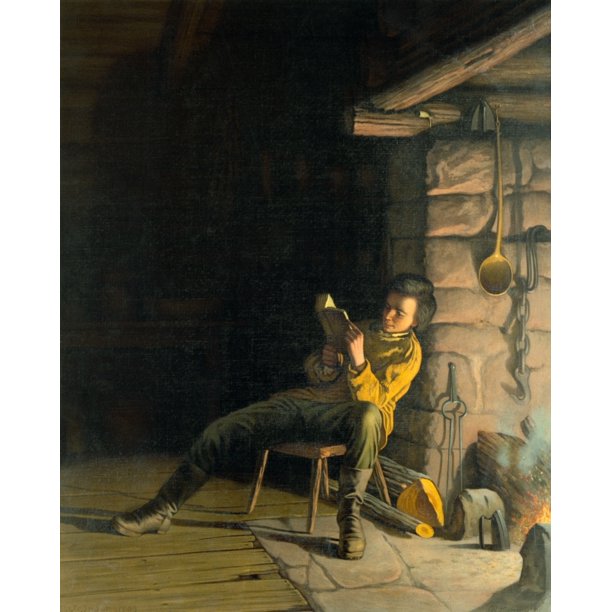
I didn’t read that statement as a kid but I knew this painting as a kid.

Young Abe Lincoln by Eastman Johnson – 1868 – University of Michigan Museum of Art

I cannot remember a time in my life that I didn’t know the images and story of this painting.

Imagine my delight when I happened to walk through the University of Michigan Art Museums (it what was supposed to be Alumni Memorial Hall) and discovered that Michigan OWNED the painting but another time – it’s a great story.)

I grew up in Grand Rapids, Michigan, in a home with a fireplace.

A fireplace for show and not for heat but a real working fireplace that we used often.

When I could, I would turn off all the lights and try to read by firelight.

Maybe that is why I needed glasses so soon.

It was fun.

It was cozy.

It made me really appreciate Thomas Edison and the stories of the Rural Electrification Act.

I cannot remember when I started reading or maybe I should say I cannot remember my life without reading.

Back in the day, if you attended the Grand Rapids Public Schools, your family had to buy school books.

This changed by the time I started school but being the 8th kid in a family of 11 kids, it meant that we had piles of school books all over the house.

At some point I picked up the early Dick and Jane books and went on from there.

But the time I got into school it seems like I had already read many of the text books I would use in elementary school.

And I got bored.

Me being bored led to me finding other things to do during class.

This is sometimes known as disruptive behavior.

I wasn’t trying to be disruptive but goodness it was boring to just sit.

This often led to interactions with my teacher that resulted in me being sent out into the hall.

The hallways at Crestview Elementary school were lined with benches and shelves and pegs for coats.

I was supposed to sit there and reflect on my disruptive ways.

I didn’t mind being out there alone but there was always a chance that another class might walk by and see me on their way to gym or music or something.

If that happened there was a chance that one of my brothers or sisters would see me.

If they saw me, they would tell on me when I got home and who needs that.

One time I saw my brother’s class coming and I hid under the coats hanging there.

When we got home my brother, all so innocently says, “Mike, what were you doing in the hallway?”

I of course denied it and he says he saw me.

I forgot that I was denying it and yelled that he couldn’t have seen me as I was hidden.

My brother yelled right back that maybe my top half was hidden but my legs and shoes were there in the hallway.

At some point the decision was made that instead of the hallway I would be sent to the library.

This may have something to do with the fact that the classroom wall along the hallway had a row of windows across the top.

In the hallway, if you climbed up the wall and stood on the shelf over the coat pegs and jumped up you could see and be seen through those windows.

Don’t ask me how I know that but like I said, it may have something to do with why I was now being sent to the library.

I was ready to complain about it because I complained about everything.

Then it sunk in where I was going.

I was going to the library.

Honestly, and I remember this clear as day, my first thought was of Brer Rabbit and don’t throw me in that briar patch and I almost said, “Don’t send me to that library” but somehow I figured that my teacher knew all about Brer Rabbit so I kept my mouth shut for once.

Also, somehow or other, as much I understood the relationship between being a little disruptive and being sent to the library and that this relationship was open to exploitation but I decided to play it honest and not push it.

Someway I knew this punishment was privilege and I could mess it up.

And I was disruptive enough without trying.

So I kept my disruptive behavior to organic origins.

From then on, at some point in any given day I would get wound up or bored or both and my teacher would catch my eye.

I would hang my head for a second or two, I got real good at showing despair, and get up and walk to the door.

‘Shall we saw 15 minutes?’ my teacher would say.

I would nod and walk out.

I would walk down the hallway first to the Principal’s office.

There I would approach the school secretary who would open a drawer and get out a set of keys and find the library key.

I would take the keys and walk to the library and unlock and open the door.

Then I would take the keys back to the School Secretary and say, “15 minutes today.”

She would replace the keys in the drawer and nod her head.

I returned to the library and closed the door and turned on the lights.

I was in third grade.

I was in the library by myself.

I was alone with all those books.

Few things in life have been more enjoyable than that moment.

At different times in my life, being alone in the bookstore where I worked or first one to the various public libraries where I later worked I have come close to this feeling of empowered freedom.

The library was filled with books.

Books were the keys to everything.

I had the key to the library.

What more could anyone want?

Some philosopher is in the back of my brain, George Santayana seems to be attached to this thought but why ruin a moment with the google, saying that happiness is a shack to live in within 5 miles of a major university library.

And then there was young Abe Lincoln.

Young Abe Lincoln loved to read.

Young Abe Lincoln reading by fire light.

Young Abe Lincoln walking miles to borrow books.

Young Abe Lincoln waking up to find a book wrecked by dripping snow and walking miles to offer to work for days to pay for the damage.

Young Abe Lincoln’s delight at being given the self same book when the debt was paid.

Young Abe Lincoln alone with his book.

This is the kicker about these young Abe Lincoln stories.

They all seem to be pretty much darn close to the truth.

What is about Mr. Lincoln?

Of all people, Leo Tolstoy was recorded as saying, “If one would know the greatness of Lincoln one should lis­ten to the stories which are told about him in other parts of the world. Once while travelling in the Caucasus I happened to be the guest of a Caucasian chief of the Circassian … {This Chief] lifted his hand and said very gravely ‘But you have not told us a syllable about the greatest gen­eral and greatest ruler of the world. We want to know some­thing about him. He was a hero. He spoke with a voice of thunder; he laughed like the sunrise and his deeds were strong as the rock and as sweet as the fragrance of roses. The angels appeared to his mother and predicted that the son whom she would con­ceive would become the greatest the stars had ever seen. He was so great that he even forgave the crimes of his greatest enemies and shook brotherly hands with those who had plotted against his life. His name was Lincoln and the country in which he lived is called America, which is so far away that if a youth should journey to reach it he would be an old man when he arrived. Tell us of that man.

I am not sure of all that.

I know I was once a little kid in America.

I knew that Mr. Lincoln was once a little kid in America.

I liked to read.

He liked to read.

I think we could have hung out in the library.

That fixed itself upon my imagination, and you all know, for you have all been kids, how these early impressions last longer than any others.

9.21.2021 – long road dissolving

long road dissolving
limit of sight, scintillant
yet ethereal

Adapted from the book, Dutch: A Memoir of Ronald Reagan (1999 – Random House) A biography with fictional elements by Edmund Morris and the passage:

All his life, Ronald Reagan has ridden a long road dissolving, at the limit of sight, into something scintillant yet ethereal. His vagueness about that vision is the typical mythopoesis of Fools or mystics.’

9.19.2021 – admire optimism

admire optimism
whatever their condition
imagine the best

Adapted from the book, A Week at the Airport: A Heathrow Diary (2009, Vintage Books) by Alain de Botton, and the passage:

I admired the optimism with which Dudley confronted every new pair of shoes that paused at his station. Whatever their condition, he imagined the best for them, remedying their abuses with an armoury of brushes, waxes, creams and spray cleaners. He knew it was not evil that led people to go for eight months without applying even an all-purpose clear cream polish. He was like a kindly dentist who, on bringing down the ceiling-mounted halogen lamp and asking new patients to open their mouths (‘Let’s have a look in here, shall we?’), remains aware of how complicated lives can become and so how easily people may give up flossing their teeth while they try to save their companies or minister to a dying parent.

Part of the series of Haiku inspired by from A Week at the Airport: A Heathrow Diary (2009, Vintage Books) by Alain de Botton. I discovered this book entirely by accident. When searching for books online, I will use the term ‘collections’ and see what turns up. I figure that someone who has taken the time to gather together the etexts of any one author to create a collected works folder is enough for me to see what this author might be all about.

In this case I came across the writing of Alain de Botton. I enjoyed his use of language very much. Much of the words he strings together lend themselves to what I do.

As for his book, I recommend it very much though written in 2009, it misses the added layer of travel under covid but still the picture of the modern airport is worth the read.