5.21.2022 – appreciative

appreciative
of the good things in life, kind,
has intelligence

If it’s Saturday (and for me it is) and if someone is reading this (and they must be to read this) and they have read these posts in the past (which they might have) it will not come as a surprise that today’s haiku is based on the weekly feature in the Guardian titled, Blind Date.”

Two people agree to meet in a London Restaurant and answer questions about the evening.

Often it is just the restaurant and its menu that brings out the comments in my fingers as they type on the keyboard and the restaurant today, Ottolenghi Spitalfield, could be a part of a Saturday morning creative process and but another day.

That being said, I find it hard to accept that I could call my wife and say, “Made reservations at Ottolenghi Spitalfield’s” and she would not have reservations of her own.

(UPDATE – further research shows that the place was Ottolengi’s IN Spitalfield but I am not sure that helps)

Also, I have to mention that a menu that list’s a Butter bean mash, burnt lemon and coriander salsa, pine nuts, Aleppo chilli for £11 or Lamb kebab, tzatziki and ladopita for £17 deserves some further attention, but I digress.

In the Blind Date today, the participants where asked the question, Best thing about …?

One of today’s blind dater’s responded: He seems kind, appreciative of the good things in life and has emotional as well as practical intelligence.

Which, I would think, anyone would be happy to have as someone’s first impression of themselves.

But it got me to thinking.

What are the good things in life?

I got to making a list of things.

I was smart enough in making my list that these ‘good things in life’ are of course those things that are free or cheap.

Right?

I mean I started my list with sunshine.

Maybe you have had to grow up in West Michigan, notably the 2nd most overcast piece of real estate in the Western Hemisphere, after the Pacific Northwest and Seattle, to understand how good a sunny day can make you feel.

Then I went the other way and made a list of the good things that aren’t free.

Not wanting to brag, by my wife and I can pick out the best bottle of wine available at the nearby gas station with our eyes closed.

Well, maybe not closed, as we do have to make sure that it is the cheapest.

This has got a little more complicated since the local gas station started keeping the Cabernet and the Merlot in the cooler for our conveince.

As a tip, the $6 gas station bottle is far superior to the $4 Kroger bottle.

(BTW, my latest book, “After the Third Sip, It All Tastes the Same” is number 3 in Germany this week)

But then I kicked myself and said, gee whiz stupid, get with the program and come up with the good things of life.

Then I looked at the phrase again, appreciative of the good things in life.

It came to me that there is no definitive list of ‘the good things.’

Everyone’s list is different.

It is the appreciative part that is the key.

Much like how Alice Walker wrote in the Color Purple, “I think it pisses God off if you walk by the color purple in a field somewhere and don’t notice it.”

I am reminded of Carl Sandburg’s poem, Happiness:

I ASKED the professors who teach the meaning of life to tell
me what is happiness.
And I went to famous executives who boss the work of
thousands of men.
They all shook their heads and gave me a smile as though
I was trying to fool with them
And then one Sunday afternoon I wandered out along
the Desplaines river
And I saw a crowd of Hungarians under the trees with
their women and children and a keg of beer and an
accordion.

There are a lot of people in this world.

God put a lot of good things in this world.

I hope I can appreciate it.

Or as the wonderful Nora York sang, Thank you for my breath, my breathing.
5.15.2022 – nuance in science

nuance in science
which is lost in debate on
social media

Boy! What might this haiku be based on today?

Howdy, what might NOT this haiku be based on today?

With all the possible topics at hand, I got the words for this haiku from an article titled, “Coffee bad, red wine good? Top food myths busted.”

The article takes on those awful bane’s of life today of red meat, coffee, red wine, plant milk and other awful anxiety causing additives that keep me up at night when I don’t have anything else to worry about.

I read the article not with a grain of salt but a bag, a pile, a State of Michigan Department of Highways salt spreader dump truck of salt.

I read the article more from the point of a humorous essay that a factual report.

The idea that statistically speaking (always get ready when that is spelled out) there are more health problems connected with moderate wine drinking … because there or so many more moderate wine drinkers is a line out of a Marx Brothers movie.

When I make presentations about the online world, I like to mention that a high percentage of people who visit a given website are most likely using the world wide web but most folks write that down in their notes.

I think it was Ricky Bobby who pointed out that on average, 97.5% of all people will die.

I am old enough to know that everything and nothing is bad for you.

You just have to pick your terms and go from there.

But the article did have two lines that I really liked.

The last line could have been predicted by anyone who had every heard, watched or read a report on what foods are good for you.

The last line says, “As with all things, moderation is key.”

No kidding?

Eating an apple a day keeps the doctor away, right?

Eating 100 apples will keep everyone else away due to the bodily production of internal methane gas as well as most likely kill you.

Moderation is key.

Gee wiz AND Boy Howdy!

The line I really liked was, when Rob Percival, author of The Meat Paradox: Eating, Empathy and the Future of Meat, was quoted saying, “But there’s nuance in the science, which isn’t often communicated in the press and is lost in the debate on social media,” he says.

Mr. Percival, speaking as an expert in the politics of meat, is talking about the science of red meat being bad for you when he said, “But there’s nuance in the science …”

But that sentence is just too cool to not let stand alone as a judgment on the last 20 years or so about anything.

But there’s nuance in the science, which isn’t often communicated in the press and is lost in the debate on social media.

And please be aware, it is not just the numbers.

As I am talking about food, I am sure everyone knows that eggs are bad for you.

Why?

Eggs are bad for you as they are high in cholesterol.

And cholesterol is bad for you.

Everyone knows that.

Right?

Do you know why we know that?

Back in 1966 President Lyndon Johnson read in his morning paper that the cost of a dozen eggs was higher then it had ever been in history and LBJ went all LBJ on his staff to bring the price of eggs down!

One effort involved the USDA releasing anything and everything it had that was bad about eggs.

The next night every major evening newscast (all three of them) carried the story that according to US Government sources, eggs were high in cholesterol and while they weren’t sure what that meant, it wasn’t good.

And the price of eggs dropped.

And that message about evil eggs has stayed in the collective conscience of the American mind ever since.

Just google ‘eggs LBJ’ if you want to look it up.

If I am not getting my point across, maybe there is a nuance in the science, which isn’t often communicated in the press and is lost in the debate on social media.

5.15.2022 – the smiling, laughing,

the smiling, laughing,
making me comfortable
was it possible

I like to start my day with a newspaper.

Which means today, my day starts online.

I like to go over the Google News headlines WITH tracking turned OFF so I can tell myself that I am getting a overview of the news, not a view tailored to my interests.

Then I click on the Guardian from Manchester, UK. (or is UK now out and GB back in?)

Of late, my outlook on life has been downright dark and gloomy and what I read in the paper or as Will Rodgers said, “All I know is what I read in the papers” and what I read is also downright dark and gloomy.

The other day I was gifted with several stories that, when read in the order I read them, gave me a mental kick in the pants.

As Mr. Lincoln said of General John Pope, who detailed many of this reports “Written from Headquarters in the Saddle” that General Pope “had his headquarters where is hindquarters should have been.”

I have had my head in my butt and all has been doom and gloom.

I am in a funk and I cannot get out.

Waiting to exhale.

Waiting for the shoes to drop.

Just waiting and waiting.

We moved to what is called the Low Country of South Carolina about a year and a half ago.

We found a good church and then we pushed ourselves out of our comfort zone to get involved and joined a small group that meets every other week or so.

We are talking our way through the topic of when bad things happen.

We are all pretty much in agreement that while we cannot see the plan, bad things DO happen, but in the end, things work out according to God’s plan and when the time comes to look back, the plan can become a little more evident.

I have no problem with this.

Though it leaves unanswered the unanswerable ‘what do you do or how do you handle yourself in that moment when the bad things are happening.’

Often, knowing that there will come a time when you can look back and see the hidden God given strength that helped you get through the bad things can be pretty thin at the moment.

To boil it down I would say that:

One: Bad things happen.

Two: Things work out as we leave things in God’s hands, or as CS Lewis would say, “It always was in God’s hands.”

Then the third point, Three: this is what you do while bad things are happening.

Notice I did sat what ‘this’ is.

As I said, of late, the news has been pretty bleak and the bad things that are happening has pretty much got me into a semi-permanent funk on the worldly issues of Country, Economy and Civil Strife.

Then I was gifted three stories in a row that responded to these three points about bad things and the current state of affairs.

First, bad things happen.

I read the article, “Americans believe nothing is getting better. Biden feeds that disillusionment” by David Sirota with much nodding and much “Boy HOWDY but that is how I feel.”

Mr. Sirota writes that many people are going through ‘Jokerfication’ – a concept based on the Joker in Batman which describes ‘becoming so thoroughly disillusioned that one loses faith in everything.’

Mr. Sirota then lists the reasons for Jokerfication and I find it hard to argue with any of them.

Thoroughly disillusioned is a marvelous phrase.

There is no light at the end of this tunnel or so it seems.

But to the 2nd point, things will get better and we will be able to see bad times in the rear view mirror.

The next article I came across was “An optimist’s guide to the future: the economist who believes that human ingenuity will save the world” by David Shariatmadari which is a review of the book, The Journey of Humanity by Econmist Oded Galor (who I have never heard of just to be transparent).

Mr. Shariatmadari writes that Mr. Galor’s: “message appears to be that whatever the circumstances you have inherited, change is possible. It’s an analysis of the human condition that leads not to a counsel of despair, but a new set of tools he believes can help build a better future.”

There is much to Mr. Galor’s to try to grasp but I was fascinated by the observation there are two cultures in the history of the world.

Wheat farmers and Rice farmers and society grew up around those two basic fundamental life styles.

I was especially intrigued as I now live what was the focus of rice growing economy in wheat growing North America but for another time.

Mr. Shariatmadari ends his review with, “For many, though, a dose of faith in human progress will be hard to resist.

And, BOY HOWDY, do identify with that!

SO there we are.

Bad things happen, but there is hope that the future can find answers to these bad things.

SO what about the third point.

What is ‘this is what you do’?

Remember we are talking about a world view here.

The next article I clicked had the headline, “How an encounter with a friendly person made me see myself differently” by Sinéad Stubbins.

Ms. Stubbins related how arriving early for an appointment she and another lady dealt with being locked out of an office.

Ms. Stubbins writes, “Then it struck me. Everything this woman had been doing – the smiling, the laughing, making me feel comfortable when I was doing silly things – I had been doing too. We were mirroring each other’s warmth exactly. Could it be? … She was friendly. Was it possible that I was friendly too?”

Simplistic I know.

But I am repulsed by the feeling of Jokerfication and I want to reject it and if the answer is to be friendly then I will embrace that and let you know how it goes.

Sometimes I need to be told to hang on, it will be okay in the end.

That I read these online stories in a row was seemingly more than chance and I appreciate it.

5.14.2022 – some mistakes are made

some mistakes are made
bit funnier than others
not have taken much

Based on an interview with one Rachel Graham.

Ms. Graham said, “We’re not really interested in fighting, we’re just pointing out the obvious that they should have looked it up themselves. It wouldn’t have taken much.”

Mistakes are made,” she added. “Some are just a bit funnier than others.

According to what I read this morning, Mark and Rachel Graham received a cease-and-desist letter from Condé Nast, the magazine publisher, asking them to change their pub’s name.

Their pub is in the town of Vogue, a hamlet in the parish of St Day, Cornwall, England.

Their pub is named, The Star Inn at Vogue.

Vogue the magazine sent them a cease and desist letter and threatened legal action if they would not change the name of the pub.

I found the Graham’s reaction to not react a bit refreshing in this day and age.

Again, Ms. Graham said, “We’re not really interested in fighting, we’re just pointing out the obvious that they should have looked it up themselves. It wouldn’t have taken much.”

Mistakes are made.

Some mistakes are funnier than others.

I think there even might have been people in Washington DC that agreed with this.

Sorry to say, though, that Abraham Lincoln hasn’t been around since 1865.

He may have been the last person to be able to not take themselves seriously inside the beltway.

Jim Harrison writes something along the line that if you look at the city of Washington and the buildings, how could some NOT BECOME POMPOUS once they got there.

He favored turning the Capitol building into a museum and putting Congress in a pole barn in Anacostia and then see how fast Congress took care of business.

I agree with this but want to make sure it is a pole barn without air conditioning.

I am also reminded of a time when the company I worked for decided to crack down on non-authorized online use of company content.

The company I worked for owned a lot of TV stations and other websites were embedding video and such without asking for permission or crediting the company.

The web team was told to go out and find these places and turn them over to corporate legal.

I was in Atlanta at the time and the very first place I found that was using WXIA TV video without permission was the Johnnie Cochran law firm.

I filled out the required paper work and sent it off to corporate legal.

That was the last I heard of the case and the project as a whole.

ANYWAY, Boy, HOWDY!

Mistakes are made.

Some mistakes are funnier than others.

It made me almost weep for a era seemingly long gone.

Do I have to move to the parish of St Day, Cornwall, England?

5.6.2022 – your freedom to read

your freedom to read
to determine what you read
independently

Where to start?

A journey of a thousand miles begins with a single step but where to begin?

Mr. Rodgers and Mr. Hammerstein said that we should, “Start at the Very Beginning, a Very Good Place to Start.”

The Bible says, “In the beginning was the Word, and the Word was with God, and the Word was God.” (John 1:1 NIV)

That’s where it starts.

In the beginning was the word.

The word comes to us in a book.

That is where is starts.

A Book.

Books are there from the beginning.

Books are at the core.

For me, books are the answer.

For some, books are the problem.

And that shakes me to the core.

Book burning and it’s little brother, book banning, are for me, black and white, wrong vs. right.

Mr. Lincoln’s “eternal struggle between right and wrong” would embody books in my book.

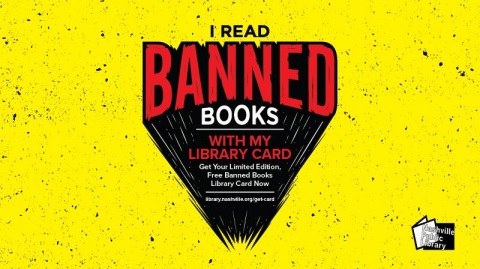
The Nashville Public Library is working to raise awareness of recent book banning efforts by issuing a library card that proclaims, “I READ BANNED BOOKS.”

The press release from the NPL quotes Director Kent Oliver, saying, “I want Nashvillians to know: Nashville Public Library will always respect your Freedom to Read – to independently determine what you read, and don’t read, and to exercise your role in determining what your children read.

While I would have been happier had Mr. Kent not split an infinitive ( and I think to determine, independently, is more effective), I am very happy that the NPL is taking a stand and I would be happy to get the bright yellow card.

But the press release that the NPL was also one of the scariest and saddest statements that I have read recently.

Making the point for public support against book banning, the Nashville Public Library pointed out that:

Since the American Library Association began tracking challenges against books in the 1980s, the organization has recorded thousands of challenges made in cities across the U.S.

In contrast, 71% of readers oppose efforts to remove books from their local public libraries, according to an ALA survey of 1,000 voters and 472 parents of public-school children.

In contrast, 71% of readers oppose efforts to remove books from their local public libraries.

71% of readers oppose efforts to remove books from their local public libraries.

29% of readers did not express that they were opposed to efforts to remove books from their local public libraries.

I am reminded of the book, Fahrenheit 451 by Ray Bradbury.

The title is based on the thought that 451 degress (F) is the temperature at which book paper catches fire, and burns.

If you are not familiar with the book, it describes society where ‘fireman’ search out and burn books.

And why?

It was felt that books and learning in general created inequality and unhappiness, and so books were banned and burned.

In the book, in a speech about why firemen burn books, Bradbury reveals that it was the people that originally decided that the books should be removed.

Who needed the problems caused by books?

For myself, that 29% of people who identify themselves as readers in a poll, did not express that they were opposed to efforts to remove books from their local public libraries … well … beyond the words that I have available to me.