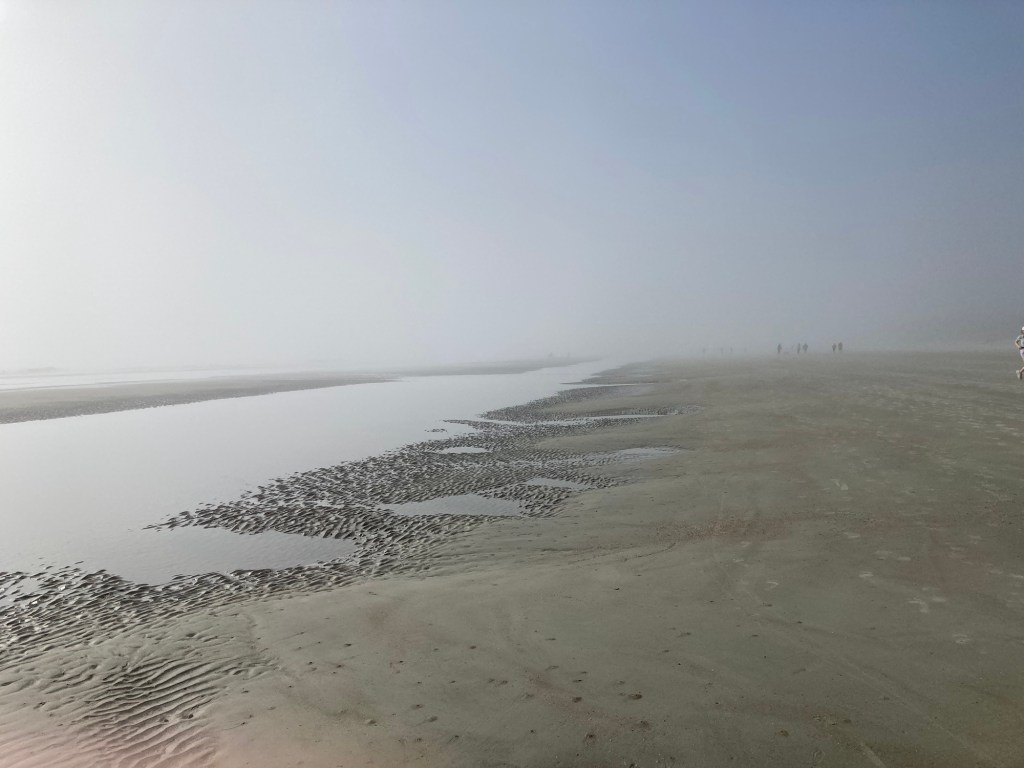
fog, little cat feet sits looking over harbor on silent haunches
From Fog in Chicago Poems by Carl Sandburg (Henry Holt and Company, 1916).
I will bet you one dollar you knew this poem.
I will double that bet and guess you knew it was Mr. Sandburg.
I will double that bet and guess that its the only poem by Mr. Sandburg you know.
Maybe a safe bet, but if there are two things I hope from all this is that most folks know this poem and that it is by this poet and for today, and you know what, that is enough!
So let us go on out to the kitchen and grab ourselves a beer to celebrate if I won or do the same thing if I lost.
Fog as published in Chicago Poems by Carl Sandburg (Henry Holt and Company, 1916).
The fog comes on little cat feet.
It sits looking over harbor and city on silent haunches and then moves on.
By the way with a 60 degree swing in the temperature since last weekend and with the ocean still at about 55 degrees, we gots ourselves a FOG warning here in the Low Country / Coastal Empire.
these are tawny days bashful mornings hurl gray mist on stripes of sunrise
These are the tawny days your face comes back The grapes take on purple the sunsets redden early on the trellis. The bashful mornings hurl gray mist on the stripes of sunrise. Creep, silver on the field, the frost is welcome Run on, yellow halls on the hills, and you tawny pumpkin flowers, chasing your lines of orange Tawny days and your face again
Tawny by Carl Sandburg in his book, Smoke and Steel, New York: Harcourt, Brace and Co., (1920).
The website, https://www.vocabulary.com/, defines tawny as an adjective meaning of a light brown to brownish orange color; the color of tanned leather.
The online Merriam-Webster says that tawny is from the Middle English, from Anglo-French tané, tauné, literally, tanned, from past participle of tanner to tan and that the first recorded use of the word is from the 14th century.
The book of Genesis, Chapter 1, verses 2-5 state:
And God said, “Let there be light,” and there was light. God saw that the light was good, and he separated the light from the darkness. God called the light “day,” and the darkness he called “night.” And there was evening, and there was morning—the first day.
For myself, when the Bible reports he separated the light from the darkness, I think that God set up what we know as the planet earth and when he separated the light from the darkness, God gave the planet a push that started it in motion so that on the planet, day was separated from night by the rotation of the planet.
From that moment all laws of what we now know as physics came into play.
Neither here nor there, that means, for me anyway, that God had a timer running as the earth revolved on its axis and when the Bible reports “… the first day”, God knew just what he meant, but I digress.
Anyway, at the end of that first day, the light sank below the horizon and on the morning of the 2nd day the light came up.
I am betting that when that light came, it was a tawny day and anyone who might be there to see it would see thatthe bashful mornings hurl gray mist on the stripes of sunrise.
My wife is not fond of these sunrise pictures I take with my iPhone because she knows that to take them, I am driving one handed, with my other hand holding my iPhone as I cross the Cross Island Bridge on Hilton Head Island.
I know it’s goofy but what can one do?
We live in the low country and it is flat.
There are few views to be had anywhere.
The Cross Island Bridge is one of few places you can see anything of the area.
And, as Augustus McCrae said the book Lonesome Dove, “, and “…if he missed sunrise, he would have to wait out a long stretch of heat and dust before he got to see anything so pretty.”
snow drifted, the wind crying because it could not get in by the fire
From the book Little House in the Big Woods by Laura Ingalls Wilder and the line, “But Laura and Mary listened to that lonely sound in the dark and the cold of the Big Woods, and they were not afraid.
They were cosy and comfortable in their little house made of logs, with the snow drifted around it and the wind crying because it could not get in by the fire.
It was 32 degrees Fahrenheit this morning in the low country.
I didn’t come here for the cool weather let me tell you.
Much is made of, in the News, when the snow storms in the South because the South doesn’t think about snow.
There are no snow shovels.
There is no road salt.
There are no snow plows.
There are no shoulders along the roads to put the snow or to direct your car when you lose control.
It is a big deal.
More so it seems to the people up north that the people in the south don’t prepare for snow.
Do you know why the people in the south don’t prepare for snow?
They DON’T HAVE TO!
If it snows down here, it IS a surprise … not something you have to prepare for like you do up north.
Today there is no snow, no ice.
Just cold.
And the south doesn’t think about cold.
I am sitting in my office and my fingers are numb.
My feet are blocks of ice.
I have on 4 shirts and a fleece vest.
BTW, the vest is something I picked up on sale one summer in an outfitters store in Mackinac, Michigan.
It would be just the thing, I said, to wear at work IN MICHIGAN … IN THE SUMMER TIME, when the air conditioning was set to 65.
When I started work here, the building I work in had central air and central heating, South Carolina style, which means these huge on-the-wall units in each area of the building.
We had a remote control for the unit and we could turn up the heat or turn down the AC as we wanted.
Over the summer the building went through a multi-million dollar renovation and standard central HVAC was installed.
The thermostat is NOT in my office.
I am not sure where that thermostat is located.
What I do know is that whatever room it is in, it must be about 85 degrees because in my office, on a morning where it is 32 degree’s outside, the air conditioning is running.
The sunny south.
It IS sunny outside but you cannot see the cold.
I can feel it, but I can’t see it.
What do I miss from living in the north.
The change in seasons?
Somehow that seems to be on most folks lists.
The food?
The beauty of the Great Lake State?
Nope.
I think back to warm heat.
The heat from a fire place.
The warmth of being inside where the wind is crying … because it can’t get in by the fire.
View from my office on Nov 29 – Can’t see the cold can you??
hurricane waiting rain raining and wind blowing not much else happens
It became evident to me after a few fast rounds with the radio that the broadcasters had opened up on Edna awfully far in advance, before she had come out of her corner, and were spending themselves at a reckless rate. During the morning hours, they were having a tough time keeping Edna going at the velocity demanded of emergency broadcasting. I heard one fellow from, I think, Riverhead, Long Island, interviewing his out-of-doors man, who had been sent abroad in a car to look over conditions on the eastern end of the island.
That is a short excerpt from EB White’s famous essay, The Eye of Edna (The New Yorker, September 25, 1954) where Mr. White told the story following Hurricane Edna using live reports … on the radio.
It was on my mind today as Hurricane Idalia came by.
Lots of dire warnings.
Lots of views of other places.
But here.
Rain raining.
Wind blowing.
The tide might be high but there is that blue moon anyway to help that along.
But you don’t want to be caught out in this if it gets worse.
So the wait continues.
Back in Mr. White wrote that. “The radio either lets Nature alone or gives her the full treatment, as it did at the approach of the storm. The idea, of course, is that the radio shall perform a public service by warning people of a storm that might prove fatal; and this the radio certainly does. But another effect of the radio is to work people up to an incredible state of alarm many hours in advance of the blow, while they are still fanned by the mildest zephyrs.”
The people I used to work with in TV News always shouted, “We are here to INFORM you, not scare you!”
And pass along advice.
As they did in 1954 when Mr. White noted, “… a man was repeating the advice I had heard many times. Fill the car with gas before the pumps lose their power. Get an old-fashioned clock that is independent of electricity. Set the refrigerator adjustment to a lower temperature”
I never thought about the clock today but I made sure my phone was charged though that will depend on cell towers being up and working.
Mr. White said, “There are always two stages of any disturbance in the country — the stage when the lights and the phone are still going, the stage when these are lost.”
All these moderns connections and conveniences.
Haven’t really come that far in the face of a Hurricane I guess.
I will tell one thing that caught me off guard.
I have been watching the storm all day through my window.
Its gray and windswept.
I know these days from growing up in Michigan.
Then I went outside for a quick trip to grab some supplies and I ran out the door and ducked my head … into the 40mph 85 degree storm.
It WAS HOT.
From my window, it was a COLD gray Michigan day.
Walking into 100% humidity and seeing folks in T shirts and shorts caught me off guard.
perihelion and aphelion move eastward solstices move westward
Over thousands of years, the Earth’s axial tilt and orbital eccentricity vary (see Milankovitch cycles). The equinoxes and solstices move westward relative to the stars while the perihelion and aphelion move eastward. Thus, ten thousand years from now Earth’s northern winter will occur at aphelion and northern summer at perihelion. The severity of seasonal change — the average temperature difference between summer and winter in location — will also change over time because the Earth’s axial tilt fluctuates between 22.1 and 24.5 degrees.
Smaller irregularities in the times are caused by perturbations of the Moon and the other planets.



 No Haiku For You