A Friday statement from the US senator Chris Van Hollen of Maryland said the Trump administration had “finally relented” to his demand to afford Ábrego García due process.
“This is not about the man,” said Van Hollen, who visited Ábrego García in El Salvador in April. “It’s about his constitutional rights – and the rights of all.”
“It’s about his constitutional rights – and the rights of all.”
Remember Dr. King’s “Injustice anywhere is a threat to justice everywhere.”
In the same article the Attorney General of the United States said, This is what American justice looks like …
I find no comfort thinking the the Attorney General of the United States of America would not have been able to pass Mr. Reagan’s 12th Grade Government class at Grand Rapids Creston Highschool.
Not that that disqualifies her from office in this administration.
think God’s on your side John Calvin’s under floorboards during board meetings
He told me that I should note in my reading of journals, monographs, and texts how all the great predators were theocratic …
that if you were going to rape the land and people, whether it was the original Indians or the working class that followed …
it was important to think that God was thoroughly on your side.
“John Calvin is always under the floorboards during America s board meetings.
From True North by Jim Harrison (New York, Grove Press, 2004).
Probably quote from Mr. Harrison a lot more than I should and I admit it isn’t without some misgivings.
The passage I quote today, I feel it explains much of what makes the Evangelical Church of Trump work.
There is a lot of my West Michigan background in the background of Mr. Harrison, though his foreground can take in a lot of life I did not experience.
And I wonder, do other people get it?
Take the John Calvin reference.
I am sure that most folks might know who Mr. Calvin was, but in West Michigan, where I grew up, John Calvin wasn’t under the table, he had a seat at the table.
The local college was named, Calvin College.
My wife went to a grade school operated by the Christian Reformed Church name Calvin Christian.
Most folks I knew had copies of The Institutes of John Calvin on a shelf in their home.
But I was raised Baptist.
Mr. Calvin was there in our theology with his TULIP acronym*, but we also told the joke that Calvinism was the fear that someone, somewhere, was having a good time.
BUT I DIGRESS.
I make no apology for Mr. Harrison’s content.
It is what it is.
But his use of language and narration and view of life, lives and lifestyle is powerful.
I remember back in the day when I worked in a bookstore and this one customer, who by his dress and manner and overall appearance was probably from what we called, ‘Up North’ which took in the part of the State of Michigan that was north of Kent Country up to and including the Upper Peninsula of the state.
Boy Howdy, maybe just north of the Grand River all the way to Lake Superior.
Nothing wrong with guy understand, but going north, you entered a different world that often times might have been more comfortable had it been about 1952.
Close to the same feeling I get when I drive across the back country of the State of South Carolina.
This feller as I remember him would not have stood had he been in the band, ZZ Top, including the long beard and dark sunglasses.
He was buying a copy of Garrison Keillor’s latest book, though I can’t remember which one.
I chit chatted with him, told him I hoped he enjoyed the book as I read all the Keillor stuff and enjoyed it all myself.
He stopped and looked at me for a second.
“I am getting it for my nephew”, he said, “he needs to read about life.”
Well says I, you should get something by Jim Harrison.
He stopped and looked at me for a second, looked away then back at me and said, “No, no way, this kid is not ready for Harrison …”
He looked off again, then said:
“Someday …”
And he caught my eye, nodded, a nod with a lot of understanding and kinship in it, and walked out.
*The acronym TULIP is used to represent the five core doctrines of Calvinism: Total depravity, Unconditional election, Limited atonement, Irresistible grace, and Perseverance of the saints.
black hats tilted down the rifle barrels sparkling in the morning sun
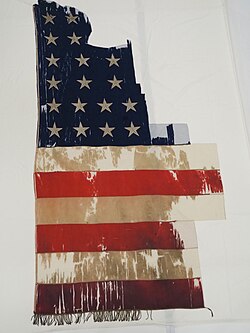
Flag of the 24th Michigan of the Iron Brigade – Regiment had 82% casualty rate at Gettysburg
As this brigade approached Gettysburg, Meredith or someone else ordered the flags uncased and set the fife-and-drum corps playing at the head of the column, and the Westerners fell into step and came swinging up the road, their black hats tilted down over their eyes, rifle barrels sparkling in the morning sun. There were eighteen hundred fighting men in this brigade, and the men were cocky. Officially they were the 1st Brigade of the 1st Division of the I Army Corps, and they figured that if the army were ever drawn up in one long line for inspection they would stand at the extreme right of it, which somehow was cause for pride. On the ridge to the west there was a crackle of small-arms fire and a steady crashing of cannon, with a long soiled cloud of smoke drifting up in the still morning air, and at the head of the column the drums and the fifes were loud—playing “The Girl I Left Behind Me,” probably, that perennial theme song of the Army of the Potomac, playing the Iron Brigade into its last great fight.
From The Army of the Potomac: Glory Road by Bruce Catton Doubleday & Company, New York, 1962
Like that master storyteller of Lincoln biography, Carl Sandburg, historian Bruce Catton passed his boyhood in a small Midwestern town, where he was entranced by the hypnotic yarns spun by elderly veterans of the Civil War. These men transfixed Catton, who listened as stories “out of the history books” came alive in the “flower-bed of Civil War veterans,” as he called his Northern Michigan home. Catton exulted: “They had been there”—and their reminiscences made him feel “as if the whole affair had taken place in the next county just a few years ago.” As a historian, Catton made his readers feel the same. Harold Holzer in the Wall Street Journal Book Reviews (Oct. 21, 2022).
as A.I. develops will need to take consciousness more seriously
Adapted from the passage:
He emphasized that this research was still early and exploratory. He thinks there’s only a small chance (maybe 15 percent or so) that Claude or another current A.I. system is conscious. But he believes that in the next few years, as A.I. models develop more humanlike abilities, A.I. companies will need to take the possibility of consciousness more seriously.
In a time when we cannot get the government to understand what it does to people when it fires 1,000s of people and stops multiple programs for poor and elderly and the sick, we might have to start worrying if I hurt my laptop’s feelings?
In the novel Ascension, Nicholas Binge has two of his characters get into an argument over how ‘remarkably similar chimpanzees and gorillas are to humans.’
Which leads to the response:
“Oh, certainly—the emotional lives of humans and other animals have marvelous similarities,” he replied in a singsong tone, almost as if he was mocking me.
“We see our social structures played out in monkeys and our emotions reflected in dogs. But come on—think about our achievements! In that, humanity stands alone of all species. Utterly alone! Alone we try to understand ourselves and the world; alone we build the Taj Mahal and develop machinery and robotics; alone we create complex financial systems and beautiful equations, play symphonies and chess, construct rockets that travel to other planets and observe the shapes of other galaxies!“
I already worry about my friends who have supplanted human relationships with dogs.
I will not ever worry about whether or not I have upset my computer.
And I hope this statement never comes back to bite me.