oral history of these places is written in piano bars
In the book of essay’s, by, Joan Didion wrote, “The oral history of Los Angeles is written in piano bars. “Moon River,” the piano player always plays, and “Mountain Greenery.” “There’s a Small Hotel” and “This Is Not the First Time.” People talk to each other, tell each other about their first wives and last husbands.“
I changed Los Angelo’s to these places.
The places where anyone and anyone gather because there are no other places to gather.
there is nothing more draining, exhausting than hate meannesses of life
I came across a biography of Winston Churchill by Mr. Paul Johnson.
A small quick overview of Mr. Churchill’s life but Mr. Johnson included an epilogue with 5 lessons that he segued into saying, ” Winston Churchill led a full life, and few people are ever likely to equal it – its amplitude, variety, and success on so many fronts. But all can learn from it, especially in five ways.”
“The first lesson is: always aim high.”
“Lesson number two is: there is no substitute for hard work.”
“Third, and in its way most important, Churchill never allowed mistakes, disaster—personal or national—accidents, illnesses, unpopularity, and criticism to get him down.”
It the fourth lesson I want to focus on.
Mr. Johnson wrote:
“Fourth, Churchill wasted an extraordinarily small amount of his time and emotional energy on the meannesses of life: recrimination, shifting the blame onto others, malice, revenge seeking, dirty tricks, spreading rumors, harboring grudges, waging vendettas.
Having fought hard, he washed his hands and went on to the next contest.
It is one reason for his success.
There is nothing more draining and exhausting than hatred.
And malice is bad for the judgment.
Churchill loved to forgive and make up.
His treatment of Baldwin and Chamberlain after he became prime minister is an object lesson in sublime magnanimity.
Nothing gave him more pleasure than to replace enmity with friendship, not least with the Germans.”
Let me go over that first line again.
“Churchill wasted an extraordinarily small amount of his time and emotional energy on the meannesses of life:
recrimination,
shifting the blame onto others,
malice,
revenge seeking,
dirty tricks,
spreading rumors,
harboring grudges,
waging vendettas.“
Some one could take that sentence and easily turn it into a list of charges against the current time.
I don’t expect there are more Churchill’s around as much I don’t expect anymore Lincoln’s or Washington’s or Groucho Marx’s.
BUT GOOD NIGHT MOON, isn’t there anyone anybody that even aspires to this outlook in public life anymore?
God help us all.
One last bit on Churchill though I may have told this story before.
Mr. Churchill’s public image is one of a gruff, grumbling crusty old man.
A curmudgeon.
Yet if you read the book that written by his official biographer ABOUT writing the 9 volume official biography, that was not the impression either he ( Martin Gilbert ) got or the impression he got from those who worked closest and knew him best.
They all swear Mr. Curchill was fun and fun filled.
In fact the fifth lesson Mr. Johnson lists is “Finally, the absence of hatred left plenty of room for joy in Churchill’s life.”
There is much talk in the Churchill historiography about Mr. Churchill’s “Black Dog” and dealing with depression.
Mr. Gilbert’s research shows that Having a Black Dog or a Black Dog Day or Kicking the Black Dog was a common saying among British Nannies of the Victorian Period.
Can’t you just hear Mary Poppins saying, “Having a bit of a black dog day are we?”
Mr. Gilbert says he truly can only find one occasion where Mr. Churchill used the term, My Black Dog and Mr. Gilbert says it caught fire and started a whole school of interpretation of Mr. Churchill’s life as a Functioning Manic Depressive all authored by a bunch of people whose education missed the lecture on Words of the Victorian Nursery.
Mr. Gilbert tells this story in his book, “In Search of Churchill.“
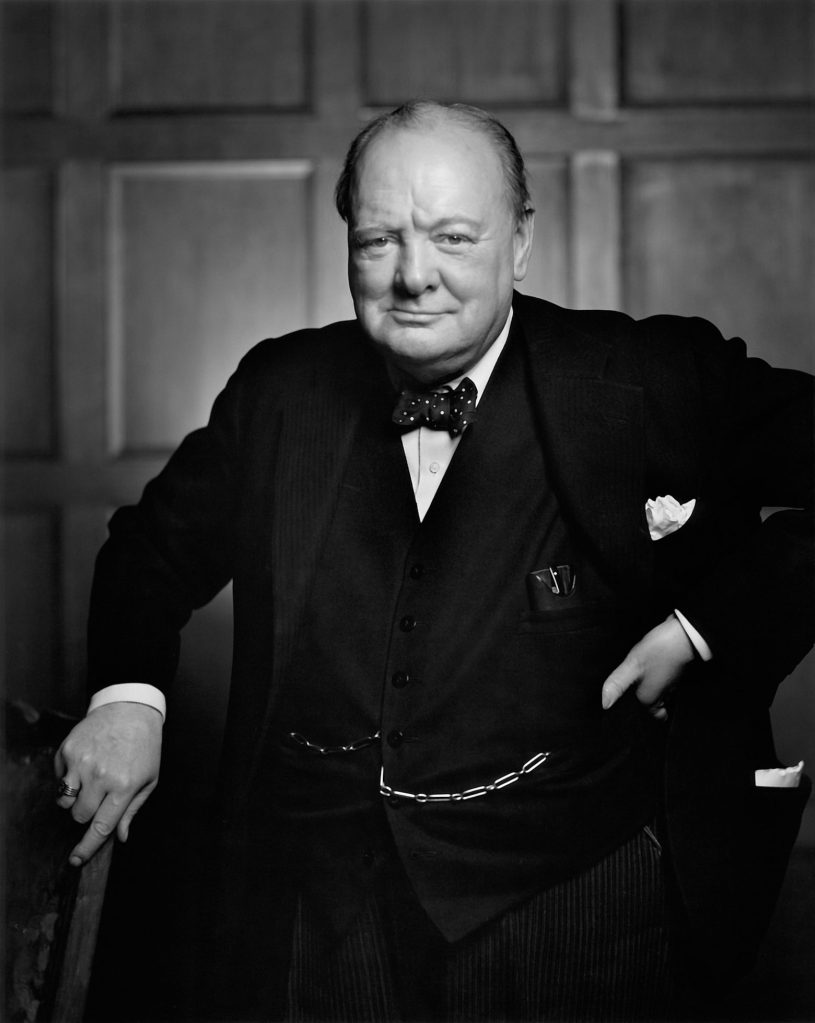
Mr. Gilbert says that perhaps the most famous photo of Churchill was taken in Ottawa, Canada by Yousuf Karsh.
Mr. Gilbert thought it was a photo of grumbling crusty old man.
Mr. Gilbert also says that it was man he did not recognize.
Mr. Gilbert also knew of a less famous photograph that had been taken just a minute earlier.
This was the man Mr. Gilbert knew.
Years later, Mr. Gillber met Mr. Karsh and Mr. Gilbert asked how did he achieve such a quick change of expression and temperament?
President cannot remake society – good thing – definitely!
In a an interview with David Remnick for an article that appeared in the January 27, 2014, issue of the New Yorker Magazine, President Barack Obama said:
“I just wanted to add one thing to that business about the great-man theory of history. The President of the United States cannot remake our society, and that’s probably a good thing.”
Mr Remnick wrote that, “He paused yet again, always self-editing.”
“Not ‘probably,’ ” he said. “It’s definitely a good thing.”
Definitely a good thing.
Lets hope President Obama was right.
The quote also reminds of story that goes the other way.
The way I remember it President Eisenhower was asked at his final press conference if he, the President, felt that any reporter had hurt or harmed the office.
The story goes that Eisenhower paused for a moment and looked at the crowd and then said, “Well, I don’t think so. And when you come right down to it, there isn’t much a reporter COULD DO to the President.”
Are these two stories illustrations of the separation of powers or checks and balances or maybe that it just how a democracy should behave.
nation, under God, shall have new birth of freedom of by for people
Today’s Haiku is abstracted from Abraham Lincoln’s remarks delivered at the dedication of a National Cemetery on the fields where the battle of Gettysburg was fought.
Mr. Lincoln said:
“… our fathers brought forth upon this continent, a new nation, conceived in Liberty, and dedicated to the proposition that all men are created equal.
Now we are engaged in a great civil war, testing whether that nation, or any nation so conceived and so dedicated, can long endure.“
Maybe we haven’t been in a Civil War of late but I guess if we haven’t been, it as close as I want to ever come.
Either way you look at it this Country has been tested of late.
A test whether that nation, or any nation so conceived and so dedicated, can long endure.
A lot of work in front of all of us.
As Mr. Lincoln said, “It is rather for us to be here dedicated to the great task remaining before us.
That this nation, under God, shall have a new birth of freedom – and that government of the people, by the people, for the people, shall not perish from the earth.
When Gerald Ford was sworn in as Vice President in the midst of Watergate, he used the line, “I am a Ford, not a Lincoln.“
When Mr. Ford was sworn in as President, he said, “Our long national nightmare is over.”
He then went on to say, “Our Constitution works; our great Republic is a government of laws and not of men. Here the people rule.”
Here the people the rule!
As Mr. Lincoln said in his first Inaugural Address:
Why should there not be a patient confidence in the ultimate justice of the people? Is there any better or equal hope, in the world.”
power always thinks doing God’s service then violate God’s laws
On Feb. 2. 1816, Former President John Adams wrote to Former President Thomas Jefferson, “Power always thinks it has a great Soul, and vast Views, beyond the Comprehension of the Weak; and that it is doing God Service, when it is violating all his Laws.”
The former Presidents had both been President along with a whole lot of other common experiences too many to try to list and as old men, engaged in one of histories great collected correspondences.
When Mr. Adams wrote the above quote he was commenting on a question from Mr. Jefferson about the current state of affairs in Europe.
Mr. Adams had on answer for that question and I used it for today’s Haiku.
Mr. Jefferson also had asked for a comment on “How the Apostacy from National Rectitude can be Accounted for?”
In other words, Mr. Jefferson had asked Mr. Adams if he could explain the abandonment or renunciation by the Country of a National moral integrity or goodness.
This was 1816.
40 years after the two men had collaborated on something called the Declaration of Independence.
In response Mr. Adams could only write that the question “is too deep and wide for my Capacity to answer.“
I cannot imagine what Mr. Adams might say today about how the Apostacy from National Rectitude can be Accounted for.
At least once he stopped throwing up.
It is almost easier to picture him in a scene from the movie Planet of the Apes when Charlton Heston rides up to remains of the Statue of Liberty and realizes he is back on Earth.
Mr. Heston’s character cries out in rage, “You finally really did it. You maniacs! You blew it up!”
Mr. Adams’ statement, Power always thinks it has a great Soul, and vast Views, beyond the Comprehension of the Weak; and that it is doing God Service, when it is violating all his Laws, has been much on my mind of late as I watch how friends and neighbors express certain points of view with the certainty that God is on their side while the point of view being expressed, to me, is a certain violation of God’s laws.
Not sure what to do with that.
Mr. Adams’ statement, Power always thinks it has a great Soul, and vast Views, beyond the Comprehension of the Weak; and that it is doing God Service, when it is violating all his Laws, brought me back to my days in college when I studied the American Colonial Period.
I had this professor who had the same feeling as Mr. Adams.
But instead of quoting Mr. Adams, this Professor would quote another great figure in American History, Bob Dylan.
He would quote Mr. Dylan’s song, With God on Our Side.
Oh my name it ain’t nothin’ My age it means less The country I come from Is called the Midwest I was taught and brought up there The laws to abide And that land that I live in Has God on its side