2.12.2021 – liberty, not for

liberty, not for
this country alone but to
the world, for all time

As it is Abraham Lincoln’s birthday I thought I take some words for one of his speeches.
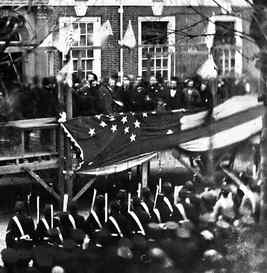
This is from an address Mr. Lincoln made at Independence Hall.

Philadelphia, Pennsylvania
February 22, 1861

Mr. Cuyler:

I am filled with deep emotion at finding myself standing here, in this place, where were collected together the wisdom, the patriotism, the devotion to principle, from which sprang the institutions under which we live. You have kindly suggested to me that in my hands is the task of restoring peace to the present distracted condition of the country. I can say in return, Sir, that all the political sentiments I entertain have been drawn, so far as I have been able to draw them, from the sentiments which originated and were given to the world from this hall. I have never had a feeling politically that did not spring from the sentiments embodied in the Declaration of Independence. I have often pondered over the dangers which were incurred by the men who assembled here, and framed and adopted that Declaration of Independence. I have pondered over the toils that were endured by the officers and soldiers of the army who achieved that Independence. I have often inquired of myself, what great principle or idea it was that kept this Confederacy so long together. It was not the mere matter of the separation of the Colonies from the motherland; but that sentiment in the Declaration of Independence which gave liberty, not alone to the people of this country, but, I hope, to the world, for all future time. It was that which gave promise that in due time the weight would be lifted from the shoulders of all men. This is a sentiment embodied in the Declaration of Independence. Now, my friends, can this country be saved upon that basis? If it can, I will consider myself one of the happiest men in the world, if I can help to save it. If it cannot be saved upon that principle, it will be truly awful. But if this country cannot be saved without giving up that principle, I was about to say I would rather be assassinated on this spot than surrender it.

Now, in my view of the present aspect of affairs, there need be no bloodshed and war. There is no necessity for it. I am not in favor of such a course, and I may say, in advance, that there will be no bloodshed unless it be forced upon the Government, and then it will be compelled to act in self-defence.

My friends, this is wholly an unexpected speech, and I did not expect to be called upon to say a word when I came here. I supposed it was merely to do something toward raising the flag. I may, therefore, have said something indiscreet. (Cries of “No, no”) I have said nothing but what I am willing to live by and, if it be the pleasure of Almighty God, die by.

The page with the txt of the speech states: On Abraham Lincoln’s inaugural journey to Washington as president-elect, he stopped in Philadelphia at the site where the Declaration of Independence had been signed. One of the most famous statements in the speech was, “I have never had a feeling politically that did not spring from the sentiments embodied in the Declaration of Independence.” This hall also was the place where Lincoln’s body lay in state after his assassination in 1865, one of many stops his funeral train made before he was laid to rest in Springfield, Illinois.
2.7.2021 – American Satire

American Satire
American Reality
Where does one stop, start?

In answer to the question, in a recent interview, “Do you consider yourself a satirist,?”, satirist Fran Lebowitz said, “In a way, yes, but, American reality has been so extreme of late that satire is almost impossible. Anything you could possible imagine actually happens. It would stump Jonathan Swift.”

It was Jonathon Swift who wrote, “Satire is a sort of glass wherein beholders do generally discover everybody’s face but their own; which is the chief reason for that kind reception it meets with in the world, and that so very few are offended with it.”

I have to admit I am not sure what this all means.

I think it boils down to, you can’t make this stuff up.

How did a national response to a global pandemic become a political statement based on wearing or not wearing a mask?

Ms. Lebowitz also said in this same interview:

When I was young there was a very strict idea of the boundary between the public and the private life.

So, things that you might do in the privacy of your bedroom, you wouldn’t do on 12th St.

That seems to have disappeared entirely and it is not just the young; it’s true even of people my age, who were brought up in a certain way and then forgot about it.

It is surprising to me just how unconscious people are of themselves in public, considering how much more acceptable it has become to think about yourself all the time”

Is that the answer to the question?

Consider how much more acceptable it has become to think about yourself all the time.

I like Ms. Leibowitz a lot.

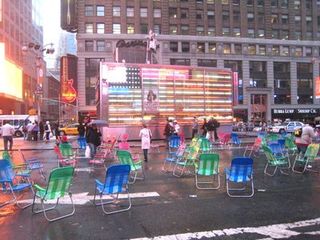
Just when you think she has gone off into the happy world of hyperbole and complains that New York City spent $40 million dollars researching how to and then putting lawn chairs in Times Square, you find out she was telling the truth.

When I consider how much more acceptable it has become to think about yourself all the time, I am reminded of an essay on the future by one of my favorite writers, Michigan’s Own, Bruce Catton.

Mr. Catton wrote, “The dismaying world we confront was given its vast intricacy and its perilous speed by human beings. The one basic resource we have always had to rely on is the innate intelligence, energy and good will of the human race. It is facing an enormous challenge, but then it always has; and it meets each one only to confront another. If now we give way to the gloom of the apostles of catastrophe we are of course in the deepest sort of trouble. The old reliance is at our service. It can bear us up if we put out full weight on it.”

This is where that comment of Ms. Leibowtiz comes in to play.

American reality has been so extreme of late that satire is almost impossible.

Anything you could possible imagine actually happens.

If we have to rely on the innate intelligence, energy and good will of the human race while at the sane time we consider how much more acceptable it has become to think about yourself all the time I think we are of course in the deepest sort of trouble.

Not something I would dare put my weight on at this time.

1.30.2021 – shovel them under

shovel them under
let me work, two years, ten years
ask where are we now?

Adapted from Carl Sandburg’s poem, Grass.

Pile the bodies high at Austerlitz and Waterloo.
Shovel them under and let me work—
I am the grass; I cover all.

And pile them high at Gettysburg
And pile them high at Ypres and Verdun.
Shovel them under and let me work.
Two years, ten years, and passengers ask the conductor:

What place is this?
Where are we now?

I am the grass.
Let me work.

Frustrated at the lack of change when I thought everything had changed.

Then I realize it has only been a couple of weeks.

This is going to take time.

But I do believe that after two years or ten years, passengers ask what place WAS this.

As Mr. Willy Wonka said, “Oh, you can’t get out backwards. You’ve got to go forwards to go back, better press on.”

1.27.2021 – in piano bars

oral history
of these places is written
in piano bars

In the book of essay’s, by, Joan Didion wrote, “The oral history of Los Angeles is written in piano bars. “Moon River,” the piano player always plays, and “Mountain Greenery.” “There’s a Small Hotel” and “This Is Not the First Time.” People talk to each other, tell each other about their first wives and last husbands.

I changed Los Angelo’s to these places.

The places where anyone and anyone gather because there are no other places to gather.

1.26.2021 – there is nothing more

there is nothing more
draining, exhausting than hate
meannesses of life

I came across a biography of Winston Churchill by Mr. Paul Johnson.

A small quick overview of Mr. Churchill’s life but Mr. Johnson included an epilogue with 5 lessons that he segued into saying, ” Winston Churchill led a full life, and few people are ever likely to equal it – its amplitude, variety, and success on so many fronts. But all can learn from it, especially in five ways.”

“The first lesson is: always aim high.”

“Lesson number two is: there is no substitute for hard work.”

“Third, and in its way most important, Churchill never allowed mistakes, disaster—personal or national—accidents, illnesses, unpopularity, and criticism to get him down.”

It the fourth lesson I want to focus on.

Mr. Johnson wrote:

“Fourth, Churchill wasted an extraordinarily small amount of his time and emotional energy on the meannesses of life: recrimination, shifting the blame onto others, malice, revenge seeking, dirty tricks, spreading rumors, harboring grudges, waging vendettas.

Having fought hard, he washed his hands and went on to the next contest.

It is one reason for his success.

There is nothing more draining and exhausting than hatred.

And malice is bad for the judgment.

Churchill loved to forgive and make up.

His treatment of Baldwin and Chamberlain after he became prime minister is an object lesson in sublime magnanimity.

Nothing gave him more pleasure than to replace enmity with friendship, not least with the Germans.”

Let me go over that first line again.

“Churchill wasted an extraordinarily small amount of his time and emotional energy on the meannesses of life:

recrimination,

shifting the blame onto others,

malice,

revenge seeking,

dirty tricks,

spreading rumors,

harboring grudges,

waging vendettas.

Some one could take that sentence and easily turn it into a list of charges against the current time.

I don’t expect there are more Churchill’s around as much I don’t expect anymore Lincoln’s or Washington’s or Groucho Marx’s.

BUT GOOD NIGHT MOON, isn’t there anyone anybody that even aspires to this outlook in public life anymore?

God help us all.

One last bit on Churchill though I may have told this story before.

Mr. Churchill’s public image is one of a gruff, grumbling crusty old man.

A curmudgeon.

Yet if you read the book that written by his official biographer ABOUT writing the 9 volume official biography, that was not the impression either he ( Martin Gilbert ) got or the impression he got from those who worked closest and knew him best.

They all swear Mr. Curchill was fun and fun filled.

In fact the fifth lesson Mr. Johnson lists is “Finally, the absence of hatred left plenty of room for joy in Churchill’s life.”

There is much talk in the Churchill historiography about Mr. Churchill’s “Black Dog” and dealing with depression.

Mr. Gilbert’s research shows that Having a Black Dog or a Black Dog Day or Kicking the Black Dog was a common saying among British Nannies of the Victorian Period.

Can’t you just hear Mary Poppins saying, “Having a bit of a black dog day are we?”

Mr. Gilbert says he truly can only find one occasion where Mr. Churchill used the term, My Black Dog and Mr. Gilbert says it caught fire and started a whole school of interpretation of Mr. Churchill’s life as a Functioning Manic Depressive all authored by a bunch of people whose education missed the lecture on Words of the Victorian Nursery.

Mr. Gilbert tells this story in his book, “In Search of Churchill.

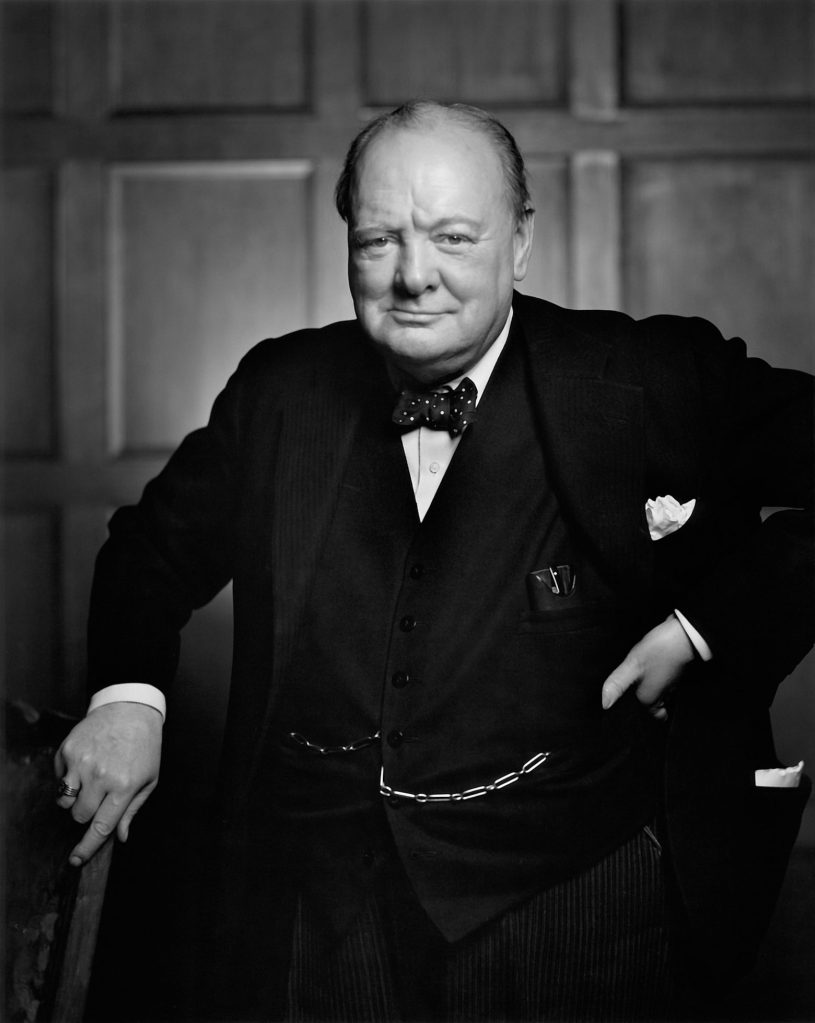
Mr. Gilbert says that perhaps the most famous photo of Churchill was taken in Ottawa, Canada by Yousuf Karsh.

Mr. Gilbert thought it was a photo of grumbling crusty old man.

Mr. Gilbert also says that it was man he did not recognize.

Mr. Gilbert also knew of a less famous photograph that had been taken just a minute earlier.

This was the man Mr. Gilbert knew.

Years later, Mr. Gillber met Mr. Karsh and Mr. Gilbert asked how did he achieve such a quick change of expression and temperament?

“I took away his cigar,” said, Mr. Karsh.