this done each man be allowed return to their homes not to be disturbed
I have long been fascinated by the United States Civil War.
Fascinated by the romance of it.
Fascinated by the accounts of battles that read along the lines of, “Our losses were small. 30 killed and 300 wounded.”
I watch the news and see what 30 killed look like today.
How was any less 160 years ago.
More and more (not or less) takes the romance out of it.
Today, April 9th, is the anniversary of the surrender of Confederate forces at Appomattox Court House in Virginia.
When asked for terms of surrender, General US (the initials famous for Unconditional Surrender or pretty much, ‘You admit we won and you have to take what comes’) Grant wrote in his own hand:
APPOMATTOX C. H., VA.,

Ap 9th, 1865.

GEN. R. E. LEE,
Comd'g C. S. A.

GEN: In accordance with the substance of my letter to you of the 8th inst., I propose to receive the surrender of the Army of N. Va. on the following terms, to wit: Rolls of all the officers and men to be made in duplicate. One copy to be given to an officer designated by me, the other to be retained by such officer or officers as you may designate. The officers to give their individual paroles not to take up arms against the Government of the United States until properly exchanged, and each company or regimental commander sign a like parole for the men of their commands. The arms, artillery and public property to be parked and stacked, and turned over to the officer appointed by me to receive them. This will not embrace the side-arms of the officers, nor their private horses or baggage. This done, each officer and man will be allowed to return to their homes, not to be disturbed by United States authority so long as they observe their paroles and the laws in force where they may reside.

Very respectfully,

U. S. GRANT,
Lt. Gen.
And that was that.
After 4 years of doing there best to kill each other, Grant told the other side to:
Give their paroles.
Give up their arms.
Go home.
Did Grant include a warning or a threat?
Nope.
He included a promise.
A promise that once they gave their parole, gave up their arms and got home they would not to be disturbed by United States authority.
He handed it the other General who, after a sort discussion of plow horses, signed it and said, “. . . that this would have a happy effect upon his army.”
I enjoyed because of what the reporter, a Mr. Tom Perkins of the Guardian, did.
He did the math.
He did the the very basic math.
GM and the State of Michigan have announced a deal that gives GM $1 Billion dollars in tax incentives over 20 years, — that is 9 zeros – $1,000,000,000 — to build a plant in the State that will create 3,200 jobs that will in around $55,000 a year.
Mr. Perkins divided that 1 billion by 3,200 to show that each job will cost State and Local entities $312,000 in lost tax revenues.
Mr. Perkins then figured state and local tax revenue at $4,600 per job over 20 years and came up with $300 Million in revenue.
Leaving the State of Michigan and local towns a $700 Million short fall.
I thought that the basic math employed by Mr. Perkins to be refreshing, simple and to the point.
This announcement, and I am sure the planning of the announcement went through several drafts and plenty of hard work in producing a memo that, used wonderful words explaining the wonderful benefits of this wonderful deal.
So long as no one did the basic math.
As Mark Twain wrote in The Man that Corrupted Hadleyburg, “There is nothing in the world like a persuasive speech to fuddle the mental apparatus and upset the convictions and debauch the emotions of an audience not practiced in the tricks and delusions of oratory.”
To be sure, Mr. Perkins, admits that each job will have an impact as each worker needs banks, gas stations and pizza places.
But Mr. Perkins writes, “The state also claimed the direct and indirect jobs created by the project will generate $29bn in new income over 20 years, or the equivalent of 29,000 jobs paying $50,000 annually. Economists from across the ideological spectrum who reviewed the analysis said that level of job creation is highly unlikely and pointed to a US Commerce Department report that labels such claims “suspicious”.”
Mr. Perkins quotes Michael LaFaive, fiscal policy director with the right-leaning Mackinac Center for Public Policy.
Forecasting 20 years of economic impacts is nearly impossible, LaFaive said, and the MEDC’s (Michigan Economic Development Corporation) job projection “strains credulity”.
“They can’t tell the future because they can’t tell the future,” he said.
Oddly enough, after writing this, I remembered that the ‘Verse of the Day’ for yesterday was:
Jeremiah 29:11-13 (NIV) For I know the plans I have for you, declares the Lord, plans to prosper you and not to harm you, plans to give you hope and a future. Then you will call on me and come and pray to me, and I will listen to you. 13 You will seek me and find me when you seek me with all your heart.
I am okay with some one knowing the future and I am okay that it is NOT the folks running the State of Michigan.
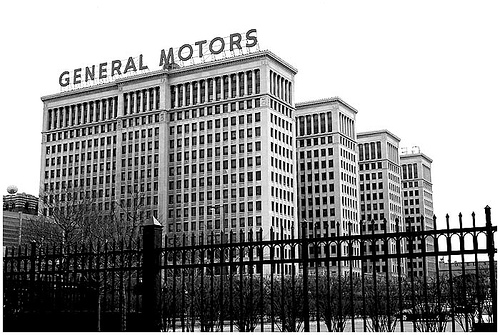
PS: I went searching online for what for me would be the perfect image of the GM building in Detroit. I did not want that silly logo on that silly ReCen. I wanted the old General Motors Building in downtown Detroit over by the Fisher Theater. And I wanted to show the sign, GENERAL MOTORS and I wanted it a night to show the sign how it looked with its glowing red letters. I grew up in a Ford family and GM was kind of a shadowy evil empire. In my mind, that huge, multi winged building looming in the haze that always seemed to be around Detroit with those glowing red letters, was the twin of the Castle of the Wicked Witch of the West. If she drove a car, she would drive a GM product. NEVERTHELESS, my search turned up empty. If anyone can find a photo of the old GM Building AT NIGHT with the sign in red letters, please let me know.
war to end all wars great war until second war does world go again
Pelican over Atlantic Ocean
World War One for a long time was known simply as the either ‘The War’ or the “The Great War.”
Woodrow Wilson named it, “The War to End All Wars” and came to the Versailles Treaty meetings with a 14 point paper that would prevent future wars. This document brought the Prime Minister of France, Georges Benjamin Clemenceau, to comment that Moses himself had only 10 points.
It did not become World War One until World War Two came along.
In the book The Winds of War, Herman Wouk has one of his characters saying, “World War Two… You know, Time has been writing about ‘World War Two’ for months. It always seemed so unreal, somehow. Now here it is, but it still has a funny ring.“
For centuries the Foreign Policy of Great Britain had been to keep things in Europe as muddled up as possible so that all the European countries would be arguing amongst themselves and no one would notice what Britain was doing around the world.
As Sir Humphrey Appleby put it, “Britain has had the same foreign policy objective for at least the last 500 years: to create a disunited Europe. In that cause we have fought with the Dutch against the Spanish, with the Germans against the French, with the French and Italians against the Germans, and with the French against the Germans and Italians. Divide and rule, you see. Why should we change now, when it’s worked so well?“
In 1914, Europe tried to sort their own problems and their solution was to act like kids at recess playing football.
The two biggest kids named themselves as Captains and then they chose up sides.
Once they had teams, everyone on each team agreed that they would be good team mates and come the aid of any other team mate who might be in trouble.
History books tell us The Great War started over an incident in the city of Sarajevo in Serbia.
Austro-Hungry claimed control over the country of Serbia.
Russia claimed an interest in ethnic Russians living in Serbia.
To calm things down, the Austro-Hungarians sent the Archduke Franz Ferdinand Carl Ludwig Joseph Maria of Austria on a tour of the Serbia.
While in Sarajevo, the Archduke was shot and killed by a assassin which brought on a war between the Austro-Hungarian Empire and Serbia.
Serbia was on the Russian team so Russia was in.
Germany was the Austro-Hungarian team so they were in.
France and Britain were on Russian’s team so they were in.
And so on and so on an so on.
Wikipedia says, “The Balkans remained a site of political unrest with teeming ambition for independence and great power rivalries.”
And we all get into The Great War.
That is one story anyway.
When talking about the early 1900’s and great power rivalries in Europe, you come down to the two biggest kids on the playground, Britain and Germany.
The Germany of Kaiser Wilhelm II, the grandson of Queen Victoria and the cousin to the then current King of Britain, George V.
Britain had a big navy.
Wilhelm II wanted just as big a navy and built one.
A problem with big navies is that if you don’t use them, they rust up and sink on their own.
It was pretty much a given that once Wilhelm II had his big navy, he would want to put it to the test against the other big navy on the block.
Kaiser Bill was that kind of guy.
He would start a war just to show that he was that kind of guy.
This is the guy who reportedly had a desk chair that was a saddle mounted on chair legs as he felt his brain worked better when he was on a horse.
(This brings to mind the Civil War General John Pope who dictated reports with the dateline, HEADQUARTERS IN THE SADDLE – meaning they were on the move – He sent off some many reports this way and was such a failure that Mr. Lincoln said that General Pope had his headquarters where his hindquarters should have been)
When Wilhelm II started on his big navy building scheme, one of Britain’s leading Admirals made a predication.
Germany’s biggest naval base, Kiel, is on the Baltic Sea and the Imperial German Navy would have to make its way up and around Denmark to get into the North Sea and attack Great Britain.
In 1907, Germany began work to deepen the Kiel Canal that cut across the bottom on Denmark and would let the Imperial German Navy get into the North Sea both quicker and secretly.
British Admiral Jackie Fisher, the man who invented the big gun battleship, said that as soon as that canal project was completed and Germany could get their fleet into the North Sea, Kaiser Bill would finally start his war.
The Kiel Canal was completed on June 23, 1914.
The Great War started that August.
Now Mr. Putin wants to start a war.
Why does Mr. Putin want to start World War One all over again?
Maybe he cares about all those ethnic Russians in Ukraine.
Maybe he worries about all the offenses those poor Russians in Ukraine have had to put up with since the USSR went away.
And maybe, Mr. Putin is just that type of guy who wants to start a war to prove that that is the type of guy he is.
Ms Solnit writes, “What’s happening goes far beyond public monuments. The statues mark the rejection of old versions of who we are and what we value, but those versions and values matter most as they play out in everyday private and public life.“