6.19.2024 – strive to learn before

strive to learn before
they die what they are running
from, and to, and why …

The Shore and the Sea

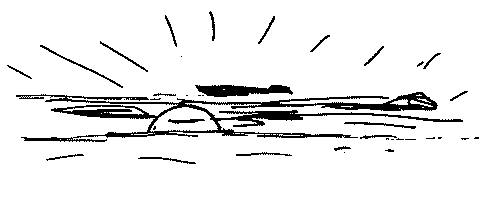
A single excited lemming started the exodus, crying, “Fire!” and running toward the sea. He may have seen the sunrise through the trees, or waked from a fiery nightmare, or struck his head against a stone, producing stars. Whatever it was, he ran and ran, and as he ran he was joined by others, a mother lemming and her young, a night watch lemming on his way home to bed, and assorted revelers and early risers.

“The world is coming to an end!” they shouted, and as the hurrying hundreds turned into thousands, the reasons for their headlong flight increased by leaps and bounds and hops and skips and jumps.

“The devil has come in a red chariot!” cried an elderly male. “The sun is his torch! The world is on fire!”

“It’s a pleasure jaunt,” squeaked an elderly female.

“A what?” she was asked.

“A treasure hunt!” cried a wild-eyed male who had been up all night. “Full many a gem of purest ray serene the dark unfathomed caves of ocean bear.”

“It’s a bear!” shouted his daughter. “Go it!” And there were those among the fleeing thousands who shouted “Goats!” and “Ghosts!” until there were almost as many different alarms as there were fugitives.

One male lemming who had lived alone for many years refused to be drawn into the stampede that swept past his cave like a flood. He saw no flames in the forest, and no devil, or bear, or goat, or ghost. He had long ago decided, since he was a serious scholar, that the caves of ocean bear no gems, but only soggy glub and great gobs of mucky gump. And so he watched the other lemmings leap into the sea and disappear beneath the waves, some crying “We are saved!” and some crying “We are lost!” The scholarly lemming shook his head sorrowfully, tore up what he had written through the years about his species, and started his studies all over again.

MORAL: All men should strive to learn before they die what they are running from, and to, and why.

From Further Fables for Our Time by James Thurber, published in Great Britain 1956 by Hamish Hamilton Ltd.

3.21.2024 – trying to escape

trying to escape,
and as you know, this is no
world for escapists

The Rabbits Who Caused All the Trouble


Within the memory of the youngest child there was a family of rabbits who lived near a pack of wolves. The wolves announced that they did not like the way the rabbits were living. (The wolves were crazy about the way they themselves were living, because it was the only way to live.) One night several wolves were killed in an earthquake and this was blamed on the rabbits, for it is well known that rabbits pound on the ground with their hind legs and cause earthquakes. On another night one of the wolves was killed by a bolt of lightning and this was also blamed on the rabbits, for it is well known that lettuce-eaters cause lightning. The wolves threatened to civilize the rabbits if they didn’t behave, and the rabbits decided to run away to a desert island. But the other animals, who lived at a great distance, shamed them, saying, “You must stay where you are and be brave. This is no world for escapists. If the wolves attack you, we will come to your aid, in all probability.” So the rabbits continued to live near the wolves and one day there was a terrible flood which drowned a great many wolves. This was blamed on the rabbits, for it is well known that carrot-nibblers with long ears cause floods. The wolves descended on the rabbits, for their own good, and imprisoned them in a dark cave, for their own protection.

When nothing was heard about the rabbits for some weeks, the other animals demanded to know what had happened to them. The wolves replied that the rabbits had been eaten and since they had been eaten the affair was a purely internal matter. But the other animals warned that they might possibly unite against the wolves unless some reason was given for the destruction of the rabbits. So the wolves gave them one. “They were trying to escape,” said the wolves, “and, as you know, this is no world for escapists.”

Moral: Run, don’t walk, to the nearest desert island

By James Thurber as published in The Thurber Carnival, Random House, New York, NY, 1957

12.10.2023 – no delete buttons,

no delete buttons,
no cut-and-paste, just the click
clack of history

Fun but unsatisfying is what I thought after reading, You Can Buy Hemingway’s Typewriter. But Would You Use It? by David Waldstein in the New York Times.

Unsatisfying because Mr. Waldstein did not tell the story on how this feller, Steve Soboroff, tracked down all the typewriters of famous people that he now plans to offer at auction.

Fun because it was fun to think about owning such a machine.

This past summer I was able to sit at a desk with one of James Thurber’s typewriters.

Maybe a musician sitting at a piano used by Stevie Wonder would feel something.

Mr. Leonard Bernstein is on film describing what it was like to direct an orchestra and standing what had to be standing somewhere near the spot Ludwig Beethoven stood when his 9th Symphony was debuted.

Something about a typewriter.

I haven’t owned one in years but I have a bunch.

The last one I got was a gift that had a small computer screen and could store up to three lines of text.

You could set it to type each letter or to wait and type out each line.

I never caught the rhythm of the line by line.

A funny thing, but the last typewriter I ever bought was vintage manual Royal typewriter I got at the Salvation Army.

The machine worked fine, but finding typewriter ribbon was a problem.

The place where I worked had just thrown out all there old adding machines, along with boxes of adding machine ribbon and with a little winding, these ribbons could be retro-fitted onto my typewriter.

Friends and neighbors let me tell you that when the time comes to move cross country, a 20lb manual typewriter quickly makes it on the list of things you don’t need to bring.

Mr. Waldstein writes, The machine has no delete buttons, no cut-and-paste. Just the click-clack of history.

Sitting at the Thurber machine, I imagined his fingers on the keys and a story coming out, letter by letter, return by return.

I could hear the click-clack and the bell and the grrrrrrrr of the carriage and the thump when the the next line came into place.

John Steinbeck said, “Sometimes just the pure luxury of long beautiful pencils charges me with energy and invention.”

There is much to be said for those pencils.

I cannot remember the source of line, but someone pointed out that the American Space Programs spent millions developing a pen that could insure the flow of ink and write in zero gravity while the Soviet Union sent their astronauts into space … with pencils.

I use a comuter.

I hear the rattle of my keyboard.

That qwerty keyboard that connects my typing with the old machines.

But I back space.

I delete.

I highlight and copy and paste.

I print multiple copies.

And …

I miss that old Royal typewriter.

no delete buttons,
no cut-and-paste, just the click
clack of history

James Thuber’s Typewriter … As I said before, the first person who would have ignored the signed and banged on the computer would have been James Thurber.

10.22.2023 – booksellers about

booksellers about
as uncommercial breed of
people possible

In a world gone crazy, when I am grasping at anything that points the compass in a positive direction, I found the recent article in the New York Times, Barnes & Noble Sets Itself Free By Maureen O’Connor to be something of a word of hope.

To quote Big Bill or better to quote Portia in the Merchant of Venice, So shines a good deed in a naughty world.

Or maybe best to quote Willy Wonka and say, “So shines a good deed in a weary world.”

At least, for a moment, this story about how Barnes and Noble  is pushing the chain to act more like the indie stores it was once notorious for displacing under the direction of a new CEO, James Daunt.

“The curious trick has been that if you actually let the local book-selling teams do what they think is best, you suddenly get much better bookstores,” Mr. Daunt said. Then he quickly added a caveat: “About a quarter of them become dramatically better, and a quarter become dramatically worse — but it is much easier to focus on that quarter and improve them.”

The change goes along with his strategy of embracing the mind-set of his typical employee. “Booksellers are about as uncommercial a breed of people as it’s possible to come across,” Mr. Daunt said. “The irony is that the less concerned we are with the commercial, the better it works commercially.

“You need to love books, and you need to know how our customers shop for books,” says a long term Barnes and Noble employee.

I read and I believe it, but only because I want to believe it.

I spent 12 years working for a chain bookstore.

For many employee’s it was a job.

For me and many employee’s and many of my good good friends that I worked with, it was a calling.

And it was a fight against those who went into it as business and tried to make it business while we tried to keep the faith.

So to read, “The curious trick has been that if you actually let the local book-selling teams do what they think is best, you suddenly get much better bookstores.” almost makes me want to cry.

I worked for Waldenbooks.

But I lived in Michigan.

If you loved books and you lived in the State of Michigan, at some point in your life you ended up at Border’s Book Store, a stand alone, independent love-affair with books in Ann Arbor, Michigan.

If you went down that path, you also at some point ended up at John King Used Books in Detroit but that’s another story.

Among booksellers in the State of Michigan, Border’s was the gold standard.

It had sofa’s and chairs and probably some sort of cafe before Starbucks.

They had a service desk set up and staffed by three people, in the pre computer era, who did nothing but researched hard to find titles so a customer could order the book.

They had floor upon floor of books.

The had an art print / map section and I still have prints on my office wall that I purchased there, using my grocery money instead of using my grocery money for groceries.

When I started with at my bookstore in a mall, I saw how it could embrace some of what Border’s was.

I fought for chairs in the store.

I fought for more and more copies of different books rather than 100 copies of the same bestseller.

We worked to create displays of content that meant something.

I started as a bookseller then assistant Manager and finally, Manager.

Though I used label tape and put the title, GUY IN CHARGE on my name tag.

One of the many, many things I did that got me trouble.

My battles can be kind of summed up when I made a display of books for Valentine’s Day.

Regardless of the topic or author, I took over a wall and made a display of every red book we had in the store.

My District Manager came in, took one look at Car Repair manuals next to Novels next to books on Knitting but ALL WITH RED COVERS surrounded by cardboard hearts and he ran back out to his car to get his camera.

That’s the type of thinking we want to see Mike!,” he told me.

I banged a big red American Heritage dictionary against my head.

This is Walden’s, Mike”, he would say, “Not Border’s.

The really funny part of this story is that after I was asked to leave the employ of company, another long story, Walden’s relocated it’s headquarters from Stamford, CT to ANN ARBOR and then bought out Border’s and in an effort to change the brand, changed the name of the Company TO Border’s Books!

In the end I guess I won.

To read Booksellers are about as uncommercial a breed of people as it’s possible to come across is a tonic to my soul.

Some where I have a book, I think it’s an autographed copy of Lake Wobegone by Garrison Keillor.

It was picked up for me by a Waldenbooks Regional Vice President.

Her office was in Ann Arbor and I got to know her when I worked at the Walden’s in Ann Arbor when I was in College.

I was allowed to switch back and forth between Grand Rapids, where I lived and Ann Arbor.

I would have long talks with this VP on bookselling as a calling and she would explain bookselling as a business.

She knew I liked Keillor and arranged to get an autographed copy when he made an appearance at some other Walden’s.

Inscribed above the author’s autograph was this sentiment.

To the most un-corporate person I know.”

And she signed it.

When James Thurber’s dog Mugg’s (The Dog that Bit People) died, he writes, “Mother wanted to bury him in the family lot under a marble stone with some such inscription as “Flights of angels sing thee to thy rest” but we persuaded her it was against the law. In the end we just put up a smooth board above his grave along a lonely road. On the board I wrote with an indelible pencil “Cave Canem.” Mother was quite pleased with the simple classic dignity of the old Latin epitaph.

To the most un-corporate person I know.

Should I have a tombstone someday, I would be quite pleased with the simple classic dignity of that sentiment.

,

10.11.2023 – computers often

computers often
in reality too dumb to
avoid hurting us

Inspired by the guest Opinion Essay, “Autonomous Vehicles Are Driving Blind” by Julia Angwin a contributing Opinion writer to the New York Times and an investigative journalist and the passage, “There’s an irony here: So many headlines have focused on fears that computers will get too smart and take control of the world from humans, but in our reality, computers are often too dumb to avoid hurting us.”

Ms. Angwin writes, “For all the ballyhoo over the possibility of artificial intelligence threatening humanity someday, there’s remarkably little discussion of the ways it is threatening humanity right now. When it comes to self-driving cars, we are driving blind.”

Ms. Angwin explains, “The National Highway Traffic Safety Administration regulates the hardware (such as windshield wipers, airbags and mirrors) of cars sold in the United States. And the states are in charge of licensing human drivers. To earn the right to drive a car, most of us at some point have to pass a vision test, a written test and a driving test. The A.I. undergoes no such government scrutiny before commanding the wheel.”

I am reminded of The Glass in the Field by James Thurber from Fables for Our Time and Famous Poems Illustrated: as in appeared in The Thurber Carnival.

A short time ago some builders, working on a studio in Connecticut, left a huge square of plate glass standing upright in a field one day. A goldfinch flying swiftly across the field struck the glass and was knocked cold. When he came to he hastened to his club, where an attendant bandaged his head and gave him a stiff drink. “What the hell happened?” asked a sea gull. “I was flying across a meadow when all of a sudden the air crystallized on me,” said the goldfinch. The sea gull and a hawk and an eagle all laughed heartily. A swallow listened gravely. “For fifteen years, fledgling and bird, I’ve flown this country,” said the eagle, “and I assure you there is no such thing as air crystallizing. Water, yes; air, no.” “You were probably struck by a hailstone,” the hawk told the goldfinch. “Or he may have had a stroke,” said the sea gull. “What do you think, swallow?” “Why, I–I think maybe the air crystallized on him,” said the swallow. The large birds laughed so loudly that the goldfinch became annoyed and bet them each a dozen worms that they couldn’t follow the course he had flown across the field without encountering the hardened atmosphere. They all took his bet; the swallow went along to watch. The sea gull, the eagle, and the hawk decided to fly together over the route the goldfinch indicated. “You come, too,” they said to the swallow. “I–I–well, no,” said the swallow. “I don’t think I will.” So the three large birds took off together and they hit the glass together and they were all knocked cold.

Moral: He who hesitates is sometimes saved.