be dizzy now turn your head upside down see how world looks upside down
Spring is when the grass turns green and glad. Spring is when the new grass comes up and says, “Hey, hey! Hey, hey!” Be dizzy now and turn your head upside down and see how the world looks upside down. Be dizzy now and turn a cartwheel, and see the good earth through a cartwheel.
Tell your feet the alphabet. Tell your feet the multiplication table. Tell your feet where to go, and, and watch ‘em go and come back.
Can you dance a question mark? Can you dance an exclamation point? Can you dance a couple of commas? And bring it to a finish with a period?
Can you dance like the wind is pushing you? Can you dance like you are pushing the wind? Can you dance with slow wooden heels and then change to bright and singing silver heels? Such nice feet, such good feet.
Lines Written for Gene Kelly To Dance To by Carl Sandburg as published in The Complete Poems of Carl Sandburg (revised and updated).
Dancing feet?
Such good feet?
Spring is when the grass turns green and glad.
Spring is when the new grass comes up and says, “Hey, hey! Hey, hey!”
Spring is when the new grass puts so much pollen in the air that I am dizzy now and I turn my head upside down and see how the world looks upside down and can’t breath and think my head is going to explode.
be different from other people – easy … being different
Tell him to be different from other people if it comes natural and easy being different.
So writes Carl Sandburg in his poem, “A Father To His Son.”
It was Dale Carnegie, a man who knew how to win friends, who said, “If you want to be interesting, be interested.”
My Dad was interested in everything.
If that made him a little different, then it was natural and easy for him to be different.
He bought books by the armload and filled our house with books.
He bought records and made tape recordings of music and filled our house with music.
He bought stereo record players and speakers by the boxful and wired up speakers around the house and filled our house with sound.
He bought art by the square yard and covered the walls of our house with original paintings and prints of his favorite Andrew Wyeth.
He wrote in a letter home during World War 2 to his future wife that he ‘liked to live in the WHOLE house,’ no rooms just for show and that is how he lived.
My Dad was interested in everything and to me it made him different from other people.
It was a difference that came natural and easy to Dad.
And for me, he encouraged me to be interested and by extension, different.
(In that respect, he succeeded beyond any dreams.)
But, he didn’t push his interests on me.
He made interesting things available and if I showed interest, he would encourage that interest.
Dad liked historical venues.
He wanted to see them, so we got to see them.
He wanted to see Hartwick Pines State Park up in northern lower Michigan.
So we got to see Hartwick Pines State Park up in northern lower Michigan.
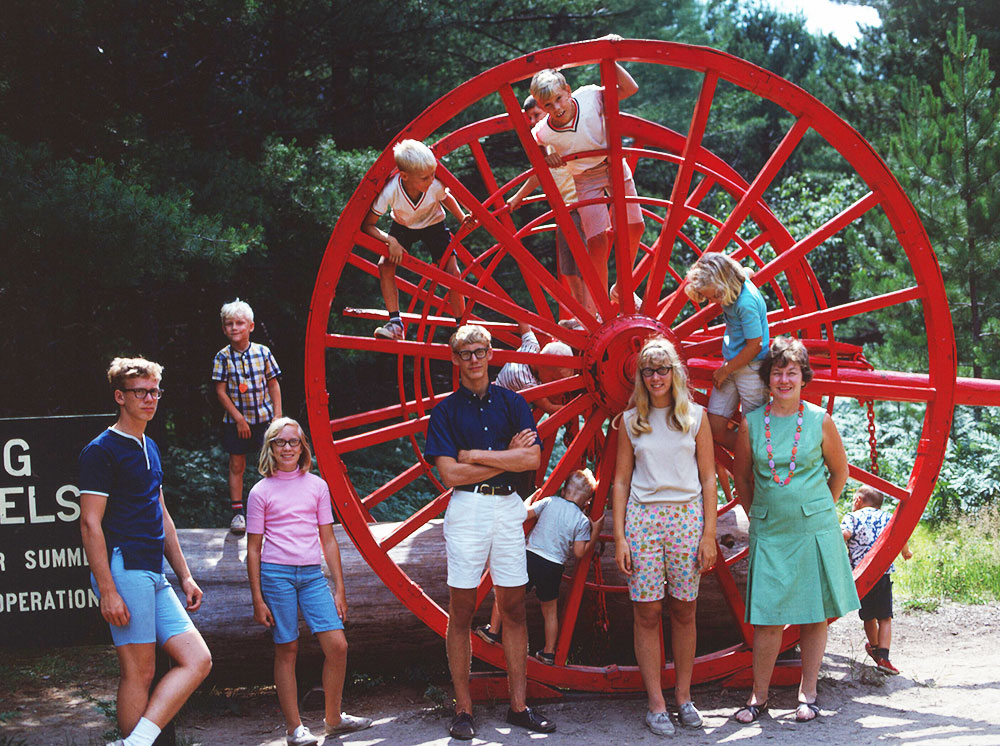
Dad wanted to pose us on a display of the BIG WHEELS used to cart giant White Pines to the lumber yard.
So we posed on the BIG WHEELS as a family.
Some years later, when we were all a little older, Dad thought that a visit to see Hartwick Pines State Park up in northern lower Michigan would be a nice summer day trip.
So we all went to see Hartwick Pines State Park up in northern lower Michigan for a nice summer day trip.
Dad wanted us to pose on the BIG WHEELS.
Notice, this year, Dad is in the picture.
This year, I had shown some in interest in photography.
Dad encouraged my interest.
I had my own camera, a little Kodak.
Dad had his Nikon.
I wanted to use the Nikon.
Dad let me, and I took this family picture on the BIG WHEELS.
I got to use the Nikon.
Dad trusted me.
Though my brothers and sisters look a little bit of the oh-brother-brother-mike-again, I don’t think Dad minded too much.
Even when the picture came back from the lab and it was evident that I need to work on my focus skills.
He would have found that interesting.
Happy birthday to my Dad.
105 today!
Here is the complete poem by Mr. Sandburg.
A Father To His Son
A father sees his son nearing manhood. What shall he tell that son? “Life is hard; be steel; be a rock.” And this might stand him for the storms and serve him for humdrum monotony and guide him among sudden betrayals and tighten him for slack moments. “Life is a soft loam; be gentle; go easy.” And this too might serve him. Brutes have been gentled where lashes failed. The growth of a frail flower in a path up has sometimes shattered and split a rock. A tough will counts. So does desire. So does a rich soft wanting. Without rich wanting nothing arrives. Tell him too much money has killed men and left them dead years before burial: the quest of lucre beyond a few easy needs has twisted good enough men sometimes into dry thwarted worms. Tell him time as a stuff can be wasted. Tell him to be a fool every so often and to have no shame over having been a fool yet learning something out of every folly hoping to repeat none of the cheap follies thus arriving at intimate understanding of a world numbering many fools. Tell him to be alone often and get at himself and above all tell himself no lies about himself whatever the white lies and protective fronts he may use against other people. Tell him solitude is creative if he is strong and the final decisions are made in silent rooms. Tell him to be different from other people if it comes natural and easy being different. Let him have lazy days seeking his deeper motives. Let him seek deep for where he is born natural. Then he may understand Shakespeare and the Wright brothers, Pasteur, Pavlov, Michael Faraday and free imaginations Bringing changes into a world resenting change. He will be lonely enough to have time for the work he knows as his own.
Carl Sandburg, in The People Yes as published in The Complete Poems of Carl Sandburg, by Carl Sandburg, Harcourt, Brace, New York, 1950.
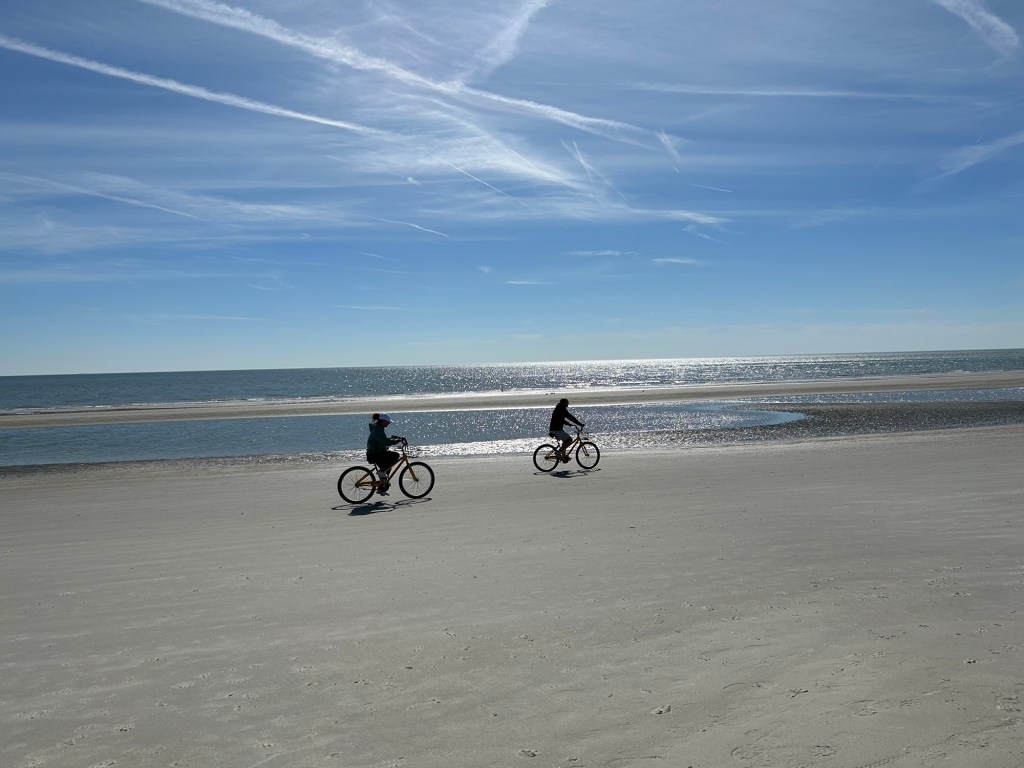
shadows of the bikes low blue lustre tardy and soft inrolling tide
Adapted from Sketch by Carl Sandburg in Chicago Poems as published in The Complete Poems of Carl Sandburg, (Harcourt Brace and Company, New York, 1950).
The shadows of the ships Rock on the crest In the low blue lustre Of the tardy and the soft inrolling tide.
A long brown bar at the dip of the sky Puts an arm of sand in the span of salt.
The lucid and endless wrinkles Draw in, lapse and withdraw. Wavelets crumble and white spent bubbles Wash on the floor of the beach.
Rocking on the crest In the low blue lustre Are the shadows of the ships.


 No Haiku For You