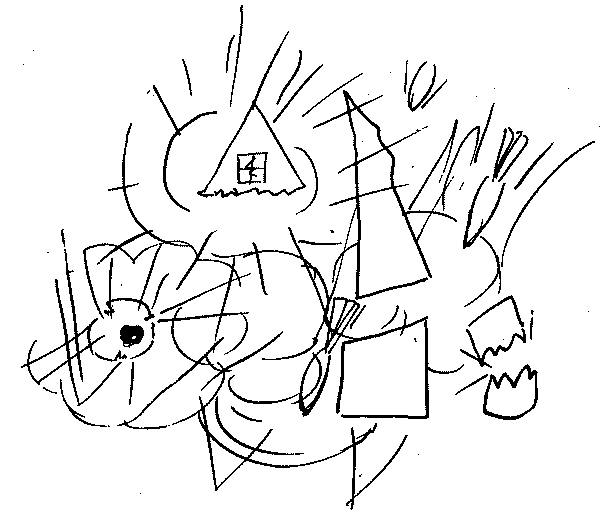
June 27 – fine, fresh, good morning

fine, fresh, good morning
unicorn in the garden?
No, but I looked

The Unicorn in the Garden

Once upon a sunny morning a man who sat in a breakfast nook looked up from his
scrambled eggs to see a white unicorn with a golden horn quietly cropping the roses in
the garden.
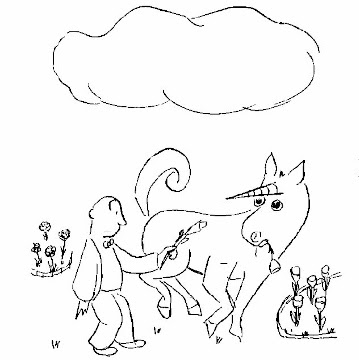
The man went up to the bedroom where his wife was still asleep and woke her.

“There’s a unicorn in the garden,” he said. “Eating roses.”

She opened one unfriendly eye and looked at him.

“The unicorn is a mythical beast,” she said, and turned her back on him.

The man walked slowly downstairs and out into the garden.

The unicorn was still there; he was now browsing among the tulips.

“Here, unicorn,” said the man and pulled up a lily and gave it to him.

The unicorn ate it gravely.

With a high heart, because there was a unicorn in his garden, the man went upstairs and roused his wife again.

“The unicorn,” he said, “ate a lily.” His wife sat up in bed and looked at him, coldly.

“You are a booby,” she said, “and I am going to have you put in a booby-hatch.”

The man, who never liked the words “booby” and “booby-hatch,” and who liked them even less on a shining morning when there was a unicorn in the garden, thought for a moment.

“We’ll see about that,” he said.

He walked over to the door.

“He has a golden horn in the middle of his forehead, “he told her.

Then he went back to the garden to watch the unicorn; but the unicorn had gone away. The man sat among the roses and went to sleep.

And as soon as the husband had gone out of the house, the wife got up and dressed as fast as she could.

She was very excited and there was a gloat in her eye.

She telephoned the police and she telephoned the psychiatrist; she told them to hurry to her house and
bring a strait-jacket.

Then the police and the psychiatrist looked at her with great interest.

“My husband,” she said, “saw a unicorn this morning.”

The police looked at the psychiatrist and the psychiatrist looked at the police.

“He told me it ate a lily,” she said.

The psychiatrist looked at the police and the police looked at the psychiatrist.

“He told me it had a golden horn in the middle of its forehead,” she said.

At a solemn signal from the signal from the psychiatrist, the police leaped from their chairs and seized the wife.

They had a hard time subduing her, for she put up a terrific struggle, but they finally
subdued her.

Just as they got her into the strait-jacket, the husband came back into the house.

“Did you tell your wife you saw a unicorn?” asked the police.

“Of course not,” said the husband. “The unicorn is a mythical beast.”

“That’s all I wanted to know,” said the psychiatrist.

“Take her away. I’m sorry, sir, but your wife is as crazy as a jay bird.”

So they took her away, cursing and screaming, and shut her up in an institution.

The husband lived happily ever after.

Moral: Don’t count your boobies until they are hatched.

James Thurber in Fables for Our Time and Famous Poems Illustrated (Harper and Brothers, 1940).
March 7 – Hellbent

Express Lane Entrance
Beware sidetracks! Hellbent get
Where they are going

I see the signs on my commute every morning and afternoon. ‘Express Lane Entrance’ and I am reminded of the Screwtape Letters by CS Lewis:

It does not matter how small the sins are provided that their cumulative effect is to edge the man away from the Light and out into the Nothing. Murder is no better than cards if cards can do the trick. Indeed the safest road to Hell is the gradual one — the gentle slope, soft underfoot, without sudden turnings, without milestones, without signposts.

Screwtape Letters XII

As I see other drivers speed around me, in and out of the express lane, regardless of the law, I also think about this short story:

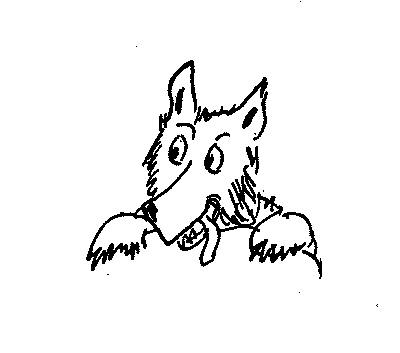
The Wolf Who Went Places

A wealthy young wolf, who was oblivious of everything except himself, was tossed out of college for cutting classes and corners, and he decided to see if he could travel around the world in eighty minutes.

“That isn’t possible,” his grandmother told him, but he only grinned at her.

“The impossible is the most fun,” he said.

She went with him to the door of the old Wolf place. “If you go that fast, you won’t live to regret it,” she warned him, but he grinned again, showing a tongue as long as a necktie.

“That’s an old wolves’ tale,” he said, and went on his reckless way.

He bought a 1959 Blitzen Bearcat, a combination motorcar and airplane, with sky-rocket getaway, cyclone speedrive, cannonball takeoff, blindall headlights, magical retractable monowings, and lightning pushbutton transformationizer. “How fast can this crate go without burning up?” he asked the Blitzen Bearcat salesman.

“I don’t know,” the salesman said, “but I have a feeling you’ll find out.”

The wealthy young wolf smashed all the ground records and air records and a lot of other things in his trip around the world, which took him only 78.5 minutes from the time he knocked down the Washington Monument on his takeoff to the time he landed where it had stood. In the crowd that welcomed him home, consisting of about eleven creatures, for all the others were hiding under beds, there was a speed-crazy young wolfess, with built-in instantaneous pickup ability, and in no time at all the wolf and his new-found mate were setting new records for driving upside down, backward, blindfolded, handcuffed, and cockeyed, doubled and redoubled.

One day, they decided to see if they could turn in to Central Park from Fifth Avenue while traveling at a rate of 175 miles an hour, watching television, and holding hands. There was a tremendous shattering, crashing, splitting, roaring, blazing, cracking, and smashing, ending in a fiery display of wheels, stars, cornices, roofs, treetops, glass, steel, and people, and it seemed to those spectators who did not die of seizures as they watched that great red portals opened in the sky, swinging inward on mighty hinges, revealing an endless nowhere, and then closed behind the flying and flaming wolves with a clanking to end all clanking, as if those gates which we have been assured shall not prevail had, in fact, prevailed.

MORAL: Where most of us end up there is no knowing, but the hellbent get where they are going.

James Thurber

Further Fables for Our Time
Thurber, James Grover (1894-1961)
1956
Edition used as base for this ebook: London: Hamish Hamilton, 1956 [first U.K. edition]
Project Gutenberg Canada ebook #1055

The Screwtape Letters, by CS Lewis, was initially published, chapter/letter, by chapter, in The Guardian on May 2nd, 1941. Based on the public domain etext provided by Gutenberg Canada Ebooks. ( public domain under Canadian copyright law)