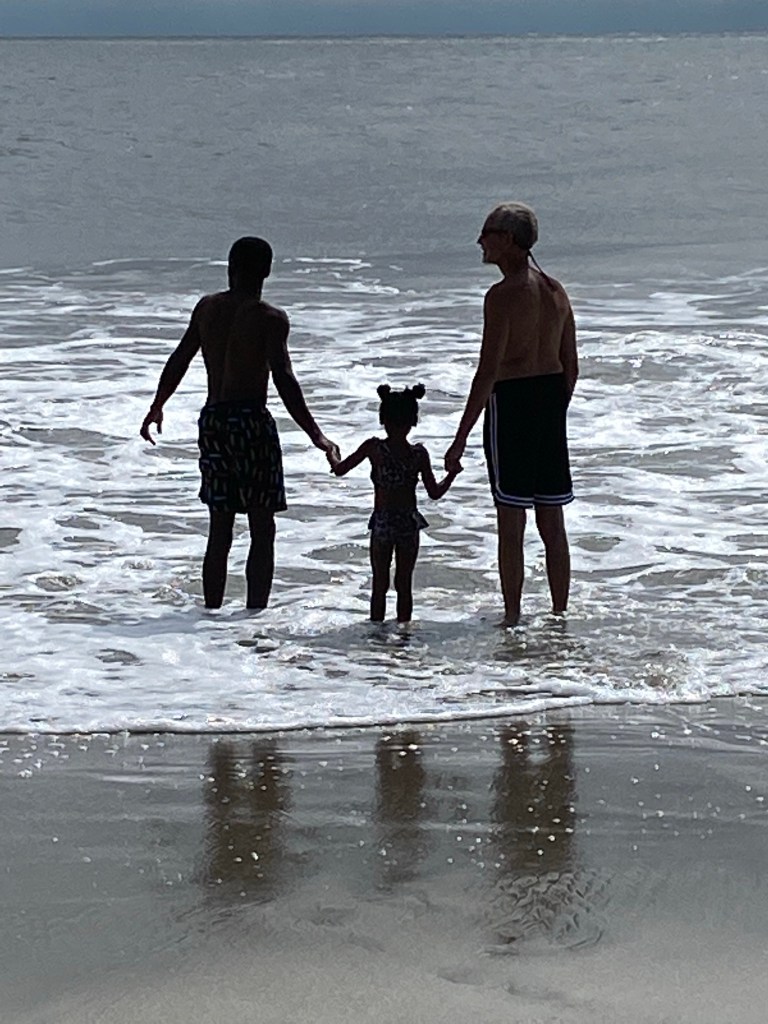
11.17.2021 – found in rare places

found in rare places
beauty being fugitive
how to possess it

I feel lucky.

Know what I mean?

I feel lucky.

I have lived in three places in my life.

For the first 50 years of my life I lived in Grand Rapids, Michigan.

On the North End of Grand Rapids, Michigan.

I used to say I lived 1 mile from the house where I was born.

Well I wasn’t born there but where I lived, after coming home from Butterworth Hospital.

Come to think of it, Butterworth Hospital probably wasn’t much more than a mile away either.

Growing up in Grand Rapids and going to an elementary school where 90% of the kids came from Grand Rapids, I remember one of my teachers going around the room and asking each kid which hospital they were born at.

There were three possbilitlies.

Butterworth was the most mentioned and the coolest as it made you think that was where the pancake syrup came from.

Then Blodgett.

But Blodgett was such an odd sounding name that we all decided that had you been born at BLODDDDD-ghet you yourself were kind of odd.

And then there were the few Catholic kids who were born at St. Mary’s.

There were so few Catholic kids at my school as most Catholic kids in the neighborhood went to Blessed Sacrament.

BUT they didn’t go to Blessed Sacrament until 2nd grade.

So these kids were part of our class for two years and then mysteriously disappeared from school.

They disappeared from school but not from the neighborhood.

We would still see these kids in the park and such.

And the word would spread, ‘They go to Blessed Sacrament.’

As my only other exposure to Catholic churches and schools at that time was St. Mary’s Hospital, I figured ‘going to Blessed Sacrament’ meant they got sick.

It was weird too because in the morning after school started we could look out the windows at the Blessed Sacrament bus as it stopped at the corner and we would see these kids line up and get on the bus and go off to therapy I guessed.

That bus stop was at a corner right next to our school, Crestview Elementary.

The Blessed Sacrament bus in the morning came by that corner, as I mentioned, after school had started.

The Blessed Sacrament bus in the afternoon came by about 10 minutes after our school got it.

Over the years it had become part of social schedule of Crestview Elementary to gather at the corner and when the Blessed Sacrament Bus stopped at the corner, exchange greetings with those kids on the bus.

Language used in these greetings was most unusal.

It would have been okay had you been deaf as both groups of students also used sign language to express themselves.

That it was the B.S. bus was just a gift of the Gods.

In the short story, I Went to Sullivant, James Thurber writes, “Now and again virtually the whole school turned out to fight the Catholic boys of the Holy Cross Academy in Fifth Street near Town, for no reason at all–in winter with snowballs and ice balls, in other seasons with fists, brickbats, and clubs.

I knew just what that was like.

This exchange lasted as long as the bus was at the corner and then satisfied that honor had been upheld, everyone went home.

When I got to sixth grade and was a member of the school safety squad, that was my corner.

Most of the time, being so close to the school, the kids who had to cross came and went quickly and I could take off.

But every once in awhile I stuck around … just to observe don’t you know.

That year, the Crestview Greeters must have got louder or more persistent or something because neighbors complained to school.

I never figured out how it came about but the Principal, Mr. Domagolski, arranged with Blessed Sacrament to have his wife ride along on the B.S. Bus.

Mrs. Domagolski road the bus and reported two things to Mr. Domagolski.

The first thing she said was she had NEVER heard such language.

Mrs. D needed to hang out on our playground a little more often.

The 2nd thing she said was, “AND THAT SAFETY JUST STOOD THERE AND DIDN’T DO A THING.”

I know this because both Mr. Vanderwheel, the teacher/coordinator of the school safety squad and I got called in the Principals office together.

When you think about it, this was again irony on the greek tragic play level.

It was in Mr. Vanderwheel’s class that I was awarded around 364 demerits.

And now both of us were in the Principal’s office.

Mr. D repeated the line, “the safety didn’t do anything” and glared at me.

I can’t remember what I said or if I melted into the floor.

This was big time crime.

And I was in for it.

I think I did ask what could I have done?

And what was I supposed to do?

I was about 5 feet tall and weighed about 47 pounds.

Any 4th grader could have beat me up and most of the mean 4th graders already had.

Really?

I was supposed to stop this crowd and make them shut up?

And besides that, how was this NEW to anybody?

It had been going on for as long as I could remember.

Mr. D stared at me then looked at Mr. Vanderwheel and back at me and said slowly, one word at a time, “YOU ARE OFF THE SAFETY SQUAD.”

In my mind I remember that he walked over and unhooked my orange cross belt and let fall to floor but that may not have happened but it felt like it.

You remember the TV show, BRANDED, where the show’s opening depicts Chuck Conners getting drummed out of the Army and and his sword taken away and broken over someone’s knee?

That’s what it felt like.

And we left.

Mr. Vanderwheel kinda sorta said he was sorry but there was nothing he could do.

But he did do something.

He let me stay on the squad a substitute.

Which was kind of funny as a safety had a corner every other week.

As a sub, I was getting calls almost everyday.

I never ever got that corner by school again.

I am pretty sure that once or twice Mr. D say me on a corner with my belt.

It seems to me like I waved.

But it was never mentioned again.

ANYWAY, as I was saying, I lived a mile from the house where I was born and a mile from the cemetery where I would be buried.

That was Fair Plains Cemetery, a City Of Grand Rapids Public Cemetery where my Father and Grand Father was buried.

My Dad said so many people from the North End in general and our Church, Berean Baptist, in particular, were buried at Fairplains that Resurrection Day was going to be like a Sunday School picnic.

From where we lived at the time, a small triangle connected my house, my mom’s house and the cemetery and that was my world.

Once when I was working at WZZM13 in Grand Rapids, there was a general conversation in the newsroom about travel and traveling.

General Conversation in the newsroom was one of the best things about working at WZZM13.

Here was this great big room, crammed (pre-covid) with desks, TV’s on everywhere, radios and cop scanners blaring and everyone would be engaged in a general free for all conversation on anything but the news.

Never knew what we would be talking about and what might be said, but everyone contributed.

I remember once to make a point, I raised my voice in song and sang the ‘WHERE OH WHERE ARE YOU TONIGHT’ song from HEE HAW.

I got to the second WHERE and the entire newsroom or at least all those who knew the song, joined in.

The best part was the look on the face of the people who didn’t know what was coming and when we all hit the “THHHHHHPTTTT You Were Gone” people screamed.

So into this conservation on travel, I interjected my “I live a mile from where I was born and I mile from where I am going to be buried” and Jenn, the noon show anchor, tears up and says, “That is so depresssssssssssssssssssssssssssssing.”

Little did I know or ever imagine that my job would take me to Atlanta, Georgia and then to the South Carolina coast.

I now live almost 1000 miles from where I thought I might be buried.

The plan today is ashes in the ocean but that’s another story.

I am living in a place I had never heard of before.

I am living on the coast of the Atlantic Ocean that I had only even seen twice in my life.

And I am lucky.

I have met a few local people down here.

And by local I mean people who grew up here.

It isn’t easy.

30 years the population of Bluffton, SC, was 738.

Today it is over 30,000.

Less than 1 out of 30 folks down here are locals, long time locals.

And you know what?

They don’t go to the beach.

Nothing new to see there for the long time locals.

For me?

Everything is new.

I love it.

This is a rare place.

The beauty in places like this are fugitive.

I wonder how I can possess it?

I wonder can I possess it?

And I quit wondering and just enjoy.

I am lucky.

Lucky to see this new, to see this new at my age.

And just enjoy it.

Lucky.
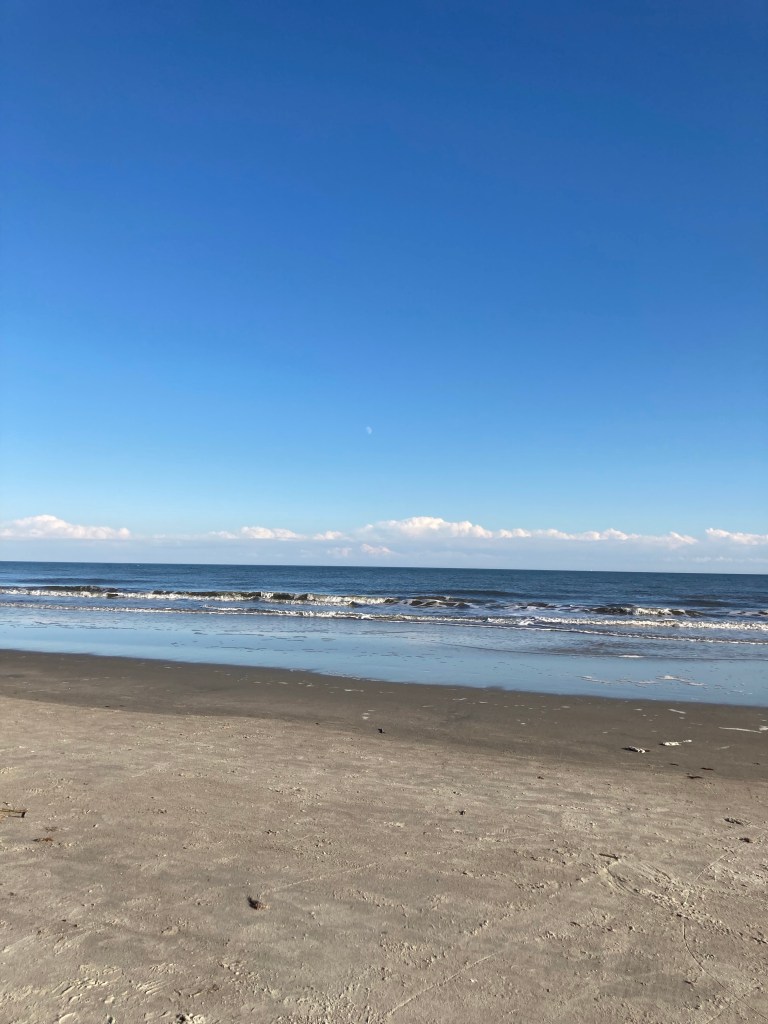
Moonrise over Folly Field Beach – Novemebr 2021

Adapted from the book, The Art of Travel (2002, Vintage Books) by Alain de Botton, and the passage:

A dominant impulse on encountering beauty is to wish to hold on to it, to possess it and give it weight in one’s life. There is an urge to say, ‘I was here, I saw this and it mattered to me.’

But beauty is fugitive, being frequently found in places to which we may never return or else resulting from rare conjunctions of season, light and weather.

How then to possess it, how to hold on to the floating train, the halvalike bricks or the English valley?

The camera provides one option. Taking photographs can assuage the itch for possession sparked by the beauty of a place; our anxiety over losing a precious scene can decline with every click of the shutter.

According to the website, GOOD READS, Any Baedeker will tell us where we ought to travel, but only Alain de Botton will tell us how and why.

As I said in the section on Architecture , what I find irresistible in reading Mr. de Botton is his use of language.

I get the feeling that if you made a spread sheet of all the words, adverbs and adjectives used by Mr. de Botton, you just might find that he used each word just once.

Neat trick in writing a book.

If I knew how to do that, hey, I would.

** More from the category TRAVEL — click here

11.6.2021 – welcome or threat, a

welcome or threat, a
sympathy for the future
hankering for past

What will tomorrow bring.

Why did yesterday have to be left behind?

Maybe tomorrow will be better.

Maybe yesterday was as good as it gets.

I like to read the books of Bernard Cornwell.

His Sharpe Series is a great way to learn about the war in Spain against Napoleon.

I have reread these books several times.

The Last Kingdom or Saxon Stories are absorbing enough though after 13 books its hard to not start flipping through the battle scenes to get to the character narrative.

Not meant as a criticism but I find myself reading through the books and hitting some passages and that scene from the movie, ‘Amadeus’ comes to mind when Mozart plays a short piece of music written by Antonio Salieri after just one hearing.

Young Mozart picks his way through the first couple of bars, squints off into the middle distance and mutters, ‘The rest is just the same, isn’t it?”

Cornwell’s Warlord Chronicles are an interesting take on the Arthurian Legends and Arthur as a reluctant hero.

I think Mr. Cornwell is a bit hard on Christians but I think I can discern between his take on Christians as portrayed in the life Galahad and professional organized religion as portrayed by everything else church related in the three novels.

Also the in depth examination of the old ‘norse’ ways does tend to make me uncomfortable but I take the long road here as I know who historically wins this argument.

Some of the best scenes are the also repeated in the Saxon Series, where the folks come across Roman ruins of villas, baths and bridges.

They look over the ruins and say, “how did they do this?”

Knowledge can be lost so easily.

I hate to think what happens to the modern library without electricty.

The great libraries prior to 1900, those wonderful, vast reading rooms like you see in Univ of Michigan Hatcher Library or even the Grand Rapids Michigan Main building were all designed to use natural lighting from windows.

The roofs were giant skylights.

The floors were thick translucent glass.

Then came Tom Edison and electric light.

Much like how it took the Wright Brothers 3 hours to get the engine on the first Wright Flyer running the morning they invented flight so they actually invented flight delay first, Tom Edison wired America with power but he also invented the power outage.

ANYWAY, the three books tell the story of Arthur once again.

And you can’t tell the story of Arthur with telling the story of Merlin.

Throughout the three novels, Merlin has a line.

Wyrd bið ful āræd. 

Fate is inexorable.

Tomorrow is coming.

Yesterday is gone.

Time and tide sweeps the beaches twice a day here.

How can anything not be new?

That might be welcome news.

That might be a threat.

We ate out last night ate one of our favorite local restaurants.

We like it as it good, local and somehow holds the line against charging resort area prices.

I would say its cheap or at least cheaper.

Last night they had new menus.

Not only new menus, but new dishes.

We searched the menu for our favorites and with the help of the waitress we came close.

Close but not the same.

Throughly enjoyed our dinner.

Wistfully, a little part of our brain, wanted our favorites back.

We understood the need for a fresh menu.

We had sympathy for the future.

We had a hankering for the past.

Wow.

All we wanted was dinner.

Wyrd bið ful āræd. 

######

Adapted from the book, The Architecture of Happiness (2009, Vintage Books) by Alain de Botton, and the passage:

However, there might be a way to surmount this state of sterile relativism with the help of John Ruskin’s provocative remark about the eloquence of architecture.

The remark focuses our minds on the idea that buildings are not simply visual objects without any connection to concepts which we can analyse and then evaluate.

Buildings speak – and on topics which can readily be discerned.

They speak of democracy or aristocracy, openness or arrogance, welcome or threat, a sympathy for the future or a hankering for the past.

What Ruskin is quoted as saying is:

‘A day never passes without our hearing our architects called upon to be original and to invent a new style,’ observed John Ruskin in 1849, bewildered by the sudden loss of visual harmony.

What could be more harmful, he asked, than to believe that a ‘new architecture is to be invented fresh every time we build a workhouse or parish church?

According the The New York Review of Books, this is “A perceptive, thoughtful, original, and richly illustrated exercise in the dramatic personification of buildings of all sorts.”

What I find irrestible in reading Mr. de Botton is his use of language.

I get the feeling that if you made a spread sheet of all the words, adverbs and adjectives used by Mr. de Botton, you just might find that he used each word just once.

Neat trick in writing a book.

If I knew how to do that, I would.

10.30.2021- toddlers into waves

toddlers into waves
scream delight expressed with voice
joyful abandon

It is there inside me.

Waiting to get out.

That joyful abandon.

I watch the toddlers at the beach.

Granddaughter at the Beach – January 2021

Their determined unsurefootedness as they toddle towards the ocean.

They slow, they speed up, they slow, totter left and right.

Then their feet hit the waves.

They stop and hunch forward.

They look down at their feet.

They look down at their feet in the water.

They look up.

They look around.

Then they scream,

They scream giving voice to the delight in their heart.

And they run into the water.

It is there inside me.

I want to scream and give voice to the delight in my heart.

I want to give in to the joyful abandon.

But I am old.

I am not allowed.

I have to wonder and worry what might other people think.

But then I have to wonder who are these other people.

Why do I care what they think?

In the words of Nick the Bartender (Hey! Get me! I’m giving out wings!) to George Bailey, “What’s that got to do with it? I don’t know you from Adam’s off ox.”

I don’t know them folks.

These folks at the beach don’t know me.

Don’t know me from Adam’s Off Ox.

Adam’s Off Ox?

I had to do the Google.

And the Google says, “The saying in any form, however, is another of the numerous ones commonly heard but of which no printed record has been found. But in 1848 the author of a book on ‘Nantucketisms’ recorded a saying then in use on that island, ‘Poor as God’s off ox,’ which, he said, meant very poor. It is possible that on the mainland ‘Adam’ was used as a euphemistic substitute. (From A Hog on Ice by Charles Earle Funk (1948, Harper & Row).

So I don’t know these people from Adam or his ox or even his off ox.

Joyful abandon.

It is in there.

It is going to get out.

One of these days.

Part of a series based on afternoons spent at the beach on Hilton Head Island.

I wanted to see if I would be ‘inspired’ by what I saw, by what I heard, by what I smelled, by what I tasted, what I felt emotionally and what I felt tactilely.

Some turned out okay.

Some were too forced.

Some were just bad.

Some did involve some or all of those feelings.

As far as it goes, I guess I was inspired by by what I saw, by what I heard, by what I smelled, by what I tasted, what I felt emotionally and what I felt tactilely.

Click here for more Haiku from the BEACH

10.29.2021 – sunny sunshine sounds

sunny sunshine sounds
waves, birds, wind, kids screaming squeals
pop of a pop top

Sitting on the beach in South Carolina on Hilton Head Island on a Saturday afternoon can be a lot of things.

Quiet is not one of them.

Start with all the sounds of the beach.

Add in all the sounds of people at the beach.

Through it all, like a knife, I can hear the clear click of a pop can (beer can, flavored sparkling water can) cut across on the audio clutter.

On a hot day, it sounds good.

Back in the day in 7th Grade science class at Riverside Junior Highschool in Grand Rapids, Michigan, our teacher Mr. Bultman, was preparing a demonstration.

With a large beaker of water, Mr. Bultman poured filled up a tall graduated cylinder.

As Mr. Bultman poured, you could hear a glug glug glug with a rising interogative like an Australian sentence.

The class went quiet.

The sound stirred something in all of us.

Mr. Bultman stopped pouring and set the beaker down.

Mr. Bultman looked out at us, smiling in the quiet.

“Pour me one of those too,” said Mr. Bultman with a big grin.

The class paused.

Then burst out laughing.

The whole room was on the the same page.

It sounded … delicious.

Part of a series based on afternoons spent at the beach on Hilton Head Island.

I wanted to see if I would be ‘inspired’ by what I saw, by what I heard, by what I smelled, by what I tasted, what I felt emotionally and what I felt tactilely.

Some turned out okay.

Some were too forced.

Some were just bad.

Some did involve some or all of those feelings.

As far as it goes, I guess I was inspired by by what I saw, by what I heard, by what I smelled, by what I tasted, what I felt emotionally and what I felt tactilely.

Click here for more Haiku in the BEACH category —

10.28.2021 – fearlessness of kids

fearlessness of kids
facing each wave after wave
fearlessly fearless

Louder than gulls the little children scream
Whom fathers haul into the jovial foam;
But others fearlessly rush in, breast high,
Laughing the salty water from their mouthes-
Heroes of the nursery.

Robert Graves – The Beach

Robert Graves or Robert von Ranke Graves (24 July 1895 – 7 December 1985) maybe more well known for his books on mythology that were all college reading lists but could be safely avoided as no Professor who ever include an exam question based on them.

From Wikipedia: Robert Graves was a British poet, historical novelist, critic, and classicist.

His father was Alfred Perceval Graves, a celebrated Irish poet and figure in the Gaelic revival; they were both Celticists and students of Irish mythology.

Graves produced more than 140 works in his lifetime.

His poems, his translations and innovative analysis of the Greek myths, his memoir of his early life- including his role in World War I – Good-Bye to All That, and his speculative study of poetic inspiration The White Goddess have never been out of print.

It was Mr. Graves who once said, “The remarkable thing about Shakespeare is that he really is very good, in spite of all the people who say he is very good.”

I like that.

But it is his quote on money and poetry that I will get on a T Shirt.

A T Shirt that I wouldn’t wear but I am not getting a tattoo so what can you do?

Anyway, Mr. Graves said, “There’s no money in poetry, but there’s no poetry in money, either.”

That suits me fine.

Part of a series based on afternoons spent at the beach on Hilton Head Island.

I wanted to see if I would be ‘inspired’ by what I saw, by what I heard, by what I smelled, by what I tasted, what I felt emotionally and what I felt tactilely.

Some turned out okay.

Some were too forced.

Some were just bad.

Some did involve some or all of those feelings.

As far as it goes, I guess I was inspired by by what I saw, by what I heard, by what I smelled, by what I tasted, what I felt emotionally and what I felt tactilely.

Click here for more Haiku from the BEACH