to look around me as though I had never been in this place before
I based this haiku and several others like it from the writing in the book, The Art of Travel (2002, Vintage Books) by Alain de Botton, and the passage:
I tried to reverse the process of habituation, to dissociate my surroundings from the uses I had previously found for them. I forced myself to obey a strange sort of mental command: I was to look around me as though I had never been in this place before. And slowly, my travels began to bear fruit.
According to the website, GOOD READS, Any Baedeker will tell us where we ought to travel, but only Alain de Botton will tell us how and why.
As I said in the section on Architecture , what I find irresistible in reading Mr. de Botton is his use of language.
To also quote myself, I get the feeling that if you made a spread sheet of all the words, adverbs and adjectives used by Mr. de Botton, you just might find that he used each word just once.
everything being of potential interest, layers of value
I based this haiku and several others like it from the writing in the book, The Art of Travel (2002, Vintage Books) by Alain de Botton, and the passage:
I tried to reverse the process of habituation, to dissociate my surroundings from the uses I had previously found for them. I forced myself to obey a strange sort of mental command: I was to look around me as though I had never been in this place before. And slowly, my travels began to bear fruit.
Once I began to consider everything as being of potential interest, objects released latent layers of value.
According to the website, GOOD READS, Any Baedeker will tell us where we ought to travel, but only Alain de Botton will tell us how and why.
As I said in the section on Architecture , what I find irresistible in reading Mr. de Botton is his use of language.
To also quote myself, I get the feeling that if you made a spread sheet of all the words, adverbs and adjectives used by Mr. de Botton, you just might find that he used each word just once.
if lives dominated by a search for happiness travel reveals much
Adapted from the book, The Art of Travel (2002, Vintage Books) by Alain de Botton, and the passage:
If our lives are dominated by a search for happiness, then perhaps few activities reveal as much about the dynamics of this quest—in all its ardour and paradoxes—than our travels. They express, however inarticulately, an understanding of what life might be about, outside of the constraints of work and of the struggle for survival. Yet rarely are they considered to present philosophical problems—that is, issues requiring thought beyond the practical. We are inundated with advice on whereto travel to, but we hear little of why and how we should go, even though the art of travel seems naturally to sustain a number of questions neither so simple nor so trivial, and whose study might in modest ways contribute to an understanding of what the Greek philosophers beautifully termed eudaimonia, or ‘human flourishing’.
Adapted from the book, The Art of Travel (2002, Vintage Books) by Alain de Botton.
According to the website, GOOD READS, Any Baedeker will tell us where we ought to travel, but only Alain de Botton will tell us how and why.
As I said in the section on Architecture , what I find irresistible in reading Mr. de Botton is his use of language.
I get the feeling that if you made a spread sheet of all the words, adverbs and adjectives used by Mr. de Botton, you just might find that he used each word just once.
tireless pointillist people often say show me picture with the dots
I opened up my computer this morning and my mind went back in time.
This was weird because I went back to a time before everyone had a computer.
I had opened the Google and the google logo was all in dots.
Small points of color.
I knew it had to have something to do with Georges Seurat and when I hovered over the logo the embedded alt information for the graphic displayed the text, “Georges Seurat’s 162nd Birthday.”
If you grew up in the midwest at some time in your life you visited Chicago.
If you visited Chicago at some time in your life you had a good chance of going to the Art Institue.
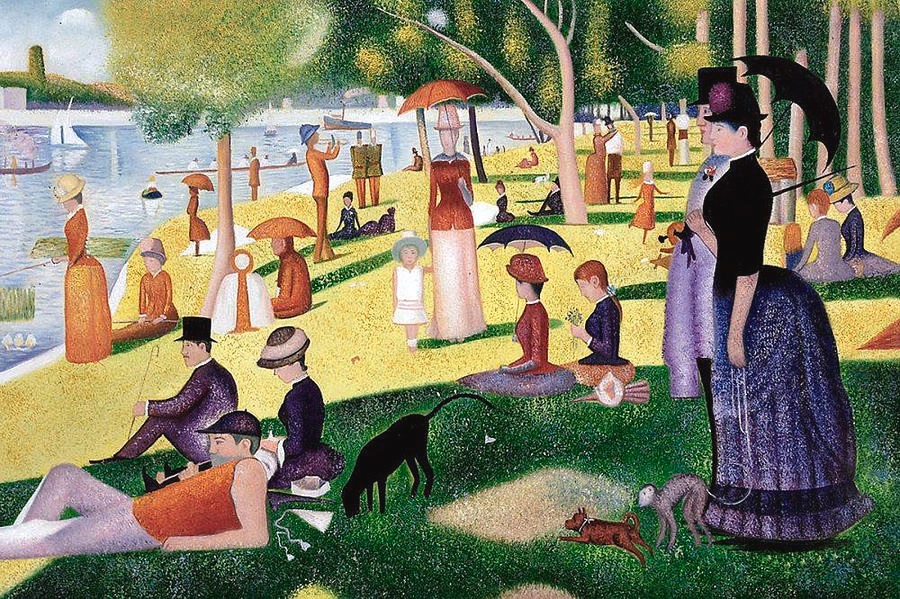
If you went to the Art Institute of Chicago, you most likely saw La Grande Jatte or A Sunday Afternoon on the Island of La Grande Jatte by Georges Seurat.
Sometimes known as Sunday Afternoon in the Park and maybe the inspiration for the song, “Saturday in the Park” by the band, Chicago.
Sometime known as the painting with the dots.
I hear two general reactions from folks who see this painting.
One is HOW BRIGHT IT IS.
Colors just cannot be captured in any form of reproduction.
I remember walking down the main hall of the National Gallery of Art in Washington and through an open entry way, I was faced, unexpectedly, with A Girl with a Watering Can by Renoir.
The color flared out from the painting so bright that I tripped.
No, I am not kidding, fell flat out on the marble floor.
Guard looked at me and shrugged like this happened a lot.
The second thing I hear from folks is HOW BIG IT IS.
Neither, here nor there, but look at this photgraph.
I feel it could have been painted by any one the great impressionists and entitled, ‘A visit to Chicago’.
This is what took me back in time when I thought of Seurat.
For me, I cannot think of this painting without thinking of a documentary on the City of Chicago by Studs Terkel.
Mr. Terkel was the American version of Alistair Cooke.
Where Mr. Cooke wrote and later, read, a weekly column, ‘Letter from America’ for the Manchester Guardian and later the BBC, tried to explain America to Brits, Studs Terkel tried to explain America to Americans.
In my mind was a quote of Mr. Terkel from that documentary on La Grande Jatte and I plugged Studs Terkel Suerat into the Google to try and find it.
It is in this documentary that Mr. Terkel talks about La Grande Jatte and says, “people often say, show me the picture with the dots.“
The bit about La Grande Jatte is at 30:00 into the but go to about 28:00 into the video to catch Mr. Terkel’s comments about Night Hawks as well.
Or, if you have the time, watch the whole show.
Overwhelming in nostalgia for a city and a place that no longer exists.
This is the Chicago I grew up with.
Still a city close to the city of Carl Sandburg.
Still the city of Daley.
You remember the old story.
Richard Daley and two guys are in boat that is sinking and there are only two life jackets.
Daley says they should vote on who got a life jacket and Daley won 9 to 2.
This is the Chicago I loved to visit.
One memorable visit, I had talked my Friend Doug into an overnight trip to the city.
The plan was to drive to Comiskey Park and see the Thursday night baseball game between the Chicago White Sox and the Detroit Tigers.
Then drive to my sister’s apartment on the northside and stay overnight.
Spend the next day in the Chicago museums, back to the ball park for another baseball game and drive home after the game finished out the plan.
I was going through a period of being a Chicago White Sox fan when I was really following their owner, Bill Veeck.
How many people today will say they were fans of an owner?
The deal got a little sweeter when it was announced that the first game was going to be a double header due to an earlier rained out game.
Doug and I knew something was up when we drove up to Comiskey Park on 34th St., and everyone in the crowd seemed to be carrying 45rpm records or singles as they called.
We didn’t know.
Maybe that’s what you did in Chicago.
What it was was a promotion by the White Sox.
You got into the game for 99 cents if you brought a record to the game.
A DISCO record.
All the records where then going to be put into a big box and blown up between games.
This was the famous DISCO DEMOLITON PROMOTION and we had box seats.
The first game was played okay more or less.
Records starting be thrown out of the upper deck late in the game.
Both the left and right fielders were wearing batting helmets IN THE FIELD.
Between games the big box was trucked in and as planned, blown up.
Then, as wasn’t planned, all the fans ran out and took over the field.
In fairness, what else was going to happen when you get 57,000 people in a stadium designed to hold 47,000.
I mean they had to go somewhere.
So Doug and I had box seats for a riot.
In a goofy way, it was kinda cool.
Disco Demolition has gone down in baseball history as the worst thought out promotional stunt in history since the dedication fireworks of the New York City Hall set the new city hall on fire and burned it down back in 1852.
But, as the organizers say, how can it be a promotional failure if we are still talking about it?
But I digress.
In the video, Studs Terkel quotes french filmaker, René Clair as saying, “Everytime I go to America I must stop off at your city to see La Grande Jatte. It refreshes me. I need it.”
Mr. Terkel ends the little bit on with the words, “Hurrah Seurat.”
And, Happy Birthday.
Will you help him change the world? Can you dig it? (Yes, I can) And I’ve been waiting such a long time For today
*The first American Letter was broadcast on 24 March 1946 (Cooke said this was at the request of Lindsey Wellington, the BBC’s New York Controller); the series was initially commissioned for only 13 instalments. The series came to an end 58 years later in March 2004, after 2,869 instalments and less than a month before Cooke’s death. (wikipedia)
**His well-known radio program, titled The Studs Terkel Program, aired on 98.7 WFMT Chicago between 1952 and 1997. The one-hour program was broadcast each weekday during those forty-five years. (wikipedia)
sensitivity on entering a new space actively aware
Even before coffee, when I wake up, I go to the window and open the blinds to look at the sky.
A new day, a new sky.
Maybe not coffee awake, but awake enough to be actively aware of the new space.
Depending on my mood I may mumble the rhyme, Red sky at night, sailor’s delight – Red sky in the morning, sailor take warning.
I was asked recently where did that saying come from and I was happy to report that, for me, the most important recorded early use is from Jesus.
In the Bible, Matthew 16:2-3, Jesus says, “When evening comes, you say, ‘It will be fair weather, for the sky is red, and in the morning, ‘Today it will be stormy, for the sky is red and overcast.’ You know how to interpret the appearance of the sky, but you cannot interpret the signs of the times.” (NIV)
There is an essay and discussion on this saying and its Biblical roots at the United States Library of Congress.
The colors we see in the sky are due to the rays of sunlight being split into colors of the spectrum as they pass through the atmosphere and ricochet off the water vapor and particles in the atmosphere. The amounts of water vapor and dust particles in the atmosphere are good indicators of weather conditions. They also determine which colors we will see in the sky.
During sunrise and sunset the sun is low in the sky, and it transmits light through the thickest part of the atmosphere. A red sky suggests an atmosphere loaded with dust and moisture particles. We see the red, because red wavelengths (the longest in the color spectrum) are breaking through the atmosphere. The shorter wavelengths, such as blue, are scattered and broken up.
Even before I have coffee, I check the sky.
Here in coastal South Carolina, the sky seems to be most often a lighter shade of sky blue than I am used to seeing.
When I was in college, my what-was-then-called-a-minor, was the field of History of Art.
Really I took History of Art classes because the college I went to was blessed with a bunch of professors in the field who loved to sit back and tell wonderful stories about art and artists.
I was happy to sit back and listen.
I can replay those lectures in my mind.
They weren’t so much lectures, they were single person plays.
I can feel the passion as this one Professor told the story of Michelangelo Merisi da Caravaggio, on the run from the law, desperately painting paintings to sell for the money to live on until he dies from the anguish of being a fugitive just as his pardon is at hand.
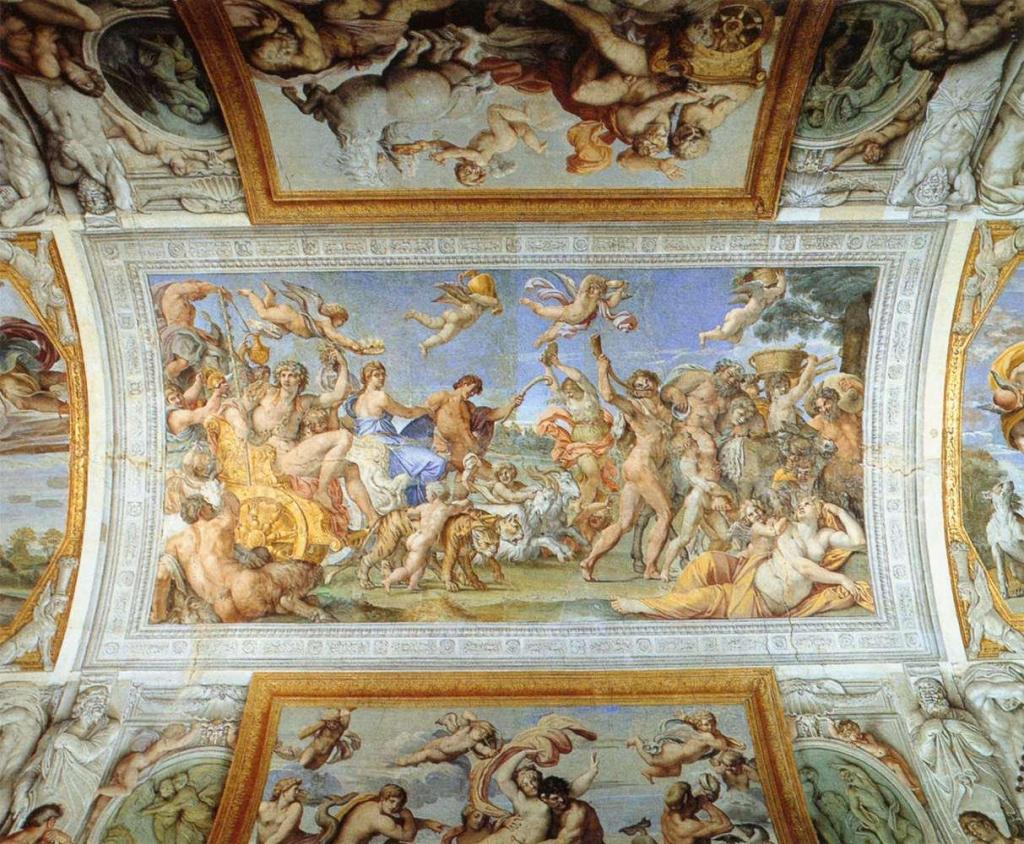
This same Professor told a story about the The Triumph of Bacchus and Ariadne, a fresco ceiling painted by Annibale Carracci, that is in the Palazzo Farnese in Rome.
He told how the Palazzo Farnese had become the French Embassy in Rome and was only open to art scholars on Sunday Mornings so if you wanted to see The Triumph of Bacchus and Ariadne, you had to show up on Sunday Morning.
The Professor related that if you got there early enough, you could watch the Piazza Farnese outside the Palazzo slowly fill up with a WHO’s WHO in the art world of who was in Rome that weekend.
The lecture was continued about the fresco, when the Professor paused, he looked out at us and smiled and said, “Good ice cream in the Piazza Farnese.”
But I digress.
When I started this I was thinking about another Professor in the History of Art department.
This Professor loved light and talking about light.
This was the feller who told us we had to visit an Art Gallery three times – In the morning for white light, in the afternoon for warm light and at night for electric light.
He was also the feller who advised us that to see paintings in the proper perspective of the painter, we had to sit on the floor.
I rarely have opportunity to visit any Art Gallery three times but I do sit on the floor (or at least drop to a knee).
He felt that the bright blues of Tuscan Renaissance Art was caused by the bright blues of the Italian sky.
He felt that the bright blues of the Italian sky was due to Italy being so narrow and having the sea on either side.
I grew up in the State of Michigan with Lake Michigan and Lake Huron on either side of me.
Sorry to say that along with being the Great Lake State, my meteorological friends also tell me that Michigan is one of the most overcast locations in the 48 states.
Maybe second only to the Seattle area.
If the lakes had any impact on the colors we saw in the sky, we most likely were not able to see the sky to know it.
Even before I have coffee, I check the sky.
Much like that the coffee will be ready because of the timer on the coffee maker, I expect to see the sky.
There have been some mornings of gray clouds but for the most part, when before I have coffee. I check the sky, I WILL see the sky.
A few miles from the coast, influenced by the sea, its a blue sky that is new to my sensitivity.
Hard to explain in the words that I have, but after a lifetime of overcast, you just feel better seeing it.
Feeling better, then I have coffee.
*I based this haiku and several others like it from the writing in the book, The Art of Travel (2002, Vintage Books) by Alain de Botton, and the passage:
On entering a new space, our sensitivity is directed towards a number of elements, which we gradually reduce in line with the function we find for the space. Of the four thousand things there might be to see and reflect on in a street, we end up being actively aware of only a few: the number of humans in our path, perhaps, the amount of traffic and the likelihood of rain. A bus that we might at first have viewed aesthetically or mechanically—or even used as a springboard to thoughts about communities within cities—becomes simply a box to move us as rapidly as possible across an area that might as well not exist, so unconnected is it to our primary goal, outside of which all is darkness, all is invisible.
*Adapted from the book, The Art of Travel (2002, Vintage Books) by Alain de Botton.According to the website, GOOD READS, Any Baedeker will tell us where we ought to travel, but only Alain de Botton will tell us how and why.
As I said in the section on Architecture , what I find irresistible in reading Mr. de Botton is his use of language.
To also quote myself, I get the feeling that if you made a spread sheet of all the words, adverbs and adjectives used by Mr. de Botton, you just might find that he used each word just once.


 No Haiku For You